Mini Gastric Bypass (One Anastomosis): Procedure, Recovery, and Risks

Updated: 2 days ago
Medically reviewed by Dr. Baraa Alnahhal, MD · Last reviewed: October 2026
A mini gastric bypass (MGB), also called a one anastomosis gastric bypass (OAGB) or omega loop bypass, is a weight loss surgery in which a surgeon makes your stomach narrower and connects it in a loop to the middle of your small intestine. It differs from a traditional (Roux-en-Y) gastric bypass because it uses one intestinal connection instead of two, which makes the surgery less complex [1].
Quick Answer: What is a mini gastric bypass?
A mini gastric bypass is a weight loss surgery that creates a small, tube-like stomach and connects it to the middle of the small intestine. It restricts food intake, reduces absorption and lowers hunger hormones. It uses one connection instead of two, carries a higher bile reflux risk than a traditional bypass, and requires lifelong vitamins and monitoring. [1]
What the research says
Weight loss and condition improvement were comparable to Roux-en-Y bypass, but reflux and ulcers were more common. A meta-analysis of 12 randomized trials with 904 patients found no significant differences in the resolution of obesity-related conditions. Excess weight loss was higher with OAGB at 12 months (95% CI 3.08 to 9.73) but comparable at 6, 24 and 60 months. New (de novo) GERD (RR 2.58; 95% CI 1.55 to 4.3) and marginal ulcers (RR 2.7; 95% CI 1.07 to 6.84) were more common after OAGB (Ahmed et al., Obes Surg, 2025 [2]).
For Type 2 diabetes, OAGB was non-inferior to Roux-en-Y bypass, but bile reflux was more common. In a non-inferiority meta-analysis of 12 trials, diabetes remission with OAGB was not inferior (risk difference -1%; 95% CI -10% to 8%). The risk of bile reflux was higher (RR 7.62; 95% CI 1.97 to 29.46), as was de novo GERD (RR 5.10; 95% CI 1.44 to 18.00) (de Oliveira Ramos et al., Obes Surg, 2025 [3]).
Reflux is the main trade-off. A meta-analysis of nine randomized trials with 643 patients found a higher risk of GERD after OAGB than after Roux-en-Y bypass (OR 3.14; 95% CI 1.23 to 8.03), and the odds of de novo GERD were almost six times higher (OR 5.65; 95% CI 1.53 to 20.82) (Kapellas et al., Obes Surg, 2024 [4]).
What Is a Mini Gastric Bypass?
A mini gastric bypass is a type of weight loss surgery in which a surgeon makes your stomach narrower and connects it in a loop to the middle of your small intestine. A smaller stomach limits how much food you can eat, and the intestinal loop allows food to skip the first part of your intestine, which decreases how many calories and nutrients your body digests and absorbs [1].
These effects can lead to significant weight loss for people with Class III obesity and/or obesity-related health conditions [1].
How does the mini gastric bypass procedure work?
Mechanism | What it does |
Restricts food intake | Creates a small, tube-like stomach that limits how much food you can eat. |
Reduces food absorption | Connects the stomach to the middle of the small intestine, bypassing the first part of the intestine, so you digest and absorb fewer calories. |
Changes hormones | Decreases ghrelin (the hunger hormone) and increases GLP-1, which lowers appetite and increases fullness. |
Source: Cleveland Clinic [1].
How do you prepare for and have a mini gastric bypass?
Preparing for a mini gastric bypass means following your provider's specific instructions, which may include health tests, a low-calorie diet and avoiding certain medications or smoking. You can expect [1]:
Blood tests, imaging tests and/or a physical exam to make sure you are healthy enough for surgery
A low-calorie diet before surgery, which can include a liquid diet for a few days just before the procedure
Avoiding certain medications and/or quitting smoking
The surgery uses minimally invasive techniques, such as laparoscopic or robotic surgery, which use small cuts and help you recover faster. During the procedure [1]:
A healthcare provider places an IV in your arm to give you medication and anesthesia.
Once you are asleep, your surgeon makes five or six small cuts (incisions) in your belly and inserts the tools needed during surgery.
Your surgeon reshapes your stomach into a long, narrow pouch that holds less food.
They attach the pouch to a loop of the middle portion of the small intestine, so food bypasses the first portion of the intestine.
All surgical tools are removed and the incisions are closed with stitches.
You are taken to a recovery room for monitoring.
The procedure takes about two hours, and you will spend one to two days in the hospital afterward [1].

A narrow stomach pouch is connected to the small intestine at one point.
How is a mini gastric bypass different from a traditional gastric bypass?
The main difference is the number of connection points. A traditional (Roux-en-Y) bypass makes your stomach smaller and reroutes your stomach and small intestine using two connection points, while a mini gastric bypass uses one, which makes the surgery faster and less complex [1].
Feature | Mini gastric bypass (MGB) | Traditional bypass (Roux-en-Y) |
Connections | One | Two |
Complexity | Less complex, faster surgery | More complex |
Bowel obstruction, leaks, hernias | Lower risk | Higher risk |
Bile reflux | Higher risk | Lower risk |
Excess weight loss at 5 years (one study) | Up to 73% | 60% |
Your own results may differ, so talk with your provider about what to expect based on your health history [1].
What are the advantages and disadvantages of a mini gastric bypass?
The main advantage is that it is effective for weight loss, and losing weight can help with many health conditions, including Type 2 diabetes, high cholesterol, high blood pressure and sleep apnea. Compared with a traditional bypass, it is faster and less complex, with less risk of bowel obstruction, leaks from the surgical connection and hernias [1].
The main risks and disadvantages are [1]:
Bile reflux: a higher risk than with a traditional bypass.
Surgical risks: complications such as bleeding and infection.
Vitamin needs: a lifelong need for vitamins to replace nutrients you do not absorb.
Ulcers: sores can form where your stomach and intestine connect.
Dumping syndrome: food moves too fast from your stomach into your intestine.
What are recovery and outlook like after a mini gastric bypass?
You will need a few weeks to recover. You may need to avoid strenuous activity for up to six weeks, and it may take up to 12 weeks to go back to a typical diet. Your provider will monitor you, usually for the rest of your life, to make sure the surgery is working as expected, check for vitamin and mineral deficiencies, and adjust your diet and supplements to help you stay healthy [1].
Cleveland Clinic describes it as one of the more effective bariatric surgeries for weight loss. One study showed up to 73% excess weight loss after five years with a mini bypass compared with 60% for a traditional bypass [1].
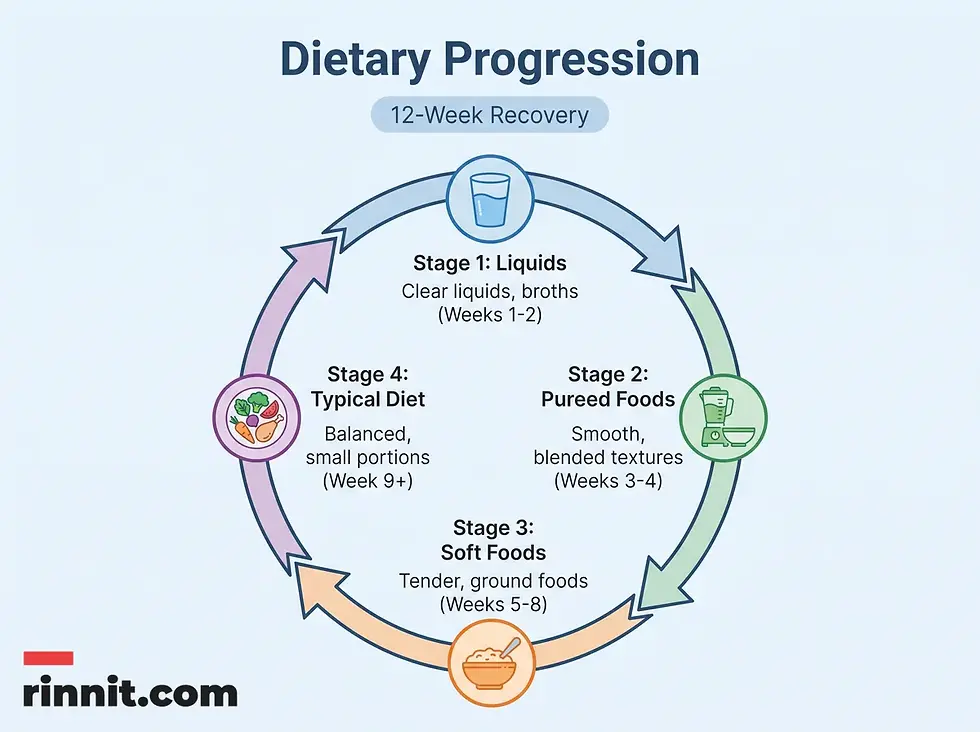
Your care team will guide how your diet advances after surgery.
When should you call your provider after a mini gastric bypass?
Contact your provider if you have any of the following after surgery [1]:
Fever of 101 degrees Fahrenheit (38.3 degrees Celsius) or higher
Severe belly pain
Swelling or leakage from an incision in your belly
Severe diarrhea or vomiting
Trouble breathing
You will need several follow-up appointments to make sure the surgery was successful and that you are getting the nutrients you need, so do not miss or skip them [1].
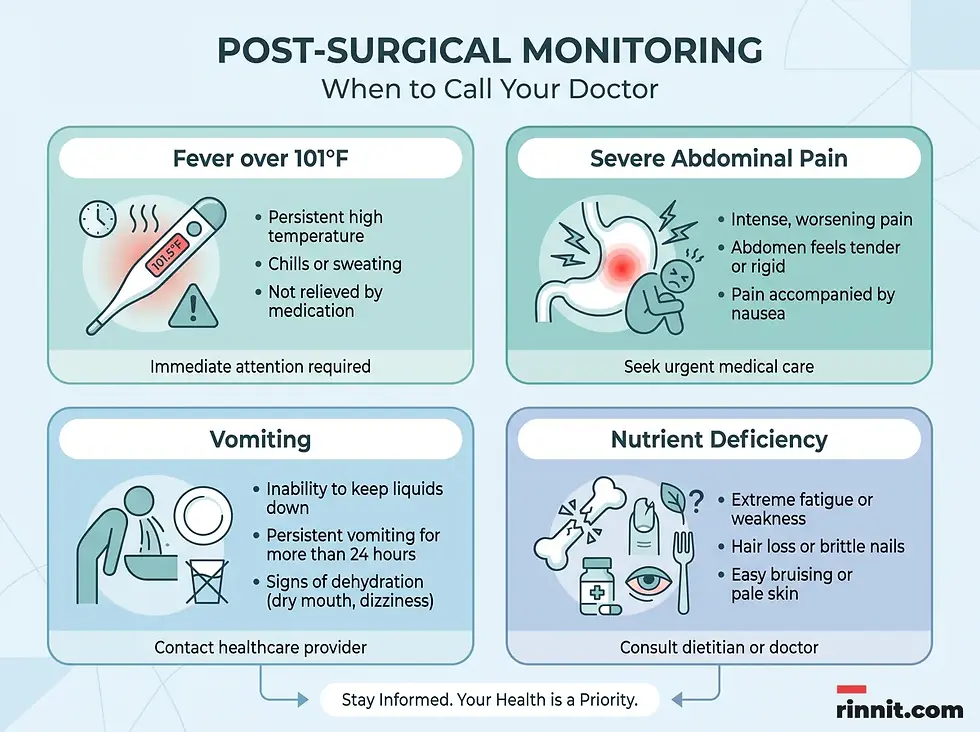
Know the warning signs that need a call to your care team.
What is the bottom line on mini gastric bypass?
A mini gastric bypass is one option your provider may suggest for Class III obesity and other health conditions, particularly if other weight loss methods have not given you the results you hoped for. Combined with a healthy diet and regular exercise, it can offer life-changing weight loss, but it means a major operation, a higher chance of reflux, and lifelong supplements and follow-up. Talk with a healthcare provider to review the benefits, risks and long-term care before deciding [1].
Frequently Asked Questions
Is the mini gastric bypass really "mini"?
"Mini" refers to the surgery being less complex because it uses one intestinal connection instead of two. It is still a weight loss operation that makes major changes to your digestive system and needs preparation, recovery and lifelong follow-up [1].
How much weight can I expect to lose?
Results vary. One study showed up to 73% excess weight loss after five years with a mini bypass compared with 60% for a traditional bypass, and your results may be different [1]. In a meta-analysis of randomized trials, weight loss was comparable to Roux-en-Y bypass at most time points [2].
What is bile reflux?
Bile reflux is bile, a digestive fluid, flowing back up into the stomach. The risk is higher after a mini gastric bypass than after a traditional bypass [1]. Randomized trials have also found higher rates of GERD with the mini bypass [2][3][4].
Do I have to take vitamins forever?
Yes. Because you do not absorb some nutrients, you will need vitamins for life, and your provider will check for vitamin and mineral deficiencies and adjust your diet and supplements [1].
What is dumping syndrome?
Dumping syndrome happens when food moves too fast from your stomach into your intestine [1].
How long will I be in the hospital and when can I be active again?
You will spend one to two days in the hospital after the procedure. Recovery takes a few weeks, and you may need to avoid strenuous activity for up to six weeks. Your provider can tell you what to expect [1].
Will my health conditions like diabetes improve?
Losing weight can help with many conditions, including Type 2 diabetes, high cholesterol, high blood pressure and sleep apnea [1]. In a meta-analysis of 12 trials, diabetes remission with the mini bypass was non-inferior to Roux-en-Y bypass [3].
What are the 5 or 6 small cuts for?
The 5 or 6 small cuts are the incisions your surgeon uses to insert the tools needed during surgery, which is what makes laparoscopic and robotic surgery less invasive and speeds recovery [1].
When should I call my doctor after surgery?
Call if you have a fever of 101 degrees Fahrenheit (38.3 degrees Celsius) or higher, severe belly pain, swelling or leakage from an incision, severe diarrhea or vomiting, or trouble breathing [1].
Who might be a candidate?
Cleveland Clinic describes it as an option for Class III obesity and other obesity-related health conditions, especially if other weight loss methods have not worked. Your provider can help you decide whether it is right for you [1].
How do I prepare for a mini gastric bypass?
Your provider gives you specific instructions, and you may have appointments to make sure you understand the procedure and recovery. [1] Expect blood tests, imaging tests and/or a physical exam, a low-calorie diet before surgery that can include a few days of liquid diet, and avoiding certain medicines and/or quitting smoking. [1]
What anesthesia is used for a mini gastric bypass?
A healthcare provider places an IV in your arm to give you medicine and anesthesia, and you're asleep while your surgeon makes five or six small incisions in your belly. [1] After surgery, severe belly pain is a reason to contact your provider. [1]
Related Reading
References
Cleveland Clinic. Mini Gastric Bypass (One Anastomosis). Cleveland Clinic. April 20, 2026. https://my.clevelandclinic.org/health/procedures/mini-gastric-bypass
Ahmed Y, Ataya K, Almubarak A, et al. One anastomosis gastric bypass versus Roux-en-Y gastric bypass for obesity: an updated meta-analysis and systematic review of randomized controlled trials. Obes Surg. 2025;35(4):1438-1446. PMID 40085185. https://doi.org/10.1007/s11695-025-07776-x
de Oliveira Ramos JV, Andrade Fernandes JV, de Oliveira Ferreira CH, et al. One-anastomosis versus Roux-en-Y gastric bypass in the resolution of comorbidities: a non-inferiority meta-analysis and meta-regression. Obes Surg. 2025;35(8):3301-3309. PMID 40679731. https://doi.org/10.1007/s11695-025-08077-z
Kapellas N, Alkhalil S, Senkal M. Efficacy of one-anastomosis gastric bypass versus Roux-en-Y gastric bypass for gastroesophageal reflux disease: a systematic review and meta-analysis of randomized controlled trials. Obes Surg. 2024;34(12):4563-4572. PMID 39499394. https://doi.org/10.1007/s11695-024-07571-0
Medical disclaimer
This article is for informational purposes only and is not a substitute for professional medical advice, diagnosis, or treatment. The clinical information in this guide reflects source material last reviewed in April 2026.



Comments