Bile Reflux: Symptoms, Causes, and Treatment

Updated: 3 days ago
Medically reviewed by Dr. Baraa Alnahhal, MD · Last reviewed: October 2026

Quick Answer: What is bile reflux?
Bile reflux is a condition in which bile, made by the liver and stored in the gallbladder, backs up into the stomach and sometimes the esophagus. It differs from acid reflux, though both can occur together. Symptoms include upper belly pain, heartburn, nausea and vomiting greenish-yellow bile. It is harder to treat than acid reflux. [1] [2]
What the research says
Gallbladder removal after sleeve gastrectomy was followed by more gastritis. In 133 patients who had a cholecystectomy after sleeve gastrectomy, gastritis prevalence rose from 33.9% to 51.4%, and moderate-to-severe gastritis from 11.9% to 23.0%, between the pre- and post-cholecystectomy endoscopies. The authors link this to increased alkaline (bile) reflux (Guerra Cordeiro et al., Obes Surg, 2026) [3].
Bile reflux after gastric bypass matters even when esophagitis is uncommon. In 1,172 patients followed for about five years after one-anastomosis gastric bypass, gastric pouch gastritis was seen on endoscopy in 27.7% and mild or greater inflammation in 38.8% on biopsy. Los Angeles grade A-B esophagitis occurred in 7.7%, with no cases of Barrett's esophagus (Pizza et al., Obes Surg, 2026) [4].
Removing the gallbladder carries a bile reflux gastritis signal. In a two-center study of 160 patients with gallbladder polyps, those who had laparoscopic cholecystectomy had a higher incidence of abdominal pain, bloating, diarrhea, bile reflux gastritis, and malabsorption at one year than those treated with radiofrequency ablation that preserved the gallbladder (Zhao et al., Sci Rep, 2026) [5].
Study details are from PubMed abstracts.
What exactly is bile reflux?
Bile reflux happens when bile backs up into the stomach. Bile is a liquid your liver makes to help digest food. Sometimes, this liquid then backs up further into the esophagus, the tube that connects your mouth and stomach. [1]
The condition usually starts at a faulty valve. Bile reflux may happen due to an incompetent sphincter between the stomach and the small intestine, known as the pylorus. It also may happen after certain surgeries, including weight-loss procedures or gallbladder surgery. [1]
The single most important point to understand: bile reflux is different from acid reflux, also known as gastroesophageal reflux disease or GERD. In acid reflux, stomach acid backs up into the esophagus. In bile reflux, bile backs up into the stomach. It is possible to have both at the same time. [1]
And unlike acid reflux, changes in diet and lifestyle do not completely relieve bile reflux. Medicines are used to treat it. In rare cases, surgery may be needed. [1]
Fact | Detail |
What it is | Bile backing up into the stomach, and sometimes into the esophagus |
What causes the backup | A pyloric valve that does not close properly, or surgery to the stomach, gallbladder, or weight-loss bypass |
Different from | Acid reflux (GERD), in which stomach acid backs up into the esophagus |
Can both occur together | Yes, bile reflux and acid reflux may happen at the same time |
Hallmark sign | Vomiting bile, a greenish-yellow fluid |
Why it is hard to treat | Lifestyle changes alone do not relieve it; evidence on treatment effectiveness is limited |
Main treatment | A combination of medicines; surgery in severe or precancerous cases |
What are the symptoms of bile reflux?
Bile reflux can be difficult to tell from acid reflux. The symptoms are alike, and the two conditions may happen at the same time. [1]
Signs and symptoms of bile reflux include upper belly pain that may be severe, frequent heartburn (a burning sensation in your chest that sometimes spreads to your throat, along with a sour taste in your mouth), nausea, vomiting bile, a fluid with a greenish-yellow color, and loss of appetite. [1]
The greenish-yellow vomit is the most distinctive clue. Heartburn alone cannot reliably distinguish bile reflux from acid reflux, which is why persistent or treatment-resistant reflux deserves a proper medical evaluation.
What causes bile reflux?
Bile is needed for digesting fats and for getting rid of worn-out red blood cells and certain toxins from your body. It is made in your liver and stored in your gallbladder. Eating a meal that contains even a small amount of fat signals your gallbladder to release bile. The bile then flows through a small tube into the duodenum, the upper part of your small intestine. [1]
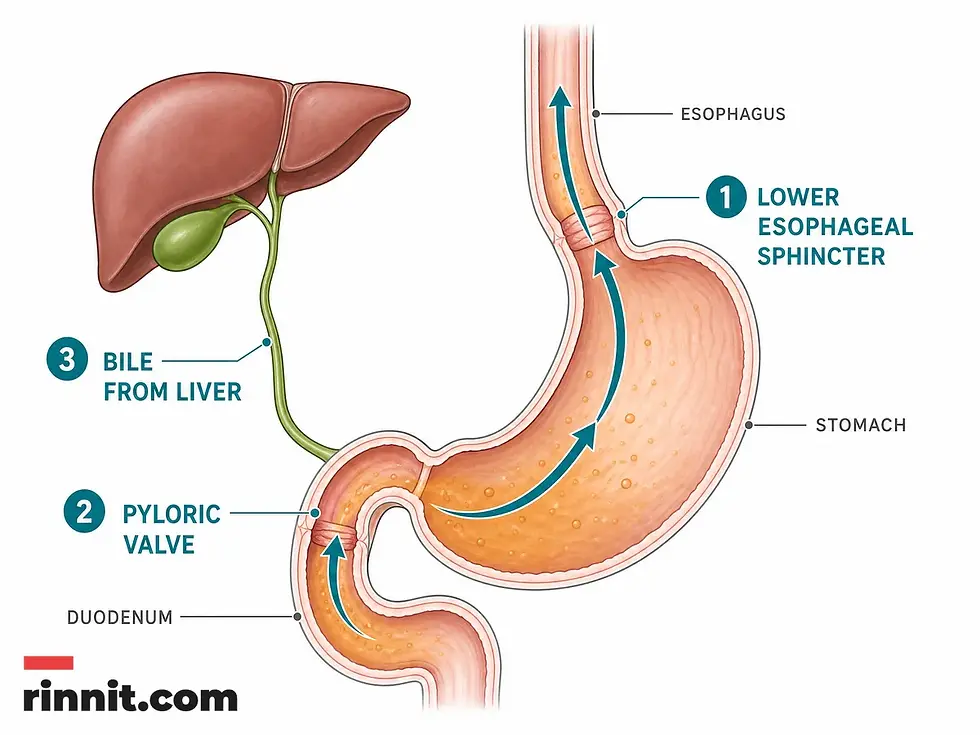
From there, two valves control the flow, and when either fails, reflux follows.
Bile reflux into the stomach. The pyloric valve is a heavy ring of muscle located at the outlet of the stomach. It usually opens only slightly, enough to release about an eighth of an ounce (about 3.75 milliliters) or less of liquefied food at a time. That small opening does not allow digestive juices to flow backward into the stomach. In cases of bile reflux, the valve does not close properly, and bile washes back into the stomach. This can lead to inflammation of the stomach lining, called bile reflux gastritis. [1]
Bile reflux into the esophagus. Bile and stomach acid can reflux into the esophagus when another muscular valve, the lower esophageal sphincter, does not work properly. This valve separates the esophagus and stomach, opening just long enough to allow food to pass. If the valve weakens or relaxes too much, bile can wash back into the esophagus. [1]
What triggers bile reflux in the first place?
Three situations most often set the stage for bile reflux: [1]
Trigger | How it leads to bile reflux |
Surgery complications | Stomach surgery, including total or partial removal of the stomach and gastric bypass surgery for weight loss, is responsible for most bile reflux |
Peptic ulcers | A peptic ulcer can block the pyloric valve so that it does not open or close properly. Stagnant food in the stomach increases pressure and allows bile and stomach acid to back up into the esophagus |
Gallbladder surgery | People who have had their gallbladder removed have significantly more bile reflux than those who have not |
If you have had any of these surgeries or a history of peptic ulcers and now have reflux symptoms, that context is worth mentioning to your doctor right away.
What are the risk factors for bile reflux?
Risk factor | How it raises the risk |
Diabetes | Long-standing diabetes with unregulated blood sugar can affect the vagus nerve, which helps move food through the intestine |
Obesity | Research shows an association between bile reflux and having a body mass index (BMI) over 30 |
Gallbladder disease | Conditions such as gallstones or polyps increase the risk of bile reflux |
Smoking and alcohol abuse | Smoking or drinking too much alcohol can irritate the intestinal lining as well as loosen the pyloric valve |
H. pylori infection | Some researchers believe Helicobacter pylori infection of the stomach is associated with bile reflux, though this is still being debated |
When should you see a doctor?
Make an appointment with a healthcare professional if you often have symptoms of reflux, or if you are losing weight without trying. [1]
Call your healthcare team if you have been diagnosed with acid reflux or GERD but are not getting enough relief from your medicines. You may need additional treatment aimed at bile reflux specifically.
Why does bile reflux matter? The possible complications
The combination of bile reflux and acid reflux increases the risk of several serious complications: [1]
GERD. This condition causes irritation and inflammation of the esophagus. It is most often due to excess acid, but bile may be mixed with the acid. Bile is often suspected of contributing to GERD when people respond incompletely or not at all to powerful acid-suppressant medicines. [1]
Barrett esophagus. This serious condition can happen when long-term exposure to stomach acid, or to acid and bile, damages tissue in the lower esophagus. The damaged esophageal cells have an increased risk of becoming cancerous. Animal studies also have linked bile reflux to Barrett's esophagus. [1]
Esophageal cancer. There is a link between acid reflux and bile reflux and esophageal cancer, which may not be diagnosed until it is quite advanced. In animal studies, bile reflux alone has been shown to cause cancer of the esophagus. [1]
Bile reflux gastritis, the stomach inflammation caused by bile, has also been linked to stomach cancer. [1]
These links sound alarming, but they describe long-term, untreated reflux. Getting an accurate diagnosis and proper treatment is precisely how this risk is managed.
How is bile reflux diagnosed?
A description of symptoms and knowledge of your medical history is usually enough for a healthcare professional to diagnose a reflux problem. But distinguishing between acid reflux and bile reflux is difficult and requires further testing. You are also likely to have tests to check for damage to your esophagus and stomach, as well as for precancerous changes. [2]
Diagnostic test | What it does |
Endoscopy | A tiny camera on the end of a flexible tube visually examines the upper digestive system. The endoscope can show bile, peptic ulcers, or inflammation in your stomach and esophagus. Tissue samples may be collected to test for Barrett esophagus or esophageal cancer, and a sample of gastric fluid may be collected |
Ambulatory acid tests | A thin, flexible catheter is threaded through your nose into your esophagus. A probe on the end measures acid over 24 hours, identifying when and for how long acid refluxes. These tests can help rule out acid reflux, but not bile reflux |
Esophageal impedance | A probe placed in the esophagus measures whether gas or liquids reflux into it. It is helpful for people who regurgitate substances that are not acidic, such as bile, and cannot be detected by an acid probe |
How is bile reflux treated?
Lifestyle adjustments and medicines can be very effective for acid reflux into the esophagus, but bile reflux is harder to treat. There is little evidence determining the effectiveness of bile reflux treatments. This is partly because it is difficult to establish whether bile reflux is the actual cause of the symptoms. [2]
Medications
Typically, treatment involves a combination of these medicines rather than any single one: [2]
Medicine | How it helps |
Ursodeoxycholic acid | May lessen the frequency and severity of your symptoms |
Proton pump inhibitors | Help relieve symptoms by blocking the production of stomach acid |
Sucralfate | Forms a protective coating that shields the lining of the stomach and esophagus against bile reflux |
Bile acid sequestrants | Disrupt the circulation of bile; studies show they are less effective than other treatments, and side effects such as bloating may be severe |
Baclofen | May relieve symptoms by stopping the relaxation of the lower esophageal sphincter, which prevents bile acid reflux |
Surgical treatments
Healthcare professionals may recommend surgery if medicines fail to reduce severe symptoms or there are precancerous changes in your stomach or esophagus. Some types of surgery can be more successful than others, so discuss the advantages and disadvantages carefully with your healthcare team. [2]
Diversion surgery creates a new connection for bile drainage farther down in the small intestine, diverting bile away from the stomach. Anti-reflux surgery wraps the part of the stomach closest to the esophagus and sews it around the lower esophageal sphincter. This strengthens the valve and can reduce acid reflux, but there is little evidence about the surgery's effectiveness for bile reflux specifically. [2]
What can you do at home?
Unlike acid reflux, bile reflux seems unrelated to lifestyle factors. But because many people experience both acid reflux and bile reflux, your symptoms may be eased by these self-care steps: [2]
Self-care step | Why it helps |
Stop smoking | Smoking increases stomach acid production and dries up saliva, which protects the esophagus |
Eat smaller meals | Smaller, more-frequent meals reduce pressure on the lower esophageal sphincter, helping prevent the valve from opening at the wrong time |
Stay upright after eating | Waiting 2 to 3 hours before lying down allows time for your stomach to empty |
Limit fatty foods | High-fat meals relax the lower esophageal sphincter and slow the rate at which food leaves your stomach |
Avoid problem foods and drinks | Caffeinated and carbonated drinks, chocolate, citrus foods and juices, vinegar-based dressings, onions, tomato-based foods, spicy foods, and mint can increase stomach acid or relax the sphincter |
Limit or avoid alcohol | Alcohol relaxes the lower esophageal sphincter and irritates the esophagus |
Lose extra weight | Excess weight puts added pressure on your stomach, making heartburn and acid reflux more likely |
Raise your bed | Sleeping with your upper body raised 6 to 8 inches (15 to 20 centimeters) may help; blocks or a foam wedge work better than extra pillows |
Relax | Stress slows digestion, possibly worsening symptoms; deep breathing, meditation, or yoga may help |
If you use over-the-counter or alternative therapies for symptom relief, remember that even natural remedies can carry risks and side effects, including potentially serious interactions with prescription medications. Do careful research and talk with your doctor before trying an alternative therapy. [2]

Bottom line
Bile reflux is the backup of digestive bile into the stomach, and sometimes the esophagus, and it is not the same condition as acid reflux, even though the symptoms overlap heavily. It most often follows stomach surgery, gallbladder removal, or a peptic ulcer, and its warning signs range from severe upper belly pain to the distinctive greenish-yellow vomit of bile.
What sets it apart from ordinary heartburn is how it behaves: diet and lifestyle changes alone do not relieve it, and diagnosis requires testing to separate bile from acid. Medicines are typically combined, surgery is reserved for cases that fail to respond, and untreated bile reflux carries real long-term risks, which is exactly why persistent reflux deserves evaluation rather than another over-the-counter antacid.
Next steps: If you have frequent reflux symptoms, unexplained weight loss, or acid reflux that no longer responds to your medication, contact a healthcare professional and ask specifically whether bile reflux could be contributing. If bile reflux is diagnosed, ask about endoscopy and whether a combination of medicines such as ursodeoxycholic acid, a proton pump inhibitor, or sucralfate fits your situation.
FAQ
Is bile reflux the same as acid reflux?
No. Bile reflux is the backup of bile, a digestive fluid made by the liver, into the stomach, while acid reflux (GERD) is the backup of stomach acid into the esophagus. Both conditions can occur in the same person, which is one reason they are so often confused.
What does bile reflux look like when you vomit?
Vomiting bile typically produces a greenish-yellow fluid. Alongside this sign, bile reflux commonly causes severe upper belly pain, frequent heartburn, nausea, and loss of appetite.
Can gallbladder removal cause bile reflux?
Yes. People who have had their gallbladder removed experience significantly more bile reflux than people who have not had this surgery. Stomach surgery, including gastric bypass for weight loss, is responsible for most bile reflux overall.
Does bile reflux increase the risk of cancer?
Untreated, long-standing bile reflux is linked to an increased risk. When bile mixes with acid, it can damage the lower esophagus (Barrett esophagus), whose altered cells have a higher chance of becoming cancerous; bile reflux has also been linked to esophageal and stomach cancer. Getting an accurate diagnosis and treatment is how this risk is managed.
Does the reflux diet work for bile reflux?
Not completely. Unlike acid reflux, bile reflux seems largely unrelated to lifestyle factors, and diet and lifestyle changes alone do not relieve it. However, because many people have both conditions, self-care steps such as smaller meals, staying upright after eating, and limiting fatty foods and alcohol may still ease symptoms.
Disclaimer: This article is for general informational purposes only and does not constitute medical advice. Always consult a qualified health care provider for individual questions.
References
Mayo Clinic Staff. Bile reflux - Symptoms and causes. Mayo Clinic. September 20, 2025. https://www.mayoclinic.org/diseases-conditions/bile-reflux/symptoms-causes/syc-20370115
Mayo Clinic Staff. Bile reflux - Diagnosis & treatment. Mayo Clinic. September 20, 2025. https://www.mayoclinic.org/diseases-conditions/bile-reflux/diagnosis-treatment/drc-20370121
Guerra Cordeiro G, et al. Association Between Cholecystectomy and Gastroesophageal Inflammatory Findings After Sleeve Gastrectomy: Endoscopic and Metabolic Evaluation. Obes Surg. 2026;36(10):5459-5466. PMID 42791465. https://doi.org/10.1007/s11695-026-08947-0
Pizza F, Braun A, Lucido FS, et al. Five-Year Endoscopic Outcomes After One-Anastomosis Gastric Bypass: A Multicenter Cohort with Bile Reflux, Marginal Ulcers, and Symptom Correlation. Obes Surg. 2026;36(11):5569-5581. PMID 42627474. https://doi.org/10.1007/s11695-026-08784-1
Zhao H, Dong G, Zhang Z, et al. Efficacy and safety of ultrasound-guided radiofrequency ablation versus laparoscopic cholecystectomy in gallbladder polyps: a bicentric study. Sci Rep. 2026;16(1):10161. PMID 41724826. https://doi.org/10.1038/s41598-026-40927-3
National Institute of Diabetes and Digestive and Kidney Diseases. Acid Reflux (GER & GERD) in Adults. National Institute of Diabetes and Digestive and Kidney Diseases. Reviewed July 2020. https://www.niddk.nih.gov/health-information/digestive-diseases/acid-reflux-ger-gerd-adults
Gavini S, Gupta M. Acid Reflux/GERD. American College of Gastroenterology. Updated April 2025. https://gi.org/topics/acid-reflux/
National Institute of Diabetes and Digestive and Kidney Diseases. Barrett's Esophagus. National Institute of Diabetes and Digestive and Kidney Diseases. Reviewed August 2024. https://www.niddk.nih.gov/health-information/digestive-diseases/barretts-esophagus
National Institute of Diabetes and Digestive and Kidney Diseases. Gallstones. National Institute of Diabetes and Digestive and Kidney Diseases. Reviewed November 2017. https://www.niddk.nih.gov/health-information/digestive-diseases/gallstones



Comments