SADI-S Surgery: A Modern Approach to Weight Loss and Metabolic Health

Updated: 3 days ago
Medically reviewed by Dr. Baraa Alnahhal, MD · Last reviewed: October 2026
Quick Answer: What is SADI-S surgery?
SADI-S is a bariatric procedure that creates a smaller, tube-shaped stomach and connects the first part of the small intestine to a lower part with a single connection. Patients eat less, absorb fewer calories and have changed hunger hormones. It is used for severe (class III) obesity and requires permanent dietary changes and daily vitamin supplements. [1]

What the research says
Weight loss is sustained at five years. A systematic review of four studies covering 1,088 patients (5-year follow-up available for 326) found mean total weight loss of 33.67% and excess weight loss of 72.88%, with a mean BMI of 31.7 kg/m² at 5 years. Short-term complication rates were 5.4% to 11.6% and long-term rates 8.7% to 17.9%, and reoperations for malnutrition were linked to a common channel length of 200 cm (Sanchez-Cordero et al., Obes Surg, 2025). [3]
SADI-S compared with gastric bypass. A meta-analysis of 8 studies (4,259 patients, 1,625 of them with SADI-S) found 10.03 percentage points more total weight loss (95% CI 4.7 to 15.35) and higher diabetes remission (odds ratio 3.48, 95% CI 2.02 to 6.02) with SADI-S than with Roux-en-Y gastric bypass, with similar long-term complication rates (Sabatella et al., Obes Surg, 2025). [4]
Obesity-related conditions often improve. A systematic review of 17 studies reported remission rates of 75.8% for type 2 diabetes, 61.2% for hypertension, 60.4% for dyslipidemia, and 71.9% for sleep apnea. Some nutritional deficiencies (protein, albumin, folate, vitamin B12, vitamin D) were reported, and deficiency rates fell as the common limb was lengthened to 250 to 300 cm (Palmieri et al., Updates Surg, 2025). [5]
What is SADI-S surgery?
SADI-S is a modified, simpler version of the traditional duodenal switch. It is used for severe obesity, also called class III obesity (a BMI of 40 or higher). The American Society for Metabolic and Bariatric Surgery officially endorsed it in 2020 as a variant of the classic duodenal switch. [1]
It works in two ways. First, the sleeve gastrectomy makes the stomach long and narrow, so you feel full sooner and eat less, and it affects hunger hormones. Second, the bypass lets food skip a large section of the small intestine, so you absorb fewer calories as food moves through faster. [1]
How does SADI-S surgery work?
The operation is done under general anesthesia through several tiny cuts in the belly and usually takes around two hours. [1]
Surgical Step | What Happens and Why |
|---|---|
Sleeve gastrectomy | Part of the stomach is removed, leaving a narrow tube. This limits how much you can eat and lowers hunger. |
Duodenal division | The first part of the small intestine (duodenum) is separated just after the stomach to prepare for rerouting. |
Single anastomosis | The duodenum is connected to a lower part of the small intestine (ileum) with one loop connection. |
Result | Food skips a large section of intestine, so fewer calories are absorbed. One connection makes surgery quicker and simpler than the traditional duodenal switch. |
A meta-analysis found that SADI-S had a shorter operating time than other malabsorptive procedures, a hospital stay that was 0.85 days shorter, and a trend toward fewer complications (Verhoeff et al., Obes Surg, 2022). [6]
What are the benefits and outcomes of SADI-S surgery?
SADI-S surgery offers significant weight loss, improvement in conditions such as type 2 diabetes and a simpler operation with one intestinal connection instead of two. [1] [2]

What are the risks and long-term considerations of SADI-S surgery?
SADI-S is a more complex operation than a sleeve alone, and most of its specific risks come from reduced nutrient absorption. [1]
Risk Category | Potential Issue and Management |
|---|---|
Nutritional deficiency | Reduced absorption of vitamins and minerals. Managed with lifelong daily supplements and regular blood tests. |
Bowel changes | More frequent loose stools and gas. Managed with diet adjustments and dietitian support. |
General surgical risks | Infection, bleeding, leaks, or reactions to anesthesia. Managed with careful screening and monitoring. |
Limited long-term data | It is a newer procedure, so very long-term data are still emerging. Managed with lifelong follow-up with a bariatric team. |
How do you prepare for and recover from SADI-S surgery?
Before surgery, your team will check your overall health and a dietitian will explain the diet and supplements you will need. You may be asked to follow a low-calorie or liquid diet, stop smoking, avoid alcohol, and change certain medicines. [1]
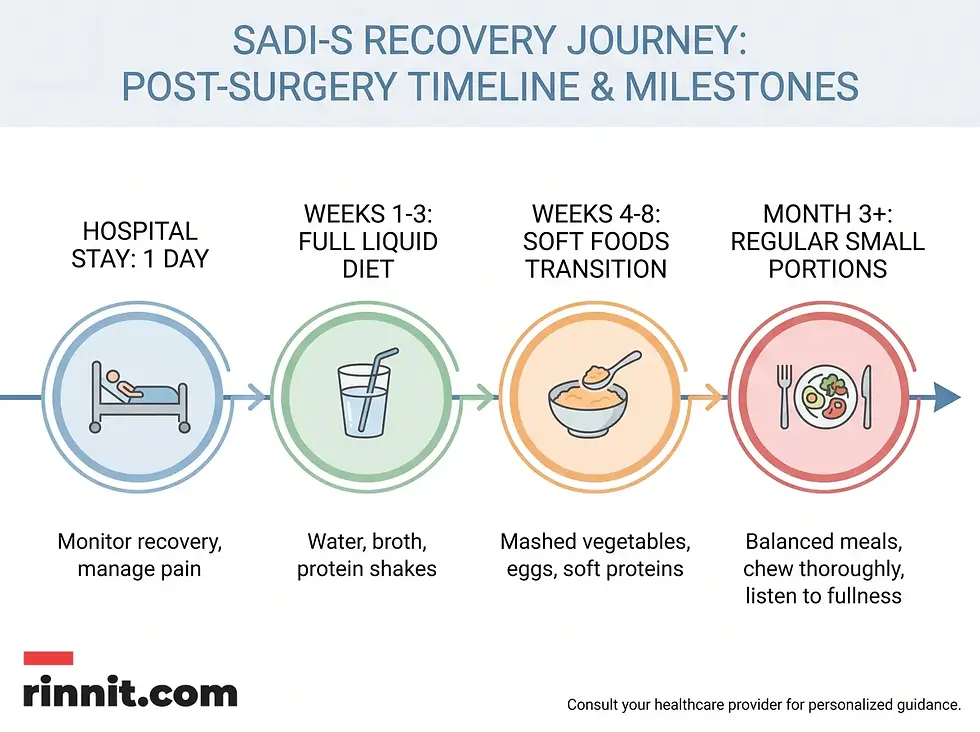
Most people spend one day in the hospital and slowly return to normal activities within about a month. A typical diet progression looks like this, although your team’s plan may differ: [1]
Weeks 1 to 3: Full liquid diet while the new stomach and intestinal connection heal.
Weeks 4 to 8: Soft, pureed foods in very small portions.
Month 3 and beyond: Gradual return to regular foods in small portions, focused on protein-rich, nutrient-dense choices.
When to call your provider: severe abdominal pain, severe diarrhea, signs of dehydration (peeing less, dry mouth, headache), fever, or vomiting that does not stop. [1]
Conclusion
SADI-S is a powerful option for severe obesity, with strong weight loss and metabolic benefits and a simpler design than the traditional duodenal switch. Those benefits come with a lifelong responsibility: daily supplements, regular blood tests, and ongoing follow-up with your bariatric team to stay well nourished.
What are the next steps for SADI-S surgery?
If you are considering surgery for severe obesity, schedule a consultation with a bariatric specialist to find out whether SADI-S is right for your health profile. A full evaluation by a multidisciplinary team, including surgeons and dietitians, is the first step.
Trusted resources: American Society for Metabolic and Bariatric Surgery (ASMBS), Obesity Action Coalition, National Institute of Diabetes and Digestive and Kidney Diseases (NIDDK).
Frequently Asked Questions
What does SADI-S stand for?
Single Anastomosis Duodeno-Ileal bypass with Sleeve gastrectomy. “Anastomosis” simply means a surgical connection. It is also called the single anastomosis duodenal switch or one anastomosis duodenal switch (OADS). [1]
How much weight can I expect to lose?
In a systematic review of 5-year results, patients lost on average 72.88% of their excess weight, which was 33.67% of their total body weight. Individual results vary with your starting weight, diet, and follow-up. [3]
How long does the surgery take?
SADI-S surgery usually takes around two hours, although your surgeon can tell you what to expect for your case. [1]
Is SADI-S better than a standard gastric bypass?
It depends on the patient. A meta-analysis of 8 studies found greater weight loss and higher diabetes remission with SADI-S than with Roux-en-Y gastric bypass, with similar long-term complications. SADI-S also carries a greater risk of vitamin and mineral deficiencies than gastric bypass or sleeve gastrectomy. [1] [4]
Will I need to take vitamins forever?
Yes. Surgery changes how your body absorbs vitamins and minerals, so lifelong supplements and regular checkups for nutrient deficiencies are part of your care. [1]
How long is the hospital stay?
Most people spend one day in the hospital for monitoring. [1]
When can I return to work?
Most people slowly return to normal activities within about one month. Ask your surgical team about your own timeline, especially if your job is physically demanding. [1]
Can SADI-S cure type 2 diabetes?
“Cure” is a strong word, but remission is common. One systematic review reported remission in about 76% of people with type 2 diabetes, along with improvements in blood pressure, cholesterol, and sleep apnea. [5]
What are the most common side effects?
More frequent loose bowel movements and more gas are common because the surgery changes how fat is absorbed. Your dietitian can help you adjust your diet. [1]
Can I eat regular food again?
Yes, in small portions. The return to regular foods can take up to three months, and a dietitian will help you build a long-term eating plan. [1]
Is SADI-S reversible?
Bariatric surgeries are meant to be permanent, and reversal is rarely done. Revisional options exist for problems such as malnutrition, so talk to your surgeon about what is possible.
What is the main difference between SADI-S and the traditional duodenal switch?
Are there age limits for this surgery?
Limits vary by surgical center. The decision is usually based on your overall health and ability to tolerate surgery rather than age alone.
What happens if I don’t take my vitamins?
Nutrient deficiencies can develop and, over time, may lead to problems such as bone loss, anemia, and nerve damage. Call your provider if you notice new symptoms.
Is SADI-S a new procedure?
SADI-S is relatively new. The American Society for Metabolic and Bariatric Surgery endorsed it in 2020, and five-year data are encouraging, but very long-term data are still being collected.
Related Reading
Duodenal Switch Surgery: How It Works, Weight Loss Results, and Risks explains the original duodenal switch that SADI-S simplifies.
Gastric Sleeve Surgery: Requirements, Procedure and Results describes the stomach-shrinking step that SADI-S builds on.
Bariatric Surgery: Types, Requirements, Risks, and Recovery compares weight-loss surgery types, requirements and risks.
Dumping Syndrome Explained: Symptoms, Causes, and the Diet Changes That Help explains a digestive side effect after stomach surgery and diet fixes.
References
Cleveland Clinic. SADI Surgery. Cleveland Clinic. March 25, 2026. https://my.clevelandclinic.org/health/procedures/sadi-surgery
American Society for Metabolic and Bariatric Surgery. Single Anastomosis Duodeno-Ileal Bypass with Sleeve Gastrectomy. ASMBS. Last updated November 2023. https://asmbs.org/condition_procedures/single-anastomosis-duodeno-ileal-bypass-with-sleeve-gastrectomy/
Sanchez-Cordero S, Lopez-Gonzalez R, Hermoza R, et al. Five-year outcomes of single anastomosis duodeno-ileal bypass with sleeve gastrectomy: a systematic review. Obes Surg. 2025;35(9):3784-3790. PMID 40730921. https://doi.org/10.1007/s11695-025-08108-9
Sabatella L, Aliseda Jover D, M Ortega P, et al. Comparison between single anastomosis duodeno-ileal bypass with sleeve gastrectomy (SADI-S) and Roux-en-Y gastric bypass in terms of weight loss, associated medical problems remission, and complications: a systematic review with meta-analysis. Obes Surg. 2025;35(9):3577-3590. PMID 40691384. https://doi.org/10.1007/s11695-025-08092-0
Palmieri L, Pennestrì F, Raffaelli M. SADI-S, state of the art. Indications and results in 2024: a systematic review of literature. Updates Surg. 2025;77(7):2037-2050. PMID 39617824. https://doi.org/10.1007/s13304-024-02041-9
Verhoeff K, Mocanu V, Zalasky A, et al. Evaluation of metabolic outcomes following SADI-S: a systematic review and meta-analysis. Obes Surg. 2022;32(4):1049-1063. PMID 35001254. https://doi.org/10.1007/s11695-021-05824-w
Medical Disclaimer
This content is for informational purposes only and does not constitute medical advice. Always seek the advice of a qualified healthcare professional with any questions regarding a medical condition or surgical procedure. Never disregard professional medical advice or delay in seeking it because of something you have read in this article.



Comments