Understanding the Role of a Plastic Surgeon: Expertise, Training, and Care

Updated: 2 days ago
Medically reviewed by Dr. Baraa Alnahhal, MD | Last reviewed: October 7, 2026

Quick Answer
A plastic surgeon is a doctor specializing in reconstructive and cosmetic surgery to repair or enhance physical features, treating birth defects, trauma and cancer-related tissue loss. [1] Training follows medical school with a six-year plastic surgery residency or general surgery plus plastic surgery training. [1] Reconstructive surgery restores form and function, while cosmetic surgery improves appearance. [1] Always verify board certification.
What the research says
Free flap reconstruction succeeds in the large majority of cases, and technique details matter. A systematic review and meta-analysis of 27 articles covering 6,842 free flaps reported an overall success rate of 97.48%; flap failure was 1.3% with a double venous anastomosis versus 3.1% with a single one (OR 0.511, 95% CI 0.349–0.747) (Riot et al., Plastic and Reconstructive Surgery, 2015) [2].
Advanced microsurgery can be delivered in lower-resource settings, with more complications to plan for. In a meta-analysis of 290 free flaps performed during international surgical collaborations in low- and middle-income countries, total flap failure was 3.8% (95% CI 1.9–6.3%), comparable to higher-income settings, but the overall complication rate was 38% and 19% of flaps needed an emergency return to theatre (de Berker et al., Journal of Plastic, Reconstructive & Aesthetic Surgery, 2022) [3].
Reconstruction choices can change how patients feel after breast cancer surgery. A meta-analysis of 13 comparative studies (3,895 patients) found that nipple-sparing mastectomy with immediate reconstruction scored higher than skin-sparing mastectomy on BREAST-Q sexual well-being (mean difference 7.64, P = 0.01) and psychosocial well-being (4.71, P = 0.03), with no difference in overall complication rates (Clarijs et al., Plastic and Reconstructive Surgery, 2023) [4].
The Scope of Plastic Surgery
Plastic surgeons are highly trained specialists who address a wide range of physical issues affecting appearance and function. [1] Their expertise is not limited to a single organ but spans across the entire body, including the skin, facial structures, breasts, and extremities. [1] By using a variety of surgical techniques, they aim to improve quality of life for people who have experienced severe injuries, congenital abnormalities, or life-changing illnesses. [1]
Clinical Expertise Areas
The following table outlines the primary regions of the body where plastic surgeons apply their specialized knowledge to restore or enhance physical features.
Body Region | Common Focus Areas |
Facial Structures | Mouth, face, ears, head, and neck |
Extremities | Arms, legs, hands, and feet |
Skin | Large wounds, burns, and scar management |
Breasts & Chest | Reconstruction and aesthetic enhancement |
External Genitalia | Functional and reconstructive repairs |
Reconstructive vs. Cosmetic Surgery
A critical distinction in this field is the difference between reconstructive and cosmetic procedures. Reconstructive surgery is primarily focused on treating medical issues that affect form or function, such as repairing a cleft lip and palate or restoring tissue after cancer removal. [1] In contrast, cosmetic surgery is performed to enhance physical features for aesthetic reasons rather than medical need. [1] Cosmetic surgery is part of all plastic surgeons’ training, and some choose additional fellowship training to focus on it. [1]
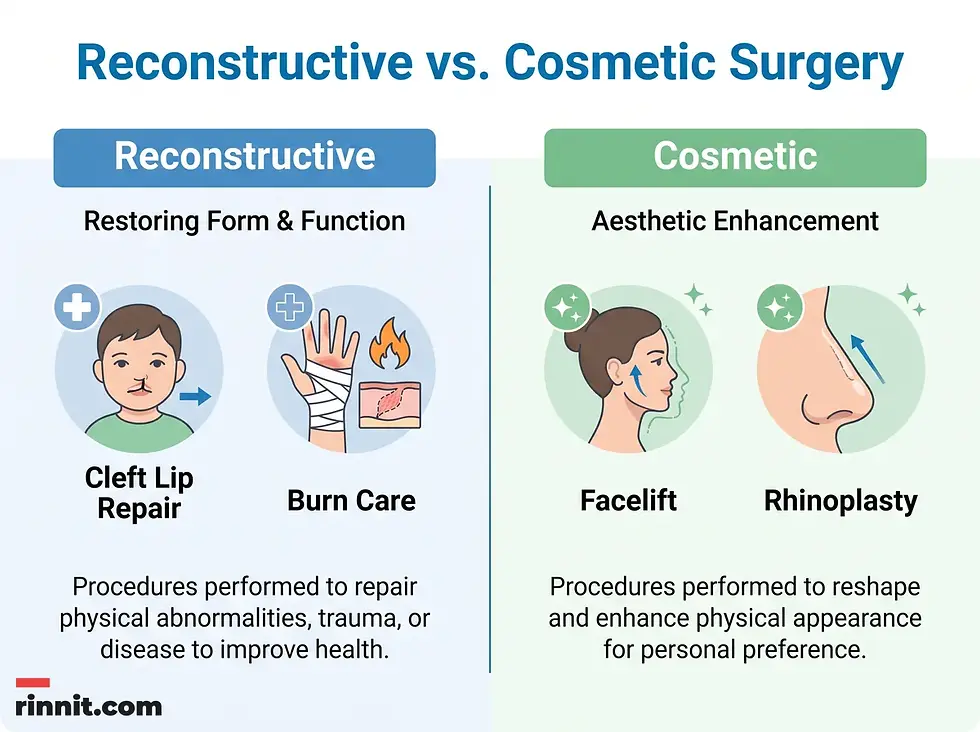
Comparing Surgical Goals
Feature | Reconstructive Surgery | Cosmetic Surgery |
Primary Goal | Restore form and function | Enhance aesthetic appearance |
Medical Necessity | High (due to injury, illness, or birth defects) | Elective (personal aesthetic choice) |
Common Examples | Cleft lip repair, burn reconstruction | Facelift, breast augmentation |
Training Basis | Core component of plastic surgery residency | Part of core training; optional fellowship |
Advanced Surgical Techniques
Plastic surgeons employ sophisticated methods to achieve optimal results in complex cases. Microsurgery, for instance, involves the use of a microscope to reconnect tiny blood vessels and nerves, [1] which is essential for successful tissue transfers. Other common techniques include skin grafting, where healthy skin is moved to repair large wounds, and tissue expansion, which involves stretching the skin with a balloon-like device so it can later be used to close a large wound. [1]
Surgeons also use flaps, which move a person’s own skin, fat and sometimes muscle to repair defects [1] caused by cancer removal or trauma. In free flap surgery (free tissue transfer), the tissue is removed from its original blood supply and reconnected to a new blood source near the repair site. [1]
Education and Board Certification
Becoming a plastic surgeon requires an extensive educational commitment. After completing medical school (MD or DO), [1] candidates must undergo a rigorous residency program. This typically involves either a six-year plastic surgery residency or a five-year general surgery residency followed by three years of specialized plastic surgery training. [1] After residency, surgeons may complete a one-year fellowship in a subspecialty such as body contouring, microsurgery, craniofacial surgery, cosmetic surgery, hand surgery, or burn surgery. [1]
In the United States, board certification is granted by organizations such as the American Board of Plastic Surgery, and surgeons maintain it through a continuous certification program and ongoing education. [1] Requirements differ from country to country, so it is always worth checking a surgeon’s credentials where you live.
Frequently Asked Questions
What is the difference between a plastic surgeon and a cosmetic surgeon?
Plastic surgeons undergo formal residency training in reconstructive and cosmetic surgery, whereas some cosmetic surgeons may only have certification in cosmetic surgery without full plastic surgery training.
What conditions do plastic surgeons treat from birth?
They repair congenital defects such as cleft lip and palate, congenital hand differences, craniosynostosis, hypospadias, webbed fingers or toes (syndactyly), and ear abnormalities like microtia.
How do plastic surgeons help cancer survivors?
They perform reconstructive procedures to restore areas affected by cancers such as breast, skin, head and neck, colorectal, gynecologic, testicular and vaginal cancer.
What is microsurgery?
It is a technique using a microscope to perform complex repairs on tiny structures like blood vessels and nerves.
What is a skin graft?
A skin graft involves taking healthy skin from one part of the body to cover and repair a wound in another area.
How does tissue expansion work?
A balloon-like device is placed under the skin and gradually filled with saline to stretch the skin, which is later used to close a large wound.
What is free flap surgery?
It involves moving a section of skin, fat and/or muscle from one part of the body to another and connecting it to a new blood supply.
Are plastic surgeons involved in trauma care?
Yes, they treat burns, complex wounds, facial fractures, and cuts involving delicate tissues such as the hands, lips, eyelids and nerves.
What facial cosmetic procedures do they perform?
Common procedures include facelifts, brow lifts, eyelid surgery (blepharoplasty), and nose reshaping (rhinoplasty).
Can plastic surgeons perform non-surgical treatments?
Yes, many provide injectables like Botox, and laser treatments such as peels, hair removal and treatment of spider veins.
What is a “mommy makeover”?
It is a combination of procedures designed to restore much of a person’s pre-pregnancy appearance.
How long is plastic surgery residency?
It typically lasts six years in an integrated program, or a total of eight years if following the path of five years of general surgery plus three years of plastic surgery training.
What sub-specialties can a plastic surgeon pursue?
Options include body contouring, microsurgery, craniofacial surgery, cosmetic surgery, hand surgery, and burn surgery, typically through a one-year fellowship.
What should I ask during a first consultation?
Ask about the surgeon’s experience with your specific procedure, the risks and benefits of each option, and what to expect for recovery, and bring your medical history and any previous test results.
Is plastic surgery only for appearance?
No, a significant portion of the field is dedicated to restoring physical function and repairing damage from injuries, illnesses and birth defects.

Conclusion
Plastic surgery is a diverse and vital medical specialty that bridges the gap between functional restoration and aesthetic enhancement. Whether addressing a congenital defect, repairing trauma, or performing elective cosmetic changes, these surgeons play a crucial role in improving both physical health and psychological well-being. By choosing a board-certified specialist, patients can ensure they receive care grounded in rigorous training and the latest surgical innovations.
Call to Action
If you are considering a reconstructive or cosmetic procedure, the first step is to schedule a consultation with a board-certified plastic surgeon. Discuss your goals and medical history openly to develop a personalized care plan that prioritizes your safety and long-term results.
Related reading on Rinnit
Sources
Cleveland Clinic. Plastic Surgeon. Cleveland Clinic. Last updated June 8, 2022. https://my.clevelandclinic.org/health/articles/23205-plastic-surgeon
Riot S, Herlin C, Mojallal A, et al. A systematic review and meta-analysis of double venous anastomosis in free flaps. Plast Reconstr Surg. 2015;136(6):1299-1311. PMID: 26595023. DOI: 10.1097/PRS.0000000000001791
de Berker HT, Čebron U, Bradley D, et al. Outcomes of microsurgical free tissue transfer performed on international surgical collaborations in low-income and middle-income countries: a systematic review and meta-analysis. J Plast Reconstr Aesthet Surg. 2022;75(7):2049-2063. PMID: 35490120. DOI: 10.1016/j.bjps.2022.04.002
Clarijs ME, Peeters NJMCV, van Dongen SAF, et al. Quality of life and complications after nipple- versus skin-sparing mastectomy followed by immediate breast reconstruction: a systematic review and meta-analysis. Plast Reconstr Surg. 2023;152(1):12e-24e. PMID: 36728484. DOI: 10.1097/PRS.0000000000010155
Related Reading
Plastic Surgery: Reconstructive and Cosmetic Types, Risks and Recovery explains reconstructive and cosmetic plastic surgery.
Medical disclaimer
This content is for informational purposes only and does not constitute medical advice. Always seek the advice of your physician or other qualified health provider with any questions you may have regarding a medical condition or procedure.



Comments