Plastic Surgery: Reconstructive and Cosmetic Types, Risks and Recovery

Updated: 2 days ago
Written and medically reviewed by Dr. Baraa Alnahhal, MD · Last reviewed: November 2026 · How we review
Quick Answer
Plastic surgery is surgery that changes or restores the shape and function of parts of the body. Reconstructive surgery repairs problems caused by birth defects, injuries, burns, cancer or disease. Cosmetic surgery is done by choice to change appearance. Choosing a board-certified plastic surgeon improves your chances of a good result.
What the research says
Smoking raises infection risk after cosmetic surgery: in 129,007 cosmetic surgery patients, major complications were about 2% in smokers and nonsmokers alike, but smoking raised the risk of surgical site infection by 61% (Kaoutzanis C et al., Aesthetic Surgery Journal, 2019) [2]
Combining procedures raises risk: among 54,927 cosmetic surgery patients, major complications occurred in about 2% of both men and women, but combining several procedures raised men's risk about 2.6-fold (Kaoutzanis C et al., Aesthetic Surgery Journal, 2018) [3]
Key takeaways
Plastic surgery includes reconstructive and cosmetic procedures.
Reconstructive surgery restores form and function after injury, disease or birth defects.
Cosmetic surgery changes appearance by choice.
Not smoking and choosing a board-certified surgeon lower your risk.
Recovery ranges from days to months.
What is plastic surgery?
The name comes from the Greek word *plastikos*, meaning "to mold" or "to form." Plastic surgeons reshape skin, fat, muscle, cartilage and bone. While many people think of cosmetic surgery, much of plastic surgery is reconstructive and medically necessary. Learn more about the role of a plastic surgeon. Sources: [1]
Reconstructive vs. cosmetic surgery
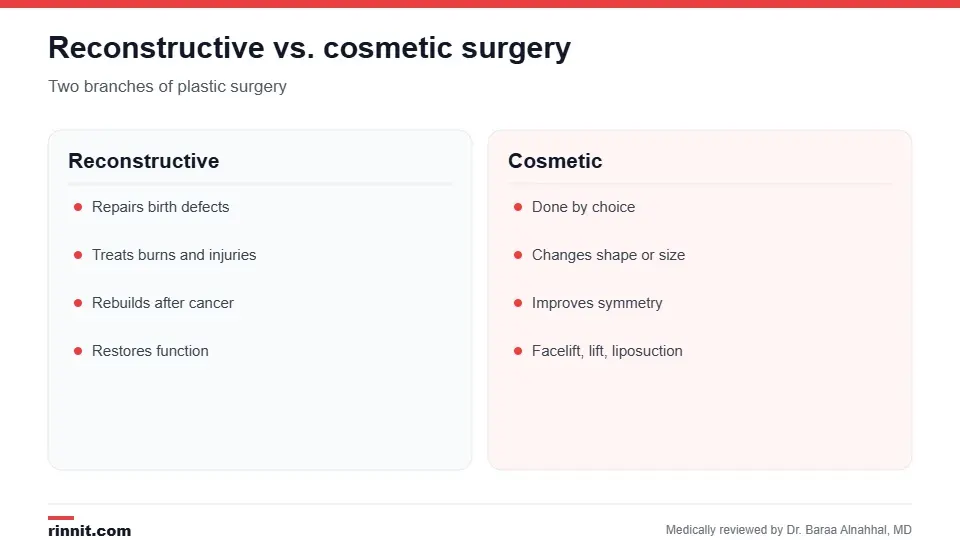
Board-certified surgeons are recommended for both.
Type | Purpose | Examples |
Reconstructive | Repairs defects or injuries and restores function | Cleft lip and palate repair, breast reconstruction, burn and scar repair, jaw surgery, limb salvage |
Cosmetic | Changes appearance by choice | Facelift, brow lift, rhinoplasty, breast augmentation, liposuction, tummy tuck |
Sources: [1]
Common procedures
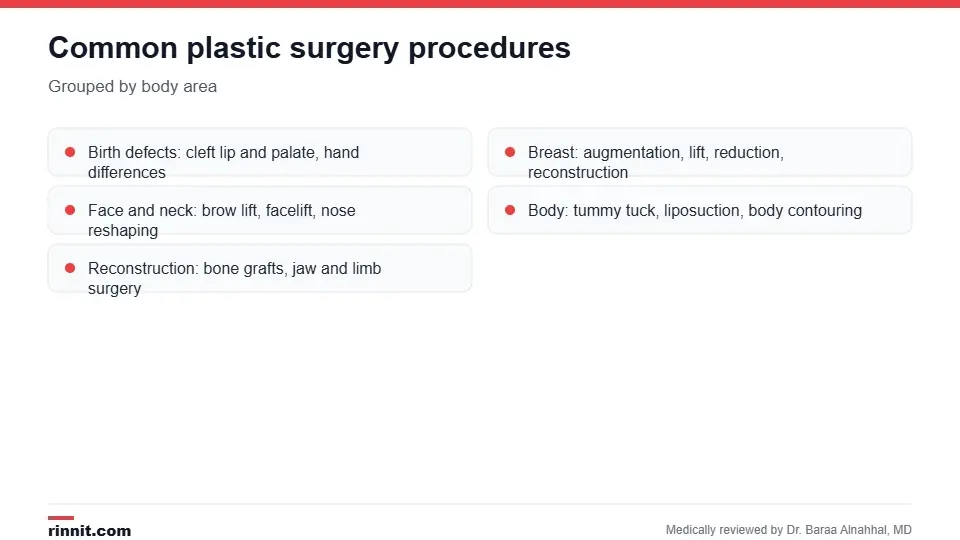
Recovery depends on the procedure.
Birth defect repair: cleft lip and palate, hand differences, craniosynostosis, hypospadias, microtia.
Breast surgery: augmentation, lift, reduction and reconstruction.
Face and neck: brow lift, cheek lift, facelift, double chin surgery, nose reshaping, eyelid surgery.
Body: tummy tuck, body contouring, liposuction.
Reconstruction: bone grafting, facial and jaw reconstruction, limb salvage. Sources: [1]
Risks
Risk | Notes |
Infection | Higher in people who smoke |
Bleeding and blood clots | Watch for leg or groin swelling |
Fluid buildup (edema) | Usually temporary |
Nerve damage | Can cause numbness or nerve pain |
Scarring or slow healing | Some scars can limit movement |
Anesthesia problems | Such as breathing issues |
Disappointing results | One of the main risks |
Your risk depends on the procedure, your health and habits such as smoking. Sources: [1, 2, 3]
Recovery

Therapy may be needed after reconstructive surgery.
Some people go home after waking up; others stay in the hospital a night or two.
At home, rest, care for your dressings, raise swollen areas and eat soft foods if needed.
Wait a few days before showering or bathing, as directed.
Many people return to normal activities in a few days; a tummy tuck can take several weeks to months.
Most people are pain-free within a few weeks.
Physical, speech or occupational therapy may help after reconstructive surgery. Sources: [1]
Benefits
Plastic surgery can restore function, ease pain, improve safety and independence, and boost body image and self-esteem. For most people, the benefits outweigh the risks. Sources: [1]
When to call your surgeon
Dressings soaked with blood.
Signs of infection, such as fever or yellow discharge from the incision.
Pain that medicine doesn't relieve.
Swelling in the groin or lower leg, which may mean a blood clot.
Vomiting and being unable to keep fluids down. Sources: [1]
Conclusion
Plastic surgery can restore what injury or disease has taken away, or help you feel more confident in your appearance. Choosing an experienced, board-certified surgeon and following your recovery plan give you the best results.
Keep learning: read about cosmetic surgery and facelift surgery.
Frequently asked questions
What is plastic surgery?
Surgery that changes or restores the shape and function of body parts.
What's the difference between plastic and cosmetic surgery?
Cosmetic surgery is one type of plastic surgery done to change appearance by choice.
What is reconstructive surgery?
Surgery that repairs defects or injuries and restores function.
What are common cosmetic procedures?
Breast augmentation, facelift, liposuction, tummy tuck and nose reshaping.
What are the risks?
Infection, bleeding, blood clots, scarring and disappointing results.
Does smoking affect plastic surgery?
Yes. It raises the risk of infection and poor healing.
How long is recovery?
From a few days to several months, depending on the procedure.
Is plastic surgery covered by insurance?
Reconstructive surgery often is; cosmetic surgery usually isn't.
How do I choose a surgeon?
Look for a board-certified surgeon with experience in your procedure.
When should I call my surgeon?
For heavy bleeding, fever, severe pain or leg swelling.
Related Reading
Cosmetic Surgery: A Guide to Aesthetic Procedures an overview of cosmetic procedures.
Understanding the Role of a Plastic Surgeon: Expertise, Training, and Care what plastic surgeons do.
Facelift Surgery: A Comprehensive Guide to Facial Rejuvenation a common cosmetic procedure.
Cleft Lip and Cleft Palate Surgery: Timing, Steps and Recovery a common reconstructive procedure.
Tummy Tuck (Abdominoplasty): A Guide to Procedure, Recovery, and Results a common body contouring surgery.
References
Cleveland Clinic. Plastic Surgery: Types, Benefits & Potential Complications. Cleveland Clinic. Last updated August 17, 2022. https://my.clevelandclinic.org/health/treatments/23999-plastic-and-reconstructive-surgery
Kaoutzanis C, Winocour J, Gupta V, et al. The effect of smoking in the cosmetic surgery population: analysis of 129,007 patients. Aesthetic Surgery Journal. 2019;39(1):109-119. PMID 29659716. https://doi.org/10.1093/asj/sjy088
Kaoutzanis C, Winocour J, Yeslev M, et al. Aesthetic surgical procedures in men: major complications and associated risk factors. Aesthetic Surgery Journal. 2018;38(4):429-441. PMID 29045566. https://doi.org/10.1093/asj/sjx161
Medical disclaimer
This article is for general education only and does not replace advice from a qualified healthcare professional. Talk to your doctor about your own diagnosis and treatment, and seek emergency care right away for severe or sudden symptoms.



Comments