Breast Lift (Mastopexy): Incision Types, Recovery and Results

Updated: 2 days ago
Written and medically reviewed by Dr. Baraa Alnahhal, MD · Last reviewed: November 2026 · How we review
Quick Answer
A breast lift (mastopexy) is cosmetic surgery that raises and reshapes sagging breasts by removing stretched skin, tightening the remaining tissue and moving the nipple and areola higher. It doesn't change breast size on its own. Surgery takes about one to two hours, and most people go home the same day. Results last several years.
What the research says
Breast lifts without implants have low complication rates: in 34 studies with 1,888 patients, the overall complication rate was 10.4%, mostly scar and nipple problems, and only 1.3% were unhappy with the shape of their breasts (di Summa PG et al., Journal of Plastic, Reconstructive & Aesthetic Surgery, 2019) [2]
Combining a lift with implants adds risk: in 23 studies covering 4,856 combined breast lift and augmentation procedures, complications occurred in 13.1% and repeat surgery in 10.7%; the most common problems were recurrent sagging and poor scarring (Khavanin N et al., Plastic and Reconstructive Surgery, 2014) [3]
Key takeaways
A breast lift raises and reshapes sagging breasts.
It doesn't change size on its own but can be combined with implants or reduction.
There are four main incision types.
Most people return to desk work in about a week.
Results last several years but are affected by aging, pregnancy and weight changes.
What is a breast lift?
A breast lift can improve symmetry, point the nipples forward, reduce a stretched areola and remove extra skin for a firmer, more youthful shape. Most insurance plans don't cover it because it's considered cosmetic. Sources: [1]
Why it's done

A lift can be combined with augmentation or reduction.
Sagging from aging, pregnancy, breastfeeding, genetics, gravity or major weight loss.
Nipples and areolas that point downward.
Nipples that point in different directions.
Breasts that are uneven. Sources: [1]
If you also want a change in size, a lift may be combined with breast augmentation or breast reduction. Sources: [1]
Incision types
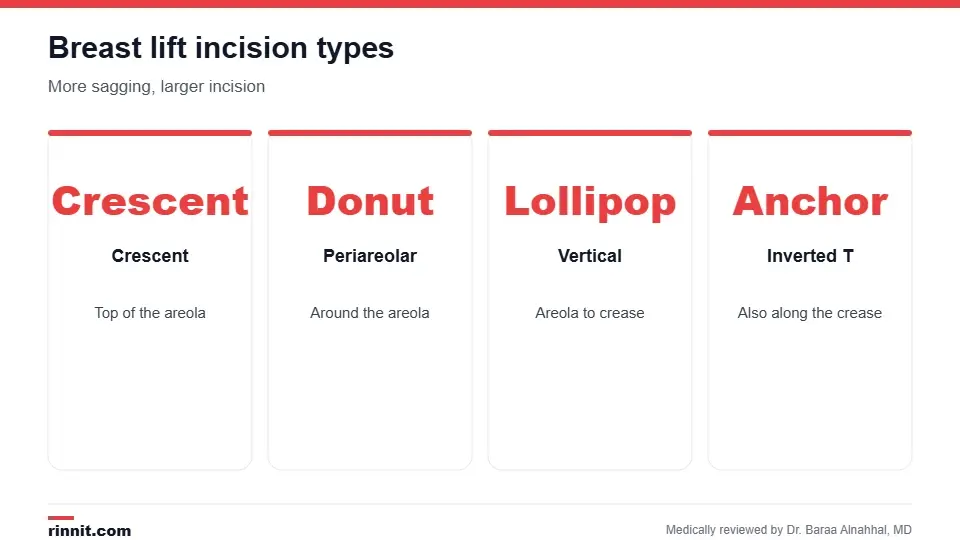
More sagging usually needs a larger incision.
Incision | Where it goes | Best for |
Crescent | A half-circle along the top of the areola | Little sagging, usually with augmentation |
Donut (periareolar) | Around the areola | Mild sagging |
Lollipop (vertical) | Around the areola and down to the crease | Moderate sagging |
Anchor (inverted T) | Around the areola, down and along the crease | More sagging or with reduction |
Scars are mostly hidden and fade considerably, though some are permanent. Sources: [1]
How to prepare
Discuss your goals, medical history, family history of breast cancer and past mammograms.
Tell your surgeon about medicines, supplements, alcohol, tobacco and drug use.
You may need blood work, a physical exam or a mammogram.
Stop smoking and avoid aspirin, NSAIDs and herbal supplements as directed.
Arrange a ride home and someone to stay with you the first night. Sources: [1]
What happens during surgery

Surgery takes about one to two hours.
You get anesthesia.
The surgeon makes incisions around the areola, sometimes extending down or along the crease.
Breast tissue is reshaped and lifted.
The nipple and areola are moved higher.
Excess skin is removed, and the incisions are closed.
Bandages and a surgical bra are applied, and drains may be placed. Sources: [1]
Risks
Risk | Notes |
Scarring or uneven breasts | Scars fade but some are permanent |
Changes in nipple or breast sensation | May be temporary or permanent |
Bleeding, blood clots or hematoma | Uncommon |
Infection or poor healing | Uncommon |
Trouble breastfeeding later | Possible |
Loss of the nipple or areola | Rare |
Need for another surgery | More likely when combined with implants |
Sources: [1, 2, 3]
Recovery
When | What to expect |
First 2 weeks | Discomfort, swelling, bruising and tight skin |
A few days | Drains removed |
About 1 week | Desk work and walking |
Up to 6 weeks | Lifting, exercise and sex |
About 8 weeks | Switch to a regular bra |
Several months | Incisions fully heal |
Sleep on your back and avoid raising your arms overhead at first. Sources: [1]
When to call your surgeon
A breast that's red, hot, swollen or painful.
Bleeding, drainage or redness at an incision.
Chest pain, dizziness, nausea or vomiting.
A fever above 100.5°F.
Severe pain that medicine doesn't relieve. Sources: [1]
Conclusion
A breast lift can restore a firmer, more youthful shape after pregnancy, weight loss or aging. Talking with a board-certified plastic surgeon about incision type, scars and whether to combine procedures helps you get the result you want.
Keep learning: read about breast reduction and breast augmentation.
Frequently asked questions
What is a breast lift?
Surgery that raises and reshapes sagging breasts.
Does a breast lift change breast size?
Not on its own; it's often combined with implants or reduction.
How long does surgery take?
About one to two hours.
Will I have scars?
Yes, but they're mostly hidden and fade over time.
How long is recovery?
About a week for desk work and up to six weeks for exercise.
When can I wear a regular bra?
After about eight weeks.
How long do results last?
Several years, depending on aging, pregnancy and weight changes.
Can I breastfeed after a breast lift?
It may be harder in some cases.
Does insurance cover a breast lift?
Usually not, because it's cosmetic.
What is an anchor lift?
An incision around the areola, down the breast and along the crease.
Related Reading
Vampire Breast Lift (PRP Breast Lift): Results and Risks explains the vampire (PRP) breast lift.
Breast Implants: Types, Surgery, Recovery and Risks explains breast implant types and risks.
Breast Augmentation: Types, Surgery, Recovery and Risks Explained surgery often combined with a lift.
Cosmetic Surgery: A Guide to Aesthetic Procedures an overview of cosmetic surgery.
Tummy Tuck (Abdominoplasty): A Guide to Procedure, Recovery, and Results often paired with a lift after pregnancy.
Liposuction: What It Is, Surgery, Recovery, and Results a body contouring procedure.
Facelift Surgery: A Comprehensive Guide to Facial Rejuvenation a lift procedure for the face.
References
Cleveland Clinic. Breast Lift (Mastopexy): Surgery & Recovery. Cleveland Clinic. Last updated June 19, 2022. https://my.clevelandclinic.org/health/treatments/23298-breast-lift
di Summa PG, Oranges CM, Watfa W, et al. Systematic review of outcomes and complications in nonimplant-based mastopexy surgery. Journal of Plastic, Reconstructive & Aesthetic Surgery. 2019;72(2):243-272. PMID 30527707. https://doi.org/10.1016/j.bjps.2018.10.018
Khavanin N, Jordan SW, Rambachan A, et al. A systematic review of single-stage augmentation-mastopexy. Plastic and Reconstructive Surgery. 2014;134(5):922-931. PMID 25347628. https://doi.org/10.1097/PRS.0000000000000582
Medical disclaimer
This article is for general education only and does not replace advice from a qualified healthcare professional. Talk to your doctor about your own diagnosis and treatment, and seek emergency care right away for severe or sudden symptoms.



Comments