Breast Implants: Types, Surgery, Recovery and Risks

Updated: 2 days ago
Written and medically reviewed by Dr. Baraa Alnahhal, MD · Last reviewed: November 2026 · How we review
Quick Answer
Breast implants are silicone shells filled with silicone gel or saline that are surgically placed to enlarge the breasts or rebuild them after mastectomy. You must be at least 18 for saline implants, and the FDA recommends at least 22 for silicone. Full recovery takes six to eight weeks. Implants aren't lifetime devices; they last about 10 years.
What the research says
Many people need more surgery over time: in 99,993 implant patients followed in FDA studies, 11.7% needed another operation within 7 years after cosmetic augmentation and 25% after reconstruction; severe capsular contracture affected 7.2% of augmentation patients (Coroneos CJ et al., Annals of Surgery, 2019) [2]
Implant-linked lymphoma is rare: in a nationwide Dutch study, the risk of breast implant lymphoma was about 29 per million women by age 50 and 82 per million by age 70, with most cases linked to textured implants (de Boer M et al., JAMA Oncology, 2018) [3]
Key takeaways
Breast implants are filled with silicone gel or saline.
They're used for augmentation and for reconstruction after cancer.
Implants typically last about 10 years.
Full recovery takes six to eight weeks.
Textured implants carry a rare lymphoma risk.
What are breast implants?
Breast implants are medical devices placed by a plastic surgeon. About 3.5 million people in the U.S. have breast implants, and about 60% are silicone gel. Implants are used for breast augmentation and breast reconstruction. Sources: [1]
Why people get them
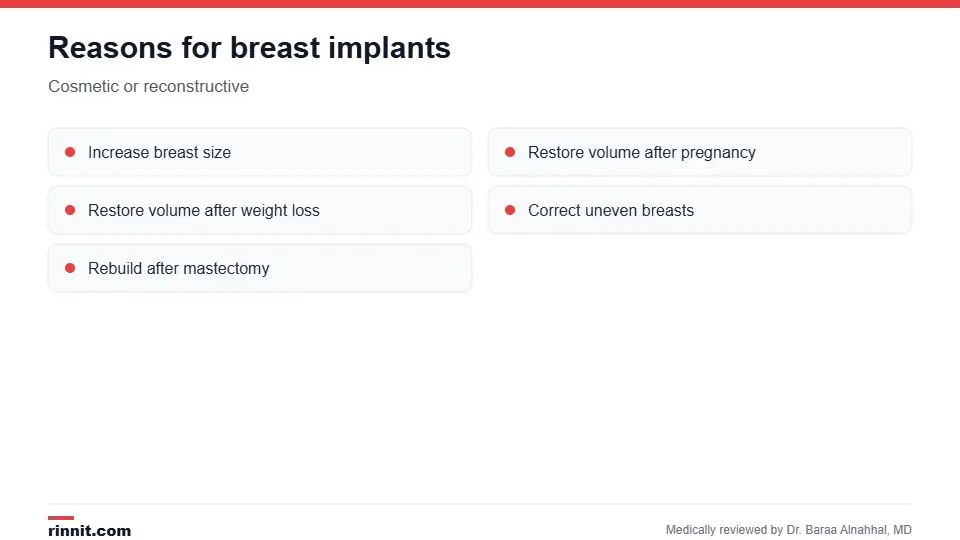
Good candidates are healthy with realistic expectations.
Increase breast size.
Restore size after pregnancy, weight loss or aging.
Correct uneven breasts.
Rebuild breasts after mastectomy. Sources: [1]
Types of implants
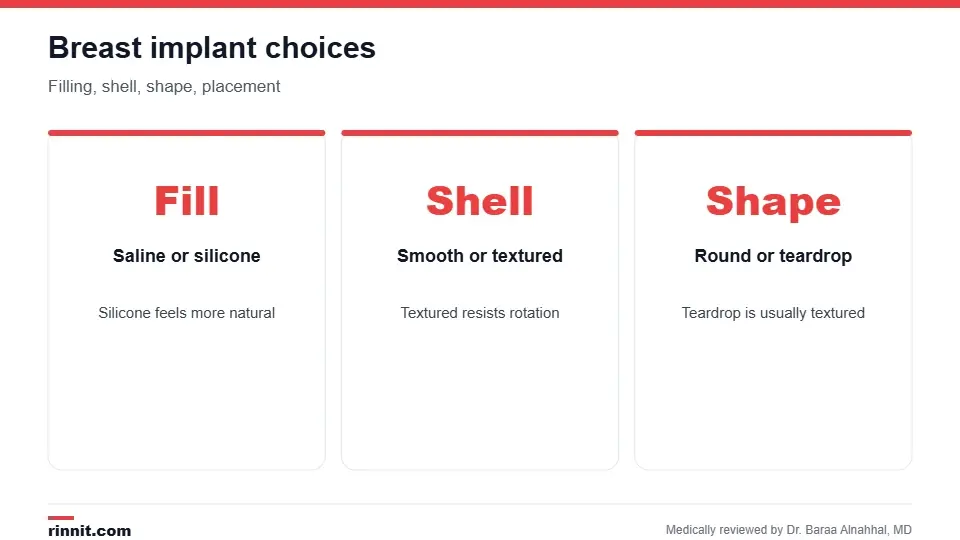
Your surgeon helps you choose the right type.
Feature | Options |
Filling | Saline (sterile salt water) or silicone gel; silicone tends to feel more natural |
Shell | Smooth (moves more freely) or textured (resists rotation) |
Shape | Round or teardrop |
"Gummy bear" | Highly cohesive silicone that keeps its shape |
Placement | Under the chest muscle (submuscular) or over it (subglandular) |
Sources: [1]
How to prepare
You must be at least 18 for saline implants; the FDA recommends at least 22 for silicone.
Your surgeon will talk about your goals, health, body image and any outside pressure.
You may try sample implants under your clothing to choose a size.
You'll decide on filling, shape, shell, placement and incision.
Arrange a ride home and someone to stay with you for 24 hours. Sources: [1]
What happens during surgery

Most people go home the same day.
You receive sedation or anesthesia so you feel no pain.
The surgeon makes an incision under the breast, around the areola, in the armpit or at the belly button.
The implant is placed under or over the chest muscle.
The incision is closed, and a supportive bra or band is applied.
You're watched in recovery for a few hours before going home. Sources: [1]
Risks
Risk | Notes |
More surgery | Replacement, scar tissue removal or repositioning; risk rises over time |
Capsular contracture | Hardening of scar tissue around the implant |
Rupture | Risk rises with implant age |
BIA-ALCL | A rare lymphoma, more common with textured implants |
Breastfeeding problems | Possible |
Implants don't lift sagging breasts; a breast lift may be needed. Sources: [1, 2, 3]
Recovery
When | What to expect |
First several days | Swelling, bruising and sore chest muscles |
5 to 7 days | Pain often eases |
1 to 2 weeks | Light activity and desk work; no lifting or arms overhead |
2 to 6 weeks | Return to most jobs |
6 to 8 weeks | Full recovery on average |
Follow-up visits are usually at one to two weeks, four to six weeks, three months and six months. Sources: [1]
Living with implants
Implants typically last about 10 years and may need replacing more than once in your lifetime. Watch for changes in size, shape, firmness or swelling, which can signal a rupture. Silicone implants can rupture without any symptoms, so the FDA recommends an ultrasound or MRI 5 to 6 years after surgery and then every 2 to 3 years. Breast implants carry an FDA boxed warning about BIA-ALCL and about symptoms such as joint pain, tiredness and memory problems that some people report (sometimes called breast implant illness). Learn about breast implant removal. Sources: [1]
Conclusion
Breast implants can restore or enhance breast shape and boost confidence. Understanding the types, the long-term upkeep and the risks helps you make an informed choice with your surgeon.
Keep learning: read about breast augmentation and breast reconstruction.
Frequently asked questions
What are breast implants?
Silicone shells filled with silicone gel or saline.
Saline or silicone: which is better?
Silicone tends to feel more natural; your surgeon can help you choose.
How old do you have to be?
At least 18 for saline; the FDA recommends 22 for silicone.
How long do implants last?
About 10 years on average.
How long is recovery?
About six to eight weeks.
When can I go back to work?
Usually in two to six weeks.
What is capsular contracture?
Hardening of scar tissue around the implant.
What is BIA-ALCL?
A rare lymphoma linked mostly to textured implants.
How do I know if an implant ruptured?
Look for changes in size, shape, firmness or swelling. Silicone ruptures can cause no symptoms, so the FDA recommends regular ultrasound or MRI checks.
Can I breastfeed with implants?
It may be affected.
Related Reading
Breast Augmentation: Types, Surgery, Recovery and Risks Explained surgery to enlarge the breasts.
Breast Implant Removal: Surgery, Recovery, Risks and Results removing breast implants.
Natural Breast Augmentation: The Fat Transfer Method augmentation using your own fat.
Breast Lift (Mastopexy): Incision Types, Recovery and Results surgery to raise sagging breasts.
Cosmetic Surgery: A Guide to Aesthetic Procedures an overview of cosmetic surgery.
References
Cleveland Clinic. Breast Implants: Types, Surgery, Recovery & Risks. Cleveland Clinic. Last updated August 31, 2021. https://my.clevelandclinic.org/health/treatments/21724-breast-implants
Coroneos CJ, Selber JC, Offodile AC, et al. US FDA breast implant postapproval studies: long-term outcomes in 99,993 patients. Annals of Surgery. 2019;269(1):30-36. PMID 30222598. https://doi.org/10.1097/SLA.0000000000002990
de Boer M, van Leeuwen FE, Hauptmann M, et al. Breast implants and the risk of anaplastic large-cell lymphoma in the breast. JAMA Oncology. 2018;4(3):335-341. PMID 29302687. https://doi.org/10.1001/jamaoncol.2017.4510
Medical disclaimer
This article is for general education only and does not replace advice from a qualified healthcare professional. Talk to your doctor about your own diagnosis and treatment, and seek emergency care right away for severe or sudden symptoms.



Comments