Breast Reconstruction: Implant and Flap Options, Surgery and Recovery

Updated: 2 days ago
Written and medically reviewed by Dr. Baraa Alnahhal, MD · Last reviewed: November 2026 · How we review
Quick Answer
Breast reconstruction is surgery that rebuilds the shape of the breast after a mastectomy or lumpectomy. It can use breast implants, a flap of your own tissue or both, and can be done at the same time as cancer surgery or later. Reconstruction is a personal choice; alternatives include a breast form or going flat.
What the research says
Flaps have more early complications than implants: in 2,234 women at 11 centers, flap reconstructions had about twice the odds of complications within a year compared with implant reconstruction, while reconstruction failure ranged from 0% to 5.9% (Wilkins EG et al., Annals of Surgery, 2018) [2]
But flaps bring higher long-term satisfaction: in 2,013 women (1,217 answered the 2-year survey), those with their own-tissue reconstruction rated breast satisfaction about 8 points higher and sexual well-being about 5.5 points higher than those with implants (Santosa KB et al., JAMA Surgery, 2018) [3]
Key takeaways
Breast reconstruction rebuilds the breast after cancer surgery.
It uses implants, your own tissue or both.
It can be done during cancer surgery or later.
Several surgeries may be needed.
It's a personal choice; a breast form or going flat are also options.
What is breast reconstruction?
Breast reconstruction recreates the shape of a breast after mastectomy or lumpectomy. Oncoplastic reconstruction uses breast reduction or lift techniques during a lumpectomy. Reconstruction can help with body image and emotions after cancer treatment. Sources: [1]
Who it's for
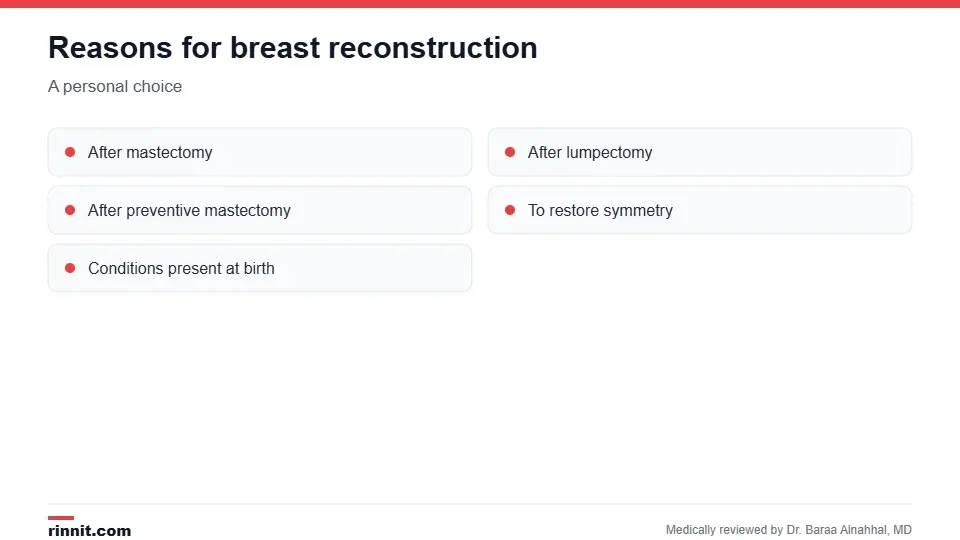
It's a personal choice, not a requirement.
After mastectomy to treat or prevent breast cancer.
After lumpectomy that changes breast shape.
To restore symmetry between the breasts.
Less often, for breasts affected by a condition present at birth. Sources: [1]
Types of reconstruction
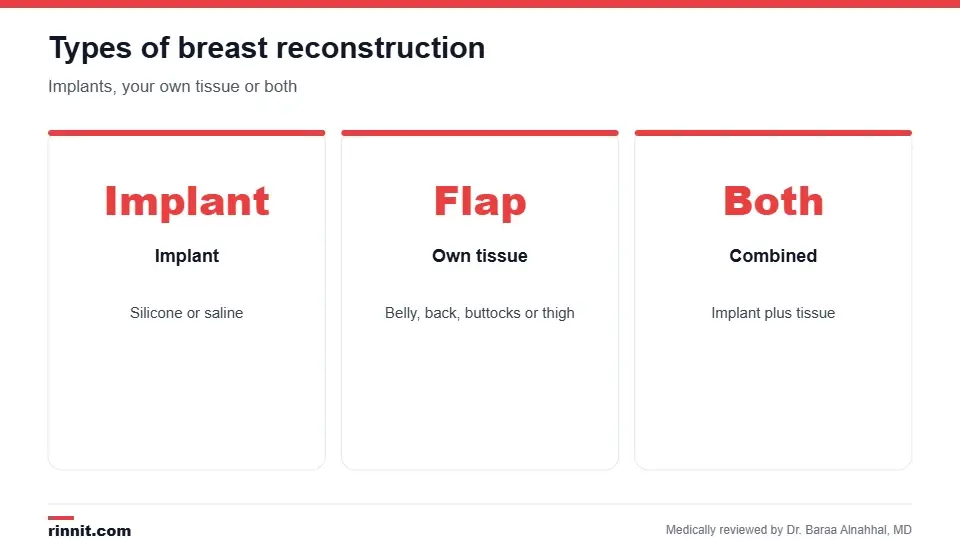
Your surgeon helps you choose based on your body and treatment.
Type | How it works |
Implant | Silicone or saline implant placed under or above the chest muscle |
Tissue expander | A balloon under the skin is filled with saline about once a week to stretch the skin before an implant |
Flap | Your own skin, fat and sometimes muscle are moved to the chest |
Combined | An implant plus your own tissue |
Flap | Tissue taken from |
DIEP | Lower belly skin and fat, no muscle |
TRAM | Lower belly, including muscle |
Latissimus dorsi | Upper back, including muscle |
GAP (IGAP or SGAP) | Buttocks, no muscle |
PAP or TUG | Inner or back of the thigh |
Learn more about nipple-sparing mastectomy and nipple reconstruction. Sources: [1]
What to expect

Some people finish in stages over several months.
Your surgeon reviews your goals, health and cancer treatment plan, and measures and photographs your breasts.
If needed, chemotherapy or radiation may come first.
Under anesthesia, the cancer surgery is done first if needed.
An implant is placed, or flap tissue is moved, shaped and attached.
A drain may be placed and removed later.
More surgeries may follow, including nipple reconstruction or tattooing. Sources: [1]
Risks
Risk | Notes |
Infection and bleeding | Possible after any surgery |
Reduced breast sensation | Some feeling may return but isn't the same |
Blood clots | More likely with some flap surgeries |
Uneven breasts | Size, shape or nipple position may differ |
Fat necrosis | Hard areas after flap surgery |
Implant problems | Wrinkling, rippling or rupture |
Donor-site problems | Weakness or pain where tissue was taken |
Some textured implants are linked to a rare lymphoma called BIA-ALCL; most of these are no longer sold in the U.S. Sources: [1, 2]
Recovery
Most people stay in the hospital up to a week.
A surgical bra supports the breasts and reduces swelling.
You'll take pain medicine and avoid lifting and exercise for a while.
More surgery may be needed to match the other breast.
Keep up with cancer checkups and mammograms on the other breast. Sources: [1]
When to call your surgeon
Fever or other signs of infection.
Severe pain or pain that medicine doesn't relieve.
Bleeding or pus from an incision.
Color changes on the breast or near the incisions. Sources: [1]
Conclusion
Breast reconstruction offers many options to restore your shape after cancer surgery. Talking through implants, flaps, timing and alternatives with your surgeon helps you make the choice that feels right.
Keep learning: read about mastectomy and breast surgery options.
Frequently asked questions
What is breast reconstruction?
Surgery to rebuild the breast after mastectomy or lumpectomy.
What are the main types?
Implant reconstruction and flap reconstruction using your own tissue.
What is a DIEP flap?
A flap using lower belly skin and fat without muscle.
Can reconstruction be done during mastectomy?
Yes. It can be immediate or delayed.
How many surgeries will I need?
Sometimes several, over months.
Will my new breast have feeling?
Sensation is usually reduced or changed.
How long is the hospital stay?
Up to about a week.
What is a tissue expander?
A balloon that stretches the skin before an implant is placed.
Do I have to have reconstruction?
No. A breast form or going flat are also options.
Can the nipple be rebuilt?
Yes, with skin grafts, local skin or 3D tattoos.
Related Reading
Prophylactic Mastectomy: Who It's For, Types and Recovery explains prophylactic mastectomy.
DIEP Flap Surgery: Breast Reconstruction, Recovery and Results explains DIEP flap breast reconstruction.
Mastectomy: Types, Surgery, Recovery and Reconstruction surgery that often comes before reconstruction.
Breast Surgery Options: Cancer, Cosmetic and Reconstructive an overview of breast surgeries.
Nipple-Sparing Mastectomy: Benefits, Candidacy, and Procedure Details a mastectomy that keeps the nipple.
Nipple Reconstruction: Surgical and Tattoo Options rebuilding the nipple and areola.
Breast Augmentation: Types, Surgery, Recovery and Risks Explained breast implant surgery.
References
Cleveland Clinic. Breast Reconstruction: What Is It, Types, Procedure & Recovery. Cleveland Clinic. Last updated September 27, 2021. https://my.clevelandclinic.org/health/treatments/16809-breast-reconstruction
Wilkins EG, Hamill JB, Kim HM, et al. Complications in postmastectomy breast reconstruction: one-year outcomes of the Mastectomy Reconstruction Outcomes Consortium (MROC) study. Annals of Surgery. 2018;267(1):164-170. PMID 27906762. https://doi.org/10.1097/SLA.0000000000002033
Santosa KB, Qi J, Kim HM, et al. Long-term patient-reported outcomes in postmastectomy breast reconstruction. JAMA Surgery. 2018;153(10):891-899. PMID 29926096. https://doi.org/10.1001/jamasurg.2018.1677
Medical disclaimer
This article is for general education only and does not replace advice from a qualified healthcare professional. Talk to your doctor about your own diagnosis and treatment, and seek emergency care right away for severe or sudden symptoms.



Comments