DIEP Flap Surgery: Breast Reconstruction, Recovery and Results

Updated: 2 days ago
Written and medically reviewed by Dr. Baraa Alnahhal, MD · Last reviewed: November 2026 · How we review
Quick Answer
DIEP flap surgery is breast reconstruction that uses skin, fat and blood vessels from the lower belly to rebuild a breast after a mastectomy or lumpectomy. It doesn't take abdominal muscle, so you keep your core strength. Surgery takes six to eight hours, with six to eight weeks of recovery. Success rates are 96% to 99%.
What the research says
Some steps lowered the risk of fat necrosis: a review of 100 studies covering 9,704 DIEP flaps found fat necrosis was less likely with blood-flow imaging during surgery and harvesting two or more vessels, and more likely with a BMI of 25 or more (Raman KS et al., Journal of Plastic, Reconstructive and Aesthetic Surgery, 2026) [2]
Radiation raised flap complications: in 8 studies of 4,447 DIEP patients, radiotherapy was linked to more wound revisions and a borderline higher risk of partial flap loss, and irradiated breasts had lower satisfaction scores (Elameen AM et al., Aesthetic Plastic Surgery, 2026) [3]
Key takeaways
DIEP flap surgery rebuilds a breast with tissue from your lower belly.
It spares the abdominal muscle.
Surgery takes six to eight hours.
Recovery takes six to eight weeks.
Success rates are 96% to 99%.
What is DIEP flap surgery?
DIEP flap surgery is a muscle-sparing breast reconstruction after a mastectomy or lumpectomy. It's done by a plastic surgeon trained in microvascular surgery. In 2017, DIEP made up about 10% of all breast reconstructions. Sources: [1]
Who it's for
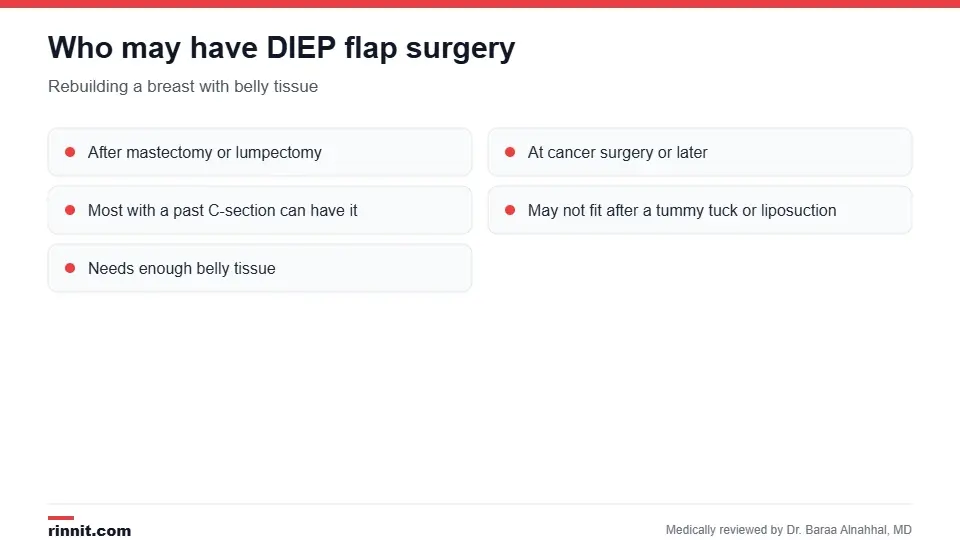
Most people with a past C-section or hysterectomy can still have it.
It can be immediate, during cancer surgery, or delayed.
Stacked DIEP takes tissue from both sides of the belly.
It may not be possible with too little belly fat, a past tummy tuck or liposuction, abnormal belly blood vessels, or some abdominal surgeries.
Most people with a past C-section, open hysterectomy or tubal ligation can still have it. Sources: [1]
DIEP vs. other reconstruction
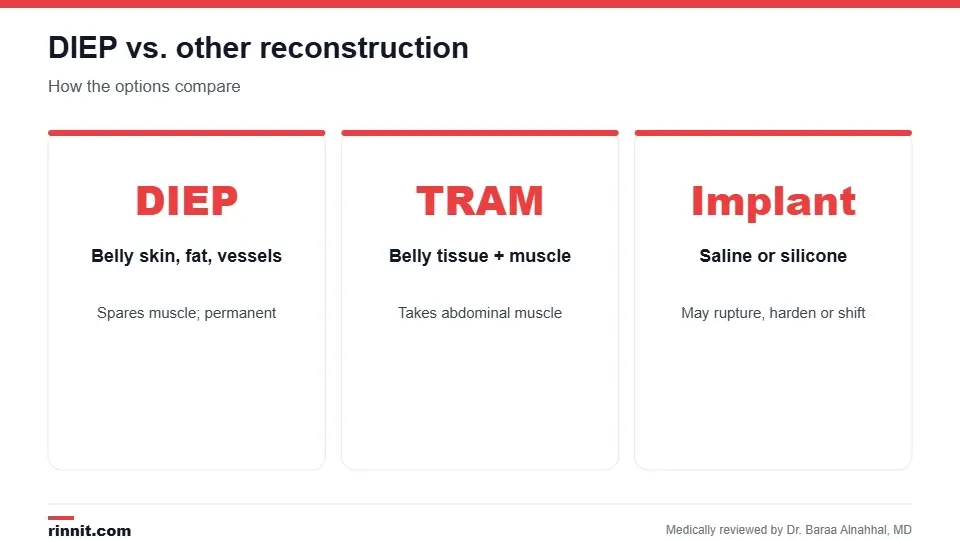
DIEP results are permanent.
Option | What's used | Notes |
DIEP flap | Belly skin, fat and blood vessels | Spares muscle; permanent |
TRAM flap | Belly tissue plus abdominal muscle | Takes muscle |
Implants | Saline or silicone | May rupture, harden, shift or need adjustment |
Sources: [1]
How to prepare
You'll have a physical exam, lab tests, photos and imaging.
Do light exercise in the weeks or months before.
Quit smoking and nicotine.
Stop certain medicines, such as aspirin and NSAIDs. Sources: [1]
What happens during surgery

Surgery takes six to eight hours.
You get anesthesia.
The surgeon makes a long incision from hip bone to hip bone.
A flap of skin, fat and blood vessels is removed without muscle.
The flap is moved to your chest and its blood vessels are connected.
The tissue is shaped into a breast, drains are placed and incisions are closed. Sources: [1]
A tissue expander, if you have one, is removed during the surgery. Sources: [1]
Risks
Hernia.
Firm lumps of scar tissue.
Tissue death (necrosis) from poor blood supply.
Rarely, the whole flap must be removed. Sources: [1, 2, 3]
Recovery
You'll stay in the hospital two to five days.
Wear a compression garment for several weeks.
Avoid strenuous activity, heavy lifting and overhead movements.
Light exercise and arm movements may be allowed by the second week.
Soreness improves after about two weeks; swelling lasts a few weeks.
Numbness may take up to a year to improve. Sources: [1]
Full recovery takes six to eight weeks. Sources: [1]
Outlook
DIEP flap surgery succeeds 96% to 99% of the time, though people with diabetes, high blood pressure or high cholesterol may be toward the lower end. Benefits include a natural look and feel, preserved core strength, a shorter recovery than other flaps and possibly some sensation if nerves are connected. Sources: [1]
When to call your provider
Bleeding.
Fever.
Severe pain.
Shortness of breath.
Pus or foul-smelling drainage from an incision. Sources: [1]
Conclusion
DIEP flap surgery offers a natural, lasting breast reconstruction while protecting your abdominal muscles. Preparing well and following your recovery plan help the flap heal successfully.
Keep learning: read about breast reconstruction and mastectomy.
Frequently asked questions
What is DIEP flap surgery?
Breast reconstruction using skin, fat and blood vessels from the lower belly.
What does DIEP stand for?
Deep inferior epigastric perforator.
Does DIEP flap surgery remove muscle?
No. It spares the abdominal muscle.
How long does surgery take?
Six to eight hours.
How long is the hospital stay?
Two to five days.
How long is recovery?
Six to eight weeks.
How successful is it?
Success rates are 96% to 99%.
Can I have it after a C-section?
Most people can.
Are the results permanent?
Yes.
Will I have feeling in the new breast?
Some sensation may return if nerves are connected; numbness can take a year to improve.
Related Reading
Breast Reconstruction: Implant and Flap Options, Surgery and Recovery an overview of breast reconstruction.
Mastectomy: Types, Surgery, Recovery and Reconstruction breast removal surgery.
Nipple-Sparing Mastectomy: Benefits, Candidacy, and Procedure Details a mastectomy that keeps the nipple.
Double Mastectomy: Types, Surgery, Recovery and Risks removing both breasts.
Tummy Tuck (Abdominoplasty): A Guide to Procedure, Recovery, and Results a similar belly incision.
References
Cleveland Clinic. DIEP Flap Surgery: Breast Reconstruction, Recovery & Results. Cleveland Clinic. Last updated August 18, 2022. https://my.clevelandclinic.org/health/treatments/24023-diep-flap-surgery
Raman KS, Akdag A, Morel SBA, et al. Fat necrosis following deep inferior epigastric artery perforator flap breast reconstruction: a systematic review and meta-analysis. J Plast Reconstr Aesthet Surg. 2026;120:162-175. PMID 42501419. https://doi.org/10.1016/j.bjps.2026.07.027
Elameen AM, Yassin AI. The impact of radiotherapy on the outcomes of deep inferior epigastric artery perforator flaps for breast reconstruction: a systematic review and meta-analysis. Aesthetic Plast Surg. 2026;50(11):3998-4008. PMID 41813983. https://doi.org/10.1007/s00266-026-05690-w
Medical disclaimer
This article is for general education only and does not replace advice from a qualified healthcare professional. Talk to your doctor about your own diagnosis and treatment, and seek emergency care right away for severe or sudden symptoms.



Comments