Lumpectomy: Purpose, Procedure, Recovery and Risks

Updated: 3 days ago
Written and medically reviewed by Dr. Baraa Alnahhal, MD · Last reviewed: November 2026 · How we review
Quick Answer: What is a lumpectomy?
A lumpectomy is breast surgery that removes a tumor and a thin rim of healthy tissue around it while keeping the rest of the breast. It's usually an outpatient operation that takes one to two hours, most people feel recovered in about two weeks, and most then have radiation to lower the chance of the cancer coming back. [1]
What the research says
A lumpectomy with radiation matches mastectomy for long-term survival. In a trial of 701 women with breast tumors no larger than 2 cm followed for 20 years, death from any cause was 41.7% after breast-conserving surgery plus radiation and 41.2% after radical mastectomy, with no meaningful difference in deaths from breast cancer. (Veronesi et al., The New England Journal of Medicine, 2002) [2]
Radiation after a lumpectomy sharply cuts the chance of the cancer returning in the same breast. In a 20-year trial of 1,851 women, cancer came back in the same breast in 14.3% of those who had a lumpectomy plus radiation versus 39.2% after a lumpectomy alone, while overall survival was similar to total mastectomy. (Fisher et al., The New England Journal of Medicine, 2002) [3]
Radiation roughly halves recurrence and lowers breast cancer deaths. A pooled analysis of 10,801 women in 17 trials found that radiation after breast-conserving surgery lowered the 10-year risk of any recurrence from 35.0% to 19.3% and the 15-year risk of breast cancer death from 25.2% to 21.4%. (EBCTCG, The Lancet, 2011) [4]
Key takeaways
A lumpectomy removes the tumor and a margin of healthy tissue but keeps the breast. [1]
It can be used to diagnose a breast lump or to treat breast cancer. [1]
Most people go home the same day and feel fully recovered in about two weeks. [1]
Most people treated for cancer need daily radiation for three to six weeks afterward. [1]
For many people, a lumpectomy plus radiation works as well as a mastectomy for survival. [1] [2]
What is a lumpectomy used for?
A lumpectomy is used either to find out whether a breast lump is cancer or to treat breast cancer while saving the breast. Because it keeps most of the breast in place, it is often called breast-conserving surgery. [1]
When it is done for cancer, most people also receive radiation therapy afterward. Radiation lowers the chance that the cancer will come back in the same breast. [1] To understand the disease itself, read our breast cancer guide.
What are the types of lumpectomy?
There are four main types of lumpectomy, and they differ in how much tissue is removed. [1]

The type of lumpectomy depends on how much tissue needs to be removed.
Type | What is removed | Why it is done |
Excisional biopsy | The lump or tumor | To test whether it is cancer |
Wide local excision | The tumor plus a small margin of healthy tissue | To remove the cancer and check the margin for cancer cells |
Quadrantectomy | About one quarter of the breast, including the tumor, a margin and the area with milk ducts | To remove a larger area around the tumor |
Re-excision of margins | More tissue from the edge of the first surgery | Cancer cells were found at the margin of the first sample |
Source: [1]
Who is a good candidate for a lumpectomy?
A lumpectomy works best when the cancer is in one area of the breast and the tumor is small compared with the size of the breast. [1]
Good candidates usually: [1]
Have cancer limited to one area of the breast
Have a tumor that is small relative to breast size
Will have enough breast tissue left to reshape the breast
Are healthy enough, and have the time, to complete radiation therapy
A lumpectomy may not be the right choice if you: [1]
Have more than one tumor in the same breast
Have a tumor that is large compared with your breast size
Have cancer that has grown through the skin or into the chest wall
Have a fast-growing type such as inflammatory breast cancer
Carry a high-risk gene change, such as a BRCA mutation, and prefer mastectomy to lower future risk (lumpectomy is still an option for many carriers)
Had cancer come back after an earlier lumpectomy with radiation, or had radiation to the same breast before
Have certain skin or connective tissue conditions, such as scleroderma or Sjögren's syndrome
Are pregnant, unless the timing allows surgery in the third trimester and radiation after birth
If a lumpectomy is not a good fit, your care team may suggest another option. Our guide to breast cancer surgery types compares lumpectomy and mastectomy.
How do you prepare for a lumpectomy?
Preparing for a lumpectomy means understanding your treatment plan and following your surgeon's instructions before the day of surgery. [1]
Learn your options. Ask what treatment will follow, such as radiation or breast reconstruction. [1]
Medicines and supplements. Follow your provider's instructions about which medicines and supplements to stop or keep taking. [1]
Fasting. Follow the instructions about when to stop eating and drinking before surgery. [1]
Transport. Arrange for someone to drive you home, because anesthesia can leave you groggy. [1]
What happens during a lumpectomy?
A lumpectomy usually follows five steps and is done as outpatient surgery. [1]

Removing the tumor usually takes about one to two hours.
Locating the tumor: An ultrasound or mammogram finds the tumor, and a small chip or wire is placed to mark it.
Anesthesia: You receive medicine to prevent pain. This is usually general anesthesia, though moderate sedation with local numbing is sometimes used.
Removing the tumor: Guided by the markers, the surgeon removes the tumor and a thin border of healthy tissue.
Pain relief and marker clips: Numbing medicine is injected, and small clips are placed where the tumor was so radiation can be aimed there later.
Closing the incision: Dissolvable stitches close the skin.
Source: [1]
Lymph node removal
During a lumpectomy, the surgeon usually removes a few lymph nodes from the nearby armpit and sends them for testing. This is called a sentinel node biopsy. Cancer cells in these nodes mean the cancer has spread beyond the tumor and may need more treatment. [1]
Breast reconstruction
A reconstructive surgeon may reshape the breast during the same operation, or this may be done later once you have healed. Small lumpectomies may not need reconstruction at all. [1]
Lumpectomy at a glance
Item | Typical detail |
Setting | Usually outpatient, home the same day |
Anesthesia | Usually general; sometimes sedation with local numbing |
Operating time | About 1 to 2 hours for the tumor removal |
Stitches | Dissolvable |
Lymph nodes | A few are often removed for a sentinel node biopsy |
Typical recovery | About 2 weeks |
Radiation afterward | Usually daily for 3 to 6 weeks |
Source: [1]
What happens after a lumpectomy?
After a lumpectomy, a pathologist examines the tumor and any lymph nodes under a microscope. The best result is no cancer in the lymph nodes and a negative margin, meaning no cancer cells at the edge of the removed tissue. [1]
Your next steps depend on these results: [1]
Cancer in the lymph nodes: You may need more tests or treatment.
Cancer cells at the margin: You may need another surgery (re-excision) to remove more tissue.
Hormone receptor-positive cancer: You may be offered hormone therapy for breast cancer.
Radiation after a lumpectomy
Most people need daily radiation for three to six weeks after a lumpectomy, and the timing depends on the diagnosis. Some people, such as some with ductal carcinoma in situ (DCIS), may not need radiation. [1] Learn more in our guide to radiation therapy for breast cancer.
How long does recovery from a lumpectomy take?
Most people feel fully recovered about two weeks after a lumpectomy. Tiredness, pain, swelling and bruising are common at first, and they usually get better every day. [1]
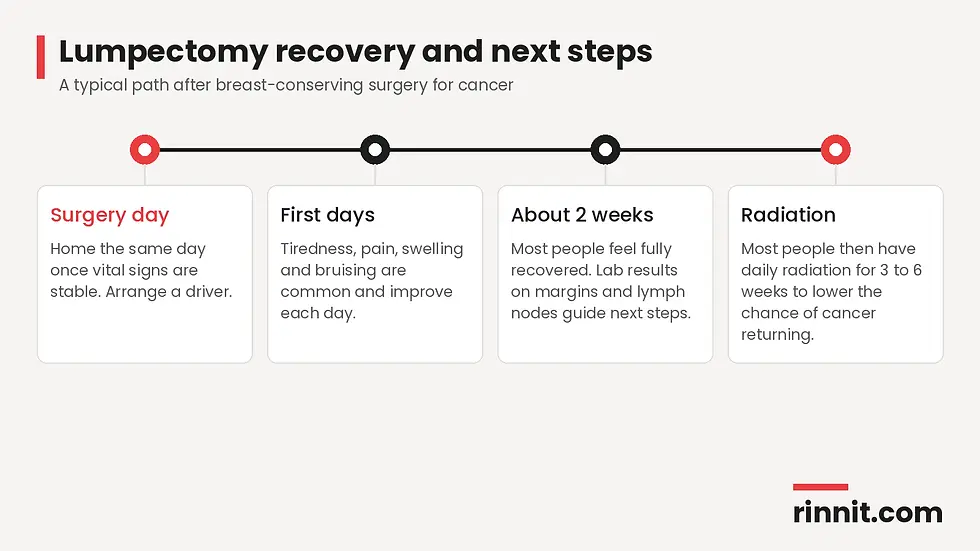
Most people feel fully recovered about two weeks after surgery.
Tips for a smoother recovery: [1]
Place an ice pack in your bra to help with swelling.
Follow your provider's limits on heavy lifting and exercise.
Ask whether you should shower or bathe while the incision heals.
Recovery is different for everyone, so follow the plan your care team gives you. [1]
What are the benefits and risks of a lumpectomy?
The main benefit of a lumpectomy is that it keeps the look and feeling of your breast. Research shows that for many people with early-stage breast cancer, a lumpectomy with radiation matches a mastectomy for survival, though cancer comes back in the same breast a little more often. [1] [2]
Like any surgery, it carries risks: [1]
Risk | What it means |
Infection | Germs enter the wound, causing redness, warmth or discharge |
Seroma | Fluid collects in the area where tissue was removed |
Hematoma | Blood collects under the skin |
Radiation fibrosis | Radiation causes scarring and firmness in the breast |
Lymphedema | Arm swelling after lymph nodes are removed |
Nerve pain | Shooting pain in the arm, armpit or chest that usually fades within a few weeks |
Change in breast shape | The breast may look different as it heals; a cosmetic surgeon can help if needed |
Source: [1]
Bruising and blood collections after breast surgery are explained in our guide to breast hematoma.
When should you call a doctor after a lumpectomy?
Contact your healthcare provider if you notice signs of infection or other problems after a lumpectomy: [1]
Redness, swelling or warmth around the incision
Thick, milky discharge from the wound
Fever, sweats or chills
Fluid building up in or around the breast
Pain that gets worse instead of better
Conclusion
A lumpectomy treats breast cancer by removing the tumor and a margin of healthy tissue while keeping the breast. For many people, combining it with radiation gives the same long-term survival as a mastectomy. [1] [2]
The right choice depends on the size and type of your tumor, your breast size and your health. Talk with your care team about whether a lumpectomy or a mastectomy suits you best. [1]
Keep learning: Read our breast cancer guide and our overview of breast cancer surgery. For more detail on choosing between surgeries, see this guide to surgery choices for breast cancer.
FAQ
What is a lumpectomy?
A lumpectomy is breast surgery that removes a tumor and a thin rim of healthy tissue while keeping the rest of the breast. It is also called breast-conserving surgery or partial mastectomy. [1]
Who is a good candidate for a lumpectomy?
Good candidates usually have cancer in one area of the breast and a tumor that is small compared with breast size. They also need enough breast tissue left to reshape the breast and must be able to complete radiation therapy. [1]
Who should not have a lumpectomy?
A lumpectomy may not suit people with several tumors in one breast, a large tumor relative to breast size, inflammatory breast cancer, a high-risk gene change such as BRCA (though many carriers can still choose lumpectomy), or previous radiation to the same breast. [1]
How long does a lumpectomy take?
Removing the tumor usually takes about one to two hours. The operation takes longer if breast reconstruction is done at the same time. [1]
Do you stay in the hospital after a lumpectomy?
Usually not. A lumpectomy is normally an outpatient procedure, and most people go home the same day once their vital signs are stable. [1]
Are lymph nodes removed during a lumpectomy?
Often, yes. The surgeon usually removes a few lymph nodes from the armpit and tests them in a sentinel node biopsy to see whether the cancer has spread. [1]
How long is recovery after a lumpectomy?
Most people feel fully recovered about two weeks after surgery. Tiredness, pain, swelling and bruising are common at first and improve each day. [1]
Do you need radiation after a lumpectomy?
Most people treated for cancer need daily radiation for three to six weeks after a lumpectomy. Some people, such as some with DCIS, may not need it. [1]
What are the risks of a lumpectomy?
Risks include infection, seroma (fluid buildup), hematoma (a blood collection), radiation scarring, lymphedema (arm swelling) and shooting nerve pain that usually fades within a few weeks. [1]
Is a lumpectomy as effective as a mastectomy?
For many people, a lumpectomy followed by radiation gives the same long-term survival as a mastectomy. A 20-year trial found almost identical death rates after the two operations. [1] [2]
When should I call my doctor after a lumpectomy?
Call your provider for redness, warmth, swelling, thick milky discharge, fever, chills, fluid buildup in the breast, or pain that gets worse after surgery. [1]
How do I prepare for a lumpectomy?
Ask what treatment will follow, such as radiation or reconstruction. Follow your provider's instructions on which medicines and supplements to stop or keep taking and when to stop eating and drinking, and arrange for someone to drive you home because anesthesia can leave you groggy [1].
Does a lumpectomy hurt, and what anesthesia is used?
You receive medicine to prevent pain, usually general anesthesia, though moderate sedation with local numbing is sometimes used, and numbing medicine is injected before the incision is closed. Pain, swelling and bruising are common at first and usually improve every day [1].
Related Reading
Neoadjuvant Therapy: Types, Uses and Benefits explains neoadjuvant cancer therapy.
Breast Surgery Options: Cancer, Cosmetic and Reconstructive compares the types of breast surgery.
References
Cleveland Clinic. Lumpectomy: Purpose, Procedure, Risks & Recovery. Cleveland Clinic. Last updated November 27, 2023. https://my.clevelandclinic.org/health/procedures/12962-lumpectomy
Veronesi U, Cascinelli N, Mariani L, et al. Twenty-year follow-up of a randomized study comparing breast-conserving surgery with radical mastectomy for early breast cancer. N Engl J Med. 2002;347(16):1227-1232. PMID 12393819. https://doi.org/10.1056/NEJMoa020989
Fisher B, Anderson S, Bryant J, et al. Twenty-year follow-up of a randomized trial comparing total mastectomy, lumpectomy, and lumpectomy plus irradiation for the treatment of invasive breast cancer. N Engl J Med. 2002;347(16):1233-1241. PMID 12393820. https://doi.org/10.1056/NEJMoa022152
Early Breast Cancer Trialists' Collaborative Group (EBCTCG); Darby S, McGale P, Correa C, et al. Effect of radiotherapy after breast-conserving surgery on 10-year recurrence and 15-year breast cancer death: meta-analysis of individual patient data for 10,801 women in 17 randomised trials. Lancet. 2011;378(9804):1707-1716. PMID 22019144. https://doi.org/10.1016/S0140-6736(11)61629-2
Medical disclaimer
This article is for general education only and does not replace advice from a qualified healthcare professional. Talk to your doctor about your own diagnosis and treatment, and seek emergency care right away for severe or sudden symptoms.



Comments