Breast Hematoma: What It Is, How Long It Takes to Heal, and When to Get Help

Updated: 3 days ago
Medically reviewed by Dr. Baraa Alnahhal, MD. Last reviewed October 13, 2026. This content is for educational purposes and is not medical advice.
Quick Answer
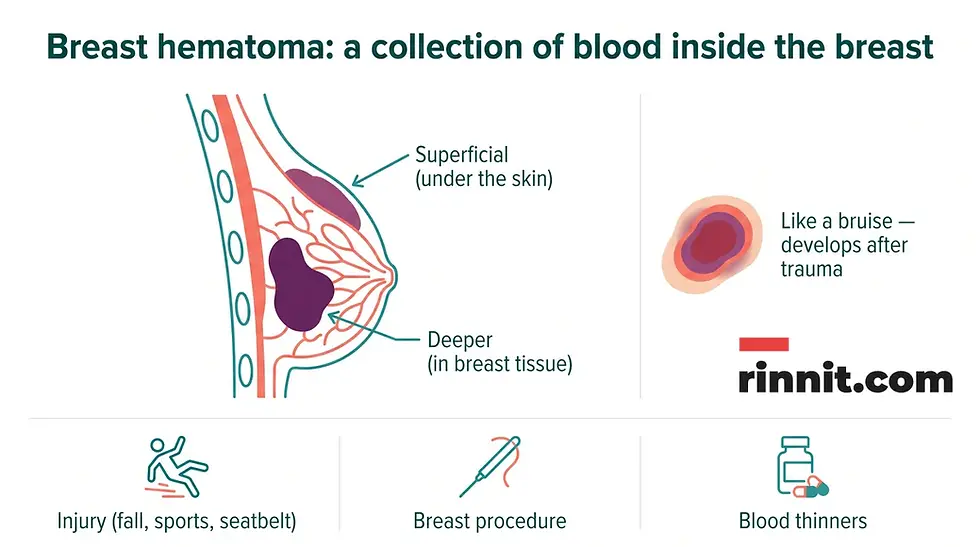
A breast hematoma is a collection of blood inside breast tissue, like a bruise, that develops after injury or a breast procedure. It causes discoloration, tenderness, a lump and swelling, and usually disappears in four to six weeks [1]. Most need only observation, cold therapy and acetaminophen (avoid NSAIDs) [1]. A rapidly growing hematoma needs urgent medical attention [1].
What the research says
Research on breast hematomas is limited, and most of it comes from individual case reports rather than large studies. Two recent reports illustrate the points above:
Blood thinners can cause a hematoma, but it is rare. A case report with a literature review notes that bleeding from anticoagulants usually occurs in the skin, gut, urinary tract, brain, or muscle, and that breast hematomas are usually traumatic, so spontaneous bleeding into the breast after anticoagulant use is rare. For that patient, the authors advised that intervention was unnecessary however large the hematoma was; this is a single case, and a rapidly growing hematoma still needs urgent evaluation (Dağtekin and Çelik, Eur J Breast Health, 2023) [2].
A seatbelt injury can produce an actively bleeding hematoma. In a reported case, a woman developed a markedly swollen breast with tissue edema and a painful palpable mass after a car accident. Imaging showed a hematoma with active bleeding, which shows why swelling that is growing after an injury needs prompt assessment (Başara Akın et al., Turk J Surg, 2023) [3].
What Is a Breast Hematoma?
A breast hematoma (pronounced "hee-mah-toe-mah") is a collection of blood inside your breast. Like a bruise, breast hematomas develop following trauma to your breast. They can be superficial, under your skin, or deeper in the breast tissue [1]. Fortunately, most hematomas are temporary and eventually resolve on their own without treatment [1].
Who gets breast hematomas?
Hematomas can affect anyone who experiences an injury to their breast tissue. This injury can be related to trauma such as a fall, car crash seat belt injury, or following a breast procedure. They will occur more frequently in people who are on blood thinners (aspirin or other anticoagulation medications) [1].
Is a breast hematoma serious?
Most hematomas aren't serious and go away on their own. Still, let your healthcare provider know if you think you have a hematoma. A hematoma that's rapidly growing needs attention urgently.
What Are the Symptoms of a Breast Hematoma?
A superficial under-the-skin hematoma will be easy to see. A hematoma occurring deeper in your breast may not show the bruise for several days [1].
If a hematoma appears after surgery, you'll usually notice changes to your breast within 24 to 72 hours of the procedure [1]. A hematoma can occur even if drains are in place [1].
Symptoms include:
Symptom | What to look for |
Discoloration | Fades over time like a bruise (from dark purple/red to green to gray to yellow) |
Pain and/or tenderness | Breast pain, sometimes mild or none |
A lump | Can feel spongy or firm to touch |
Swelling | In the area of the hematoma |

Do breast hematomas hurt?
Hematomas can cause pain, or they may not cause symptoms (asymptomatic). If you've experienced breast trauma or injury within a short time before getting a mammogram, it may appear on the image. Notifying the mammography technicians of recent breast trauma before a mammogram is important.
What Causes a Breast Hematoma?
Breast hematomas may form after trauma to breast tissue because of an injury or procedure. For example, hematomas may develop after a sports injury, a fall, or from the pressure of a seatbelt during a car accident. The rates of hematomas following breast procedures are low [1].
Which procedures carry a hematoma risk?
The healthcare provider treating you will inform you of the risk of a hematoma related to the specific procedure. These procedures include but aren't limited to:
Procedure type | Examples |
Minimally invasive breast biopsies | Needle biopsy of a breast lump |
Breast cancer surgeries | Operations to treat breast cancer |
Cosmetic plastic breast procedures | Such as breast reduction |
Can hematomas happen without an injury?
Spontaneous hematomas can occur if you have a bleeding disorder or if you're taking blood thinners [1]. Common blood thinners include:
Blood thinner | Brand name |
Warfarin | Coumadin |
Apixaban | Eliquis |
Rivaroxaban | Xarelto |
Are breast hematomas ever a sign of cancer?
Sometimes, hematomas may be associated with a presentation of breast cancer, but this is rare [1].
How Is a Breast Hematoma Diagnosed?
A breast hematoma is most often a clinical diagnosis that doesn't require imaging. This means a provider completing a breast exam can assess a breast hematoma. Imaging is rarely used for diagnosis, but it can be used to assess the extent a hematoma is expanding, and may be used if the diagnosis isn't clear [1].
What tests might be used?
Test | What it shows |
Mammogram | A large hematoma may look like cancer on a mammogram, especially if there's scar tissue near it; scar tissue has a spiky appearance that looks similar to a cancerous tumor. Unlike cancer, breast hematomas are benign. |
Ultrasound | Shows whether a mass is solid or fluid-filled; can show fluid-filled pockets called seromas, which often accompany hematomas. |
Biopsy | In the rare instance there's a question about whether a mass is a hematoma or cancer, tissue samples are sent to a lab for testing. |
Why is it important to mention a past hematoma at mammogram screening?
When having a mammogram screening, it's important to tell your provider if you were previously diagnosed with a hematoma. The scar tissue left behind from the breast tissue trauma can resemble cancer on a mammogram [1]. It's important that your providers understand your history as they screen your breasts for cancer.
How Is a Breast Hematoma Treated?
Most hematomas can be observed and don't require treatment. A hematoma that's getting bigger needs to be evaluated by your healthcare provider [1]. Contact your provider or go to the nearest ER if their office is closed.
How can I take care of myself?
Usually, you'll be able to manage any swelling or pain from a hematoma at home.
Self-care step | How to do it |
Cold therapy for the first 48 hours | Apply a cold compress or ice wrapped in a towel for 20 to 30 minutes three times a day to reduce pain, inflammation, and swelling |
Pain relief | Take acetaminophen (Tylenol) for pain instead of NSAIDs, which have blood-thinning properties |
How long does a hematoma take to heal?
It usually takes around four to six weeks for a hematoma to disappear, but in some cases it may take months [1]. In rare cases, it may take years for signs of it to completely fade [1]. Have your healthcare provider assess how your hematoma is healing in case it requires treatment.

When does a hematoma need surgery?
If a hematoma is especially large and rapidly getting larger (or your breast looks like it's getting larger) and your provider is concerned it's bleeding, they may need to take you to the operating room to remove the hematoma and control the bleeding [1].
Once a hematoma is formed and stable, it can stay the same size for one to two weeks — and then slowly decrease in size [1].
What Can I Expect if I Have a Breast Hematoma?
Your body will most likely absorb the blood in your hematoma over time.
Can a Breast Hematoma Be Prevented?
Breast hematomas aren't usually preventable unless you're taking blood thinners, which make you more susceptible to hematomas following a breast injury. If you're taking a blood thinner, follow your healthcare provider's guidance about avoiding injury to your breast.
How can you live with a breast hematoma while it heals?
A breast hematoma is a sign of broken blood vessels, much like a bruise, and it will most likely heal on its own in time.
When should I seek care?
Your healthcare provider will assess for a hematoma at the follow-up after a breast procedure. Contact your provider if you notice signs of infection:
Sign of infection | What to watch for |
Worsening skin changes | Redness, swelling, or pain in your breast that gets worse |
Abnormal drainage | Drainage from the incision site that isn't clear |
Warmth | Breast feels warm to the touch |
Fever | Elevated body temperature |
Finding a breast hematoma can be alarming, especially if you've experienced an injury or are in the recovery phase following a breast procedure. The good news is that, like a bruise, a hematoma is just a sign of broken blood vessels. And like a bruise, it will most likely heal on its own in time. Your body does a good job managing these repairs. If you're slow to heal or if you have concerns, your healthcare provider can help determine if an intervention is needed.
Conclusion
A breast hematoma is simply a collection of blood inside the breast — a bruise caused by trauma from an injury like a fall, sports impact, or seatbelt pressure, or from a breast procedure such as a biopsy, breast cancer surgery, or breast reduction. People on blood thinners like warfarin, apixaban, or rivaroxaban are more likely to develop one, and they can even occur spontaneously with bleeding disorders. The telltale signs — discoloration that fades like any bruise, a spongy or firm lump, tenderness, and swelling — typically appear within 24 to 72 hours after surgery and heal on their own in about four to six weeks [1]. Most need nothing more than observation, cold compresses for the first 48 hours, and acetaminophen for pain [1]. Two things deserve attention: a rapidly growing hematoma (or a breast that looks like it's getting larger) needs urgent evaluation, and a past hematoma should always be mentioned before mammogram screening, since the leftover scar tissue can mimic cancer on the image [1]. With proper care, your body absorbs the blood over time — just like a bruise, it heals.
Want clear, plain-language answers about breast health and more? Explore more trusted guides at Rinnit.com — your everyday companion for understanding conditions, treatments, and staying healthy.
Frequently Asked Questions
What is a breast hematoma?
A breast hematoma (pronounced "hee-mah-toe-mah") is a collection of blood inside your breast. Like a bruise, breast hematomas develop following trauma to your breast. They can be superficial, under your skin, or deeper in the breast tissue. Fortunately, most hematomas are temporary and eventually resolve on their own without treatment.
Who gets breast hematomas?
Hematomas can affect anyone who experiences an injury to their breast tissue — from trauma such as a fall, car crash seat belt injury, or following a breast procedure. They occur more frequently in people who are on blood thinners (aspirin or other anticoagulation medications).
Is a breast hematoma serious?
Most hematomas aren't serious and go away on their own. Still, let your healthcare provider know if you think you have one. A hematoma that's rapidly growing needs attention urgently.
What are the symptoms of a breast hematoma?
Discoloration that fades over time like a bruise (from dark purple/red to green to gray to yellow), breast pain and/or tenderness, a lump that can feel spongy or firm to touch, and swelling. After surgery, changes usually appear within 24 to 72 hours of the procedure, even if drains are in place.
Can a breast hematoma happen without an injury?
Yes. Spontaneous hematomas can occur if you have a bleeding disorder or if you're taking blood thinners such as warfarin (Coumadin), apixaban (Eliquis), or rivaroxaban (Xarelto).
Which breast procedures can cause a hematoma?
Rates of hematomas following breast procedures are low, but they can follow minimally invasive breast biopsies, breast cancer surgeries, and cosmetic plastic breast procedures such as breast reduction. Your provider will inform you of the risk related to your specific procedure.
Are breast hematomas a sign of breast cancer?
Sometimes hematomas may be associated with a presentation of breast cancer, but this is rare.
How is a breast hematoma diagnosed?
Most often by clinical diagnosis — a provider completing a breast exam can assess it, so imaging isn't required. Imaging is rarely used for diagnosis but can assess how much a hematoma is expanding, or be used if the diagnosis isn't clear.
Can a breast hematoma look like cancer on a mammogram?
Yes. A large hematoma may look like cancer on a mammogram, especially if there's scar tissue near it. Scar tissue has a spiky appearance that looks similar to a cancerous tumor. Unlike cancer, breast hematomas are benign.
What does an ultrasound show for a breast hematoma?
An ultrasound can show whether a mass is solid or filled with fluid, and can show fluid-filled pockets called seromas, which often accompany hematomas.
How do you treat a breast hematoma at home?
Use cold therapy for the first 48 hours — apply a cold compress or ice wrapped in a towel for 20 to 30 minutes three times a day to reduce pain, inflammation, and swelling. Take acetaminophen (Tylenol) for pain instead of NSAIDs, which have blood-thinning properties.
How long does a breast hematoma take to heal?
Usually around four to six weeks to disappear, but in some cases it may take months. In rare cases, it may take years for signs to completely fade. Once formed and stable, it can stay the same size for one to two weeks, then slowly decrease in size.
When does a breast hematoma need surgery?
If it's especially large and rapidly getting larger (or your breast looks like it's getting larger) and your provider is concerned it's bleeding, they may need to take you to the operating room to remove the hematoma and control the bleeding.
What signs of infection should I watch for after a breast procedure?
Contact your provider if you notice worsening redness, swelling or pain in your breast; drainage from the incision site that isn't clear; a breast that feels warm to the touch; or fever.
Can I prevent a breast hematoma?
Breast hematomas aren't usually preventable unless you're taking blood thinners, which make you more susceptible following a breast injury. If you're taking a blood thinner, follow your healthcare provider's guidance about avoiding injury to your breast.
Related Reading
Breast Cancer: Symptoms, Causes, and Treatment: the broader picture of breast cancer, since scar tissue from a past hematoma can resemble it on a mammogram.
References
Cleveland Clinic. Breast Hematoma. Cleveland Clinic. October 3, 2022. https://my.clevelandclinic.org/health/diseases/24250-breast-hematoma
Dağtekin E, et al. Breast Hematoma: A Rare Complication of Anticoagulant and Antiplatelet Use and Review of the Literature. European Journal of Breast Health. 2023;19(3):257-260. PMID 37415659. https://doi.org/10.4274/ejbh.galenos.2023.2023-3-8
Başara Akın I, et al. Breast hematoma with active bleeding due to seat belt injury. Turkish Journal of Surgery. 2023;39(2):173-175. PMID 38026916. https://doi.org/10.47717/turkjsurg.2022.4580
Medical disclaimer
This article is for general informational purposes only and is not a substitute for professional medical advice, diagnosis, or treatment. Always consult a qualified healthcare provider about any breast lump, rapidly growing hematoma, or signs of infection, and mention any past hematoma before breast cancer screening.



Comments