Invasive Ductal Carcinoma: Symptoms, Causes, and Treatment

Updated: 3 days ago
Medically reviewed by Dr. Baraa Alnahhal, MD. Last reviewed October 17, 2026. This content is for educational purposes and is not medical advice.

Quick Answer
Invasive ductal carcinoma is the most common type of breast cancer, starting in the milk ducts and growing into nearby breast tissue. [1] Symptoms can include a breast lump, inverted nipple or skin dimpling, though early cases often cause none and are found on mammograms. [1] Surgery is usually the first step, often combined with radiation, chemotherapy or hormone therapy. [2]
What the research says
Screening mammograms are linked to fewer breast cancer deaths. A JAMA systematic review (7 reviews, 10 randomized trials, 72 observational studies, and 1 modeling study) found that, for women at average risk, mammography screening was associated with about a 20% reduction in breast cancer mortality (relative risks of 0.80 to 0.82 across three trial meta-analyses), while noting uncertainty about the size of the benefit at ages 40 to 49 and for annual versus biennial screening (Myers et al., JAMA, 2015). [7]
Even light drinking is linked to higher breast cancer risk. A systematic review of 139 cohort studies (106 in the meta-analysis) found that light alcohol consumption was not linked to all-cancer risk overall (RR 1.02; 95% CI 0.99 to 1.04) but was significantly linked to higher risks of esophageal, colorectal, and breast cancers, and the authors concluded there is no safe level of alcohol for cancer risk (Jun et al., Epidemiology and Health, 2023). [8]
Giving chemotherapy before surgery lets more women keep their breast, with a trade-off. A meta-analysis of individual data from 4,756 women in ten randomized trials found breast-conserving therapy in 65% of women given chemotherapy first versus 49% given it after surgery, but 15-year local recurrence was higher (21.4% vs. 15.9%); distant recurrence (38.2% vs. 38.0%), breast cancer mortality (34.4% vs. 33.7%), and death from any cause (40.9% vs. 41.2%) did not differ significantly (EBCTCG, Lancet Oncology, 201830777-5)). [9]
Key Facts at a Glance
Fact | Detail |
Also called | Infiltrating ductal carcinoma [1] |
Type | Most common form of breast cancer [1] |
Where it starts | Milk ducts that carry breast milk to the nipple [1] |
“Invasive” means | Cancer cells have broken through the duct into nearby tissue [1] |
How it's found | Often on a screening mammogram before symptoms appear [1] |
Common signs | Breast lump, nipple changes, skin changes, shape/size changes [1] |
Confirmed by | Biopsy — the only test that can diagnose IDC [2] |
Main treatments | Surgery, radiation, chemotherapy, estrogen blocker therapy, targeted therapy, immunotherapy [2] |
Outlook | Many people with this diagnosis are cured; treatments can control it when a cure isn't possible [1] |
What Are Invasive Ductal Carcinomas?
Each breast contains 15 to 20 lobes of glandular tissue arranged like the petals of a daisy. [1] These lobes are divided into smaller lobules, which produce milk for breastfeeding. [1] Small tubes called ducts carry the milk to a reservoir just beneath the nipple. [1]
IDC is a kind of breast cancer that causes a growth of cells in these milk ducts. [1] It is an invasive cancer, meaning the cancer cells have broken through the duct wall and grown into the surrounding breast tissue. [1] From there, the cells can spread to the lymph nodes and other parts of the body. [1]
This is different from ductal carcinoma in situ (DCIS), a noninvasive form in which abnormal cells form inside a duct but have not grown outside of it. [1]
IDC is also called infiltrating ductal carcinoma, and it is the most common type of breast cancer — most breast cancers are invasive ductal carcinomas. [1] The other main type is invasive lobular carcinoma, which forms in the milk-producing lobules. [1] Compared with the lobular type, IDC is more likely to cause a lump in the breast and more likely to be detected on an imaging test such as a mammogram. [1]
The Six Subtypes of IDC
Breast cancers, including IDCs, are grouped into subtypes based on lab tests of the cancer cells. [1] The tests show whether the cells use hormones or a protein called HER2 (human epidermal growth factor receptor 2) to fuel their growth. [1] The combination determines the cancer's type:
Subtype | What the cells do | Typical behavior | Treatment response |
HR positive | Use estrogen and/or progesterone to grow; cells carry hormone receptors [1] | Tends to grow slowly [1] | Responds well to estrogen blocker therapy [1] |
HER2 positive | Makes extra HER2 protein to fuel growth | Tends to grow quickly | Many treatments can target HER2 [1] |
HER2 negative | Doesn't make extra HER2 | Varies | Doesn't respond to HER2-targeting medicines [1] |
HER2 low / ultralow | Makes a low level of HER2 — not enough to be positive [1] | Varies | May respond to HER2-targeting medicines [1] |
Triple positive | Has hormone receptors AND extra HER2 | Varies | Responds to estrogen blocker therapy and HER2-targeted medicines [1] |
Triple negative | No hormone receptors, no extra HER2 [1] | Tends to grow quickly; often diagnosed later [1] | Responds to chemotherapy; may benefit from immunotherapy [1] |
What Are the Symptoms?
IDC doesn't always cause symptoms at first. Like other types of breast cancer, it may be found on a screening test such as a mammogram before it ever causes symptoms. [1]
When signs do happen, they may include a breast lump or thickened area of skin that feels different from the surrounding tissue, and a nipple that looks flattened or turns inward. The skin over the breast can change — it may look dimpled or resemble an orange peel, or it may peel, scale, crust, or flake. [1] Some people notice a change in the size, shape, or appearance of a breast. [1]
Breast skin color changes can look different depending on skin tone. In people with white skin, the breast skin may look pink or red. [1] In people with brown and Black skin, the breast skin may look darker than the other skin on the chest, or it may look red, purple, or brown. [1]
Compared with other types of breast cancer, IDC is more likely to form a lump in the breast tissue. [1] The other main type, invasive lobular carcinoma, often doesn't cause a lump you can feel. [1]

When to See a Doctor
If you find a lump or other change in your breast, make an appointment with a doctor or other healthcare professional. Don't wait for your next mammogram. Report any changes in your breasts even if a recent mammogram showed no breast cancer.
What Causes Invasive Ductal Carcinoma?
The exact cause of IDC isn't known. Research has found a link between IDC and a family history of breast cancer, obesity, and drinking alcohol. [1] But it isn't clear why some people who have all these risk factors never get cancer while some people without any risk factors do. IDC is likely caused by a complex mix of your genetic makeup and the world around you. [1]
IDC starts when something changes the DNA inside cells within a milk duct. A cell's DNA holds the instructions that tell the cell what to do. In healthy cells, DNA instructs cells to multiply at a set rate and to die off at a set time. [1] In cancer cells, DNA changes alter those instructions. The cancer cells multiply faster than healthy cells and keep living when healthy cells would die [1], creating too many cells in the area.
The cancer cells may form a growth called a tumor inside the milk duct. In IDC, the tumor grows beyond the duct and into the nearby breast tissue, and it can take over the local blood supply. [1] Over time, cancer cells can break away and spread to other parts of the body — when cancer spreads, it's called metastatic cancer. IDC most often spreads to the bones, lungs, liver, and brain. [1]
Risk Factors
Risk factors for IDC are the same as the risk factors for breast cancer in general. [1] Notably, most people diagnosed with breast cancer don't have a family history of the disease. [1]
Risk factor | How it may increase risk |
Family history | A parent, sibling, or child with breast cancer raises risk — higher if multiple relatives had it or it occurred at a young age [1] |
Personal history | Cancer in one breast increases the risk of cancer in the other; conditions like LCIS or atypical hyperplasia found on biopsy are risk markers [1] |
Being female | Women are much more likely to develop breast cancer, though anyone — including men — can, since everyone is born with some breast tissue [1] |
Reproductive history | Period starting before age 12, menopause after 55, never being pregnant, or a first child after age 30 [1] |
Dense breasts | More dense tissue than fatty tissue increases risk and makes cancer harder to detect on a mammogram [1] |
Alcohol | Any drinking increases risk — there is no safe amount; more drinking means greater risk [1] |
Age | Risk goes up as you get older [1] |
Genetics | Inherited DNA changes such as BRCA1 and BRCA2 mutations greatly increase risk, though not everyone with these changes gets cancer [1] |
Hormone therapy | Menopausal hormone therapy combining estrogen and progesterone may increase risk [1] |
Obesity | Obesity increases the risk of breast cancer [1] |
Radiation | Radiation treatments to the chest as a child or young adult raise the risk [1] |
Prevention and Lowering Your Risk
You can take several steps to help lower your risk of IDC and other types of breast cancer.
Ask about breast cancer screening. Talk with a healthcare professional about when to begin screening and about the benefits and risks of screening tests. Together you can decide which tests are right for you.
Become familiar with your breasts. Occasional breast self-exams help you learn what your breasts typically feel like, so a new change, lump, or unusual finding can be reported right away. Self-exams can't prevent breast cancer [1], but breast awareness makes it more likely you'll notice changes.
Drink alcohol in moderation, if at all. For breast cancer prevention, there is no safe amount of alcohol. [1] If you drink, limit yourself to one or fewer drinks a day and don't drink every day — the less you drink, the better. [1]
Exercise most days. Aim for at least 30 minutes of exercise on most days of the week. [1] If you haven't been active lately, ask a healthcare professional whether it's OK to start and begin slowly.
Limit menopausal hormone therapy. Combination estrogen and progesterone therapy may increase risk, so discuss benefits and risks with a professional.
Maintain a healthy weight. If your weight is healthy, work to maintain it; if you need to lose weight, ask about healthy ways to do so.
Talk about your cancer risk. If you have a family history or think you may have an increased risk, preventive medicines, surgery, and more-frequent screening may be options for people at high risk. [1]
How Is Invasive Ductal Carcinoma Diagnosed?
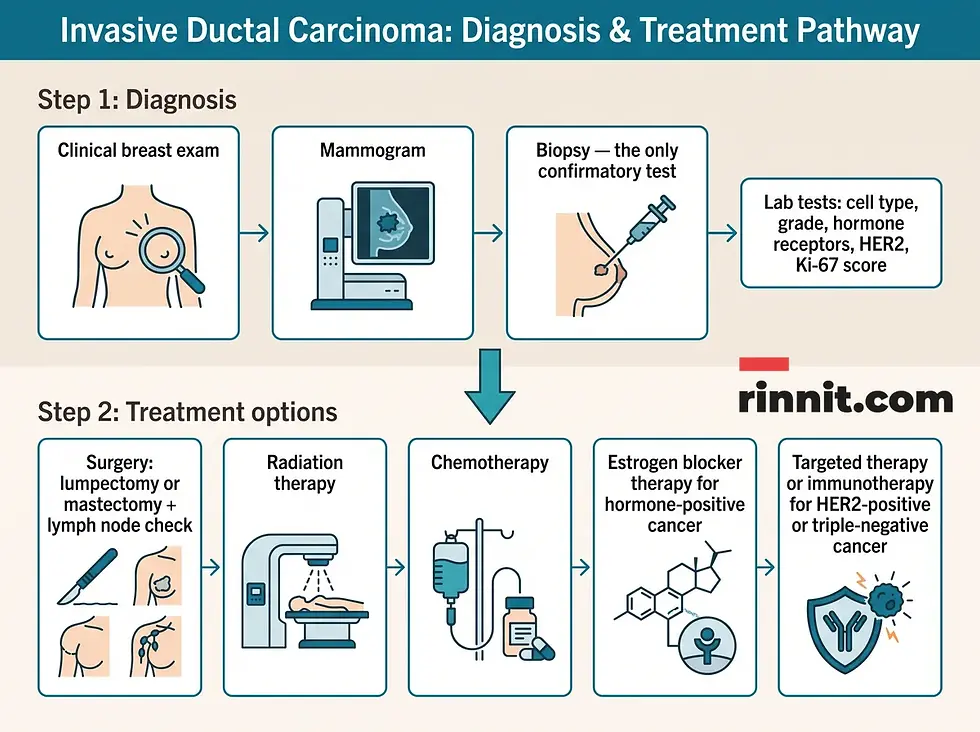
Diagnosis may begin with an exam and a discussion of symptoms, or sometimes with an imaging test such as a mammogram finding something concerning in a breast. [2] While many tests can spot something that may be cancer, a biopsy is the only test that can say whether you have invasive ductal carcinoma. [2]
A clinical breast exam involves looking at the breasts for anything unusual — changes in the skin or nipple — and feeling the breasts, along the collarbones, and around the armpits for lumps. [2]
A mammogram is an X-ray of the breast tissue commonly used for screening. [2] If a screening mammogram finds something concerning, a more detailed diagnostic mammogram is used to look closely at the area, often in both breasts. [2] On a mammogram, IDC typically looks like a growth with irregular borders. [2]
A breast ultrasound uses sound waves to make pictures of structures inside the body and can show whether a lump is a solid mass or a fluid-filled cyst. [2] IDC typically looks like a dark spot with an irregular border, sometimes with thin lines extending from its edge. [2]
A breast MRI uses a magnetic field and radio waves for more-detailed pictures, often after a contrast material injection. [2] It may be used to look closely for other areas of cancer in the affected breast or in the other breast. [2]
A breast biopsy uses a needle guided by imaging (X-ray, ultrasound, or another type) to remove a sample of tissue, which is analyzed by pathologists. [2] A small metal marker may be placed at the biopsy site to mark the area on future imaging. [2]
What the Lab Tests Show
Pathology result | What it tells the care team |
Cell type | Whether the cancer cells are ductal, lobular, or another kind (IDC contains ductal cells) [2] |
Cell grade | How the cells look under a microscope; predicts whether the cancer grows slowly or quickly [2] |
Hormone receptor status | Whether the cells have receptors for estrogen and/or progesterone (HR positive) or not (HR negative) [2] |
HER2 status | Whether the cells have extra copies of the HER2 gene or extra HER2 protein (HER2 positive) [2] |
Ki-67 score | How fast the cancer cells divide, from 0% to 100%; a higher score suggests faster growth [2] |
The team uses these results to decide the cancer's stage, understand the prognosis, and make a treatment plan. [2]
Cancer Grade Explained
Grades go from 1 to 3 and describe how different the cancer cells look from healthy cells. [2] Grade 1 (low grade, “well-differentiated”) means the cells look similar to healthy cells and typically grow slowly with a low risk of spreading. [2] Grade 2 (intermediate, “moderately differentiated”) means cells look a little different and grow more quickly with a higher risk of spreading. [2] Grade 3 (high grade, “poorly differentiated”) means cells look very different and the cancer is fast-growing with the highest risk of spreading. [2] High-grade cancers are more likely to spread and may need more intense treatment. [2]
Staging Tests
Once IDC is diagnosed, other tests may determine the cancer's stage — its extent. Breast cancer stages range from 0 to 4, with lower numbers meaning the cancer is less advanced and more likely to be cured. [2] Complete stage information may not be available until after breast cancer surgery. [2] Staging tests may include blood tests (complete blood count, kidney and liver function), a bone scan, CT scan, MRI, and PET scan. [2] Not everyone needs all of these; the team picks the right tests for your situation. [2]
How Are Invasive Ductal Carcinomas Treated?
IDC treatment often involves surgery to remove the cancer, plus one or more of the following: radiation therapy, chemotherapy, estrogen blocker therapy, targeted therapy, and immunotherapy. [2] Most people have more than one treatment. [2] There are no treatments specific to IDC — options depend on the cancer's stage, hormone receptor status, and HER2 status. [2]
For most people with stage 1 or 2 IDC, surgery is the first treatment [2], often followed by radiation, chemotherapy, or estrogen blocker therapy. These additional treatments kill any cancer cells left after surgery and lower the risk that the cancer comes back. [2]
Sometimes treatment starts with medicines — usually for stage 3 IDC that has grown large or spread to the lymph nodes. [2] Using medicine first may shrink the cancer so surgery is possible or less invasive, and it shows the care team how the cancer responds. That response informs the prognosis and next steps. [2]
For stage 4 IDC that has spread to other parts of the body, treatment uses medicines. [2] Surgery usually isn't used to remove the cancer in the breast once it has spread. [2]
You don't have to sort through the many options alone. Your healthcare team can explain them and help you choose a plan that fits your needs and goals. Consider a second opinion from a breast specialist, and many people find it helpful to talk with breast cancer survivors who have faced similar decisions.
Breast Cancer Surgery
The main surgical procedures include lumpectomy, mastectomy, and lymph node surgery.
A lumpectomy removes the cancer and some of the healthy tissue around it, allowing you to keep most of your breast. [2] It's also called breast-conserving surgery or wide local excision, and most people have radiation therapy afterward. [2] [5] A mastectomy removes all breast tissue from a breast; a total (simple) mastectomy removes the breast including the lobules, ducts, fatty tissue, and some skin, including the nipple and areola. [2] Other versions, such as skin-sparing or nipple-sparing mastectomy, leave some parts in place. [2] Lymph node surgery checks the nearby underarm nodes, since breast cancer spreads most often to the lymph nodes under the arm — a sentinel node biopsy removes some nodes for testing, while an axillary lymph node dissection removes most of them. [2]
For early-stage IDC, lumpectomy followed by radiation has the same survival rate as mastectomy. [2] The type of cancer doesn't decide the procedure — your personal preferences and the details of your cancer do. [2] Lumpectomy is preferred for small cancers when you're willing to have radiation and there is only one small area of cancer. [2] Mastectomy is preferred for larger cancers, multiple areas, or people who don't want or can't have radiation. [2]
Breast reconstruction — restoring the breast's shape with an implant or your own tissue — is optional and can be done at the time of mastectomy or later. [2] Consider asking for a plastic surgeon referral before your breast cancer surgery. [2]
Radiation, Chemotherapy, and Other Treatments
Radiation therapy uses powerful energy beams (X-rays, protons, or other sources) precisely aimed at the cancer. [2] In external beam radiation, you lie on a table while a machine moves around you. [2] It's often used after surgery to kill leftover cells and lower the risk of the cancer returning. [2]
Chemotherapy treats cancer with strong medicines, often in combination. [2] Most are given through a vein and some come in pill form. [2] It's often used after surgery to kill remaining cells and lower recurrence risk [2], and sometimes before surgery to shrink the cancer. When cancer spreads, chemotherapy can help control it and relieve symptoms such as pain. [2]
Estrogen blocker therapy (also called endocrine therapy or hormone therapy for breast cancer) treats hormone-sensitive cancers — and most breast cancers, including most IDCs, are hormone sensitive. [2] Options include selective estrogen receptor modulators (blocking or destroying hormone receptors), aromatase inhibitors (lowering hormone production), and surgery or medicines to stop the ovaries from making hormones. [2] It's often used after surgery to lower recurrence risk and can help control cancer that has spread. [2]
Targeted therapy uses medicines that attack specific chemicals in the cancer cells, causing them to die. [2] Some target the extra HER2 in HER2-positive cancers; others attack other proteins that help cancer cells grow. [2] These medicines may be used before surgery to shrink the cancer, after surgery to lower recurrence risk, or only when the cancer has spread. [2]
Immunotherapy is medicine that helps the body's immune system find and kill cancer cells that hide from it. [2] It may be an option for triple-negative IDC and can be used before and after surgery. [2]
Conclusion and Next Steps
Invasive ductal carcinoma is the most common type of breast cancer, and it carries a hopeful message hidden in that fact: because it is so common, it is also among the best-studied and most treatable cancers. It's usually found early — often on routine screening before symptoms appear — and it responds to a wide range of treatments, from surgery and radiation to hormone blockers, targeted therapies, and immunotherapy.
If you've found a breast lump or noticed a change, the single most important step is to get it checked promptly. Many lumps turn out to be harmless, and even when the diagnosis is cancer, today's treatment options are broader and more personalized than ever. Many people with IDC are cured, and for those whose cancer can't be cured, treatments can control it and help them live longer. [1]
FAQ
What is the difference between invasive ductal carcinoma and DCIS? DCIS (ductal carcinoma in situ) means abnormal cells formed inside a milk duct but haven't grown outside of it — it's noninvasive. [1] IDC means the cells have broken through the duct wall and grown into surrounding breast tissue, where they can spread. [1]
What are the first signs of invasive ductal carcinoma? IDC often causes no symptoms early and is found on a mammogram first. [1] When signs appear, they include a breast lump or thickened area, a flattened or inward-turning nipple, skin color changes, dimpled or orange-peel skin, flaking or crusting skin, and changes in breast size or shape. [1]
Is invasive ductal carcinoma the most common breast cancer? Yes. Most breast cancers are invasive ductal carcinomas. [1] It's also called infiltrating ductal carcinoma, and it's more likely than the other main type (invasive lobular carcinoma) to form a lump you can feel. [1]
How is invasive ductal carcinoma treated? Treatment usually starts with surgery — a lumpectomy or mastectomy, often with lymph node surgery — and may be followed by radiation, chemotherapy, estrogen blocker therapy, targeted therapy, or immunotherapy, depending on the stage, hormone receptor status, and HER2 status. [2]
Can invasive ductal carcinoma be cured? Many people with IDC are cured. [1] Treatment options continue to expand, and care is tailored to each person's situation. When a cure isn't possible, treatments can help control the cancer and extend life. [1]
Trusted External Resources
Related Reading
Mastectomy: Types, Surgery, Recovery and Reconstruction explains when a mastectomy is chosen over a lumpectomy, the main types and what recovery involves.
Breast Biopsy: Types, What to Expect, Recovery and Results explains the procedure used to confirm or rule out breast cancer.
References
Mayo Clinic Staff. Invasive ductal carcinoma (IDC) - Symptoms and causes. Mayo Clinic. June 9, 2026. https://www.mayoclinic.org/diseases-conditions/invasive-ductal-carcinoma/symptoms-causes/syc-20602075
Mayo Clinic Staff. Invasive ductal carcinoma (IDC) - Diagnosis and treatment. Mayo Clinic. June 9, 2026. https://www.mayoclinic.org/diseases-conditions/invasive-ductal-carcinoma/diagnosis-treatment/drc-20602113
National Cancer Institute. Cancer Stat Facts: Female Breast Cancer. Surveillance, Epidemiology, and End Results Program. Accessed October 15, 2026. https://seer.cancer.gov/statfacts/html/breast.html
American Cancer Society. Breast Cancer Facts & Figures. American Cancer Society. Accessed October 15, 2026. https://www.cancer.org/research/cancer-facts-statistics/breast-cancer-facts-figures.html
Radiological Society of North America and American College of Radiology. Breast Cancer: Imaging Tests and Treatment. RadiologyInfo.org. Last reviewed April 22, 2024. https://www.radiologyinfo.org/en/info/breast-cancer
National Comprehensive Cancer Network. NCCN Clinical Practice Guidelines in Oncology: Breast Cancer Risk Reduction. NCCN. NCCN Guidelines Version 1.2027. https://www.nccn.org/guidelines/guidelines-detail?id=1420
Myers ER, Moorman P, Gierisch JM, et al. Benefits and Harms of Breast Cancer Screening: A Systematic Review. JAMA. 2015;314(15):1615-34. PMID 26501537. https://doi.org/10.1001/jama.2015.13183
Jun S, Park H, Kim UJ, et al. Cancer risk based on alcohol consumption levels: a comprehensive systematic review and meta-analysis. Epidemiol Health. 2023;45:e2023092. PMID 37905315. https://doi.org/10.4178/epih.e2023092
Early Breast Cancer Trialists' Collaborative Group (EBCTCG). Long-term outcomes for neoadjuvant versus adjuvant chemotherapy in early breast cancer: meta-analysis of individual patient data from ten randomised trials. Lancet Oncol. 2018;19(1):27-39. PMID 29242041. https://doi.org/10.1016/S1470-2045(17)30777-5



Comments