Neoadjuvant Therapy: Types, Uses and Benefits

Updated: 2 days ago
Written and medically reviewed by Dr. Baraa Alnahhal, MD · Last reviewed: November 2026 · How we review
Quick Answer
Neoadjuvant therapy is cancer treatment given before surgery to shrink a tumor so it's easier to remove, and sometimes to eliminate it so surgery isn't needed. It may be chemotherapy, hormone therapy, immunotherapy, radiation or a combination. It's used for more than a dozen cancers, including breast, rectal and lung cancer.
What the research says
Adding immunotherapy before surgery helped more breast cancers disappear: in the KEYNOTE-522 trial in early triple-negative breast cancer, adding pembrolizumab to chemotherapy before surgery raised the rate of no remaining cancer at surgery to 64.8% versus 51.2% with chemotherapy alone (Schmid P et al., New England Journal of Medicine, 2020) [2]
Total neoadjuvant therapy cut rectal cancer treatment failure: in the RAPIDO trial of 912 people with high-risk rectal cancer, short-course radiation then chemotherapy before surgery lowered 3-year disease-related treatment failure to 23.7% versus 30.4% with standard chemoradiation (Bahadoer RR et al., Lancet Oncology, 2021) [3]
Key takeaways
Neoadjuvant therapy is cancer treatment before surgery.
It shrinks tumors so surgery is smaller or unnecessary.
It can be chemo, hormone therapy, immunotherapy or radiation.
It shows whether a treatment is working.
It's not an option for every cancer.
What is neoadjuvant therapy?
It's the opposite timing of adjuvant therapy, which follows surgery. Some people get both. Neoadjuvant therapy may also lower the risk of tiny cancer spread (micrometastases) and recurrence. Sources: [1]
Types of neoadjuvant therapy
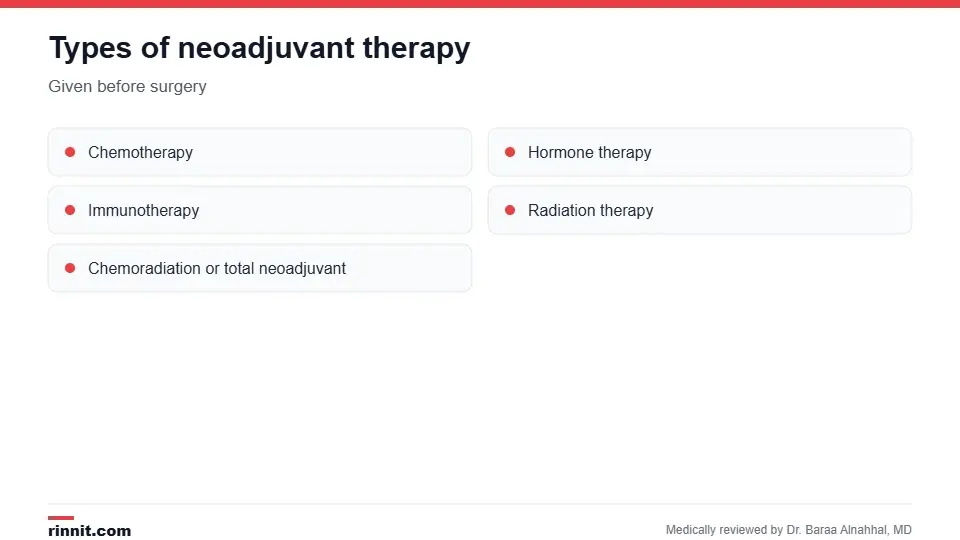
Your oncologist chooses based on your cancer.
Immunotherapy, including monoclonal antibodies.
Combinations, such as chemoradiation or total neoadjuvant therapy for rectal cancer. Sources: [1]
Cancers it treats
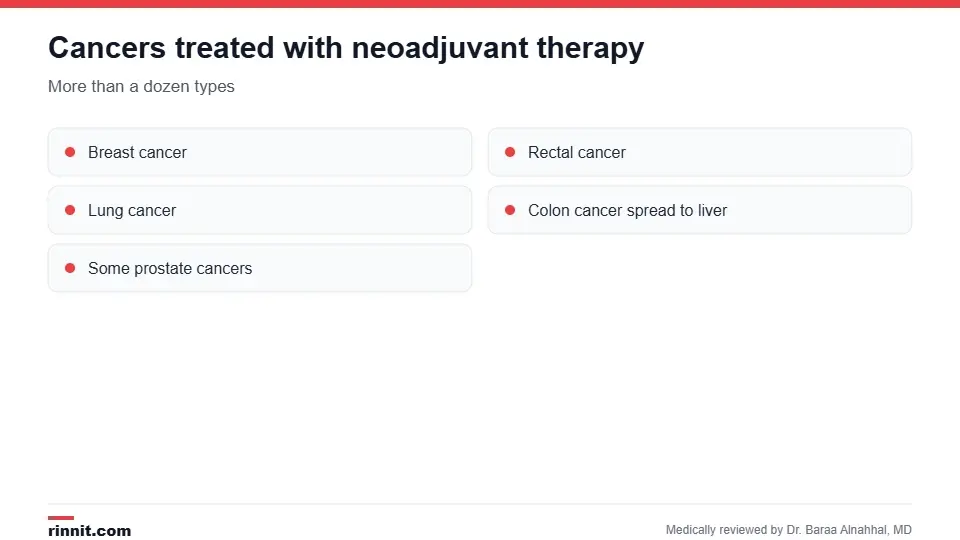
It's used for more than a dozen kinds of cancer.
Cancer | Common neoadjuvant approach |
Breast (inflammatory, ER-positive, HER2-positive, triple-negative) | Chemotherapy, hormone therapy or immunotherapy |
Colon cancer spread to the liver | Chemotherapy |
Non-small cell lung cancer | Chemotherapy or chemoradiation |
Some metastatic prostate cancers | Hormone therapy, sometimes with radiation |
Rectal cancer | Radiation plus chemotherapy |
Sources: [1, 2, 3]
Benefits

It isn't an option for every cancer.
It may allow a lumpectomy instead of a mastectomy.
It may eliminate small tumors so surgery isn't needed.
Smaller incisions and possibly an easier recovery.
It shows whether a treatment works.
It may lower the risk of cancer spread and recurrence. Sources: [1]
How long it lasts
Treatment may last weeks, months or up to a year. Most people have surgery within a month after finishing. Adjuvant therapy may follow surgery. Sources: [1]
Side effects
Loss of appetite.
Diarrhea.
Fatigue.
Loss of taste.
Nausea and vomiting. Sources: [1]
Side effects depend on the treatment. Palliative care can help ease them. Sources: [1]
Outlook
The outlook is generally good. Research shows neoadjuvant therapy can lower the chance of needing surgery and, when surgery is needed, raise the chance that surgery plus adjuvant therapy leads to remission. Sources: [1, 2, 3]
When to call your provider
Side effects that are worse than expected or that medicine doesn't control.
Body changes that could mean your cancer is getting worse. Sources: [1]
Conclusion
Neoadjuvant therapy treats cancer before surgery, often making the operation smaller and more effective. Ask your oncologist whether it fits your cancer type and stage.
Keep learning: read about adjuvant therapy and chemotherapy.
Frequently asked questions
What is neoadjuvant therapy?
Cancer treatment given before surgery.
How is it different from adjuvant therapy?
Adjuvant therapy is given after surgery.
What types are used?
Chemotherapy, hormone therapy, immunotherapy and radiation.
Which cancers use it?
Breast, rectal, lung, colon and some prostate cancers, among others.
Can it replace surgery?
Sometimes, if it eliminates small tumors.
Can it help me avoid a mastectomy?
It may allow a lumpectomy instead.
How long does it last?
From weeks to up to a year.
When is surgery after treatment?
Usually within a month.
What are common side effects?
Fatigue, nausea, diarrhea and appetite or taste changes.
Is it right for every cancer?
No. Your oncologist will decide.
Related Reading
Adjuvant Therapy: What It Is, Types and Why It's Used treatment after surgery.
Chemotherapy: How It Works, Side Effects, and What to Expect how chemotherapy works.
Radiation Therapy: Types, How It Works and Side Effects an overview of radiation.
Immunotherapy for Cancer: How It Works and What to Expect immune-based treatment.
Lumpectomy: Purpose, Procedure, Recovery and Risks breast-conserving surgery.
References
Cleveland Clinic. Neoadjuvant Therapy: Types, Uses & Benefits. Cleveland Clinic. Last updated January 8, 2025. https://my.clevelandclinic.org/health/treatments/neoadjuvant-therapy
Schmid P, Cortes J, Pusztai L, et al. Pembrolizumab for early triple-negative breast cancer. New England Journal of Medicine. 2020;382(9):810-821. PMID 32101663. https://doi.org/10.1056/NEJMoa1910549
Bahadoer RR, Dijkstra EA, van Etten B, et al. Short-course radiotherapy followed by chemotherapy before total mesorectal excision (TME) versus preoperative chemoradiotherapy, TME, and optional adjuvant chemotherapy in locally advanced rectal cancer (RAPIDO): a randomised, open-label, phase 3 trial. Lancet Oncology. 2021;22(1):29-42. PMID 33301740. https://doi.org/10.1016/S1470-2045(20)30555-6
Medical disclaimer
This article is for general education only and does not replace advice from a qualified healthcare professional. Talk to your doctor about your own diagnosis and treatment, and seek emergency care right away for severe or sudden symptoms.



Comments