Adjuvant Therapy: What It Is, Types and Why It's Used

Updated: 2 days ago
Written and medically reviewed by Dr. Baraa Alnahhal, MD · Last reviewed: November 2026 · How we review
Quick Answer
Adjuvant therapy is cancer treatment given after surgery to destroy tiny cancer cells the surgery may have missed. It can lower the risk that cancer comes back or spreads and may help people live longer. It can include chemotherapy, hormone therapy, immunotherapy, targeted therapy or radiation therapy. It's common for breast, colorectal, non-small cell lung cancer and melanoma.
What the research says
Adjuvant targeted therapy improved lung cancer survival: in a trial of 682 people with surgically removed EGFR-mutated lung cancer, 5-year survival was 88% with adjuvant osimertinib versus 78% with placebo (Tsuboi M et al., New England Journal of Medicine, 2023) [2]
Adjuvant immunotherapy improved kidney cancer survival: in a trial of 994 people after kidney cancer surgery, about a year of adjuvant pembrolizumab raised 4-year survival to 91.2% versus 86.0% with placebo (Choueiri TK et al., New England Journal of Medicine, 2024) [3]
Key takeaways
Adjuvant therapy is given after cancer surgery.
It targets cancer cells too small to see.
It can lower the chance cancer comes back.
Types include chemo, hormone therapy, immunotherapy, targeted therapy and radiation.
The choice depends on your cancer's stage, grade and features.
What is adjuvant therapy?
Adjuvant therapy follows surgery that removed a tumor. It's different from neoadjuvant therapy, which is given before surgery to shrink a tumor. Adjuvant therapy targets microscopic cells left behind. Sources: [1]
Why it's recommended

It may be recommended even after the tumor is removed.
Stage: large tumors and cancer in lymph nodes are more likely to spread.
Grade: higher-grade cells look more abnormal and are more aggressive.
Cell features: some genetic mutations, biomarkers and proteins signal a higher risk of recurrence. Sources: [1]
Types of adjuvant therapy

Your care team chooses based on your cancer.
Type | How it works | Cancers it's used for |
Kills cancer cells | Breast, colorectal, lung, melanoma | |
Stops hormones that fuel cancer growth | Breast | |
Helps the immune system destroy cancer cells | Breast, colorectal, lung, melanoma | |
Blocks proteins that help cancer grow | Breast, lung, melanoma | |
Radiation therapy | Targets the area where cancer started | Breast, lung |
Sources: [1]
Getting support during treatment
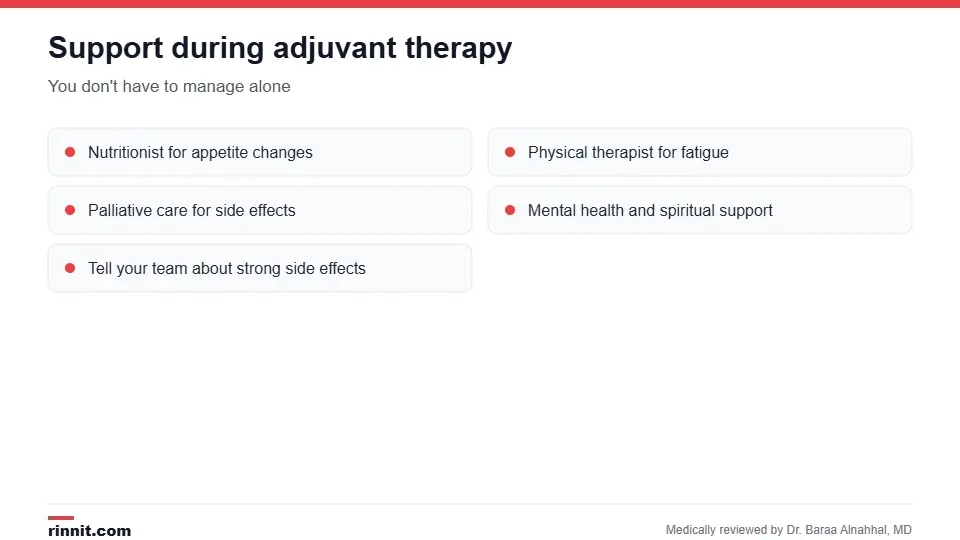
Tell your team if side effects are stronger than expected.
A nutritionist can help with appetite changes.
A physical therapist can guide gentle exercise for fatigue and stress.
Palliative care helps manage side effects and connects you with mental health, community and spiritual support. Sources: [1]
Side effects
Side effects depend on the treatment. They can include appetite changes, fatigue and stress, and may be stronger than expected. Learning that cancer could return can also be frustrating. Sources: [1]
Outlook
Research shows adjuvant therapy may keep cancer from coming back, though results vary by cancer type, stage and medicine. In one study, half of people with stage III melanoma were cancer-free seven years after adjuvant therapy. Immunotherapy is an effective adjuvant treatment for non-small cell lung cancer. Sources: [1, 2, 3]
When to call your care team
Contact your cancer care team if side effects are stronger than expected or you need help managing them. Sources: [1]
Conclusion
Adjuvant therapy helps clear away hidden cancer cells after surgery and lowers the chance of recurrence. Ask your care team why it's recommended for you and which support services can help you through it.
Keep learning: read about immunotherapy and targeted therapy.
Frequently asked questions
What is adjuvant therapy?
Cancer treatment given after surgery to destroy remaining cancer cells.
Why is it called helper therapy?
It helps surgery by targeting cells the surgery may have missed.
What types are there?
Chemotherapy, hormone, immune, targeted and radiation therapy.
Which cancers use adjuvant therapy?
Commonly breast, colorectal, lung cancer and melanoma.
Why would I need it if the tumor is gone?
Tiny cancer cells may remain and cause cancer to come back.
How do doctors decide?
Based on the cancer's stage, grade and genetic features.
What's the difference from neoadjuvant therapy?
Neoadjuvant therapy is given before surgery.
What are the side effects?
They depend on the treatment and may include fatigue and appetite changes.
Does it work?
Research shows it may keep cancer from coming back.
Who can help with side effects?
Nutritionists, physical therapists and palliative care teams.
Related Reading
Neoadjuvant Therapy: Types, Uses and Benefits explains neoadjuvant cancer therapy.
Chemotherapy: How It Works, Side Effects, and What to Expect how chemotherapy works.
Immunotherapy for Cancer: How It Works and What to Expect immune-based cancer treatment.
Targeted Therapy for Cancer: How It Works, Types, Side Effects and Outlook drugs that target cancer proteins.
Hormone Therapy for Cancer: How It Works, Types and Side Effects hormone-blocking cancer treatment.
Non-Small Cell Lung Cancer: Understanding Symptoms, Types, and Treatments a cancer often treated with adjuvant therapy.
References
Cleveland Clinic. Adjuvant Therapy: Purpose & Types. Cleveland Clinic. Last updated May 13, 2026. https://my.clevelandclinic.org/health/treatments/22483-adjuvant-therapy
Tsuboi M, Herbst RS, John T, et al. Overall survival with osimertinib in resected EGFR-mutated NSCLC. N Engl J Med. 2023;389(2):137-147. PMID 37272535. https://doi.org/10.1056/NEJMoa2304594
Choueiri TK, Tomczak P, Park SH, et al. Overall survival with adjuvant pembrolizumab in renal-cell carcinoma. N Engl J Med. 2024;390(15):1359-1371. PMID 38631003. https://doi.org/10.1056/NEJMoa2312695
Medical disclaimer
This article is for general education only and does not replace advice from a qualified healthcare professional. Talk to your doctor about your own diagnosis and treatment, and seek emergency care right away for severe or sudden symptoms.



Comments