Targeted Therapy for Cancer: How It Works, Types, Side Effects and Outlook

Updated: 4 days ago
Written and medically reviewed by Dr. Baraa Alnahhal, MD · Last reviewed: November 2026 · How we review
Quick Answer: What is targeted therapy?
Targeted therapy is a cancer treatment that aims at the genetic changes, or mutations, that turn healthy cells into cancer cells, while trying to spare healthy cells. It is used most often for breast, lung and prostate cancer, is given as a pill, shot or IV, and can cause side effects such as diarrhea, rash and high blood pressure. [1]
What the research says
Matching the drug to the tumor's marker works better. A review of 570 phase II studies with 32,149 patients found that biomarker-matched (personalized) treatment had a median response rate of 31% versus 10.5% without matching, and longer median survival (13.7 vs 8.9 months). (Schwaederle et al., J Clin Oncol, 2015) [6]
The right target matters in lung cancer. Across 23 trials and 14,570 people with advanced non-small cell lung cancer, EGFR-blocking pills used as a first treatment slowed cancer growth in people whose tumors carried an EGFR mutation (hazard ratio 0.43 for progression), but not in people without it (hazard ratio 1.06). (Lee et al., J Natl Cancer Inst, 2013) [7]
A targeted antibody improves survival in HER2-positive breast cancer, with a heart trade-off. In 8 trials with 11,991 women, trastuzumab-based treatment improved overall survival (hazard ratio 0.66) but raised the risk of congestive heart failure (risk ratio 5.11). (Moja et al., Cochrane Database Syst Rev, 2012) [8]
Targeted therapy works best when the tumor has the target: in a trial of 1,217 people with advanced lung adenocarcinoma, the EGFR-blocking pill gefitinib kept cancer in check longer than chemotherapy in the 261 people whose tumors had an EGFR mutation, but chemotherapy did better in the 176 people without the mutation (Mok TS et al., New England Journal of Medicine, 2009) [9]
Some targeted drugs work for many years: in a long-term trial of imatinib for chronic myeloid leukemia, about 83% of people were alive 10 years after starting treatment, and serious side effects linked to the drug were uncommon (Hochhaus A et al., New England Journal of Medicine, 2017) [10]
Key takeaways
Targeted therapy goes after the specific changes that make cancer cells grow. [1]
Doctors may also call it a form of precision medicine. [1]
More than 100 targeted therapy drugs exist. [1]
It is given as a pill, a shot or through an IV, on a daily, weekly or monthly schedule. [1]
You may be a candidate only if a targeted drug exists for your type of cancer. [1]
Side effects are real and need regular monitoring with blood tests and scans. [1]
How does targeted therapy work?
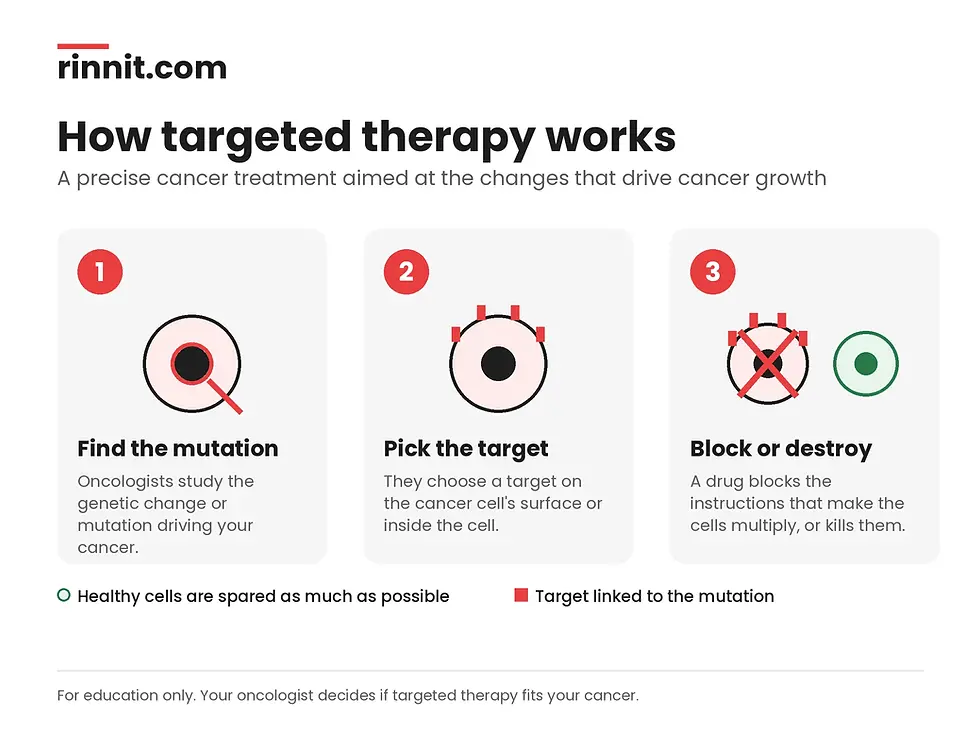
Targeted therapy works by aiming a drug at the genetic change, or mutation, that drives a person's cancer, so the drug can kill cancer cells or stop them from multiplying. [1]
The aim is to damage cancer cells while sparing healthy cells as much as possible. [1]
Your oncologist follows three steps: [1]
Find the driver. They research which mutation is fuelling your cancer.
Choose the target. They pick which part of the cancer cell to aim at, either on the cell's surface or inside the cell.
Use the drug. The drug may kill the cancer cells, or block the instructions that make them multiply.
For a wider view of every option, see our guide to cancer treatment types and how doctors choose.
What are the types of targeted therapy?
Targeted therapy comes in three main types: small-molecule drugs, immunotherapies and antibody-drug conjugates. [1]
Type | What it does |
Small-molecule drugs | Act on targets inside cancer cells and disrupt their growth [1] |
Immunotherapies | Include monoclonal antibodies, bispecific antibodies and CAR T-cell therapy [1] |
Antibody-drug conjugates | A third group your oncologist may use for some cancers [1] |

Which cancers can targeted therapy treat?
Targeted therapy is most commonly used to treat breast, lung and prostate cancer. [1]
It may also be used for many other cancers: [1]
Body area | Cancers |
Blood | Multiple myeloma, acute leukemia, non-Hodgkin lymphoma (about blood cancers) |
Bone and soft tissue | Some soft tissue sarcomas |
Digestive system | Colorectal (colon cancer) and esophageal cancer |
Female reproductive system | Cervical and endometrial cancer |
Head and neck | Laryngeal and nasopharyngeal cancer |
Skin | Melanoma and squamous cell carcinoma |
Thyroid | Anaplastic and medullary thyroid cancer |
Urinary system | Bladder and kidney cancer |
Who is a candidate for targeted therapy?
You may be a candidate for targeted therapy if a targeted drug exists for your type of cancer. [1]
That is why your oncologist first needs to know which mutation drives your cancer. Not everyone qualifies. [1]
How is targeted therapy given?
Targeted therapy is given as a pill, as a shot, or through an IV into a vein. [1]
What are the side effects of targeted therapy?
Targeted therapy can cause side effects that range from diarrhea and rash to blood clots and heart problems. [1]
Side effect | What to know |
Diarrhea | A common digestive side effect [1] |
Dry skin or rash | Skin changes are possible [1] |
High blood pressure (hypertension) | Your team checks blood pressure at visits [1] |
Blood clots | A serious possible effect [1] |
Bleeding in the stomach or intestines | May show as bright red blood or black, tarry stools [1] |
Elevated liver enzymes | Found on blood tests [1] |
Heart conditions | Includes arrhythmia (irregular heartbeat) and cardiotoxicity (heart damage) [1] |
Pulmonary fibrosis | Scarring of the lungs [1] |
Loss of hair color | Hair may lose its pigment [1] |
Slow-healing wounds | Cuts and wounds may take longer to heal [1] |
Your oncologist weighs these side effects before recommending treatment, explains how they may affect you, and discusses medicines or other steps to prevent or ease them, such as palliative care. [1]

Is targeted therapy better than chemotherapy?
Targeted therapy can be more selective than chemotherapy in destroying cancer cells, but it is not automatically better, and not everyone qualifies for it. [1]
Targeted therapy | Chemotherapy | |
Aim | Specific mutations or targets in cancer cells [1] | Fast-growing cells in general (how chemo works) |
Who can get it | Only people whose cancer has a matching drug [1] | Many cancer types |
Still effective? | Yes, when a target exists [1] | Yes — chemotherapy remains effective [1] |
Used together? | Sometimes the combination works better than either alone [1] | Same [1] |
Learn more about the drugs on the other side of this comparison in our guide to chemotherapy drugs and their side effects.
How well does targeted therapy work?
Targeted therapy success rates vary widely depending on the type of cancer, its stage and your overall health. [1]
Ask your oncologist for figures specific to your cancer. They can explain what results to expect in your case. [1]
When should you call your oncologist during targeted therapy?
Call your oncologist promptly if a side effect is more serious than you were told to expect. [1]
Targeted therapy at a glance
Question | Answer |
What is it? | A cancer treatment aimed at the mutations that drive cancer [1] |
Also called | A form of precision medicine [1] |
Number of drugs | More than 100 [1] |
Main types | Small-molecule drugs, immunotherapies, antibody-drug conjugates [1] |
Most common uses | Breast, lung and prostate cancer [1] |
How given | Pill, shot or IV [1] |
How often | Daily, weekly or monthly [1] |
Monitoring | Blood tests, X-rays, CT scans and other tests [1] |
Conclusion
Targeted therapy is changing how cancer is treated. As researchers decode the genetic changes behind cancer, they can design more precise drugs. [1]
It is not right for everyone, and it has its own side effects. The best next step is a clear conversation with your oncologist about all of your options, including whether a targeted drug fits your cancer. [1]
Bring this page to your next appointment. Use the "at a glance" table and the side-effects list as your question checklist. For support during and after treatment, read our guide to cancer rehabilitation.
FAQ
What is targeted therapy?
Targeted therapy is a cancer treatment that aims at the genetic changes, or mutations, that turn healthy cells into cancer cells. It tries to destroy cancer cells while sparing healthy ones. [1]
Is targeted therapy the same as chemotherapy?
Targeted therapy is not the same as chemotherapy. Targeted therapy can be more selective in destroying cancer cells, while chemotherapy remains effective, and sometimes combining the two works better than either alone. [1]
Is targeted therapy a type of immunotherapy?
Targeted therapy includes some immunotherapies, such as monoclonal antibodies, bispecific antibodies and CAR T-cell therapy. Other types are small-molecule drugs and antibody-drug conjugates. [1]
How is targeted therapy given?
Targeted therapy is given as a pill, a shot or through an IV. Depending on the drug, it may be daily, weekly or monthly, for a set time or indefinitely. [1]
What are the side effects of targeted therapy?
Targeted therapy side effects can include diarrhea, dry skin or rash, high blood pressure, blood clots, elevated liver enzymes and heart conditions. Less common effects include pulmonary fibrosis, loss of hair color and slow-healing wounds. [1]
Who can get targeted therapy?
Targeted therapy is an option when a targeted drug exists for your type of cancer. Your oncologist checks the mutation driving your cancer to decide. [1]
How successful is targeted therapy?
Targeted therapy success rates vary widely by cancer type, stage and overall health. Your oncologist can give figures specific to your cancer. [1]
When should I call my doctor during targeted therapy?
Call your oncologist promptly if side effects are more serious than expected, such as bright red blood or black, tarry stools. Keep all regular check-ups. [1]
Why do I need a biomarker test before targeted therapy?
Targeted drugs only work when the tumor has the specific change they aim at. A biomarker test checks a tumor or blood sample for these changes so your oncologist can pick the right drug.
Can cancer stop responding to targeted therapy?
Yes. Cancer cells can change over time and become resistant to a targeted drug. If that happens, your oncologist may order new tests and switch you to a different treatment.
Related Reading
Antibody-Drug Conjugates (ADCs): How They Work and Side Effects explains antibody-drug conjugates for cancer.
Adjuvant Therapy: What It Is, Types and Why It's Used explains adjuvant cancer therapy.
Biomarker Testing for Cancer: What It Is, How It Works and What Results Mean explains how testing a tumor for gene changes and proteins helps match people with cancer to the treatments most likely to work.
References
Cleveland Clinic. Targeted Therapy for Cancer. Cleveland Clinic. Last updated April 14, 2025. https://my.clevelandclinic.org/health/treatments/22733-targeted-therapy
American Cancer Society. Targeted Therapy. American Cancer Society. Last revised June 2, 2025. https://www.cancer.org/cancer/treatment-types/targeted-therapy.html
National Cancer Institute. Targeted Therapy to Treat Cancer. National Cancer Institute. Updated May 31, 2022. https://www.cancer.gov/about-cancer/treatment/types/targeted-therapies
Choi HY, Chang JE. Targeted Therapy for Cancers: From Ongoing Clinical Trials to FDA-Approved Drugs. Int J Mol Sci. 2023;24(17):13618. PMID 37686423. https://doi.org/10.3390/ijms241713618
Karati D, Kumar D. A Comprehensive Review on Targeted Cancer Therapy: New Face of Treatment Approach. Curr Pharm Des. 2023;29(41):3282-3294. PMID 38038008. https://doi.org/10.2174/0113816128272203231121034814
Schwaederle M, Zhao M, Lee JJ, et al. Impact of Precision Medicine in Diverse Cancers: A Meta-Analysis of Phase II Clinical Trials. J Clin Oncol. 2015;33(32):3817-3825. PMID 26304871. https://doi.org/10.1200/JCO.2015.61.5997
Lee CK, Brown C, Gralla RJ, et al. Impact of EGFR inhibitor in non-small cell lung cancer on progression-free and overall survival: a meta-analysis. J Natl Cancer Inst. 2013;105(9):595-605. PMID 23594426. https://doi.org/10.1093/jnci/djt072
Moja L, Tagliabue L, Balduzzi S, et al. Trastuzumab containing regimens for early breast cancer. Cochrane Database Syst Rev. 2012;2012(4):CD006243. PMID 22513938. https://doi.org/10.1002/14651858.CD006243.pub2
Mok TS, Wu YL, Thongprasert S, et al. Gefitinib or carboplatin-paclitaxel in pulmonary adenocarcinoma. New England Journal of Medicine. 2009;361(10):947-957. PMID 19692680. https://doi.org/10.1056/NEJMoa0810699
Hochhaus A, Larson RA, Guilhot F, et al. Long-term outcomes of imatinib treatment for chronic myeloid leukemia. New England Journal of Medicine. 2017;376(10):917-927. PMID 28273028. https://doi.org/10.1056/NEJMoa1609324
Medical disclaimer
This article is for general education and does not replace advice from your doctor or oncologist. Treatment choices depend on your cancer type, stage, test results and overall health. If you have a medical emergency, contact your local emergency services right away.



Comments