Cancer Rehabilitation: What It Is, the 4 Stages, and How It Helps You Feel and Move Better

Updated: 6 days ago
Written and medically reviewed by Dr. Baraa Alnahhal, MD · Last reviewed: October 2026 · How we review
Quick Answer: What is cancer rehabilitation?
Cancer rehabilitation is supportive care that helps prevent, relieve and reduce the physical and mental effects of cancer and its treatment, before, during and after therapy. A tailored team that may include physical, occupational and speech therapists treats problems such as fatigue, weakness, pain, swelling, balance issues and brain fog. [1]
What the research says
Exercise before cancer surgery lowers complication risk. A 2026 meta-analysis of 55 randomized trials found that exercise-based prehabilitation reduced overall postoperative complications (risk ratio 0.82, about 18% fewer) and shortened hospital stays by roughly 0.8 days in people having cancer surgery. (Fernandez-Escabias et al., European Journal of Internal Medicine, 2026) [2]
Supervised physical rehabilitation eases fatigue during chemotherapy. Across 21 trials with 1,992 adults receiving cytotoxic cancer treatment, supervised physical therapy reduced general fatigue (standardized mean difference −0.69), with about one extra person helped for every three treated (NNT 3). Moderate-intensity programs gave the greatest relief. (Penna et al., Supportive Care in Cancer, 2023) [3]
Home exercise improves physical function after treatment. In 18 randomized trials with 1,720 breast cancer survivors, home-based walking and resistance training moderately improved physical function (effect size 0.49). Gains in quality of life were small and not statistically significant. (Kanda et al., Journal of Rural Medicine, 2026) [4]
Key takeaways
Cancer rehabilitation treats symptoms of cancer and side effects of its treatment, at any point in your care.
It has four stages: preventive (prehabilitation), restorative, supportive and palliative.
These rehab stages are about where you are in treatment, not how far the cancer has spread.
Your plan is built around your age, health, cancer type, treatments and daily life.
Some benefits, like easier breathing and less stress, can come quickly; strength and pain relief take regular practice.
What is cancer rehabilitation?
Cancer rehabilitation is a supportive service that aims to prevent, relieve and reduce symptoms at any point during cancer treatment. [1]
Any medical care for symptoms of cancer, or for side effects of cancer treatment, counts as cancer rehabilitation.
Your care team may call it by other names. Common ones are:
Physical therapy
Occupational therapy
Speech therapy
Cancer rehab is tailored to your body and your needs. For example, you might want to:
Improve your heart and blood vessel health before treatment starts.
Get your energy back so you can handle family responsibilities.
Rebuild muscle strength so you can move around your home safely.
Work on remembering things and finding the right words.
How is cancer rehabilitation different from cancer survivorship care?
Cancer rehabilitation is one part of cancer survivorship care, focused on relieving physical discomfort and improving physical function. [1]
Survivorship care is the bigger umbrella. It helps you manage both the emotional and the physical changes that come with the cancer experience.
Cancer rehabilitation | Cancer survivorship care | |
Main focus | Physical discomfort and physical function | Emotional and physical changes across the whole cancer experience |
Relationship | One part of survivorship care | The wider care plan that includes rehab |
What symptoms can cancer rehabilitation help with?
Cancer rehabilitation can help you prepare for treatment and can ease a wide range of symptoms during and after treatment, from fatigue and pain to brain fog and mood changes. [1]

Area of life | Problems cancer rehab can address |
Movement | Balance problems, muscle weakness |
Energy | Fatigue |
Eating | |
Bowel and bladder | Bowel incontinence, constipation, bladder leakage |
Nerves | Tingling or numbness from peripheral neuropathy |
Comfort | Pain |
Swelling | Swelling and discomfort from lymphedema |
Sexual health | Sexual dysfunction |
Thinking | Slower or less clear thinking (brain fog or "chemo brain") |
Mood | Mood disorders, anxiety, panic attacks |
Does the type of cancer affect a cancer rehabilitation plan?
Yes, the type of cancer shapes a cancer rehabilitation plan, along with several other personal factors. [1]
Your team builds the program around your:
Age and any other health conditions
Cancer type
Cancer treatments
Usual activities and lifestyle
Example: After breast cancer surgery, rehab may include lymphatic drainage massage to relieve swelling in the arms and chest.
What are the four stages of cancer rehabilitation?
The four stages of cancer rehabilitation are preventive rehabilitation (prehabilitation), restorative rehabilitation, supportive rehabilitation and palliative rehabilitation. [1]
These stages are not the same as the cancer stage your oncologist gives you at diagnosis. They do not describe how far the cancer has spread. They describe where you are in diagnosis and treatment.

Cancer rehabilitation stages at a glance
Stage | When it happens | Main goal | Examples |
Preventive (prehabilitation) | Before treatment starts | Get in the best shape possible and help prevent some treatment-related problems | Stopping alcohol, drug or tobacco use; talk therapy; balance and strength exercises; nutrition support |
Restorative | During treatment | Reduce treatment side effects | Physical therapy after surgery, walkers or canes, gentle exercise, breathing exercises, nutrition, yoga, massage, acupuncture |
Supportive | After treatment ends | Manage lingering weakness and fog; learn new ways to do daily tasks | Strength, flexibility and balance exercise; speech, occupational and recreational therapy; cognitive rehab |
Palliative | When the cancer is not responding to treatment | Keep you comfortable and ease things for caregivers | Gentle movement, heat therapy, relaxation techniques |
What happens in preventive rehabilitation (prehabilitation)?
Preventive rehabilitation, or prehabilitation, prepares your body before treatment so you start in the best possible shape. [1]
Your providers first learn how your body normally feels and works. They use that baseline to design a plan that may help prevent some treatment-related symptoms and complications.
Prehabilitation may include:
Help to stop drinking alcohol, misusing drugs, or smoking cigarettes or marijuana.
Talk therapy (psychotherapy) to help you understand and accept your diagnosis, manage anxiety and sleep well.
Physical therapy for balance to prevent falls, plus exercises to strengthen muscle groups before surgery.
Working with a nutrition professional to keep a weight that is healthy for you.
What happens in restorative rehabilitation?
Restorative rehabilitation takes place during cancer treatment to reduce side effects. [1]
It may include:
Physical therapy after surgery so you can move with confidence.
Mobility aids such as walkers or canes to keep you safe on your feet.
Gentle aerobic and strengthening exercise for fatigue, weakness and range of motion.
Respiratory therapy and breathing exercises.
Nutrition support to make sure you get enough calories.
Relaxation techniques such as yoga and massage.
Acupuncture.
What happens in supportive rehabilitation?
Supportive rehabilitation helps with effects that last after treatment ends, such as weakness, mental fog and trouble with daily tasks. [1]
You may continue therapies from the restorative stage, like physical therapy and nutrition. Depending on the cancer you had, you may also benefit from:
Exercise focused on strength, flexibility, motion and balance.
Speech therapy.
Recreational and occupational therapy.
Cognitive rehabilitation.
Learning about the lingering effects of cancer and treatment on body and mind.
What happens in palliative rehabilitation?
Palliative rehabilitation keeps you comfortable when your care team finds the cancer is not responding to treatment. [1]
It can work alongside other palliative care services. Specialists may use gentle movement, heat therapy and relaxation techniques to make daily life easier for you and for the people who care for you.
Who provides cancer rehabilitation services?
Cancer rehabilitation is provided by a team of specialists from different fields, chosen to match your symptoms and goals. [1]
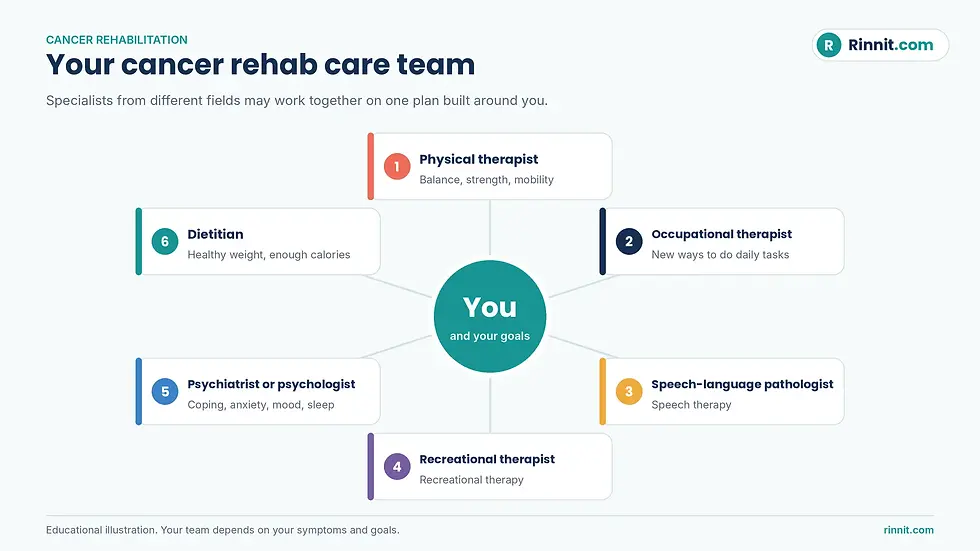
Team member | How they may help in cancer rehab |
Dietitian or nutrition counselor | Helps you keep a healthy weight and get enough calories |
Occupational therapist | Helps you find new ways to manage daily tasks |
Physical therapist | Works on balance, strength, mobility and moving safely after surgery |
Psychiatrist or psychologist | Offers talk therapy for coping, anxiety, mood and sleep |
Recreational therapist | Uses recreational therapy to support recovery |
Speech-language pathologist | Provides speech therapy |
What should you expect during cancer rehabilitation?
Cancer rehabilitation follows a simple process: you talk about your concerns, set measurable goals and work with your team to reach them. [1]
If you are in the hospital, you may get inpatient rehab. Otherwise, you may get outpatient care, such as joining an exercise program.
The three steps:
Talk with your healthcare provider about your physical concerns.
Set measurable goals.
Work with a team of providers to reach those goals.
Your role matters. Energy levels in people with cancer are often low or change from day to day, and pain and other symptoms can come and go. Try to do your exercises and activities as instructed, but if something hurts, don't do it. Keep telling your providers how you feel and how the program is affecting you.
When should you tell your care team about new symptoms during cancer rehabilitation?
You should tell your care team right away if new emotional or sleep problems appear during cancer rehabilitation. [1]
Let your provider know if you notice new:
Anxiety, depression, panic attacks or feelings of hopelessness
Problems with sleep
Get help now: If you have thoughts of hurting yourself, go to the nearest emergency room or contact local emergency services. In the U.S., you can call or text the 988 Suicide & Crisis Lifeline.
How long does cancer rehabilitation last?
Cancer rehabilitation can last for a short time or for the rest of your life, depending on your needs. [1]
How soon does cancer rehabilitation start to help?
Cancer rehabilitation can bring some quick changes, such as easier breathing and lower stress, while other gains take longer. [1]
Benefit | Typical timing |
Breathing and stress levels | You may notice a difference right away |
Strength and coordination | Builds over time with regular exercise |
Pain relief | Builds over time with regular exercise |
To get the most from your program, do your exercises regularly. Ask your provider what to expect from your specific plan.
Conclusion
Cancer treatment helps many people live long after diagnosis, but surgery, chemotherapy and radiation can leave pain, unsteadiness, fatigue and brain fog behind. Cancer rehabilitation helps you prepare for and manage these changes, with a plan built around you, so you can enjoy the best quality of life possible. [1]
Your next step: Save or print this guide and bring it to your next appointment. Ask your care team which stage of rehabilitation fits you now, and which specialists could help. For a deeper look at what to expect at a first rehab visit, see this overview of cancer rehabilitation. Then explore more plain-language cancer guides on Rinnit.com.
Frequently asked questions
What is cancer rehabilitation in simple terms?
Cancer rehabilitation is care that helps you feel, move and think better when cancer or its treatment causes problems such as fatigue, weakness, pain or brain fog. It can start before treatment and continue during and after it.
Is cancer rehabilitation the same as physical therapy?
Physical therapy is one type of cancer rehabilitation. Cancer rehab can also include occupational therapy, speech therapy, nutrition support, talk therapy and recreational therapy.
Can cancer rehabilitation start before treatment?
Yes. Preventive rehabilitation, called prehabilitation, starts before treatment. It aims to get you in the best possible shape and help prevent some treatment-related problems.
Do the four stages of cancer rehab mean my cancer has spread?
No. The four rehab stages describe where you are in diagnosis and treatment. They are different from the cancer stage your oncologist uses to describe how far the cancer has spread.
Is it normal to feel pain during rehab exercises?
If an exercise or activity hurts, stop and don't do it. Tell your providers how you feel so they can adjust your program.
How long will I need cancer rehabilitation?
It depends on your needs. Some people need rehab for a short time, and others need it for the rest of their lives.
Can cancer rehabilitation help with chemo brain?
Yes. Trouble thinking as clearly or quickly as before is one of the symptoms cancer rehab can address, and cognitive rehabilitation is one of the supportive-stage options.
Who is on a cancer rehabilitation team?
The team is chosen to fit your needs. It may include a rehabilitation doctor, physical and occupational therapists, a speech therapist, a dietitian and mental health professionals.
Can cancer rehabilitation help with fatigue?
Yes. Cancer rehabilitation can help you manage fatigue with gentle exercise, pacing and energy-saving strategies.
How do I get started with cancer rehabilitation?
Ask your oncologist or care team for a referral. You can ask at any point, including before treatment starts.
Related Reading
Chemo Brain: Complete Guide to Symptoms, Causes, and Coping Strategies explains memory and thinking changes after cancer treatment and what helps.
Physical Therapy: Enhancing Mobility, Strength, and Recovery explains how physical therapy rebuilds strength and mobility.
Occupational Therapy: What It Is, Who Needs It, and What to Expect describes how occupational therapy helps with daily tasks and independence.
Cancer Treatment: Types, How Doctors Choose, and What to Expect covers the main cancer treatments and what to expect from each.
References
Cleveland Clinic. What Is Cancer Rehabilitation? Types, Purpose & Benefits. Cleveland Clinic. Last updated October 14, 2024. https://my.clevelandclinic.org/health/treatments/cancer-rehabilitation
Fernandez-Escabias M, Carrilho-Candeias S, Garcia-Sanchez C, et al. Exercise-based prehabilitation programs reduces hospital stay and postoperative complications in surgical patients with cancer: a systematic review and meta-analysis. European Journal of Internal Medicine. 2026. Epub ahead of print July 29, 2026. PMID: 42527160. https://doi.org/10.1016/j.ejim.2026.107104
Penna GB, Otto DM, da Silva TC, et al. Physical rehabilitation for the management of cancer-related fatigue during cytotoxic treatment: a systematic review with meta-analysis. Supportive Care in Cancer. 2023;31(2):129. PMID: 36683104. https://doi.org/10.1007/s00520-022-07549-7
Kanda K, Higuchi D, Sunaga M, et al. Home-based walking and resistance training interventions for breast cancer survivors: a systematic review. Journal of Rural Medicine. 2026;21(4):376-389. PMID: 42846212. https://doi.org/10.2185/jrm.2026-044
American Cancer Society. Cancer Rehabilitation (Rehab). Cancer.org. Last revised December 8, 2025. https://www.cancer.org/cancer/supportive-care/what-is-cancer-rehabilitation.html
Medical disclaimer
This article is for general education only and is not a substitute for professional medical advice, diagnosis or treatment. Always talk with your doctor or cancer care team about your own symptoms and treatment plan.



Comments