Dysphagia (Trouble Swallowing): Symptoms, Causes, Diagnosis & Treatment — Complete Guide

Updated: 3 days ago
Medically reviewed by Dr. Baraa Alnahhal, MD · Last reviewed: October 2026
Quick Answer
Dysphagia is the medical term for trouble swallowing, when food or liquid has difficulty moving from the mouth and throat to the stomach. Occasional trouble from eating too fast is usually not a concern, but ongoing dysphagia needs evaluation and treatment to prevent choking, poor nutrition and complications. It is more common in older adults.
What the research says
Swallowing disorders are linked to pneumonia after a stroke. A meta-analysis of 25 studies covering 4,251,064 patients (153,431 of whom developed stroke-associated pneumonia) identified swallowing disorders as one of 11 factors associated with pneumonia after ischemic stroke; the authors note the complication occurs in roughly 3.9% to 12% of cases. (Li et al., Clin Neurol Neurosurg, 2024) [3]
For achalasia, cutting the muscle outperformed balloon dilation at follow-up. A meta-analysis of 66 studies (6,268 patients) found clinical success with peroral endoscopic myotomy (POEM) beat pneumatic balloon dilation at 12 months (92.9% vs 76.9%) and at 36 months (88.4% vs 72.2%), though POEM carried a higher reflux risk (pooled odds ratio 2.95 by symptoms). (Ofosu et al., Endosc Int Open, 2021) [4]
Balloon dilation improved swallowing and cut aspiration pneumonia in one stroke-related swallowing problem. In a meta-analysis of 25 studies (1,134 patients) of cricopharyngeal achalasia after stroke, balloon dilatation raised the treatment effective rate versus routine rehabilitation training (odds ratio 6.11, 95% CI 4.16 to 8.98) and lowered aspiration pneumonia (odds ratio 0.46, 95% CI 0.21 to 0.98). (Wu & Jiang, Front Neurol, 2026) [5]
Dysphagia at a Glance
Category | Key Facts |
Definition | Medical term for trouble moving food or liquid from the mouth and throat to the stomach |
Who it affects | Can occur at any age; more common in older adults |
Two main types | Oropharyngeal (mouth/throat) and esophageal (esophagus) |
Top warning signs | Increased swallowing effort, pain, food stuck in throat or chest, coughing, weight loss |
Emergency signs | Difficulty breathing; food stuck in throat or chest that can't be swallowed |
Main complications | Malnutrition, dehydration, aspiration pneumonia, choking |
Common causes | Stroke and nerve conditions, achalasia, GERD scarring, esophageal spasm, tumors, radiation |
Diagnosis tools | Swallowing evaluation, barium swallow, endoscopy, manometry, CT/MRI scans |
Treatment options | Exercises, techniques, diet changes, dilation, medicines, Botox, surgery, feeding tube |
What Is Dysphagia?
Swallowing is a complex process involving many nerves and muscles working together. It moves food from the mouth, through the throat and esophagus (the tube to your stomach), and into the stomach itself. Several built-in safety mechanisms keep things flowing in the right direction.
The back of the roof of the mouth rises to prevent food from moving up into the nasal passages. A flap in the throat prevents food from entering the airway to your lungs. Two muscular rings called sphincters act as gatekeepers:
The upper esophageal sphincter sits at the top of the esophagus. It controls the flow of food from the throat into the esophagus, prevents air from entering your stomach, and prevents food from backing up into your throat.
The lower esophageal sphincter sits at the bottom. It controls the flow of food from the esophagus into the stomach and prevents stomach contents from backing up.
When dysphagia occurs, there are generally two explanations: damage to the nerves or muscles limits your ability to swallow, or a physical structure or object limits the passage of food.

Dysphagia Symptoms: 10 Warning Signs
Dysphagia can appear in several ways. The most common signs include:
# | Warning Sign | What It Looks Like |
1 | Increased effort | Needing noticeably more effort to swallow food |
2 | Pain with swallowing | Pain or discomfort every time you swallow |
3 | Inability to swallow | Not being able to swallow at all |
4 | Food stuck | Feeling as if food is stuck in your throat or chest |
5 | Drooling | Drooling or food spilling from the mouth |
6 | Backflow | Food or stomach acid backing up into the throat or nasal passage |
7 | Coughing or gagging | Coughing or gagging when swallowing |
8 | Frequent heartburn | Heartburn that keeps returning |
9 | Hoarse voice | A voice that sounds rougher or hoarse |
10 | Weight loss | Losing weight without trying |
When to See a Doctor
If you often have trouble swallowing, see a healthcare professional. Also seek care if weight loss, regurgitation, or vomiting accompanies your swallowing trouble.
Go to the emergency room right away if you cannot swallow because food feels stuck in your throat or chest, or if a blockage makes it hard to breathe. Call for emergency help immediately in breathing emergencies.
The Two Types of Dysphagia
Doctors divide dysphagia into two general types based on where the problem occurs. In esophageal dysphagia, narrowing of the esophagus is called a stricture, and poor movement of the esophagus is called a motility disorder — some people have more than one cause at once.
Type | Where the Problem Is | What Happens |
Oropharyngeal dysphagia (ohr-oh-fuh-RIN-jee-ul) | Mouth and throat, at the beginning of swallowing | You have trouble moving food from your mouth to your throat and into the esophagus |
Esophageal dysphagia (uh-sof-uh-JEE-ul) | The esophagus itself | Conditions narrow the esophagus or limit its ability to move food; often feels like food sticking in the base of the throat or chest |
Causes of Oropharyngeal Dysphagia
Five main conditions cause trouble at the start of swallowing:
Nervous system conditions. Multiple sclerosis, muscular dystrophy, and Parkinson's disease affect the nerves and muscles that control swallowing.
Nervous system damage. A stroke or an injury to the brain or spinal cord can damage the swallowing pathways.
Past treatments. Chemotherapy, surgery, or radiation treatment for cancer may damage the nerves and muscles used in swallowing.
Cancer. Tumors of the mouth or throat can limit the passage of food.
Zenker diverticulum. A small pouch where food particles collect in the throat can block food from entering the esophagus. It can also cause gurgling sounds, bad breath, and repeated throat clearing or coughing.
Causes of Esophageal Dysphagia
Nine conditions can narrow the esophagus or limit how it moves food:
Cause | What Happens |
Nervous system conditions | Parkinson's disease, stroke, or trauma damage the nerves, leading to poor muscle function in the esophagus |
Achalasia (ak-uh-LAY-zhuh) | A nerve condition affecting the wave of muscle activity that moves food down the esophagus. The lower esophageal sphincter does not open, stopping food from moving into the stomach. Symptoms gradually get worse |
Esophageal spasm | Changes in how the esophagus muscles contract and relax prevent food from moving through |
GERD (gastroesophageal reflux disease) | Frequent backflow of stomach acid damages the esophagus; scar tissue can narrow the passage |
Cancerous tumors | Tumors progressively narrow the esophagus; trouble swallowing food may worsen to include liquids |
Foreign bodies | A piece of food or an object partially blocks the throat or esophagus. Older adults with dentures and people who don't chew food well are more likely to get food stuck |
Esophageal ring (or web) | A ledge of tissue at the lower end of the esophagus narrows the passageway and may slow the passage of food into the stomach |
Eosinophilic esophagitis (e-o-sin-o-FILL-ik uh-sof-uh-JIE-tis) | An immune system condition; an increase in eosinophils (a type of white blood cell) causes inflammation that narrows the esophagus |
Radiation therapy | Cancer treatment can cause inflammation and scarring of the esophagus |
Who Is at Risk?
Four factors raise the chance of developing dysphagia:
Aging. Older adults face a higher risk of dysphagia and related conditions.
Certain health conditions. People with nervous system conditions such as stroke or Parkinson's disease are more likely to have swallowing trouble.
Cancer treatment. Radiation therapy or head and neck surgery increases the risk.
Long-term care. People in nursing homes or with long hospital stays are at high risk.
Complications: Why Dysphagia Shouldn't Be Ignored
Untreated dysphagia can lead to three serious complications:
Malnutrition, weight loss, and dehydration. If swallowing is difficult, you may struggle to take in enough food and fluids.
Aspiration pneumonia. Food or water can enter your lungs and introduce bacteria, causing a lung infection.
Choking. Food stuck in the throat can be life-threatening. If food completely blocks the airway, death can occur without immediate action.
Can Dysphagia Be Prevented?
There is no way to prevent dysphagia itself. However, you can reduce the risk of occasional swallowing trouble by eating slowly and chewing food well. If you develop symptoms, see a healthcare professional promptly, and if you have GERD, see a professional for treatment.
How Is Dysphagia Diagnosed?
Diagnosis starts with questions about your symptoms, medical history, and recent treatments, along with a questionnaire about how symptoms affect daily life. A thorough physical exam follows, with special attention to the head, neck, mouth, and throat. Because multiple specialists are usually involved, the tests vary depending on whether the problem is suspected in the throat or the esophagus.
The 8 Diagnostic Tests
Test | What It Involves |
Clinical swallowing evaluation | A speech-language specialist observes your swallowing behaviors while you swallow different foods and liquids, guiding further testing |
Barium swallow | You swallow a barium solution that is visible on X-rays; videofluoroscopy shows its passage and reveals tissue function, changes, and blockages |
Modified barium swallow (dynamic swallowing study) | Videofluoroscopy while you swallow barium solutions of different thicknesses and barium-coated foods, giving a real-time evaluation |
Endoscopy | A thin, flexible, lighted instrument with a video camera passes through the nose or mouth into the esophagus to view tissue changes or blockages; a biopsy can be taken and some blockages can be removed |
FEES (fiber-optic endoscopic evaluation of swallowing) | An endoscope passes through the nasal passage into the throat so the specialist can observe swallowing of different foods and liquids |
Manometry (muh-NOM-uh-tree) | A small tube placed into the esophagus connects to a pressure recorder that measures the strength and timing of muscle contractions during swallowing |
Imaging scans | CT or MRI scans of the neck and chest — CT uses X-rays and a computer for cross-sectional images; MRI uses a magnetic field and radio waves for detailed organ images |
Nuclear medicine motility scan (scintigraphy) | A tracer added to foods shows how different food consistencies travel from the mouth to the stomach |
Dysphagia Treatment: 7 Options
Treatment has three goals: improve swallowing function to ensure good nutrition and hydration, prevent airway blockage, and prevent food or liquids from entering the lungs.
1. Exercises
A specialist teaches exercises to improve the strength and coordination of your chewing, tongue, and swallowing muscles.
2. Swallowing Techniques
You learn how to place food in your mouth and how to position your body and head to help food swallow more easily.
3. Changes to Diet and Eating Habits
You may be referred for eating strategies that use a variety of textures or modified textures that are easier to swallow. Alternating bites of solids with sips of liquid and eating at a slower pace can also help.
4. Esophageal Dilation
Used for conditions that narrow the esophagus, dilation stretches it open. An endoscope with a small inflatable balloon at its tip is passed into the esophagus to expand it. Alternatively, a rigid tube can be passed through the mouth to stretch the esophagus. A stent may be placed to keep a narrowed esophagus open.
5. Medicines
Depending on the cause, treatment may include prescription drugs to reduce stomach acid (for GERD), corticosteroids and other drugs for esophageal inflammation, or muscle relaxants for muscle spasms in the esophagus.
6. Surgery
Surgery removes tumors, damaged tissue, or blockages. Other procedures cut the tissues of the lower esophagus or lower esophageal sphincter that limit food passage.
7. Botox Injections
Injections of onabotulinumtoxinA into tissue at the lower end of the esophagus relax the muscles there. This provides short-term relief of dysphagia caused by achalasia.
Severe Dysphagia and Feeding Tubes
If you cannot eat or drink enough, or if treatment does not allow safe swallowing, a feeding tube may be used to provide nutrients without needing to swallow. Feeding tubes are common during end-of-life care for Alzheimer's disease, Parkinson's disease, and other life-limiting illnesses. Because the decision is significant, careful consideration and open conversation are recommended — and in some cases, patients and families may choose not to use a feeding tube, focusing instead on comfort and pain management based on personal preferences.
Home Remedies and Daily Habits
If you have dysphagia, the first step is always to see a healthcare professional. In the meantime, these habits can make eating easier and safer:
Change eating habits. Eat smaller, more frequent meals. Cut food into smaller pieces and chew thoroughly, eating at a slower pace.
Try different foods and drinks. Test various textures to find what is easiest to swallow. Thickened liquids may go down more easily than thin liquids — thickening products are available at drugstores.
Avoid sticky foods. Some foods, such as peanut butter and caramel, are difficult to swallow.
Limit alcohol and caffeine. These can dry your mouth and throat, making swallowing harder.
Preparing for Your Appointment
Your healthcare professional may refer you to an ear, nose and throat specialist, a gastroenterologist, or a neurologist.
Before your appointment:
Ask ahead whether anything needs to be done in advance, such as a diet restriction.
Write down all your symptoms, including any that seem unrelated.
List key personal information, including major stresses or recent life changes.
List all medicines, vitamins, and supplements you take, with doses and reasons.
Write down questions to ask.
Questions you may want to ask include: What is the likeliest cause? What are other possible causes? What tests do I need? Is this temporary or long lasting? How can I best manage my other health conditions together? Are there diet restrictions? Can I have printed materials or recommended websites?
Your doctor will likely ask about when symptoms occur, which foods are hardest, whether coughing or choking happens, how long meals take, whether food or pills feel stuck, whether you bring food back up, heartburn and GERD history, choking first aid, and any unintentional weight loss. In the meantime, chew more slowly and thoroughly; if you have heartburn or GERD, eat smaller meals and avoid eating right before bedtime — over-the-counter antacids may help.
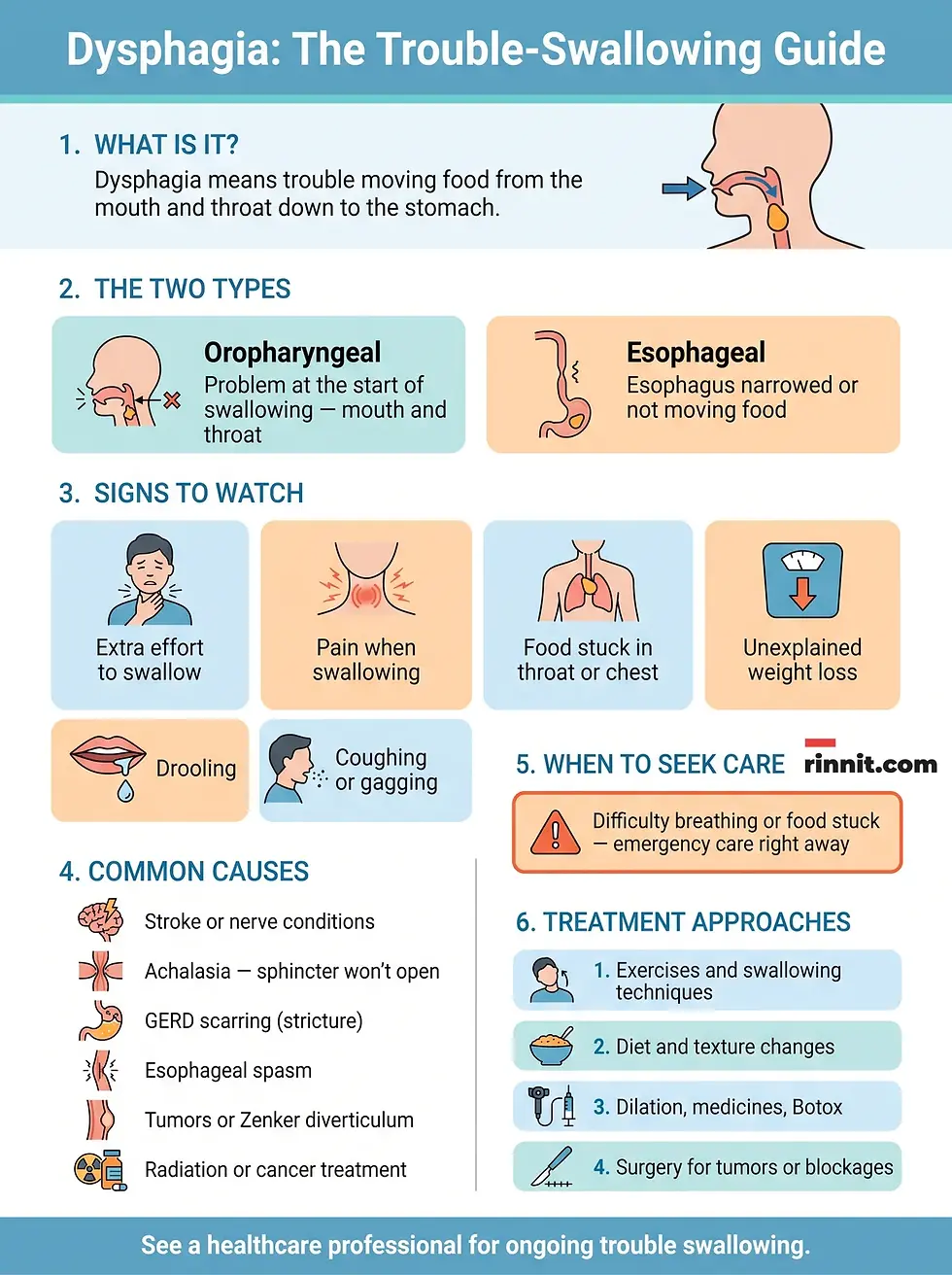
FAQ: Dysphagia (Trouble Swallowing)
What is dysphagia?
Dysphagia is the medical term for trouble swallowing — difficulty moving food or liquid from the mouth and throat down to the stomach. It can occur at any age but is more common in older adults, and treatment depends on the underlying cause.
Is dysphagia the same as trouble swallowing?
Yes. Dysphagia is simply the clinical name for trouble swallowing. Occasional difficulty when eating too fast or not chewing well is usually harmless, but frequent or ongoing trouble should be evaluated.
What are the main symptoms of dysphagia?
Key signs include needing increased effort to swallow, pain with swallowing, feeling that food is stuck in the throat or chest, drooling, coughing or gagging when swallowing, frequent heartburn, a hoarse voice, and unexplained weight loss.
What causes dysphagia?
The two main types have different causes. Oropharyngeal dysphagia is usually caused by nervous system conditions, nerve damage from stroke or injury, cancer, past radiation or surgery, or a Zenker diverticulum. Esophageal dysphagia is usually caused by achalasia, GERD scarring, esophageal spasm, tumors, a ring or web, eosinophilic esophagitis, foreign bodies, or radiation therapy.
How is dysphagia diagnosed?
Diagnosis starts with a medical history, physical exam, and clinical swallowing evaluation. Further tests may include a barium swallow, modified barium swallow, endoscopy, FEES, manometry, CT or MRI imaging scans, and a nuclear medicine motility scan.
Can dysphagia be cured?
Treatment depends on the cause and can significantly improve swallowing. Options include swallowing exercises and techniques, diet changes, esophageal dilation, medicines, Botox injections, and surgery. Severe cases may require a feeding tube to ensure safe nutrition.
When is trouble swallowing an emergency?
Call for emergency help if a blockage makes it hard to breathe. Go to the nearest emergency room if you cannot swallow because food feels stuck in your throat or chest. Do not wait on these warning signs.
Conclusion
Occasional trouble swallowing is usually harmless, but ongoing dysphagia deserves medical attention — left untreated, it can lead to malnutrition, dehydration, aspiration pneumonia, and choking.
There are two types, and treatment depends on the type: oropharyngeal dysphagia (mouth and throat) and esophageal dysphagia (esophagus), each with its own set of causes, tests, and treatments.
Treatment works — from swallowing exercises and diet changes to dilation, medicines, Botox, and surgery, most causes of dysphagia can be managed effectively with the right diagnosis.
This guide walked you through the warning signs, the two types and their causes, the full diagnostic pathway, and the seven treatment options so you know exactly what to expect. If you suspect you or a loved one has dysphagia, schedule an evaluation promptly — especially if any of the emergency triggers apply.
If swallowing trouble connects to other digestive symptoms, our complete guide to diarrhea covers another common warning sign that the digestive tract may need attention, and our dehydration guide explains how to stay hydrated when eating and drinking get difficult. Explore more health topics at the rinnit.com homepage.
Disclaimer: This article is for general informational purposes only and does not constitute medical advice. Always consult a qualified healthcare professional for diagnosis and treatment of any health condition. Never disregard professional medical advice or delay seeking it because of something you have read here.
Related Reading
PEG Tube (Percutaneous Endoscopic Gastrostomy): Placement and Care explains PEG feeding tube placement and care.
Learn more in our guide to Esophageal Dilation: Uses, Procedure, Risks and Recovery.
Learn more in our guide to Esophagram (Barium Swallow): Purpose, Prep, Procedure and Results.
Laryngoscopy: What It Is, Why It's Done, Types, Procedure and Results explains how a laryngoscopy lets your provider look closely at your voice box and throat.
Fluoroscopy: What It Is, How It Works, Risks and What to Expect explains the real-time X-ray imaging used in many exams and procedures for this condition.
Esophageal Manometry: What the Test Measures, How to Prepare and What Results Mean explains the test that measures how your esophagus muscles and valves work.
Esophagoscopy: Why It's Done, Types, What to Expect, Results and Risks explains the scope procedure used to look inside the esophagus, take samples and remove stuck objects.
Upper GI Series: What It Is, Why It's Done, How to Prepare and What to Expect explains the barium X-ray test that can show this condition in the esophagus, stomach and duodenum.
Videofluoroscopic Swallowing Study (VFSS): Modified Barium Swallow explains the video X-ray test that shows how you swallow.
References
Mayo Clinic Staff. Dysphagia - Symptoms and causes. Mayo Clinic. June 12, 2026. https://www.mayoclinic.org/diseases-conditions/dysphagia/symptoms-causes/syc-20372028
Mayo Clinic Staff. Dysphagia - Diagnosis and treatment. Mayo Clinic. June 12, 2026. https://www.mayoclinic.org/diseases-conditions/dysphagia/diagnosis-treatment/drc-20372033
Li D, et al. Risk factors for stroke-related pneumonia in patients with ischaemic stroke: A systematic evaluation and meta-analysis. Clin Neurol Neurosurg. 2024;246:108593. PMID 39426216. https://doi.org/10.1016/j.clineuro.2024.108593
Ofosu A, et al. Peroral endoscopic myotomy (POEM) vs pneumatic dilation (PD) in treatment of achalasia: A meta-analysis of studies with ≥ 12-month follow-up. Endosc Int Open. 2021;9(7):E1097-E1107. PMID 34222636. https://doi.org/10.1055/a-1483-9406
Wu L, et al. A meta-analysis of the efficacy of balloon dilation intervention for patients with cricopharyngeal achalasia after stroke. Front Neurol. 2026;17:1797311. PMID 42780724. https://doi.org/10.3389/fneur.2026.1797311



Comments