Laryngoscopy: What It Is, Why It's Done, Types, Procedure and Results

Updated: 2 days ago
Written and medically reviewed by Dr. Baraa Alnahhal, MD · Last reviewed: November 2026 · How we review
Quick Answer: What is laryngoscopy?
Laryngoscopy is a procedure that lets a throat specialist look at the larynx, or voice box, with a lighted scope and camera. It finds the cause of speaking or swallowing problems and checks for laryngitis, growths or cancer. A flexible scope passes through the nose in an office visit; a direct scope goes through the mouth under anesthesia. [1]
What the research says
Adding stroboscopy to a standard voice box exam often sharpens the diagnosis in hoarseness. In a study of 76 people with hoarseness, video-stroboscopy added a diagnosis in 26 people (34.21%) and changed the diagnosis in 29 people (38.16%) compared with video-laryngoscopy alone. (Kapoor et al., Indian Journal of Otolaryngology and Head and Neck Surgery, 2025) [2]
A flexible office scope with special lighting can match a rigid scope used under anesthesia. In 233 people with throat and voice box lesions, narrow band imaging during flexible laryngoscopy found cancer with 92% sensitivity, similar to 91% for standard white light during rigid laryngoscopy. (Zwakenberg et al., The Laryngoscope, 2021) [3]
Narrow band imaging helps spot laryngeal cancer more reliably than white light alone. A meta-analysis of 6 studies covering 716 lesions found pooled sensitivity of 0.94 and specificity of 0.89 for narrow band imaging, while white light showed sensitivity of 0.81 in the studies that tested it. (Sun et al., Otolaryngology-Head and Neck Surgery, 2017) [4]
Key takeaways
Laryngoscopy uses a lighted scope with a camera to examine your voice box. [1]
It helps find the cause of speaking or swallowing problems and can detect growths or cancer. [1]
Flexible laryngoscopy goes through your nose in the office and takes only a few minutes. [1]
Direct laryngoscopy is done through your mouth under general anesthesia and allows a biopsy. [1]
Complications are rare, and most side effects are temporary. [1]
Flexible exam results are known right away, while biopsy results take about a week. [1]
What is laryngoscopy?
Laryngoscopy is a procedure used to examine your larynx, the voice box in your throat. Ear, nose and throat specialists (otolaryngologists) and voice box specialists (laryngologists) perform it. [1]
The scope used for the exam has a light and a camera at its tip. Some versions also have small tools that can remove tissue. [1]
Types of laryngoscopy
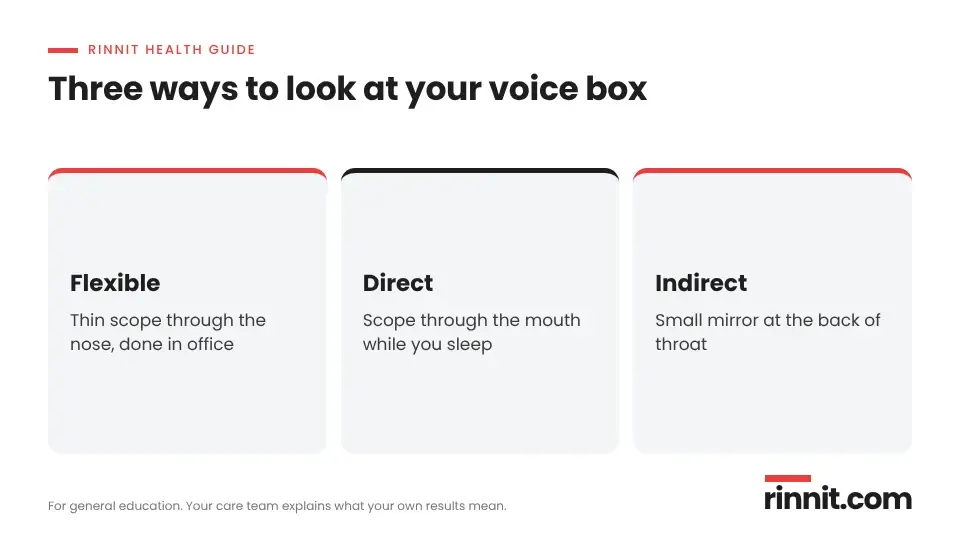
Your provider picks the type of laryngoscopy based on what they need to see or treat.
There are three main types, and each reaches the voice box in a different way. [1]
Type | How it's done | Where | Anesthesia |
Flexible | Thin fiberoptic scope with a tiny camera passes through your nose | Provider's office | Numbing medicine |
Direct | Scope passes through your mouth; tools can take tissue or treat growths | Operating room | General anesthesia |
Indirect | A small mirror, like a dental mirror, is held at the back of your throat | Office | Usually none |
Sources: [1]
Indirect laryngoscopy is much less common today than the other two types. [1]
Why is laryngoscopy done?
Your provider may suggest laryngoscopy if you have trouble speaking or swallowing and the cause isn't clear. [1]
The exam can help:
During a direct laryngoscopy, your provider can also remove tissue for a biopsy or treat problems like polyps. [1]
How do you prepare for laryngoscopy?
Preparation depends on which type you're having. Your provider will give you specific instructions. [1]
What happens during laryngoscopy?
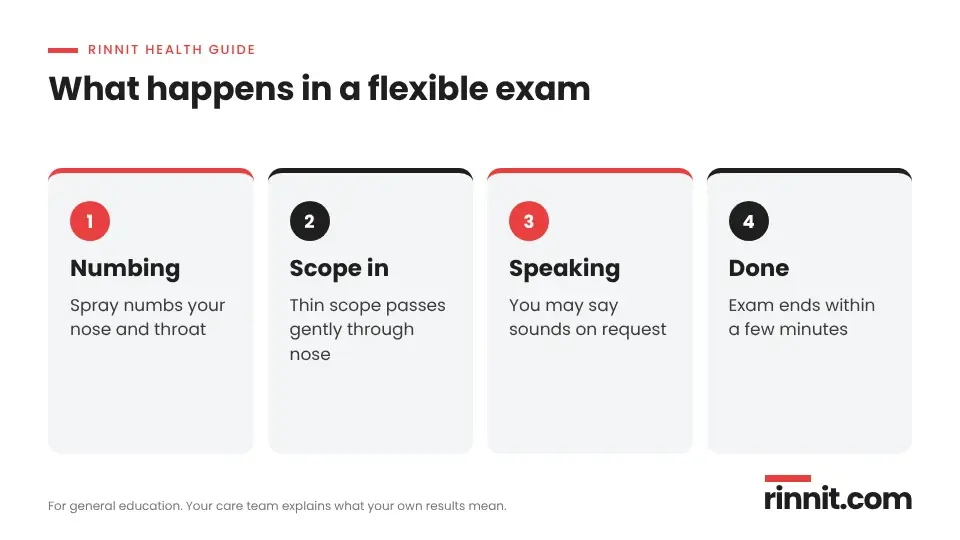
A flexible laryngoscopy is usually quick and is done while you're awake.
Flexible laryngoscopy
Your provider may first spray a numbing medicine and a decongestant into your nose. [1]
The medicine can taste bitter and may make you feel like coughing, but this feeling usually fades. The numbness can last about 30 minutes. [1]
Your provider then passes the thin scope through your nose to view your voice box. They may ask you to speak or make sounds so they can see how your vocal cords move. [1]
The whole exam usually takes just a few minutes. [1]
Direct laryngoscopy
Direct laryngoscopy takes place in an operating room under general anesthesia. You're asleep and won't feel pain. [1]
Your provider passes the scope through your mouth. They can use tools on the scope to take a tissue sample or treat problems such as polyps. [1]
Does laryngoscopy hurt?
A flexible exam in the office can feel uncomfortable and may trigger your gag reflex. Numbing medicine helps prevent this. [1]
A direct laryngoscopy is painless because you're asleep during it. [1]
What happens after laryngoscopy?
After a flexible exam, your throat may feel numb for a while because of the medicine. [1]
After a direct laryngoscopy, you may have a sore throat or a hoarse voice. Most people go home the same day. [1]
Recovery depends on the type of procedure. Your provider will tell you how to care for yourself afterward. [1]
What are the risks of laryngoscopy?
Laryngoscopy is generally a safe procedure, and complications are rare. [1]
Side effects depend on the type of laryngoscopy and are usually temporary. Your provider will go over the possible risks with you before the procedure. [1]
Type | Common after-effects |
Flexible | Throat numbness, bitter taste, brief urge to cough |
Direct | Sore throat, hoarseness |
Sources: [1]
What do laryngoscopy results mean?
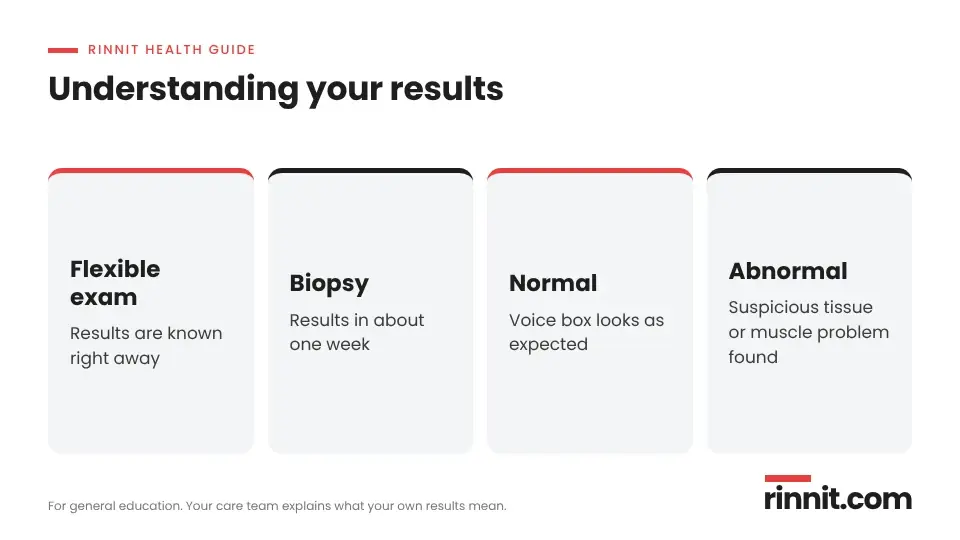
Your provider will explain your results and whether you need more tests or treatment.
When will you get results?
With a flexible laryngoscopy, your provider can usually tell you what they saw right away. [1]
If you had a biopsy during a direct laryngoscopy, results take about one week. They may take longer if extra lab analysis is needed. [1]
Normal and abnormal results
A normal result means your voice box looks as expected. [1]
An abnormal result may mean your provider found suspicious tissue or a problem with the muscles you use to speak or swallow. [1]
Your provider will explain what the findings mean and whether you need treatment or more testing. [1]
Laryngoscopy vs. upper endoscopy
Both procedures use a scope, but they look at different parts of your body. [1]
Laryngoscopy examines your voice box, while an upper endoscopy (EGD) examines your digestive tract. [1]
Gastroenterologists use upper endoscopy to check for conditions such as acid reflux and celiac disease. [1]
Conclusion
Laryngoscopy gives your care team a clear, direct view of your voice box. It can help explain hoarseness, swallowing trouble, and other throat symptoms.
Most flexible exams take only a few minutes in the office, and serious problems are rare. If you need a direct laryngoscopy, your provider will guide you through preparation, recovery, and your results.
Keep learning: Read our guide to hoarseness and voice recovery or our guide to endoscopy and how scope exams work. For more background, see the MedlinePlus Laryngoscopy and Nasolaryngoscopy page.
FAQ
What is a laryngoscopy?
A laryngoscopy is an exam that uses a lighted scope with a camera to look at your voice box. A throat specialist performs it.
Why would I need a laryngoscopy?
You may need one if you have speaking or swallowing problems. It can find laryngitis, nodules, polyps, or signs of cancer.
How is a flexible laryngoscopy done?
After numbing your nose, your provider passes a thin scope through it to view your voice box. You may be asked to speak during the exam.
Does a laryngoscopy hurt?
A flexible exam may feel uncomfortable or make you gag, but numbing medicine helps. A direct laryngoscopy is painless because you're asleep.
How do I prepare for a laryngoscopy?
A flexible exam usually needs no preparation. For a direct laryngoscopy, you may need to fast and arrange a ride home.
How long does a laryngoscopy take?
A flexible laryngoscopy usually takes just a few minutes. A direct laryngoscopy is a surgical procedure, and most people go home the same day.
How long does the numbness last?
Numbness from the medicine used for a flexible exam can last about 30 minutes.
When will I get my results?
Flexible exam results are usually known right away. Biopsy results take about one week, or longer if more lab work is needed.
What does an abnormal result mean?
It may mean your provider saw suspicious tissue or a problem with the muscles you use to speak or swallow. They'll explain next steps.
What are the risks of laryngoscopy?
Laryngoscopy is generally safe and complications are rare. Side effects like a sore throat or hoarseness are usually temporary.
Is a laryngoscopy the same as an endoscopy?
No. Both use a scope, but laryngoscopy looks at your voice box, while an upper endoscopy looks at your digestive tract.
Related Reading
Microlaryngoscopy: Vocal Fold Surgery, Recovery and Voice Rest explains the microscope-guided procedure to examine and treat the vocal folds.
Videostroboscopy: How It Shows Your Vocal Cords in Slow Motion explains the slow-motion camera exam of the vocal cords.
Hoarseness (Dysphonia): Causes, Symptoms, and Voice Recovery explains common causes of a hoarse voice, one of the main reasons a laryngoscopy is done.
Vocal Cord Lesions: Understanding Nodules, Polyps, and Cysts covers the growths a laryngoscopy can find and, in some cases, help treat.
What Is Vocal Cord Paralysis? A Plain-Language Guide to the Voice Problem That Can Also Make Breathing and Swallowing Hard explains a voice problem that a scope exam can help reveal by showing how your vocal cords move.
Understanding Laryngeal Cancer: Symptoms, Causes, and Treatment Options covers the cancer that laryngoscopy and biopsy help diagnose.
Understanding Laryngopharyngeal Reflux (LPR): Symptoms, Causes, and Care explains how reflux can irritate the voice box, a common reason for throat symptoms that lead to an exam.
Dysphagia (Trouble Swallowing): Symptoms, Causes, Diagnosis & Treatment — Complete Guide covers swallowing problems that a laryngoscopy can help evaluate.
References
Cleveland Clinic. Laryngoscopy: Purpose & Procedure. Cleveland Clinic. Last updated January 19, 2026. https://my.clevelandclinic.org/health/diagnostics/22803-laryngoscopy
Kapoor AB, Pradhan N, Agrawal S, et al. Role of Video-stroboscopy Vs Video-Laryngoscopy in Hoarseness of Voice. Indian J Otolaryngol Head Neck Surg. 2025;77(3):1271-1275. PMID 40093490. https://doi.org/10.1007/s12070-025-05319-5
Zwakenberg MA, Halmos GB, Wedman J, et al. Evaluating Laryngopharyngeal Tumor Extension Using Narrow Band Imaging Versus Conventional White Light Imaging. Laryngoscope. 2021;131(7):E2222-E2231. PMID 33393666. https://doi.org/10.1002/lary.29361
Sun C, Han X, Li X, et al. Diagnostic Performance of Narrow Band Imaging for Laryngeal Cancer: A Systematic Review and Meta-analysis. Otolaryngol Head Neck Surg. 2017;156(4):589-597. PMID 28168890. https://doi.org/10.1177/0194599816685701
Medical disclaimer
This article is for general education only and does not replace advice from a qualified healthcare professional. Talk to your doctor about your own diagnosis and treatment, and seek emergency care right away for severe or sudden symptoms.



Comments