What Is Vocal Cord Paralysis? A Plain-Language Guide to the Voice Problem That Can Also Make Breathing and Swallowing Hard

Updated: 2 days ago
Medically reviewed by Dr. Baraa Alnahhal, MD · Last reviewed: October 2026
Quick Answer
Vocal cord paralysis is a loss of control of the voice muscles caused when nerve impulses to the voice box are disrupted. [1] It causes a breathy, hoarse voice, noisy breathing and choking or coughing when swallowing. [1] [3] Common causes include nerve damage during thyroid or chest surgery, stroke and tumors. Treatments include voice therapy, injections and surgery, and some voices recover. [2]
What the research says
Most bilateral cases follow a medical procedure, and many need urgent airway help. A systematic review of 55 papers on bilateral vocal fold paralysis found that 76.6% of cases were iatrogenic (caused by a medical procedure) and that 36.2% needed an immediate tracheotomy. Laterofixation of the vocal fold was described as a cost-effective alternative to tracheotomy while awaiting potential recovery. The authors note that differences between studies and the lack of large randomized trials make it hard to say which technique is best. (Lechien et al., Otolaryngol Head Neck Surg, 2024) [5]
Nerve replacement gives lasting voice improvement in one-sided paralysis. A systematic review of 42 studies (1,859 patients) found high rates of voice improvement after laryngeal reinnervation, with durable results and minimal complication rates. Younger patients (under 60) and those who had been without nerve supply for under 2 years did better, although good results were also seen beyond those thresholds. (Mes et al., Eur Arch Otorhinolaryngol, 2025) [6]
Paralysis after anesthesia is uncommon. A meta-analysis of 39 studies on anesthesia drugs and equipment found vocal cord paralysis in about 4.2% of cases (95% CI 2.9–5.4%), far less often than cough (39.2%) or hoarseness (35.3%). (Shokri et al., Eur Arch Otorhinolaryngol, 2025) [7]
What Are Vocal Cords, and What Does Paralysis Mean?
Your vocal cords are two flexible bands of muscle tissue that sit at the entrance to the windpipe, also known as the trachea. [1] They do more than produce sound. When you speak, the bands come together and vibrate to make sound. [1] The rest of the time, they relax into an open position so you can breathe freely. [1] And they protect the airway — keeping food, drink, and even saliva from slipping into the windpipe and making you choke. [1]
Vocal cord paralysis is a condition that causes the loss of control of the muscles that control the voice. [1] It happens when the nerve impulses to the voice box, also called the larynx, are disrupted. [1] That disruption results in paralysis of the vocal cord muscles. [1]
Most of the time, vocal cord paralysis involves the loss of control of only one vocal cord. [1] Paralysis of both vocal cords is a rare but serious condition — it can make it hard to speak and can cause trouble with breathing and swallowing. [1]

What Does Vocal Cord Paralysis Feel Like?
Symptoms of vocal cord paralysis may include:
Warning sign | What it looks like |
Breathy voice | A breathy quality to the voice [1] |
Hoarseness [1] | A rough, raspy voice |
Noisy breathing [1] | Breathing sounds loud or strained |
Shortness of breath [1] | Trouble catching your breath |
Loss of vocal pitch [1] | Difficulty hitting higher or lower notes |
Choking or coughing while swallowing | Choking or coughing when swallowing food, drink, or saliva [1] |
Extra breaths while speaking | The need to take several breaths while speaking [1] |
Quiet voice | Inability to speak loudly [1] |
Loss of gag reflex [1] | Reduced protection against choking |
Weak cough | Ineffective coughing [1] |
Throat clearing | Frequent throat clearing [1] |

When Should You See a Doctor?
Contact your healthcare professional if you have a hoarse voice that can't be explained and that lasts for more than 2 to 4 weeks. [1] Also see your healthcare professional if you notice any voice changes or discomfort. [1]
What Causes Vocal Cord Paralysis?
Vocal cord paralysis happens when nerve impulses to the voice box are disrupted, and although the exact cause is often unknown, some causes are known. [1] This causes the muscle to become paralyzed. [1] Often the exact cause of vocal cord paralysis isn't known. [1] [3] But some known causes may include:
Cause | How it damages the voice box |
Injury during surgery | Surgery on or near the neck or upper chest can damage the nerves that serve the voice box — especially thyroid, parathyroid, esophagus, neck, and chest surgeries [1] |
Neck or chest injury | Trauma to the neck or chest may injure the nerves that serve the vocal cords or the voice box itself [1] |
Stroke | A stroke interrupts blood flow in the brain and may damage the part of the brain that sends messages to the voice box [1] |
Tumors | Both cancerous and noncancerous tumors can grow in or around the muscles, cartilage, or nerves controlling the voice box [1] |
Infections | Lyme disease, Epstein-Barr virus, and herpes can cause inflammation and directly damage the nerves in the voice box; there's some evidence that COVID-19 infection may cause it too [1] |
Neurological conditions |
Who Is at Higher Risk?
The risk factors for vocal cord paralysis come down to two main situations. People who need surgery on their thyroid, throat, or upper chest have an increased risk of vocal cord nerve damage. [1] Sometimes the breathing tubes used in surgery — or used to help people breathe when they're having serious respiratory trouble — can damage the vocal cord nerves. [1] And people with certain neurological conditions, such as Parkinson's disease or multiple sclerosis, are more likely to develop vocal cord weakness or paralysis. [1]
How Serious Can It Get?
Breathing problems associated with vocal cord paralysis may be so mild that you just have a hoarse-sounding voice. [1] Or they can be so serious that they're life-threatening. [1]
Vocal cord paralysis keeps the opening to the airway from completely opening or closing. [1] This can cause someone to choke on or inhale food or liquid, known as aspiration. [1] Aspiration that leads to severe pneumonia is rare but serious and requires immediate medical care. [1]
How Is Vocal Cord Paralysis Diagnosed?
Vocal cord paralysis is diagnosed by asking about your symptoms and lifestyle, listening to your voice and, if needed, doing further tests. [2] Your care professional also listens to your voice and asks how long you've had voice changes. [2] You also may need the following tests:
Test | What it involves | What it reveals |
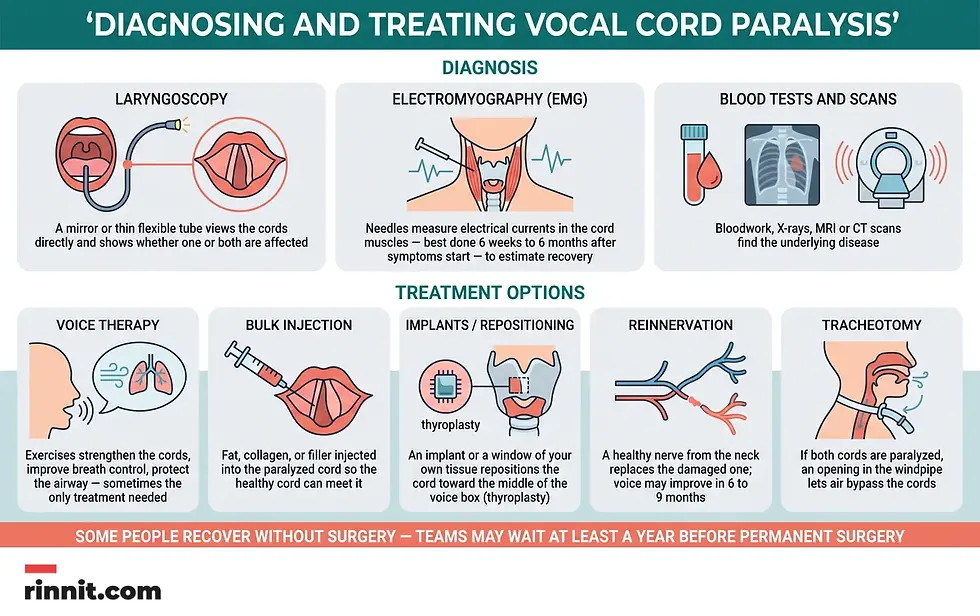
Laryngoscopy | The professional looks at your vocal cords using a mirror or a thin, flexible tube known as a laryngoscope or endoscope, or both; a special version called videostrobolaryngoscopy uses a tiny camera at the scope's tip [2] | The movement and position of the vocal cords, and whether one or both cords are affected [2] |
Laryngeal electromyography | Small needles are inserted into the vocal cord muscles through the skin of the neck to measure electrical currents in the voice box muscles [2] | An estimate of how well you may recover — most useful when done between six weeks and six months after symptoms began; it doesn't guide treatment [2] |
Blood tests and scans | Bloodwork, X-rays, MRI, or CT scans [2] | The underlying disease causing the nerve injury, since several conditions may be responsible [2] |
How Is Vocal Cord Paralysis Treated?
Treatment of vocal cord paralysis depends on the cause, how serious the symptoms are, and when symptoms began. [2] Treatment may include voice therapy, bulk injections, surgery, or a combination of treatments. [2]
An important point about timing: in some instances, you may get better without surgical treatment. [2] [3] For this reason, your healthcare team may delay permanent surgery for at least a year from the beginning of your vocal cord paralysis. [2] [3] However, surgical treatment with various bulk injections is often done within the first three months of voice loss. [2] During the waiting period, voice therapy helps keep you from using your voice improperly while the nerves heal. [2]
What Does Voice Therapy Do?
Voice therapy sessions involve exercises or other activities to strengthen your vocal cords and help improve breath control during speech. [2] Voice therapy also can prevent tension in muscles around the paralyzed vocal cord or cords, and protect your airway during swallowing. [2] It may be the only treatment needed if the paralysis occurs in an area that doesn't require additional bulk or repositioning. [2]
What Surgical Options Exist?
If your vocal cord paralysis symptoms don't fully recover on their own, you may need surgery to improve your ability to speak and to swallow. [2] The surgical options include:
Surgical option | What happens | What to know |
Bulk injection | A laryngologist (a doctor who specializes in disorders of the larynx) injects the paralyzed vocal cord with body fat, collagen, or another approved filler; the added bulk brings the affected cord closer to the middle of the voice box [2] | Paralysis leaves the vocal cord muscle thin and weak; the filler lets the functioning cord make closer contact when you speak, swallow, or cough [2] |
Structural implants | An implant is placed in the larynx to reposition the vocal cord [2] | Also called thyroplasty, medialization laryngoplasty, or laryngeal framework surgery; rarely, a second surgery may be needed to reposition the implant [2] |
Vocal cord repositioning | A surgeon moves a window of your own tissue from the outside of the voice box inward, pushing the paralyzed cord toward the middle [2] | Lets the functioning cord better vibrate against the paralyzed cord [2] |
Reinnervation (nerve replacement) | A healthy nerve is moved from a different area of the neck to replace the damaged vocal cord nerve [2] | It can take as long as 6 to 9 months before your voice gets better; sometimes combined with a bulk injection [2] |
Tracheotomy | A cut is made in the front of the neck to create an opening in the windpipe; a breathing tube is inserted [2] | Used when both vocal cords are paralyzed and positioned closely together, cutting airflow and causing major breathing trouble; air bypasses the vocal cords [2] |
Are There New Treatments Being Researched?
Linking the vocal cords to another source of electrical stimulation may restore opening and closing of the vocal cords that can't move. [2] Other sources of electrical stimulation might be a nerve from another part of the body or a device similar to a cardiac pacemaker. [2] Researchers continue to study this and other options. [2]
How Should You Prepare for Your Appointment?
You're likely to first see your main healthcare professional about vocal cord paralysis. [2] But if both vocal cords are paralyzed, you'll probably first be seen in a hospital emergency department. [2] After the initial assessment, you'll likely be referred to a doctor who specializes in ear, nose and throat conditions, and you also may be referred to a speech-language pathologist for voice assessment and therapy. [2]
Arrive well prepared. Write down any symptoms you're experiencing, including any that don't seem related to the reason for your appointment. Note key personal information, including major stresses or recent illnesses or life changes. Make a list of all medicines, vitamins, or supplements you're taking, including doses. Ask a family member or friend to come along if possible — sometimes it's hard to remember everything said during an appointment. And write down questions to ask. [2]
Questions to ask your healthcare professional | Questions they may ask you |
What's the most likely cause of my vocal cord paralysis? | When did your symptoms start? |
What kinds of tests do I need? Do they require special preparation? | Did any special events or circumstances happen before or at the same time your symptoms developed? |
Is this condition temporary, or will my vocal cords always be paralyzed? | Have you received any treatment yet? |
What treatments are available, and which do you recommend? | Have your symptoms been continuous or do they come and go? |
What types of side effects can I expect from treatment? | How are your symptoms affecting your lifestyle? |
Are there alternatives to the treatment you're suggesting? | Does anything seem to improve your symptoms? |
Are there restrictions on using my voice after treatment? For how long? | What appears to worsen your symptoms? |
Will I be able to talk or sing after treatment? | Do you have any other medical conditions? |
Are there brochures or printed material I can take home? | — |
How Do People Cope?
Vocal cord paralysis can be frustrating and affect your daily life — it can be hard to communicate with other people. [2] A speech therapist can help you develop the skills you need to communicate. [2] Even if you're not able to get back the voice you once had, voice therapy can help you learn effective ways to make up for it. [2] In addition, a speech-language pathologist can teach you how to use your voice without causing further damage to the vocal cords. [2]
What is the bottom line on vocal cord paralysis?
Vocal cord paralysis is the loss of control of the muscles that control your voice, caused when nerve signals to the voice box are disrupted. [1] The vocal cords aren't just voice-makers — they're the airway's trapdoor, and when they can't close properly, swallowing becomes dangerous and, in rare cases where both cords are paralyzed, breathing itself is at risk. [1] The telltale warning sign is unexplained hoarseness that lasts more than 2 to 4 weeks. [1] Known causes run from nerve damage during thyroid or neck surgery to stroke, tumors, infections, and neurological diseases, though often the exact cause is never found. [1] The good news is that treatment is well-developed — voice therapy, filler injections, implants, repositioning, nerve replacement, and in severe cases a tracheotomy — and some people recover on their own, which is why teams often wait at least a year before committing to permanent surgery. [2] [3] The key move is getting the hoarseness checked early, while the nerves are still healing.
Take the Next Step
If your voice has been hoarse, breathy, or weaker for more than 2 to 4 weeks without an obvious explanation, see your healthcare professional — this is the classic signal of vocal cord paralysis. Don't wait for it to worsen: aspiration of food or liquid into the airway can lead to severe pneumonia [1], and trouble breathing is a reason to seek immediate care. Ask about a laryngoscopy to see whether one or both cords are affected, what's causing the paralysis, and whether voice therapy, an injection, or surgery fits your situation. A speech-language pathologist can help you protect and strengthen your voice through recovery. [2] [3]
Frequently Asked Questions
What is vocal cord paralysis?
A condition that causes the loss of control of the muscles that control the voice. [1] It happens when the nerve impulses to the voice box, also called the larynx, are disrupted, resulting in paralysis of the vocal cord muscles. [1]
What do the vocal cords actually do?
The vocal cords are two flexible bands of muscle tissue at the entrance to the windpipe (trachea). [1] When speaking, the bands come together and vibrate to make sound. [1] The rest of the time, they relax in an open position so you can breathe — and they protect the airway by preventing food, drink, and saliva from entering the windpipe and causing choking. [1]
Is one cord or both usually affected?
Vocal cord paralysis usually involves the loss of control of only one vocal cord. [1] Paralysis of both vocal cords is rare but serious — it can make it hard to speak and can cause trouble with breathing and swallowing. [1]
What are the symptoms?
A breathy quality to the voice, hoarseness, noisy breathing, shortness of breath, loss of vocal pitch, choking or coughing while swallowing, needing several breaths while speaking, inability to speak loudly, loss of a gag reflex, ineffective coughing, and frequent throat clearing. [1]
When should I see a doctor about hoarseness?
Contact your healthcare professional if you have a hoarse voice that can't be explained and lasts more than 2 to 4 weeks. [1] Also see your healthcare professional if you notice any voice changes or discomfort. [1]
What causes it?
Disruption of the nerve impulses to the voice box. [1] Known causes include injury to the vocal cord during neck or chest surgery (especially thyroid or parathyroid surgery), neck or chest trauma, stroke, tumors (cancerous or noncancerous), infections such as Lyme disease, Epstein-Barr virus, and herpes (with some evidence for COVID-19), and neurological conditions like multiple sclerosis or Parkinson's disease. [1] Often the exact cause isn't known. [1] [3]
Why is surgery a common cause?
Surgery on or near the neck or upper chest can damage the nerves that serve the voice box — particularly thyroid, parathyroid, esophagus, neck, and chest surgeries. [1] Breathing tubes used during surgery or to assist breathing can also damage the vocal cord nerves. [1]
Who is at higher risk?
People who have had throat or chest surgery (thyroid, throat, or upper chest) and people with neurological conditions such as Parkinson's disease or multiple sclerosis, who are more likely to develop vocal cord weakness or paralysis. [1]
How serious can it be?
Vocal cord paralysis ranges from a mild hoarse-sounding voice to life-threatening problems. [1] Because paralysis keeps the airway opening from fully opening or closing, food or liquid can be inhaled (aspiration), and aspiration leading to severe pneumonia is rare but serious and requires immediate medical care. [1]
How is it diagnosed?
Your healthcare professional asks about symptoms and listens to your voice, then may use laryngoscopy (viewing the cords with a mirror or thin flexible scope, sometimes with a camera called videostrobolaryngoscopy) to see cord movement and position, laryngeal electromyography (needles measuring electrical currents in the vocal cord muscles — most useful six weeks to six months after symptoms begin), and blood tests, X-rays, MRI, or CT scans to find the underlying cause. [2]
What is laryngeal electromyography?
A test that measures the electrical currents in your voice box muscles. [2] Small needles are inserted into the vocal cord muscles through the skin of the neck. [2] It isn't used to guide treatment, but it may estimate how well you may recover. [2]
Will I always need surgery?
No. In some instances, you may get better without surgical treatment, which is why teams may delay permanent surgery for at least a year. [2] [3] Voice therapy may be the only treatment needed if the paralysis occurs in an area that doesn't require additional bulk or repositioning. [2] But bulk injections are often done within the first three months of voice loss. [2]
What is a bulk injection?
Paralysis leaves the vocal cord muscle thin and weak, so a laryngologist (a doctor specializing in larynx disorders) injects the paralyzed cord with body fat, collagen, or another approved filler. [2] The added bulk brings the affected cord closer to the middle of the voice box, letting the healthy cord make closer contact when you speak, swallow, or cough. [2]
What is thyroplasty?
A structural implant placed in the larynx to reposition the vocal cord. [2] It's also called medialization laryngoplasty or laryngeal framework surgery. [2] Rarely, a second surgery is needed to reposition the implant. [2]
What is reinnervation?
Replacing the damaged nerve — a healthy nerve is moved from a different area of the neck to replace the damaged vocal cord nerve. [2] It can take as long as 6 to 9 months before your voice improves, and the procedure is sometimes combined with a bulk injection. [2]
When is a tracheotomy needed?
If both vocal cords are paralyzed and positioned closely together, airflow decreases and breathing becomes very difficult. [2] A tracheotomy creates an opening in the windpipe through the front of the neck, and a breathing tube is inserted so air can bypass the vocal cords. [2]
Can the voice fully come back?
Some people get better without surgery as nerves heal. [2] [3] When it doesn't fully recover, treatments improve speaking and swallowing. [2] A speech therapist can help you develop communication skills, and a speech-language pathologist can teach you to use your voice without causing further damage — even if you can't get back the voice you once had. [2]
Are there treatments being researched?
Yes. Linking the vocal cords to another source of electrical stimulation — such as a nerve from another part of the body or a device similar to a cardiac pacemaker — may restore opening and closing of cords that can't move. [2] Researchers continue to study this and other options. [2]
Related Reading
Voice Therapy: Exercises, Uses and What to Expect explains voice therapy.
Videostroboscopy: How It Shows Your Vocal Cords in Slow Motion explains the slow-motion camera exam of the vocal cords.
Laser Cordotomy: Procedure, Recovery and Results for Vocal Cord Paralysis explains the minimally invasive laser procedure that widens the airway when both vocal cords are paralyzed.
Laryngoscopy: What It Is, Why It's Done, Types, Procedure and Results explains how a laryngoscopy lets your provider look closely at your voice box and throat.
References
Mayo Clinic Staff. Vocal cord paralysis: Symptoms & causes. Mayo Clinic. Last updated June 22, 2024. Accessed October 15, 2026. https://www.mayoclinic.org/diseases-conditions/vocal-cord-paralysis/symptoms-causes/syc-20378873
Mayo Clinic Staff. Vocal cord paralysis: Diagnosis & treatment. Mayo Clinic. Last updated June 22, 2024. Accessed October 15, 2026. https://www.mayoclinic.org/diseases-conditions/vocal-cord-paralysis/diagnosis-treatment/drc-20378878
National Institute on Deafness and Other Communication Disorders. Vocal fold paralysis. NIDCD, National Institutes of Health. Accessed October 15, 2026. https://www.nidcd.nih.gov/health/vocal-fold-paralysis
American Speech-Language-Hearing Association. Vocal fold paralysis. ASHA. Accessed October 15, 2026. https://www.asha.org/public/speech/disorders/Vocal-Fold-Paralysis
Lechien JR, Hans S, Mau T. Management of bilateral vocal fold paralysis: a systematic review. Otolaryngol Head Neck Surg. 2024;170(3):724-735. PMID: 38123531. https://doi.org/10.1002/ohn.616
Mes SD, Heijnen BJ, Hendriksma MH, et al. Laryngeal reinnervation for unilateral vocal fold paralysis in adults; a systematic review of the literature for the clinician. Eur Arch Otorhinolaryngol. 2025;282(11):5779-5795. PMID: 41094224. https://doi.org/10.1007/s00405-025-09737-7
Shokri P, Zarif M, Kharaz L, et al. The impact of anesthesia instruments and drugs on the occurrence of vocal cord injury, systematic review and meta-analysis. Eur Arch Otorhinolaryngol. 2025;282(4):1719-1730. PMID: 39572412. https://doi.org/10.1007/s00405-024-09074-1
Medical disclaimer
This guide is for general information only and is not a substitute for professional medical advice, diagnosis, or treatment. Vocal cord paralysis can affect breathing and swallowing, and aspiration of food or liquid into the airway can lead to severe pneumonia requiring immediate medical care. Always seek the advice of a physician or other qualified health provider with any questions about a medical condition. Never disregard professional medical advice or delay seeking it because of something you have read here.



Comments