Voice Therapy: Exercises, Uses and What to Expect

Updated: 2 days ago
Written and medically reviewed by Dr. Baraa Alnahhal, MD · Last reviewed: November 2026 · How we review
Quick Answer
Voice therapy is a type of speech therapy that uses education and vocal exercises to prevent or treat voice disorders. It's led by a speech-language pathologist who specializes in voice. It helps laryngitis, muscle tension dysphonia and vocal cord nodules, and recovery after vocal cord surgery. Most people attend a few times a month for several months.
What the research says
Voice therapy improved results after polyp surgery: in a review of 9 trials with 730 people, voice therapy after vocal cord polyp surgery lowered Voice Handicap Index scores by 9.66 points and improved voice measures and how long people could sustain a sound (Yang K et al., European Archives of Oto-Rhino-Laryngology, 2026) [2]
Therapy helped people with a paralyzed vocal cord: in a review of 12 studies with 459 people with one paralyzed vocal cord, voice therapy with breathing control, throat muscle work and resonance training significantly improved voice handicap scores and phonation time (Cheng TW et al., Journal of Voice, 2026) [3]
Key takeaways
Voice therapy uses education and exercises to treat voice disorders.
A voice-specialized speech-language pathologist leads it.
It helps nodules, polyps, paralysis, dysphonia and more.
It's often part of recovery after vocal cord surgery.
Practice at home is key to success.
What is voice therapy?
Voice therapy is a branch of speech therapy. Exercises reduce strain on your vocal cords, help them vibrate better and use airflow more efficiently. There's no one-size-fits-all plan. Sources: [1]
What it treats

It also protects the voices of singers and other professional voice users.
Laryngitis.
Spasmodic dysphonia and vocal tremor.
Inducible laryngeal obstruction.
Recovery after vocal cord surgery. Sources: [1]
Types of voice exercises
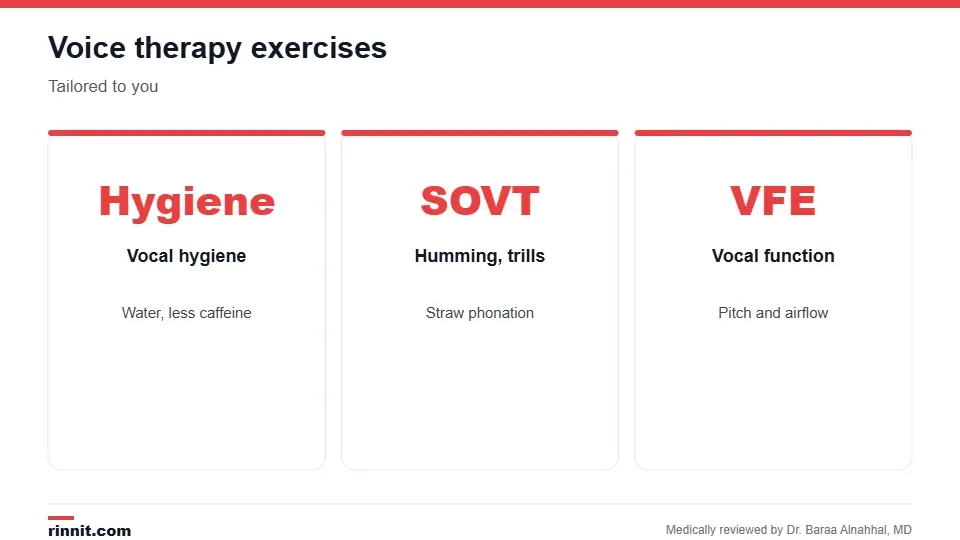
Your SLP tailors exercises to your voice.
Type | Examples |
Vocal hygiene | Staying hydrated, limiting caffeine and alcohol, quitting smoking |
Breathing and relaxation | Diaphragmatic breathing, good posture |
Tension release | Hands-on release of neck and jaw muscles |
Semi-occluded vocal tract (SOVT) | Humming, lip trills, tongue trills, straw phonation |
Resonant voice therapy | A variation of SOVT work |
Vocal function exercises | Sustaining sounds, pitch-range work, efficient airflow |
Sources: [1]
How it works
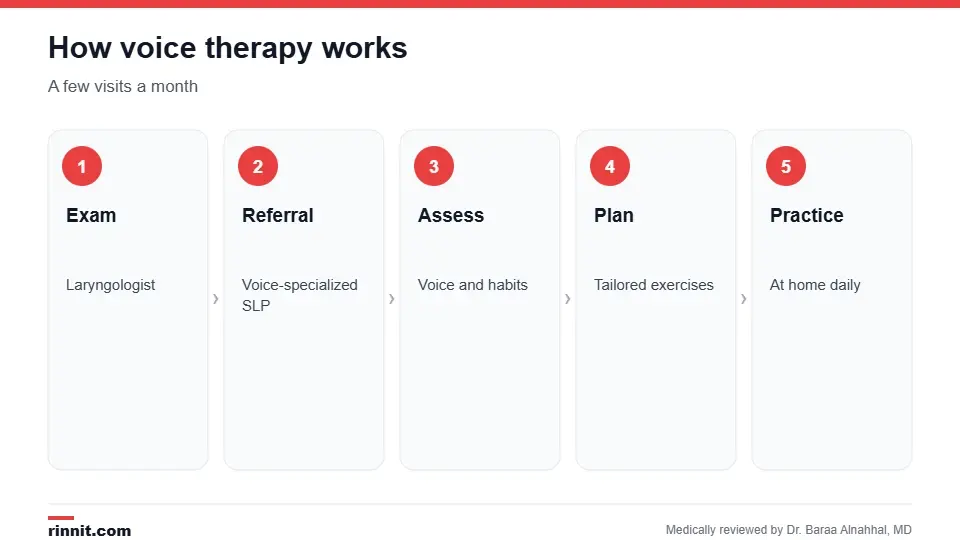
Most people attend a few times a month for several months.
You may first see a laryngologist for a laryngoscopy.
You're referred to a voice-specialized SLP.
The SLP assesses your voice and asks about habits that may have caused injury.
You get a tailored plan and home exercises.
During recovery, you may rest your voice and communicate by writing or text-to-speech apps. Sources: [1]
Risks
Voice therapy has no notable risks. Don't overdo exercises, which can cause overuse injury. Sources: [1]
How long it takes
Most people attend a few times a month for several months, depending on the condition. Success depends on practicing exercises on schedule. Apps may help you track pitch or voice steadiness. Sources: [1, 2, 3]
Outlook
Voice therapy can help your voice recover from disorders or vocal cord surgery and protect it if you use your voice professionally. Sources: [1, 2, 3]
When to see a provider
Hoarseness that doesn't go away.
Losing your voice or a raspy voice for several weeks.
Neck pain or a lump in your throat.
Shortness of breath or wheezing.
Trouble speaking or swallowing. Sources: [1]
Conclusion
Voice therapy teaches you to use your voice with less strain so it can heal and stay healthy. Regular practice between sessions is the key to lasting results.
Keep learning: read about hoarseness and voice disorders.
Frequently asked questions
What is voice therapy?
Speech therapy that uses education and exercises to treat voice disorders.
Who provides voice therapy?
A speech-language pathologist who specializes in voice.
What conditions does it treat?
Nodules, polyps, paralysis, dysphonia, laryngitis and more.
Is it used after vocal cord surgery?
Yes, often as part of recovery.
What is straw phonation?
Making sound through a straw to reduce vocal strain.
Can singers benefit?
Yes. It protects professional voices.
How often are sessions?
Usually a few times a month.
How long does it take?
Several months for most people.
Do I need to practice at home?
Yes. Home practice is key.
When should I see a doctor about my voice?
If hoarseness lasts several weeks or you have trouble swallowing.
Related Reading
Speech Therapy: What It Is, Who Needs It, and How It Works an overview of speech therapy.
Voice Disorders (Dysphonia): Hoarseness, Causes, Diagnosis & Treatment — Complete Guide voice disorders.
Vocal Cord Lesions: Understanding Nodules, Polyps, and Cysts growths on the vocal cords.
What Is Vocal Cord Paralysis? A Plain-Language Guide to the Voice Problem That Can Also Make Breathing and Swallowing Hard a paralyzed vocal cord.
Muscle Tension Dysphonia: Symptoms, Causes, Diagnosis and Treatment voice strain from tense muscles.
References
Cleveland Clinic. Voice Therapy: What It Is & Exercises. Cleveland Clinic. Last updated September 1, 2026. https://my.clevelandclinic.org/health/treatments/22339-voice-therapy
Yang K, You Q, Huang S, et al. Results of postoperative voice therapy for vocal cord polyps: systematic review and meta-analysis. European Archives of Oto-Rhino-Laryngology. 2026;283(6):3513-3526. PMID 41680504. https://doi.org/10.1007/s00405-026-10017-1
Cheng TW, Chu EH, Lin CH, et al. Effectiveness of voice therapy on voice quality and function in individuals with unilateral vocal fold paralysis: systematic review and meta-analysis. Journal of Voice. 2026;40(6):1738.e17-1738.e33. PMID 39122575. https://doi.org/10.1016/j.jvoice.2024.07.006
Medical disclaimer
This article is for general education only and does not replace advice from a qualified healthcare professional. Talk to your doctor about your own diagnosis and treatment, and seek emergency care right away for severe or sudden symptoms.



Comments