Your Voice: Vocal Cords Anatomy, Function, and Health

Updated: 2 days ago
Medically reviewed by Dr. Baraa Alnahhal, MD · Last reviewed: October 2026
Vocal cords, also known as vocal folds, are two muscular bands located within the larynx that are essential for speech, breathing, and airway protection. [1] They vibrate to produce sound, close to prevent aspiration during swallowing, and open to allow airflow. Maintaining vocal health involves avoiding strain and managing underlying conditions like acid reflux. Understanding their anatomy helps in recognizing and preventing disorders such as laryngitis and vocal nodules.
Quick Answer: What are vocal cords?
Vocal cords are two flexible bands of muscle and tissue inside the larynx, or voice box, at the top of the trachea. [1] They produce the voice by vibrating, regulate airflow during breathing and protect the lungs by closing during swallowing. Their layered structure changes in size and thickness throughout life, shaping vocal pitch and quality.
What the research says
Voice problems are common, especially in older adults. A meta-analysis of 13 studies estimated that 18.79% of older adults (95% CI 16.34-21.37%) have a voice disorder, with a higher rate in institutionalized older adults (33.03%) than in community-dwelling older adults (15.2%) (Wang et al., Am J Speech Lang Pathol, 2023) [5].
Voice therapy shows positive results for nodules in adults, but the evidence is limited. Of 30 articles reviewed, 9 met the inclusion criteria and all reported positive effects of voice therapy in adults with vocal fold nodules, but the evidence levels were low and the authors could not conclude that voice therapy is generally effective (Alegria et al., Eur Arch Otorhinolaryngol, 2020) [6].
In children with nodules, voice therapy has some support. A systematic review of 24 studies found that 8 reported a significant improvement in at least one outcome after voice therapy and 5 found no significant change; the 11 studies that did not test for significance all reported improvements, and the authors call for more randomized trials (Adriaansen et al., Int J Lang Commun Disord, 2022) [7].
Overview of Vocal Cords
Vocal cords, or vocal folds, are the primary instruments for human vocalization. Located within the larynx, they function as a biological valve that controls the passage of air and foreign substances. While often referred to as "cords," they are actually complex folds of tissue connected to various muscles and cartilage that facilitate precise movements required for speaking and singing.
In simple terms, the vocal cords are two bands of muscle inside the voice box that let you make sound: when you speak, they close by meeting in the middle of your exhaled airstream and vibrate. [1]
Anatomical Structure and Location
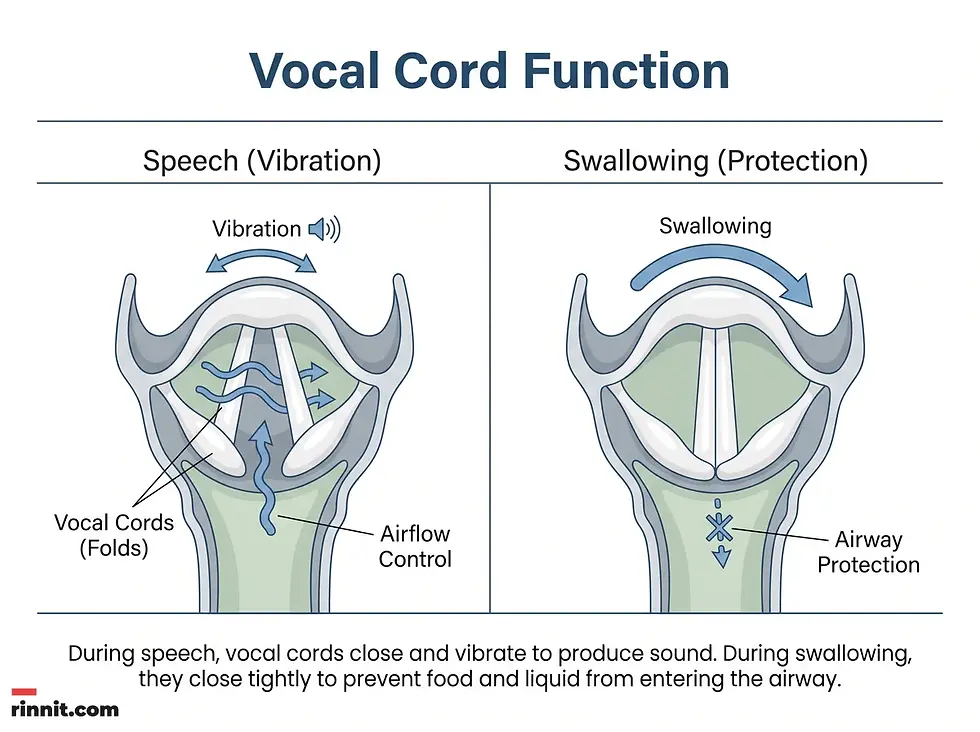
The vocal cords are positioned directly behind the Adam's apple, atop the windpipe. [1] They form an upside-down "V" shape when open [1] and a narrow slit when closed. Their structure is composed of three main layers that work together to provide both protection and flexibility.
Layer | Component | Function |
Outer | Epithelium | A moist, protective mucous membrane lining. |
Middle | Lamina Propria | Facilitates the movement and vibration of the folds. |
Inner | Vocalis Muscle | The muscular core that controls tension and shape. |
The size of the vocal cords changes significantly from birth to adulthood. At birth, they are approximately 6 to 8 millimeters long. [1] In adults, male vocal cords typically range from 1.75 to 2.5 centimeters, while female vocal cords average between 1.25 and 1.75 centimeters. [1] These differences in length and thickness are primarily responsible for variations in vocal pitch.

Primary Functions
The vocal cords serve three critical roles in the human body: sound production, airflow regulation, and airway protection. These functions are achieved through the coordinated opening and closing of the folds.
Sound Production
When you speak or sing, the vocal cords come together to block the airflow from the lungs. [1] [2] The resulting pressure causes the folds to vibrate hundreds of times per second [1], creating sound waves. This sound is then fine-tuned by the mouth, teeth, tongue, and sinuses [1] to produce distinct speech.
Airway Protection
One of the most vital functions is protecting the lungs. During swallowing, the vocal cords close tightly to prevent food, liquids, or foreign objects from entering the trachea. [1] If an object does move toward the airway, the vocal cords trigger a cough reflex to clear the passage. [1]
Common Conditions and Disorders
Various factors can affect the health of the vocal cords, ranging from temporary inflammation to chronic growths. Overuse and environmental factors are the most frequent causes of vocal disorders.
Condition | Description | Common Causes |
Laryngitis | Inflammation and swelling of the vocal folds. | Overuse, infections, smoking, acid reflux. |
Nodules & Polyps | Benign lumps or bumps on the tissue. | Straining the voice, chronic misuse. |
Vocal Cord Paralysis | Inability to open or close the folds normally. | Nerve damage from injury or surgery. |
Laryngospasm | Sudden, unpredictable spasms of the folds. | Irritants, stress, or underlying conditions. |
Muscle tension dysphonia is another common issue where excessive muscle activity in the neck [1] prevents the vocal cords from moving freely, leading to strain and discomfort.
Vocal Health and Care Tips
Maintaining the integrity of the vocal cords requires mindful habits and proactive management of irritants. Healthcare providers recommend several strategies to prevent injury and maintain a clear voice.
Avoid Vocal Strain: Limit yelling, whispering, and speaking for extended periods without rest. [1] [2]
Stay Hydrated: Drink plenty of water [2] to keep the mucous membranes moist.
Manage Reflux: Treat chronic acid reflux (GERD) [1] to prevent stomach acid from irritating the larynx.
Quit Smoking: Tobacco smoke is a major irritant that increases the risk of laryngitis and cancer. [2] [3]

Conclusion
The vocal cords are indispensable for communication and biological safety. By understanding their complex anatomy and vital functions, individuals can better appreciate the importance of vocal hygiene. Recognizing early signs of strain or disorder is key to maintaining a healthy voice and a protected airway throughout life. See a healthcare provider if hoarseness lasts more than 4 weeks, especially if you smoke, and get emergency care for noisy or difficult breathing, coughing up blood or trouble swallowing.
Frequently Asked Questions
What is the difference between vocal cords and vocal folds?
Most healthcare providers prefer the term "vocal folds" because the structures are composed of multiple layers of tissue rather than single strings or cords.
Why does my voice sound hoarse?
Hoarseness is often caused by laryngitis, which is the swelling of the vocal cords due to overuse, infection, or irritation from smoking or acid reflux.
Can whispering damage your vocal cords?
Yes, whispering can actually place more strain on your vocal cords than normal speaking, as it requires the muscles to work harder to control the airflow.
How do vocal cords produce different pitches?
Pitch is determined by the length and thickness of the vocal cords. Thicker, longer cords produce lower pitches, while thinner, shorter cords produce higher pitches.
What are vocal cord nodules?
Nodules are benign, callous-like growths that form on the vocal cords, usually as a result of chronic vocal strain or misuse.
Can vocal cord paralysis be treated?
Yes, depending on the cause, treatments may include voice therapy, injections to bulk up the folds, or surgery to reposition them.
What is a laryngospasm?
A laryngospasm is a sudden, temporary closure of the vocal cords that makes it difficult to breathe or speak for a short period.
How does acid reflux affect the voice?
Stomach acid can travel up the esophagus and irritate the larynx, leading to chronic inflammation and hoarseness known as reflux laryngitis.
Are vocal cord polyps cancerous?
No, vocal cord polyps and nodules are benign (noncancerous) growths, though they can significantly affect voice quality.
What should I do if I lose my voice?
The best treatment for a lost voice is complete vocal rest, hydration, and identifying the underlying cause, such as an infection or strain.
Related Reading
Videostroboscopy: How It Shows Your Vocal Cords in Slow Motion explains the slow-motion camera exam of the vocal cords.
Laser Cordotomy: Procedure, Recovery and Results for Vocal Cord Paralysis explains how a small laser cut in the vocal cords can open a narrow airway caused by bilateral vocal cord paralysis.
References
Cleveland Clinic. Vocal Cords. Cleveland Clinic. Last updated November 13, 2022. https://my.clevelandclinic.org/health/body/24456-vocal-cords
National Institute on Deafness and Other Communication Disorders. Taking Care of Your Voice. NIDCD. Last updated June 11, 2025. https://www.nidcd.nih.gov/health/taking-care-your-voice
Mayo Clinic Staff. Laryngitis. Mayo Clinic. September 20, 2025. https://www.mayoclinic.org/diseases-conditions/laryngitis/symptoms-causes/syc-20374262
National Cancer Institute. Larynx. SEER Training Modules, Head & Neck Cancer. U.S. National Institutes of Health. Accessed October 11, 2026. https://training.seer.cancer.gov/head-neck/anatomy/larynx.html
Wang LH, Doan TN, Chang FC, et al. Prevalence of Voice Disorders in Older Adults: A Systematic Review and Meta-Analysis. Am J Speech Lang Pathol. 2023;32(4):1758-1769. PMID 37285381. https://doi.org/10.1044/2023_AJSLP-22-00393
Alegria R, Vaz Freitas S, Manso MC. Effectiveness of voice therapy in patients with vocal fold nodules: a systematic search and narrative review. Eur Arch Otorhinolaryngol. 2020;277(11):2951-2966. PMID 32444967. https://doi.org/10.1007/s00405-020-06059-8
Adriaansen A, Meerschman I, Van Lierde K, et al. Effects of voice therapy in children with vocal fold nodules: A systematic review. Int J Lang Commun Disord. 2022;57(6):1160-1193. PMID 35758272. https://doi.org/10.1111/1460-6984.12754
Medical disclaimer
The information provided in this article is for educational purposes only and should not be used as a substitute for professional medical advice, diagnosis, or treatment. Always seek the advice of your physician or other qualified health provider with any questions you may have regarding a medical condition.



Comments