Videostroboscopy: How It Shows Your Vocal Cords in Slow Motion

Updated: 2 days ago
Written and medically reviewed by Dr. Baraa Alnahhal, MD · Last reviewed: November 2026 · How we review
Quick Answer
Videostroboscopy is an office test that uses a camera and a flashing light to show how the vocal cords vibrate when you speak or sing. The strobe light makes the fast vibrations appear in slow motion. It takes 15 to 20 minutes and needs no general anesthesia. It helps diagnose hoarseness, vocal cord lesions and vocal cord paralysis.
What the research says
Looking at the larynx beats history alone: in a prospective study, laryngologists' diagnostic accuracy for hoarseness was only 5% from history and physical exam, rising to 68.3% after flexible laryngoscopy and stroboscopy; no cancers were missed once the larynx was examined (Paul BC et al., Laryngoscope, 2013) [2]
Stroboscopy findings match surgery well: a review of five years of voice surgery cases found the diagnosis made with stroboscopy before surgery matched what was found during the operation in 90% of cases, helping decide between surgery, voice therapy or both (Hernández Sandemetrio R et al., Acta Otorrinolaringol Esp, 2010) [3]
Key takeaways
Videostroboscopy shows vocal cord vibration in slow motion.
A thin scope passes through your numbed nose; no general anesthesia is needed.
The recording part takes about 15 to 20 minutes.
It helps diagnose hoarseness, lesions, paralysis and swallowing problems.
Avoid eating until the numbness wears off, usually 1 to 2 hours.
What is videostroboscopy?
Your vocal cords vibrate hundreds of times per second when you make sound. A regular laryngoscopy shows their shape and movement, but not each vibration. Videostroboscopy uses a light that flashes in time with your voice to create a slow-motion video, so your provider can see how smoothly and evenly the vocal cords move and close. Sources: [1, 3]
Why it's done
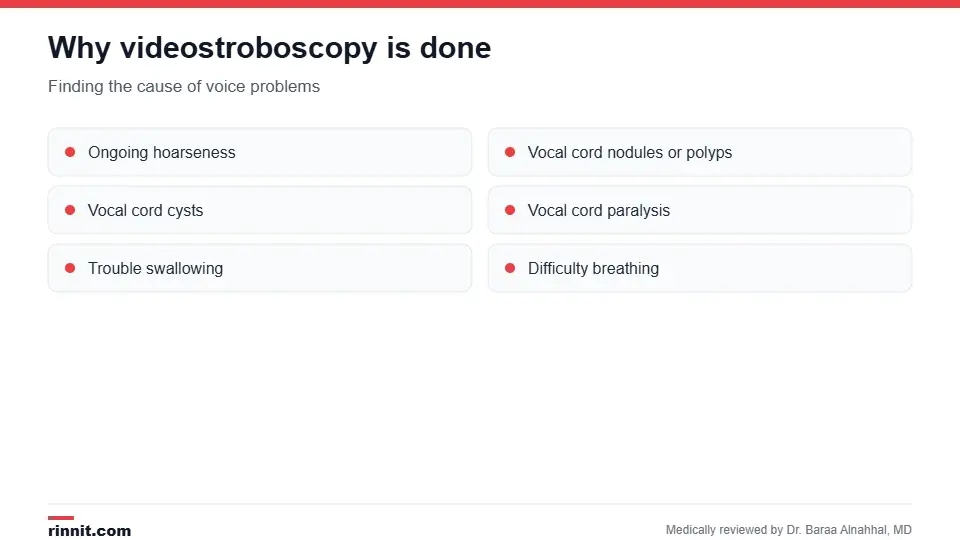
Videostroboscopy helps find the cause of voice problems.
Ongoing hoarseness or other voice disorders.
Benign vocal cord lesions such as nodules, polyps or cysts.
Vocal cord paralysis.
Difficulty breathing. Sources: [1]
The test may be done by a laryngologist, an ENT specialist, a speech-language pathologist or a nurse practitioner working with them. Sources: [1]
What happens during the test

The test is done in an exam room.
Numbing medicine is sprayed inside your nose and spreads to your throat.
A small microphone is placed around your neck to record your voice.
A thin, flexible scope is passed through your nose to the back of your throat.
You say sounds like "aah" or "eee" while video is recorded, for about 15 to 20 minutes.
The scope is gently removed. Sources: [1]
The scope doesn't touch your voice box or vocal cords. Children may find a comfort item, such as a favorite toy, helpful. Sources: [1]
After the test

Most people go back to normal activities right away.
Numbness may take 1 to 2 hours to wear off.
Drink only water or clear liquids until your throat feels normal, then eat.
Expect little to no pain.
Get care right away for trouble breathing, wheezing or worsening swallowing problems. Sources: [1]
Risks and results
The risk of problems is very low when an experienced provider does the test. Your provider may discuss results right away. Sometimes a diagnosis is clear immediately, and sometimes more tests are needed. Sources: [1, 2]
Conclusion
Videostroboscopy gives a detailed, slow-motion view of your vocal cords in action. It's quick, done in the office and helps your care team choose the right treatment for voice and throat problems.
Keep learning: read about laryngoscopy and hoarseness.
Frequently asked questions
What is videostroboscopy used for?
To see how your vocal cords vibrate and find the cause of voice problems.
Does videostroboscopy hurt?
Your nose and throat are numbed, so most people feel little to no pain.
How long does it take?
The recording takes about 15 to 20 minutes.
Do I need anesthesia?
No general anesthesia is needed; only numbing spray.
Do I need to prepare?
Little to no preparation is needed.
Can I eat afterward?
Wait until the numbness wears off, usually 1 to 2 hours.
Who performs the test?
A laryngologist, ENT specialist or trained speech-language pathologist.
How is it different from laryngoscopy?
It adds a strobe light to show vocal cord vibration in slow motion.
When will I get results?
Often right after the test.
When should I seek urgent care afterward?
For trouble breathing, wheezing or worsening swallowing.
Related Reading
Microlaryngoscopy: Vocal Fold Surgery, Recovery and Voice Rest explains the microscope-guided procedure to examine and treat the vocal folds.
Laryngoscopy: What It Is, Why It's Done, Types, Procedure and Results the standard exam of the voice box.
Hoarseness (Dysphonia): Causes, Symptoms, and Voice Recovery the most common reason for this test.
Vocal Cord Lesions: Understanding Nodules, Polyps, and Cysts growths videostroboscopy can find.
What Is Vocal Cord Paralysis? A Plain-Language Guide to the Voice Problem That Can Also Make Breathing and Swallowing Hard a condition this test helps diagnose.
Your Voice: Vocal Cords Anatomy, Function, and Health how the vocal cords make sound.
References
Cleveland Clinic. Videostroboscopy: Definition, Procedure & Uses. Cleveland Clinic. Last updated April 12, 2022. https://my.clevelandclinic.org/health/diagnostics/22869-videostroboscopy
Paul BC, Chen S, Sridharan S, et al. Diagnostic accuracy of history, laryngoscopy, and stroboscopy. Laryngoscope. 2013;123(1):215-219. PMID 23070976. https://doi.org/10.1002/lary.23630
Hernández Sandemetrio R, Nieto Curiel P, Dalmau Galofre J, et al. What is the contribution of stroboscopy in the diagnosis of voice disorders? Acta Otorrinolaringol Esp. 2010;61(2):145-148. PMID 20092807. https://doi.org/10.1016/j.otorri.2009.10.010
Medical disclaimer
This article is for general education only and does not replace advice from a qualified healthcare professional. Talk to your doctor about your own diagnosis and treatment, and seek emergency care right away for severe or sudden symptoms.



Comments