Microlaryngoscopy: Vocal Fold Surgery, Recovery and Voice Rest

Updated: 2 days ago
Written and medically reviewed by Dr. Baraa Alnahhal, MD · Last reviewed: November 2026 · How we review
Quick Answer
Microlaryngoscopy is a procedure in which a surgeon uses a microscope and a rigid tube through the mouth to examine the vocal folds (vocal cords), with no cuts on the skin. The surgeon can remove growths such as nodules, polyps or cysts or take a biopsy. It's done under general anesthesia, and most people go home the same day.
What the research says
Voice improves after surgery for polyps and cysts: in people who had microflap surgery for benign vocal fold polyps and cysts, Voice Handicap Index scores improved significantly for everyone, and the length of recommended strict voice rest afterward didn't change long-term voice outcomes (King RE et al., American Journal of Speech-Language Pathology, 2022) [2]
The procedure is safe in experienced hands: a prospective study of 150 microlaryngoscopy procedures found an adequate view of the larynx in 149 cases, no deaths and low complication rates; the most common problem was a temporary sore throat, with occasional temporary tongue or tooth symptoms (Maughan EF et al., Clinical Otolaryngology, 2022) [3]
Key takeaways
Microlaryngoscopy lets a surgeon examine and treat the vocal folds through the mouth.
It's done under general anesthesia, usually in an hour or less.
It can remove nodules, polyps or cysts and take biopsies.
Most people go home the same day with a sore throat for a few days.
Voice rest and reduced voice use for 2 to 6 weeks may be advised.
What is microlaryngoscopy?
A regular laryngoscopy or videostroboscopy can show a problem with your voice box. Microlaryngoscopy goes a step further: while you're asleep, a rigid tube called a laryngoscope is placed through your mouth, and a microscope gives a magnified view so the surgeon can precisely treat the problem using tiny instruments or a laser. Sources: [1]
Why it's done

The procedure can both diagnose and treat.
Noncancerous growths such as vocal fold nodules, polyps or cysts.
Vocal fold movement problems such as vocal cord paralysis.
Signs of laryngeal cancer, to take a biopsy.
Subglottic stenosis, a narrowing below the vocal folds. Sources: [1]
How to prepare
Stop smoking at least a day before; quitting two weeks before and after gives the best healing.
Don't eat or drink for at least 8 hours before, unless told otherwise.
Tell your provider about all medicines, vitamins and supplements; some may need to be stopped days ahead.
Arrange for someone to drive you home. Sources: [1]
What happens during the procedure

Most procedures take an hour or less.
You receive general anesthesia so you're asleep and comfortable.
The surgeon places a rigid laryngoscope through your mouth to view the larynx.
A microscope and light give a magnified view of your vocal folds.
Small instruments or a laser remove growths or take samples as needed. Sources: [1]
It's usually done at an outpatient surgery center. Sources: [1]
Recovery
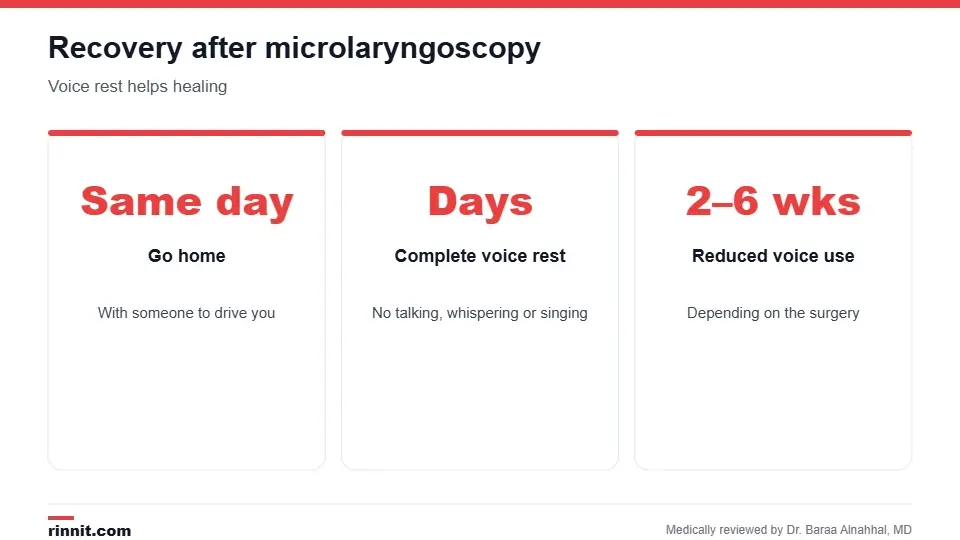
Following voice rest instructions helps healing.
Most people go home the same day after waking up.
A sore throat for a few days is common.
You can usually eat normally the same day or the next day.
Complete voice rest may be advised for a few days: no talking, whispering, singing, throat clearing or coughing if you can avoid it.
Reduced voice use may follow for 2 to 6 weeks, depending on the surgery. Sources: [1, 2]
Risks and results
The procedure is considered safe when done by an experienced surgeon. Possible problems include sore throat and, less often, temporary tongue numbness or dental injury. Your surgeon usually shares findings after you wake up, and biopsy results take a few days. Sources: [1, 3]
Conclusion
Microlaryngoscopy gives a close, magnified view of your vocal folds and lets your surgeon treat many voice problems in one short visit. Careful voice rest afterward helps you get the best result.
Keep learning: read about laryngoscopy and vocal cord lesions.
Frequently asked questions
What is microlaryngoscopy?
A procedure using a microscope to examine and treat the vocal folds through the mouth.
Will I be asleep?
Yes. It's done under general anesthesia.
Are there any cuts on my neck?
No. Everything is done through the mouth.
How long does it take?
Usually an hour or less.
Can I go home the same day?
Most people do, with a driver.
How long is voice rest?
Often a few days of complete rest, then reduced voice use for 2 to 6 weeks.
Will my throat hurt?
A sore throat for a few days is common.
When can I eat?
Usually the same day or the next day.
When will I get biopsy results?
Usually within a few days.
Should I stop smoking?
Yes. Quitting before and after surgery helps healing.
Related Reading
Laryngoscopy: What It Is, Why It's Done, Types, Procedure and Results the basic exam of the voice box.
Videostroboscopy: How It Shows Your Vocal Cords in Slow Motion the office test that often comes before surgery.
Vocal Cord Lesions: Understanding Nodules, Polyps, and Cysts growths microlaryngoscopy can remove.
Subglottic Stenosis: Understanding Airway Narrowing and Care an airway narrowing it can treat.
Understanding Laryngeal Cancer: Symptoms, Causes, and Treatment Options a cancer it can help diagnose.
References
Cleveland Clinic. Microlaryngoscopy: Procedure Details and Recovery. Cleveland Clinic. Last updated August 24, 2022. https://my.clevelandclinic.org/health/diagnostics/24071-microlaryngoscopy
King RE, Novaleski CK, Rousseau B. Voice Handicap Index changes after microflap surgery for benign vocal fold lesions are not associated with recommended absolute voice rest duration. American Journal of Speech-Language Pathology. 2022;31(2):912-922. PMID 35179998. https://doi.org/10.1044/2021_AJSLP-21-00115
Maughan EF, Rotman A, Rouhani MJ, et al. Suspension laryngoscopy experiences in a tertiary airway service: a prospective study of 150 procedures. Clinical Otolaryngology. 2022;47(1):52-60. PMID 34570956. https://doi.org/10.1111/coa.13867
Medical disclaimer
This article is for general education only and does not replace advice from a qualified healthcare professional. Talk to your doctor about your own diagnosis and treatment, and seek emergency care right away for severe or sudden symptoms.



Comments