Subglottic Stenosis: Understanding Airway Narrowing and Care

Updated: 3 days ago
Medically reviewed by Dr. Baraa Alnahhal, MD · Last reviewed: October 2026
Quick Answer
Subglottic stenosis is a narrowing of the windpipe just below the voice box, affecting about 1 in every 400,000 people. It may be present at birth, follow injury or prolonged breathing tube use, or have no known cause. Symptoms include stridor and persistent breathlessness. Treatment ranges from steroid injections to surgical reconstruction to widen the airway.
What the research says
Endoscopic treatment helps, but the narrowing often returns. A systematic review of 15 series of adults with idiopathic subglottic stenosis (mean age 47) found the time between endoscopic procedures averaged about 12 months, the stenosis came back in a weighted average of 68% of patients (range 40–100%), and patients needed a weighted average of 3.7 procedures; no single technique was clearly superior (Lavrysen et al., Front Surg, 2020) [2].
Office-based steroid injections may lengthen the time between operations. A systematic review of four studies (55 adults, mean age 50.4, 78.1% women) found the surgery-free interval rose from a mean of 362.9 days to 582.2 days with serial steroid injections, and 41 of 55 patients (74.5%) needed no further operative intervention during the studies; the data were limited (Luke et al., Ear Nose Throat J, 2023) [3].
Open surgery may mean fewer repeat operations than endoscopic treatment. In a systematic review of 39 studies (834 patients aged over 13), 32% of those who had laryngotracheal resection with anastomosis needed additional surgery, versus 38% after reconstruction with expansion grafting and 44% after endoscopic procedures; decannulation rates were 89%, 83%, and 63% (Lewis et al., Laryngoscope, 2017) [4]. The studies were non-randomized.
What is subglottic stenosis?
Subglottic stenosis is a rare breathing condition in which the trachea, or windpipe, is unusually narrow in the area just below the vocal cords. "Subglottic" refers to this location, and "stenosis" means narrowing. The narrowing can restrict airflow, producing symptoms that range from a mild whistling noise to severe, life-threatening breathing distress. [1]
The condition is classified by when and why it develops. Some babies are born with an unusually narrow airway, known as congenital subglottic stenosis. [1] Others develop it later because of injury or medical factors, which is called acquired subglottic stenosis. In some cases, particularly in females between the ages of 30 and 60, the narrowing develops for no known reason, which is called idiopathic subglottic stenosis. [1]

What causes subglottic stenosis?
The causes depend on whether the condition is present at birth or develops later. Congenital cases result from an airway that is naturally narrower than usual. Acquired cases are often linked to specific medical events or underlying health problems.
One of the most common causes of acquired stenosis is needing a breathing tube on a ventilator, particularly for more than two weeks. [1] Physical injury to the airway or scar tissue from rare autoimmune disorders or vasculitis can also lead to narrowing. [1]
Category | Common Causes and Factors |
|---|---|
Congenital | A naturally narrow airway present at birth. |
Medical Procedures | Prolonged intubation (more than two weeks) on a ventilator. [1] |
Trauma and Injury | Physical damage or injury to the windpipe. |
Systemic Health | Autoimmune disorders or vasculitis that cause scar tissue to build up. |
Idiopathic | No known cause, tending to affect females between ages 30 and 60. |
What are the symptoms of subglottic stenosis across age groups?
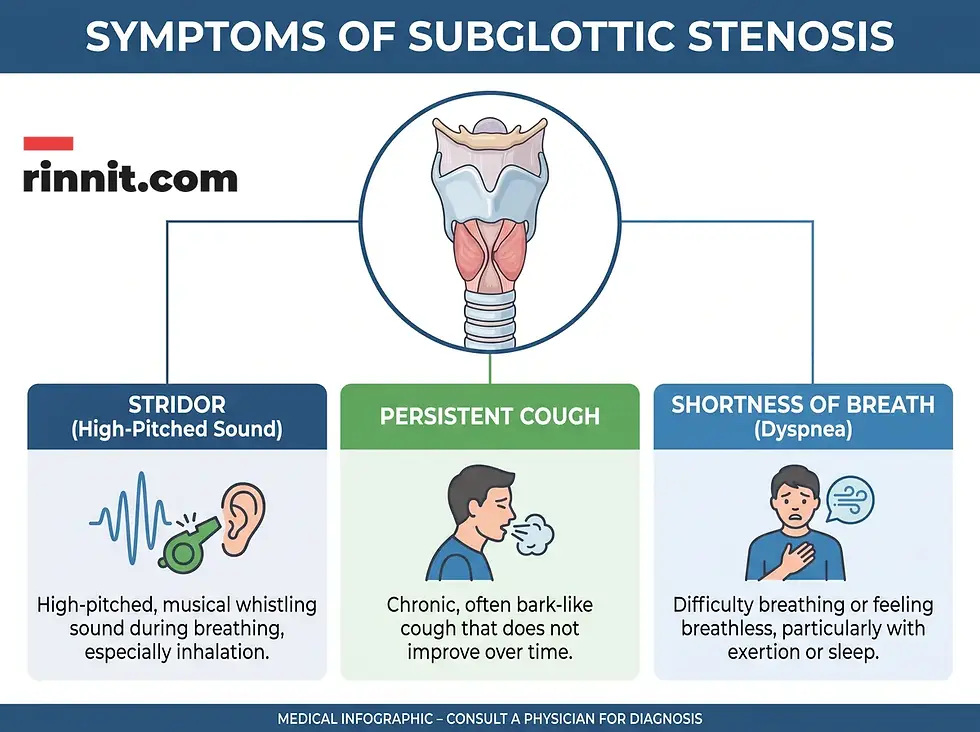
Symptoms depend on how narrow the airway is. Think of sipping water through a flexible straw: when the straw is wide open you get plenty, and the more you squeeze it, the less flows through. In severe cases the airway is nearly closed, so very little air reaches the lungs. [1]
Symptoms often differ between babies and older people. Babies often have noisy breathing, while older children and adults may have a persistent cough or shortness of breath that does not improve with inhalers or other asthma treatments, which is why some people are misdiagnosed at first.
Patient Group | Primary Symptoms |
|---|---|
Infants and Babies | Stridor (a high-pitched whistling noise), difficulty breathing, and recurring croup. [1] |
Adults and Older Children | A cough that does not go away, more mucus than usual, stridor, and shortness of breath that does not improve with inhalers. [1] |
All Ages | Shortness of breath (dyspnea) that may get worse with activity. |
How is subglottic stenosis diagnosed?
Diagnosis begins with a physical examination and a review of your medical history, especially any history of intubation or airway injury. Because the condition is rare, people are often referred to an ear, nose, and throat (ENT) specialist for definitive testing.
Specialists use several tools to see the airway and measure how well it works. A flexible laryngoscopy lets the provider look at the voice box and windpipe directly with a tiny camera. Pulmonary function tests measure how much air you can move in and out of your lungs, and reduced airflow is a sign of subglottic stenosis. [1] A CT scan may also be ordered to look at the structure of the airway. [1]
What are the treatment options for subglottic stenosis?
Treatment is tailored to how severe the narrowing is and to the person's overall health. Because the condition is rare, there is no single standard treatment [1], and providers often combine monitoring with active treatment.
For mild narrowing, regular check-ups may be enough. More active treatments include steroid injections to reduce inflammation, usually as a series every four to six weeks, and surgical procedures that widen the airway temporarily or permanently. [1]
Treatment Type | Description and Purpose |
|---|---|
Monitoring | Regular check-ups to make sure the narrowing is not getting worse. |
Steroid Injections | Injections through the neck into the airway to reduce swelling. |
Endoscopic Dilation | A tiny balloon is used to stretch the narrow windpipe temporarily, and the procedure may need to be repeated. [1] |
Surgical Reconstruction | Cricotracheal resection removes the narrowed section, and laryngotracheal reconstruction widens the airway with cartilage. [1] |

What is the outlook and long-term care for subglottic stenosis?
The outlook is generally positive when the condition is treated promptly, because treatment can effectively widen the airway and restore breathing. However, subglottic stenosis can come back, which means more treatment may be needed over time. [1] Keep your follow-up appointments, and contact your provider as soon as you notice changes such as stridor or breathing difficulty.
What are the next steps for subglottic stenosis?
If you or your child has persistent whistling sounds when breathing, or shortness of breath that does not improve with standard treatments, consult a healthcare provider promptly. Call 911 or go to the emergency room right away for severe trouble breathing, noisy breathing at rest that is getting worse, or bluish lips or skin. An early evaluation by an ENT specialist is the most effective way to manage airway narrowing and protect long-term breathing.
Frequently Asked Questions
1. What is subglottic stenosis?
Subglottic stenosis is a narrowing of the windpipe (trachea) just below the vocal cords.
2. What does "subglottic" mean?
The term subglottic refers to the part of the trachea located just below the voice box, while "stenosis" means narrowing.
3. Is it a common condition?
No. It is rare, affecting about 1 in every 400,000 people.
4. Can you be born with it?
Yes. A baby can be born with an unusually narrow airway, which is called congenital subglottic stenosis.
5. What causes the condition in children and adults?
Common causes include needing a breathing tube on a ventilator for more than two weeks, an injury that damages the airway, or a rare autoimmune disorder or vasculitis that causes scar tissue to build up in the airway.
6. What is idiopathic subglottic stenosis?
Idiopathic subglottic stenosis is a narrowing that develops for no known reason. These cases tend to affect females between the ages of 30 and 60.
7. What is stridor?
Stridor is a high-pitched whistling noise heard when breathing in or out.
8. Is subglottic stenosis life-threatening?
Severe cases can be life-threatening if the airway becomes nearly closed. Treatment to widen the narrow area can effectively treat the condition.
9. How do doctors diagnose it?
Doctors take a medical history and perform a physical exam, and an ear, nose, and throat (ENT) specialist may use flexible laryngoscopy, pulmonary function tests, and a CT scan.
10. What are steroid injections used for?
Steroid injections are often the first treatment tried. A steroid is injected through the neck into the airway to reduce inflammation, usually as a series of injections every four to six weeks.
11. What is endoscopic dilation?
Endoscopic dilation is a procedure in which a tiny balloon is placed in the narrow part of the windpipe through an endoscope and inflated to stretch it. It is not a permanent solution, so it may need to be repeated.
12. Is surgery permanent?
Surgery such as cricotracheal resection, which removes the narrowed section and reconnects the airway to the voice box, can work well, but subglottic stenosis can come back and may need more treatment.
13. Can children have the same treatments as adults?
The main approaches (monitoring, steroid injections, endoscopic dilation, and surgery) are used across age groups, but the choice depends on age, how narrow the airway is, and overall health.
14. What should I do if symptoms return?
Contact your healthcare provider as soon as you notice changes such as stridor or breathing problems, because you or your child may need more treatment to prevent the symptoms from getting worse.
15. Does the condition affect the voice?
The narrowing sits just below the vocal cords, so the main effect is on breathing, but some people also notice changes to their voice.
Trusted External Resources
Related Reading
Microlaryngoscopy: Vocal Fold Surgery, Recovery and Voice Rest explains the microscope-guided procedure to examine and treat the vocal folds.
Tracheostomy: Purpose, Procedure, Recovery and Living With a Trach explains how a tracheostomy bypasses a narrowed airway, the two main methods and how to care for the tube.
Learn more in our guide to Bronchoscopy: Why It's Done, What to Expect, Recovery and Risks.
References
Cleveland Clinic. Subglottic Stenosis. Cleveland Clinic. Last updated May 10, 2024. https://my.clevelandclinic.org/health/diseases/22031-subglottic-stenosis
Lavrysen E, Hens G, Delaere P, et al. Endoscopic treatment of idiopathic subglottic stenosis: a systematic review. Front Surg. 2020;6:75. PMID 31998744. https://doi.org/10.3389/fsurg.2019.00075
Luke AS, Varelas EA, Kaplan S, et al. Efficacy of office-based intralesional steroid injections in the management of subglottic stenosis: a systematic review. Ear Nose Throat J. 2023;102(6):372-378. PMID 33765859. https://doi.org/10.1177/01455613211005119
Lewis S, Earley M, Rosenfeld R, et al. Systematic review for surgical treatment of adult and adolescent laryngotracheal stenosis. Laryngoscope. 2017;127(1):191-198. PMID 27767216. https://doi.org/10.1002/lary.26151
Medical Disclaimer
This article is for informational purposes only and does not constitute medical advice. Always seek the advice of your physician or other qualified health provider with any questions you may have regarding a medical condition. Never disregard professional medical advice or delay in seeking it because of something you have read in this article. If you think you may have a medical emergency, call your doctor or emergency services immediately.



Comments