Tracheostomy: Purpose, Procedure, Recovery and Living With a Trach

Updated: 3 days ago
Written and medically reviewed by Dr. Baraa Alnahhal, MD · Last reviewed: November 2026 · How we review
Quick Answer: What is a tracheostomy?
A tracheostomy is an opening through the neck into the windpipe (trachea), with a tube placed in it to help you breathe. It's used when the airway is blocked, when someone needs a ventilator for more than a week or when mucus cannot be coughed up. Most are temporary, and the opening heals in about two weeks. [1]
What the research says
Earlier tracheostomy may improve survival on a ventilator. A review of 8 randomized trials with 1,977 critically ill adults found that a tracheostomy within 10 days of intubation lowered the risk of death by about 17% (RR 0.83) and raised the chance of leaving intensive care by day 28 (RR 1.29) compared with a later tracheostomy. (Andriolo et al., Cochrane Database of Systematic Reviews, 2015) [2]
The bedside method causes fewer wound problems. Across 20 randomized trials with 1,652 patients, percutaneous tracheostomy cut wound infection by about 76% (RR 0.24) and unfavorable scarring by about 75% (RR 0.25) compared with open surgery, with no clear difference in serious complications or death. (Brass et al., Cochrane Database of Systematic Reviews, 2016) [3]
Key takeaways
A tracheostomy creates a direct airway through the neck, bypassing the mouth, nose and throat. [1]
It is usually planned in advance but can be done in an emergency. [1]
Compared with a breathing tube through the mouth, it is more comfortable and can help people wean off a ventilator. [1]
Talking and eating take practice, and a speech-language pathologist can help with both. [1]
The tube must be cleaned at least twice a day, and problems such as trouble breathing or a dislodged tube need urgent attention. [1]
Why is a tracheostomy done?
A tracheostomy is done when a person cannot breathe well enough through the mouth and nose, or needs long-term breathing support. Common reasons include: [1]
A narrowed or blocked airway when a breathing tube through the mouth is not possible, for example from subglottic stenosis
Breathing trouble from a lung condition, paralysis, or a head or neck injury
Breathing support after surgery on the voice box or throat, such as for laryngeal cancer
Needing a ventilator for more than about a week, often because of respiratory failure
Difficulty clearing mucus by coughing, since the tube allows suctioning
Learn more about breathing machines in our guide to mechanical ventilation.
How does a tracheostomy work?
A tracheostomy works by creating a short, direct path for air into the windpipe below the voice box. Air flows in and out through the trach tube instead of the nose and mouth, and the tube can be connected to a ventilator if needed. [1]

The trach tube sits below the voice box and is held in place with a neck collar.
What are the types of tracheostomy?
There are two main ways to perform a tracheostomy: an open surgical tracheotomy and a percutaneous tracheostomy. [1] [3]
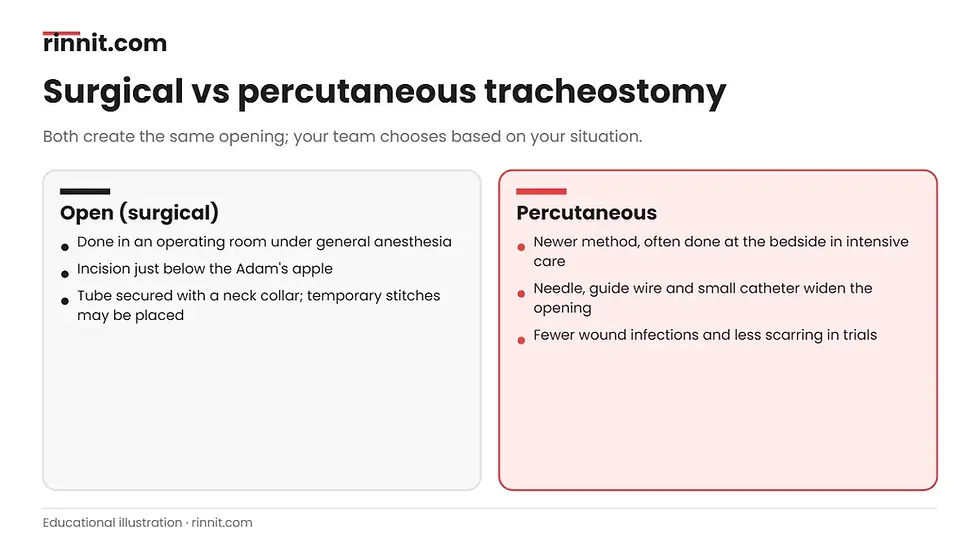
Both methods create the same opening; the choice depends on your situation.
Feature | Open (surgical) tracheotomy | Percutaneous tracheostomy |
Where it is done | Operating room | Often at the bedside |
Anesthesia | General anesthesia | As decided by your care team |
Technique | Incision just below the Adam's apple, then the opening is widened | Needle, guide wire and small catheter widen the opening |
Wound infection and scarring | More common | Less common in trials [3] |
Serious complications | No clear difference | No clear difference [3] |
Sources: [1]
How do you prepare for a tracheostomy?
If your tracheostomy is planned, follow your provider's instructions. Before general anesthesia you may need to stop eating or pause some medicines for several hours. Pack: [1]
Comfortable clothing and toiletries
Your medicines and supplements
Something to pass the time
A way to communicate without speaking, such as pen and paper, a phone or a tablet
What happens during a tracheostomy?
In an open tracheotomy, you are asleep under general anesthesia in an operating room: [1]
The surgeon makes an incision in the neck just below the Adam's apple.
The opening into the windpipe is widened.
The trach tube is placed and secured with a collar around the neck; temporary stitches may be added.
If you cannot breathe on your own, the tube is connected to a ventilator.
In a percutaneous tracheostomy, the care team uses a needle, a guide wire and a small catheter to gradually widen the opening before inserting the tube, often without moving you to an operating room. [1]
What is recovery like after a tracheostomy?
Recovery after a tracheostomy usually means a hospital stay of a few days to a few weeks, depending on the reason for the procedure. The opening heals in about two weeks. Neck soreness is common, and getting used to breathing through the tube may take a day or two. [1]

A speech-language pathologist can help with talking and swallowing.
Milestone | Typical timing |
Getting used to breathing through the tube | 1–2 days |
Hospital stay | A few days to a few weeks |
Opening heals | About 2 weeks |
Tube cleaning | At least twice a day, ongoing |
Tube changes | At scheduled visits with your provider |
Sources: [1]
What is it like living with a tracheostomy?
Talking
Speaking with a trach takes practice. You may talk by covering the tube opening with a finger or by using a speaking valve, which lets you speak without covering the opening. Until you learn these, you communicate by writing. [1]
Eating and swallowing
Eating and swallowing may take time to return to normal. Some people need IV nutrition or a feeding tube at first, and swallowing exercises with a speech-language pathologist can help. [1]
Tube care and activity
Clean the tube at least twice a day, and your provider will change it at scheduled visits. Rest often, take a short walk each day to help keep your lungs clear and avoid overexertion. [1]
Removing mucus from the tube is covered step by step in our guide to tracheostomy suctioning.
What are the risks of a tracheostomy?
Keeping the tube clean and following your care instructions lowers the risk of complications. Possible problems include: [1]
Risk | What it means |
Bleeding and infection | At or around the opening |
Blocked tube | Mucus or blood clots plugging the trach |
Tracheal narrowing | Scar tissue or inflammation narrowing the windpipe |
Nerve injury | Damage to the recurrent laryngeal nerve, which controls the voice box |
Trapped air | Air collecting under the skin, in the chest or around the lungs |
Damage to nearby structures | Injury to the windpipe or esophagus, or an abnormal opening between them |
Sources: [1]
How is a tracheostomy tube removed?
When a tracheostomy is temporary, the tube is removed once the airway is open and you can breathe on your own. The hole often closes by itself within weeks; sometimes a small procedure is needed to close it. Most people are left with a small scar. [1]
When should you call a doctor about a tracheostomy?
Contact your provider right away if you have: [1]
Trouble breathing
An irregular heartbeat
Severe pain that medicine does not relieve
Mucus plugs, crusting or swelling at the opening
Signs of infection, such as fever, redness, warmth or pus
A tube that shifts or slips out
If breathing becomes very difficult or the tube comes out and you cannot breathe, call your local emergency number.
Conclusion
A tracheostomy gives a secure airway when breathing through the mouth and nose is not enough, and it often makes long-term breathing support more comfortable. Most are temporary. Learning tube care, speech and swallowing techniques, and the warning signs that need urgent help makes life with a trach safer and easier.
Keep learning: Read our step-by-step guide to tracheostomy suctioning or learn how breathing machines work in our mechanical ventilation guide. For more background, see this tracheostomy overview from MedlinePlus.
FAQ
What is a tracheostomy?
A tracheostomy is an opening made through the front of the neck into the windpipe, with a tube placed in it to help you breathe.
What is the difference between a tracheostomy and a tracheotomy?
A tracheotomy is the procedure that creates the opening, and a tracheostomy is the opening itself, though the terms are often used interchangeably.
Why would someone need a tracheostomy?
Reasons include a blocked or narrowed airway, needing a ventilator for more than about a week, breathing problems from lung disease or injury, and trouble clearing mucus.
Is a tracheostomy permanent?
Most tracheostomies are temporary. The tube is removed once the airway is open, though some people need one long term.
How is a tracheostomy done?
It is done either as open surgery in an operating room under general anesthesia or as a percutaneous procedure, often at the bedside, using a needle and guide wire.
How long is the hospital stay after a tracheostomy?
Most people stay a few days to a few weeks, depending on why the tracheostomy was needed. The opening heals in about two weeks.
Can you talk with a tracheostomy?
Yes, with practice. You can speak by covering the tube opening with a finger or by using a speaking valve, often taught by a speech-language pathologist.
Can you eat with a tracheostomy?
Many people can, but eating and swallowing may take time to return to normal. Some need a feeding tube or IV nutrition at first.
What are the risks of a tracheostomy?
Risks include bleeding, infection, a blocked tube, windpipe narrowing, nerve injury, air trapped under the skin or in the chest and an abnormal connection to the esophagus.
How do I prepare for a tracheostomy?
Your provider tells you how to prepare for a planned tracheostomy; before general anesthesia you may need to fast or stop certain medicines for several hours. [1] Pack comfortable pajamas, hygiene products, your medicines and supplements, something to read, and a pen and paper or a phone or tablet, because you can't talk right after surgery. [1]
Does a tracheostomy hurt, and what anesthesia is used?
An open tracheotomy is usually done under general anesthesia, so you are asleep. [1] It's common to feel neck soreness while you heal, and severe pain that medicine doesn't relieve is a reason to contact your provider. [1]
When should I get help for a tracheostomy problem?
Contact your provider right away for trouble breathing, a mucus plug, a tube that shifts or comes out, severe pain, an irregular heartbeat or signs of infection.
Related Reading
Heliox Therapy: Uses, How It Works and Risks explains heliox breathing therapy.
Glossectomy: Types, Surgery and Recovery explains glossectomy surgery for tongue cancer.
Respiratory Failure: Symptoms, Causes, and Management explains when the lungs cannot supply enough oxygen and why long-term ventilator support may lead to a tracheostomy.
Subglottic Stenosis: Understanding Airway Narrowing and Care covers narrowing of the airway below the vocal cords, a condition that can require a tracheostomy.
Understanding Laryngeal Cancer: Symptoms, Causes, and Treatment Options describes voice box cancer, where a tracheostomy may be needed during or after treatment.
References
Cleveland Clinic. Tracheostomy: What It Is, Purpose & Procedure. Cleveland Clinic. Last updated February 12, 2025. https://my.clevelandclinic.org/health/procedures/tracheostomy
Andriolo BNG, Andriolo RB, Saconato H, et al. Early versus late tracheostomy for critically ill patients. Cochrane Database Syst Rev. 2015;1(1):CD007271. PMID 25581416. https://doi.org/10.1002/14651858.CD007271.pub3
Brass P, Hellmich M, Ladra A, et al. Percutaneous techniques versus surgical techniques for tracheostomy. Cochrane Database Syst Rev. 2016;7(7):CD008045. PMID 27437615. https://doi.org/10.1002/14651858.CD008045.pub2
Medical disclaimer
This article is for general education only and does not replace advice from a qualified healthcare professional. Talk to your doctor about your own diagnosis and treatment, and seek emergency care right away for severe or sudden symptoms.



Comments