Mechanical Ventilation: How a Ventilator Works, Types, Risks and Recovery

Updated: 6 days ago
Written and medically reviewed by Dr. Baraa Alnahhal, MD · Last reviewed: October 2026 · How we review
Quick Answer: What is mechanical ventilation?
Mechanical ventilation is a form of life support in which a machine called a ventilator helps a person breathe, or breathes for them, when they cannot breathe well enough alone. It delivers oxygen, removes carbon dioxide and keeps the lungs' air sacs open. It does not cure illness; it supports the body while other treatments work. [1][2]
What the research says
Gentler ventilator settings save lives in severe lung injury. In a randomized trial of 861 adults with acute lung injury or acute respiratory distress syndrome (ARDS), using smaller breaths (about 6 mL per kg of predicted body weight instead of 12 mL) lowered deaths from 39.8% to 31.0% and gave patients more days off the ventilator in the first 28 days. (Acute Respiratory Distress Syndrome Network, N Engl J Med, 2000) [4]
Daily "wake up and breathe" checks shorten ventilator time. In 336 ICU patients, pairing a daily pause in sedation with a daily breathing trial added 3.1 days of unassisted breathing over 28 days, shortened the median ICU stay from 12.9 to 9.1 days, and lowered the risk of death over the following year (hazard ratio 0.68). (Girard et al., Lancet, 2008) [5]
Mask ventilation can prevent a breathing tube in COPD flare-ups. Across 17 randomized trials (1,264 people) with acute high-carbon-dioxide breathing failure from a COPD flare-up, noninvasive ventilation cut the risk of death by 46% and the need for intubation by 65%. (Osadnik et al., Cochrane Database Syst Rev, 2017) [6]
Key takeaways
A ventilator supports breathing; it does not treat the disease itself. [1][3]
Ventilation can be invasive (a tube in the windpipe) or noninvasive (a tight-fitting face mask). [1]
People need it during surgery, severe lung infections, brain injuries, emergencies that block the airway, and other conditions that cause low oxygen or high carbon dioxide. [1]
The care team tests breathing at least daily and removes support as early as it is safe. [1][2]
Risks include lung infection, lung damage, a collapsed lung and effects on the heart and blood pressure. [1][2]
What does a ventilator do?
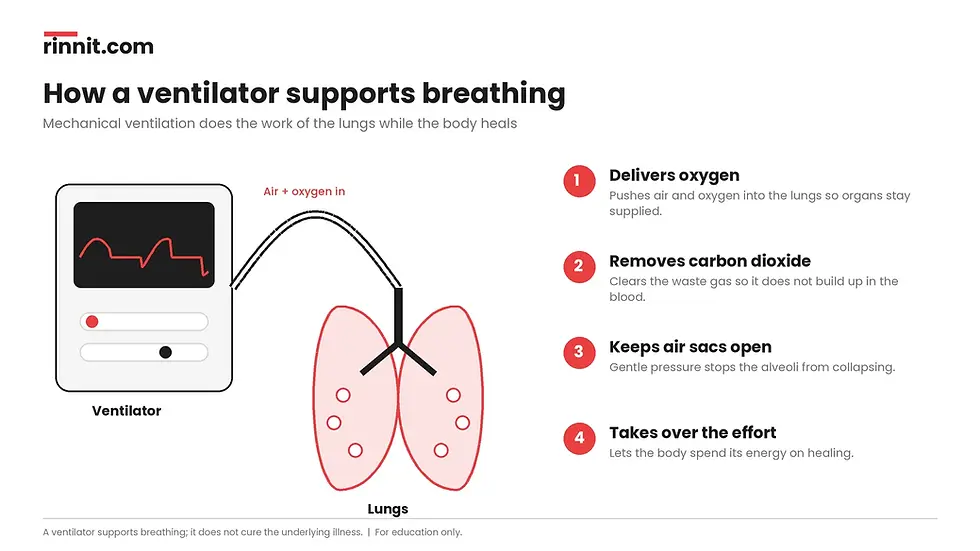
A ventilator is a machine that partly or fully takes over the work of the lungs, much like crutches take weight off an injured leg. [1] The team adjusts its settings to each person's needs. [1]
Job of the ventilator | Why it matters |
Delivers oxygen to the lungs | Keeps vital organs supplied when the lungs can't keep up [1] |
Removes carbon dioxide | |
Keeps air sacs (alveoli) open with pressure | Prevents parts of the lung from collapsing [1] |
Takes over the effort of breathing | Lets the body spend its energy on fighting infection and healing [2] |
Ventilators are mainly used in hospitals, often for short periods such as surgery under general anesthesia. [3] Some people need one long term, and in those cases it can be used in long-term care facilities or at home. [3]
What is the difference between mechanical ventilation and intubation?
Intubation is placing a breathing tube into the windpipe (trachea); mechanical ventilation is the breathing support the machine delivers through that tube. [1] The two often happen together, but they are not the same thing. [1]
After intubation, the tube is connected to the ventilator. [1] In some cases, a face mask connects the person to the ventilator instead, and no tube is needed. [1]
What are the types of mechanical ventilation?
Mechanical ventilation comes in two main types, invasive and noninvasive, and both use positive pressure to push air into the lungs. [1]
Feature | Invasive ventilation | Noninvasive ventilation |
How it connects | A tube through the mouth into the windpipe (endotracheal tube), or through the neck (tracheostomy) [1] | A face mask held tightly in place with straps [1] |
Common examples | ICU ventilation after intubation; long-term support through a tracheostomy [1] | CPAP and BiPAP devices, including ones used at home [1] |
Eating and talking | Not possible by mouth while a tube passes the vocal cords [2] | Mask is removable between sessions |
Typical setting | Intensive care unit (ICU) [1] | Hospital wards, ICU or home [1] |
A tracheostomy tube can stay in as long as needed, but it does not have to be permanent. [2] It is also possible for a person to talk and eat with a tracheostomy tube. [2] For home care of these tubes, see our guide to tracheostomy suctioning.

Who needs mechanical ventilation?
Mechanical ventilation is needed when a person cannot breathe well enough on their own, whether during surgery, a serious illness or an emergency. [1] Low oxygen levels or severe shortness of breath from an infection such as pneumonia are among the most common reasons. [2]
Common situations
Surgery: general anesthesia reduces the ability to breathe deeply enough alone. [1]
Lung conditions or infections that make breathing too hard. [1]
Emergencies that block the airway or impair breathing. [1]
Brain injuries or conditions that stop the brain from signaling the lungs properly. [1]
Abnormal blood gases: too much carbon dioxide (hypercapnia) or too little oxygen (hypoxemia). [1]
Protecting the lungs from inhaling food, saliva or other mouth contents (aspiration). [1]
Specific conditions that may require it
How is a person placed on a ventilator?
Starting invasive mechanical ventilation usually follows three steps: medication, tube placement and connection to the machine. [1]
Medication: the person receives a sedative to relax them and a short-acting paralytic to stop movement. Sedation usually continues, but the paralytic wears off once the ventilator is running. [1]
Tube placement: a provider passes an endotracheal (ET) tube through the mouth (or sometimes the nose) into the windpipe. [1][2]
Connection: the tube is attached to the ventilator, which supports breathing until the team decides it is safe to breathe alone. [1]
These steps can differ slightly depending on the situation, especially in an emergency. [1]
What happens while a person is on a ventilator?
While a person is on a ventilator, the ICU team monitors them closely and carries out routine care to treat illness and prevent complications. [1]
Care task | What it involves |
Monitoring | |
Suctioning | A thin catheter passed into the breathing tube removes mucus; it can cause coughing or gagging [1] |
Medications | Sprayed (aerosolized) medicines through the tube and medicines through an IV [1] |
Nutrition | Liquid nutrition, usually through a tube from the nose to the stomach; fluids by IV [1] |
Mobilization | Sitting the person up regularly and sometimes helping them walk [1] |
Bronchoscopy | A thin, lighted camera passed through the tube to view the airways and sometimes take samples [1] |
The ventilator itself does not cause pain, but the tube can feel uncomfortable and may trigger coughing or gagging. [2] Watching suctioning can be hard for loved ones, which is normal. [1]
Who cares for a person on a ventilator?
People on mechanical ventilation are cared for in the ICU by staff specially trained in ventilator care. [1] The team usually includes respiratory therapists, physicians (anesthesiologists, pulmonologists and critical care doctors), nurse practitioners, registered nurses and nurse aides. [1]
Are people awake on a ventilator?
Many people on a ventilator are awake but sleepy, because the team aims to keep them as alert as possible while calm and comfortable. [1] They may feel confused or not fully aware of what is happening. [1]
When illness is severe, deep sedation may be needed so the body can rest and recover. [1] Arms may be gently restrained to prevent the person from pulling out the tube. [1] Medicines that stop muscle movement are sometimes used in very severe lung injury and are stopped as soon as possible. [2]
How long can a person stay on a ventilator?
Time on a ventilator ranges from hours to days or weeks, and rarely months or years, depending on the reason it was needed. [1] The goal is always the shortest safe time, and breathing ability is tested daily or more often. [1]
How long a person needs support can depend on their overall strength, how healthy their lungs were beforehand, and how many other organs are affected. [2] If support is needed for about two weeks or longer, the breathing tube is usually switched to a tracheostomy tube in the neck. [1]
How does a person come off a ventilator?
Coming off a ventilator, called weaning, starts with breathing tests done while the tube is still in place. [1][2] When the person's condition improves and they can breathe on their own, the team removes the tube, a step called extubation. [1]
After extubation:

What are the benefits of mechanical ventilation?
The main benefit of mechanical ventilation is that it removes the work of breathing so the body can focus on healing. [1]
What are the risks of mechanical ventilation?
Mechanical ventilation can cause infection, lung injury and changes in heart function, even though care teams take steps to prevent them. [1]
Risk | What happens | How care teams respond |
Lung infection (pneumonia) | The tube can carry bacteria into the lungs [1] | |
Lung damage | Using the lowest pressure and oxygen needed [2] | |
Collapsed lung (pneumothorax) | A weak area of lung develops a hole and air leaks out [1] | A chest tube drains the air until the lung heals [2] |
Heart and blood flow changes | Lower blood pressure, faster heart rate, less oxygen reaching tissues [1] | Close monitoring of heart and blood pressure [1] |
Medicine side effects | Sedatives can cause confusion or delirium; muscle-blocking drugs can leave weakness [2] | Adjusting doses to each person [2] |
Difficulty coming off |
When someone is unlikely to recover, a ventilator may prolong the dying process and cause unnecessary suffering. [1] In that situation, the care team guides the family through decisions about continuing support. [1][2]
What is PEEP, and how is it different from CPAP?
PEEP (positive end-expiratory pressure) is a ventilator setting that keeps gentle pressure in the lungs as a person breathes out, so the air sacs stay open. [1] This helps conditions like ARDS, where air sacs tend to collapse and block oxygen from reaching the blood. [1] Its risks include lung overinflation leading to a collapsed lung, and low blood pressure. [1]
PEEP | CPAP | |
When pressure is applied | Only when breathing out [1] | Same pressure breathing in and out [1] |
Typical use | A setting on many ventilator modes for people who can't breathe on their own [1] | Keeping the airway open, as in obstructive sleep apnea, often with noninvasive ventilation [1] |
How long does recovery take after mechanical ventilation?
Recovery time after mechanical ventilation depends on why it was needed and how long it lasted. [1] Muscle weakness from certain medicines may improve over time, but in some cases it lasts weeks to months. [2] The care team can explain what to expect and how to recover safely. [1]
How can you make your wishes about ventilator use known?
You can make your wishes known by talking with your family and doctor and putting them in writing through an advance directive. [1][2] Mechanical ventilation is a life-sustaining treatment, and some people with severe illness choose not to use it because it cannot fix the underlying disease. [2]
Naming a healthcare power of attorney helps loved ones make decisions if you cannot speak for yourself. [1] If you cannot communicate, the team will speak with your legally authorized representative. [2]
Conclusion
Mechanical ventilation is a bridge, not a cure: it breathes for the body while doctors treat the illness underneath. Knowing the two main types, what daily ICU care involves, how weaning works and which risks the team watches for can make a frightening time easier to understand. If someone you love is on a ventilator, ask the care team why it is needed, share your concerns, and talk about their wishes early.
Want to understand the conditions that most often lead to a ventilator? Read our guides on respiratory failure, pneumonia and hypoxemia, and share this guide with family members who may be facing ICU decisions.
FAQ
Is mechanical ventilation the same as life support?
Yes, mechanical ventilation is a form of life support that helps a person breathe when they cannot breathe on their own. [1] It keeps the body stable while other treatments work on the underlying illness. [1]
Does being on a ventilator hurt?
The ventilator itself does not cause pain, but the breathing tube can be uncomfortable and may cause coughing or gagging. [2] Medicines are used to keep the person calm and comfortable. [1][2]
Can a person talk or eat while on a ventilator?
A person cannot talk or eat by mouth while an endotracheal tube passes between the vocal cords. [2] Nutrition is given through a tube into the stomach, and talking and eating can be possible with a tracheostomy tube. [1][2]
How long can someone be on a ventilator?
Someone can be on a ventilator for hours, days or weeks, and rarely for months or years, depending on the cause. [1] After about two weeks, the tube is usually changed to a tracheostomy in the neck. [1]
What is the difference between invasive and noninvasive ventilation?
Invasive ventilation uses a tube in the windpipe through the mouth or neck, while noninvasive ventilation uses a tight-fitting face mask. [1] CPAP and BiPAP are common noninvasive types. [1]
What are the most common risks of a ventilator?
The most common risks of a ventilator are lung infection, lung damage from pressure, a collapsed lung and changes in heart function. [1] Care teams reduce these risks with close monitoring and the lowest settings needed. [1][2]
What happens when the breathing tube is removed?
When the breathing tube is removed, a step called extubation, a sore throat and hoarse voice are common. [1] Some people need an oxygen mask or noninvasive ventilation for a while, and a few need the tube replaced. [1]
Are people awake on a ventilator?
Many people on a ventilator are awake but sleepy, because the care team keeps them as alert as is safe while staying calm and comfortable. When illness is severe, deeper sedation may be needed.
How does a person come off a ventilator?
Coming off a ventilator is called weaning. The team runs breathing tests while the tube is still in place, then removes it once the person can breathe well on their own.
What is a tracheostomy, and why might it be needed?
A tracheostomy is a breathing tube placed through the front of the neck. It may be used when someone needs a ventilator for a long time, and it does not have to be permanent.
Related Reading
Extubation: When a Breathing Tube Comes Out, Risks and Recovery explains how breathing tubes are removed.
BiPAP Machine: Uses, How It Works and Side Effects explains BiPAP machines and how they support breathing.
References
Cleveland Clinic. Mechanical Ventilation: Purpose, Types & Complications. Cleveland Clinic. Last updated September 27, 2024. https://my.clevelandclinic.org/health/treatments/15368-mechanical-ventilation
American Thoracic Society. Mechanical Ventilation. ATS Patient Education Series. Last updated April 2020. https://www.thoracic.org/patients/patient-resources/resources/mechanical-ventilation.pdf
National Heart, Lung, and Blood Institute. Ventilator/Ventilator Support - What Is a Ventilator? NHLBI, NIH. Last updated March 24, 2022. https://www.nhlbi.nih.gov/health/ventilator
Acute Respiratory Distress Syndrome Network; Brower RG, Matthay MA, Morris A, et al. Ventilation with lower tidal volumes as compared with traditional tidal volumes for acute lung injury and the acute respiratory distress syndrome. N Engl J Med. 2000;342(18):1301-1308. PMID 10793162. https://doi.org/10.1056/NEJM200005043421801
Girard TD, Kress JP, Fuchs BD, et al. Efficacy and safety of a paired sedation and ventilator weaning protocol for mechanically ventilated patients in intensive care (Awakening and Breathing Controlled trial): a randomised controlled trial. Lancet. 2008;371(9607):126-134. PMID 18191684. https://doi.org/10.1016/S0140-6736(08)60105-1
Osadnik CR, Tee VS, Carson-Chahhoud KV, et al. Non-invasive ventilation for the management of acute hypercapnic respiratory failure due to exacerbation of chronic obstructive pulmonary disease. Cochrane Database Syst Rev. 2017;7(7):CD004104. PMID 28702957. https://doi.org/10.1002/14651858.CD004104.pub4
Disclaimer
This article is for general education only and is not a substitute for professional medical advice, diagnosis or treatment. Decisions about mechanical ventilation are made by a qualified medical team together with the patient or their representative. If someone is struggling to breathe, call your local emergency number right away.



Comments