BiPAP Machine: Uses, How It Works and Side Effects

Updated: 2 days ago
Written and medically reviewed by Dr. Baraa Alnahhal, MD · Last reviewed: November 2026 · How we review
Quick Answer
A BiPAP machine (bilevel positive airway pressure) is a type of noninvasive ventilation that delivers air through a face mask at two pressures: higher when you breathe in and lower when you breathe out. It's used for COPD, heart failure, sleep apnea and hypercapnic respiratory failure. BiPAP isn't life support; it doesn't fully take over breathing.
What the research says
BiPAP-type ventilation saved lives in COPD flare-ups: a Cochrane review of 17 trials with 1,264 people with COPD flare-ups and high carbon dioxide found noninvasive ventilation cut the risk of death by 46% and the need for a breathing tube by 65%, and shortened hospital stays by 3.39 days (Osadnik CR et al., Cochrane Database of Systematic Reviews, 2017) [2]
Home ventilation kept people out of the hospital longer: in the HOT-HMV trial of 116 people with high carbon dioxide after a COPD flare-up, adding home noninvasive ventilation to oxygen lengthened the time to readmission or death from 1.4 to 4.3 months (Murphy PB et al., JAMA, 2017) [3]
Key takeaways
BiPAP delivers air through a mask using two pressures.
It helps people who breathe on their own but need support.
It treats COPD, heart failure, sleep apnea and respiratory failure.
It's an option when CPAP doesn't work.
Use it every night for sleep apnea.
What is a BiPAP machine?
BiPAP is a trade name for bilevel positive airway pressure (BPAP). It keeps your airway open and moves air in and out of your lungs. It requires you to be breathing on your own, so it isn't life support. Sources: [1]
What it treats
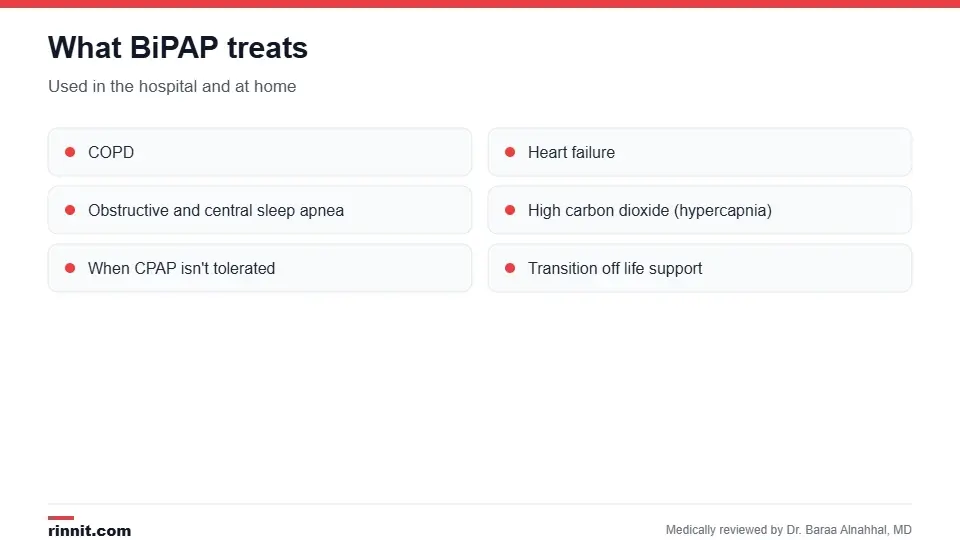
It's used in the hospital and at home.
COPD.
Heart failure.
Obstructive and central sleep apnea.
Hypercapnic respiratory failure, when carbon dioxide builds up.
Helping someone transition off a ventilator. Sources: [1]
BiPAP vs. CPAP

BiPAP is an option when CPAP isn't working.
;; BiPAP | ||
Pressure | Two levels: higher to inhale, lower to exhale | One constant pressure |
Settings | Timed or automatically adjusted to your breathing | Fixed |
Common use | COPD, heart failure, respiratory failure, CPAP intolerance | Most people with sleep apnea |
Sources: [1]
How to use a BiPAP machine
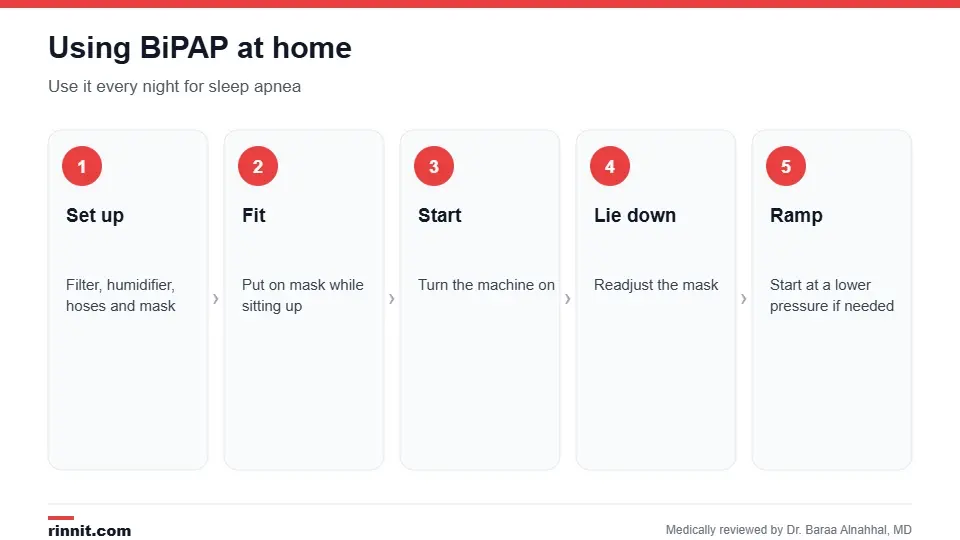
Masks cover the nose only or the nose and mouth.
Set up the machine, which includes a filter, humidifier, hoses and mask.
Put on and adjust the mask, usually while sitting up.
Turn the machine on.
Lie down and readjust the mask. Sources: [1]
Use it every night for sleep apnea; skipping nights makes adjusting harder.
Practice wearing the mask during the day with the machine off.
Try the ramp feature, which starts at a lower pressure.
Ask your provider or supplier about mask options. Sources: [1]
In the hospital, your provider adjusts the settings and fits the mask so it's not too tight or loose. Sources: [1]
Risks and side effects
Risk | Notes |
Discomfort | Some people have trouble tolerating the mask |
Claustrophobia | Practicing with the mask can help |
Lung injury | Rare; from too much pressure |
Low blood pressure | Possible |
Aspiration pneumonia | Possible |
BiPAP can't be used if you're not breathing on your own. Sources: [1]
Results
BiPAP is noninvasive and has fewer risks than a breathing tube. With sleep apnea, people usually feel better in a few days to a few weeks, with more energy and fewer naps. COPD flare-ups can take days or weeks to improve, even with BiPAP. Sources: [1, 2, 3]
When to call your provider
Your sleep apnea or COPD isn't well controlled.
The mask or machine isn't working well for you. Sources: [1]
Conclusion
A BiPAP machine supports your breathing without a tube and can be lifesaving during COPD flare-ups. Using it consistently and finding a comfortable mask help you get the most benefit.
Keep learning: read about CPAP machines and sleep apnea.
Frequently asked questions
What is a BiPAP machine?
A machine that delivers air through a mask at two pressure levels.
What does BiPAP stand for?
Bilevel positive airway pressure.
What's the difference between BiPAP and CPAP?
BiPAP uses two pressures; CPAP uses one constant pressure.
Is BiPAP life support?
No. You must be breathing on your own.
What conditions does BiPAP treat?
COPD, heart failure, sleep apnea and respiratory failure.
How often should I use BiPAP for sleep apnea?
Every night.
How long until I feel better?
A few days to a few weeks for sleep apnea.
What if I feel claustrophobic?
Practice wearing the mask and ask about other mask styles.
What is the ramp feature?
A setting that starts at a lower pressure.
Are there risks?
Discomfort, low blood pressure and, rarely, lung injury.
Related Reading
Positive Airway Pressure (PAP) Therapy: CPAP, BPAP and Benefits explains positive airway pressure therapy.
Heliox Therapy: Uses, How It Works and Risks explains heliox breathing therapy.
Extubation: When a Breathing Tube Comes Out, Risks and Recovery explains how breathing tubes are removed.
CPAP Machine: How It Works, Masks and Side Effects the most common sleep apnea machine.
Obstructive Sleep Apnea: Symptoms, Causes, and What Actually Helps a condition BiPAP treats.
What Is Chronic Obstructive Pulmonary Disease (COPD)? Symptoms, Causes, Stages, and Treatment a lung disease treated with BiPAP.
Understanding Hypercapnia: Causes, Symptoms, and Management carbon dioxide buildup.
Mechanical Ventilation: How a Ventilator Works, Types, Risks and Recovery breathing support with a tube.
References
Cleveland Clinic. BiPAP Machine: Uses, Benefits, Side Effects & Alternatives. Cleveland Clinic. Last updated May 10, 2023. https://my.clevelandclinic.org/health/treatments/24970-bipap
Osadnik CR, Tee VS, Carson-Chahhoud KV, et al. Non-invasive ventilation for the management of acute hypercapnic respiratory failure due to exacerbation of chronic obstructive pulmonary disease. Cochrane Database Syst Rev. 2017;7(7):CD004104. PMID 28702957. https://doi.org/10.1002/14651858.CD004104.pub4
Murphy PB, Rehal S, Arbane G, et al. Effect of home noninvasive ventilation with oxygen therapy vs oxygen therapy alone on hospital readmission or death after an acute COPD exacerbation: a randomized clinical trial. JAMA. 2017;317(21):2177-2186. PMID 28528348. https://doi.org/10.1001/jama.2017.4451
Medical disclaimer
This article is for general education only and does not replace advice from a qualified healthcare professional. Talk to your doctor about your own diagnosis and treatment, and seek emergency care right away for severe or sudden symptoms.



Comments