Extubation: When a Breathing Tube Comes Out, Risks and Recovery

Updated: 2 days ago
Written and medically reviewed by Dr. Baraa Alnahhal, MD · Last reviewed: November 2026 · How we review
Quick Answer
Extubation is the removal of a breathing tube (endotracheal tube) from the throat and windpipe once the care team decides you can breathe safely on your own. A sore throat for a few days is common. In intensive care, extubation succeeds about 85% of the time; about 12% to 14% of people need the tube put back in.
What the research says
High-flow oxygen cut reintubation in low-risk patients: in a trial of 527 low-risk ICU patients, high-flow nasal oxygen after extubation lowered the need for reintubation within 72 hours from 12.2% to 4.9% compared with standard oxygen (Hernández G et al., JAMA, 2016) [2]
High-flow oxygen matched noninvasive ventilation in high-risk patients: in a trial of 604 high-risk ICU patients, reintubation was 22.8% with high-flow nasal oxygen versus 19.1% with noninvasive ventilation, and breathing failure after extubation was lower with high-flow (26.9% vs. 39.8%) (Hernández G et al., JAMA, 2016) [3]
Key takeaways
Extubation removes a breathing tube when you can breathe on your own.
A breathing test and gag reflex check come first.
A sore throat for a few days is common.
You may need extra oxygen afterward.
About 85% of ICU extubations succeed.
What is extubation?
An endotracheal tube (ETT) connects you to a ventilator when you can't breathe well enough on your own. Removing it lets you breathe, eat, drink and talk again. It also avoids the risks of keeping the tube in, such as pneumonia and vocal cord problems. Sources: [1]
Why a breathing tube is used
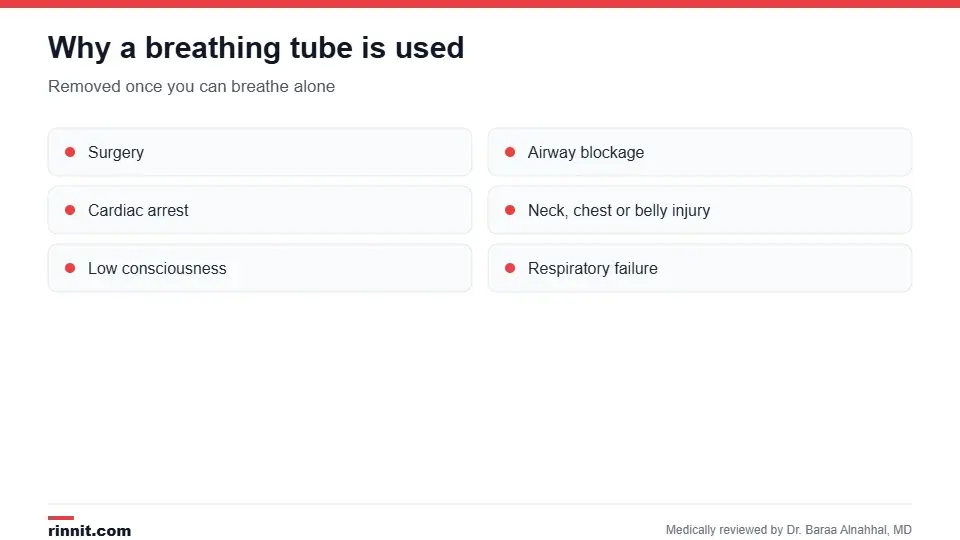
Extubation happens once you can breathe safely on your own.
Surgery that keeps you from breathing on your own.
Airway blockage.
Cardiac arrest.
Injuries to the neck, chest or belly that affect your airway.
Loss of consciousness.
Respiratory failure or stopped breathing.
Risk of inhaling food or fluid into the lungs. Sources: [1]
Learn about rapid sequence intubation, used to place a tube in an emergency. Sources: [1]
Getting ready for extubation

Failing a breathing test is called weaning failure.
Spontaneous breathing test: checks that you can breathe with little or no ventilator support.
Gag reflex check: helps prevent choking or inhaling food or fluid.
Several breathing tests may be needed; not passing is called weaning failure. Sources: [1]
What happens during extubation
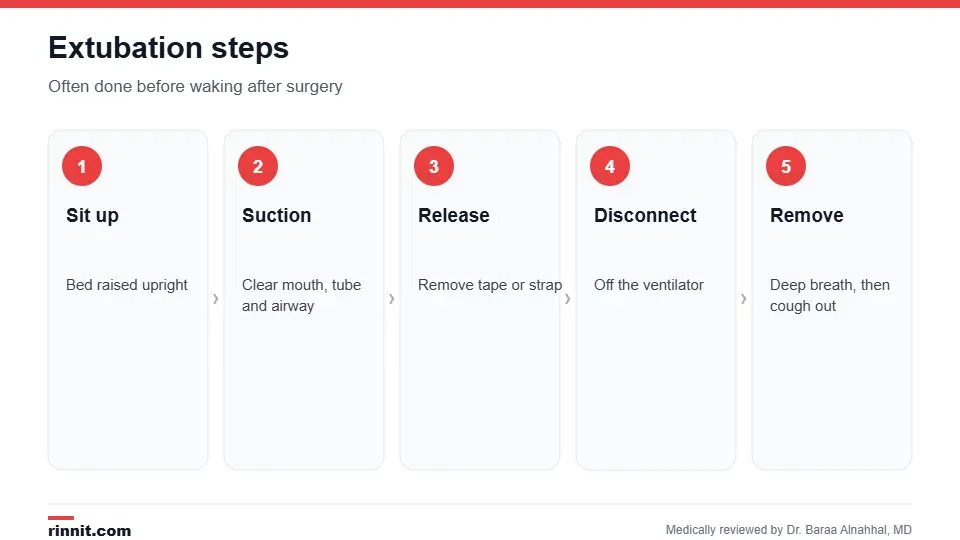
After surgery, the tube is often removed before you wake up.
Your bed is raised so you're sitting up.
Your mouth, tube and airway are suctioned.
The tape or strap holding the tube is removed.
You're disconnected from the ventilator.
You take a deep breath, then cough or breathe out as the tube is pulled out. Sources: [1]
Risks
Risk | Notes |
Extubation failure | The tube must be put back in; about 12% to 14% of planned extubations |
Noisy breathing (stridor) | Less than 10%; more likely after more than two days intubated or over age 80 |
Throat or vocal cord damage | Possible |
Severe coughing | Can lead to throat spasm or inhaling fluid |
Blood pressure changes | Possible right after removal |
Extubation failure is more common over age 65 and in people with heart or lung disease. Sources: [1, 2, 3]
Recovery
You may have a sore throat and trouble talking for a few days.
After intensive care, you'll usually need extra oxygen through a nasal tube or mask.
After surgery, you may not need extra oxygen.
Your team monitors your oxygen, heart rate and ability to clear your airway. Sources: [1, 2]
Outlook
After outpatient surgery, extubation success is high and complications are rare. For serious illness or injury in intensive care, it succeeds about 85% of the time. Needing the tube again means a longer ICU stay and higher risk, but recovery is still possible. Sources: [1]
Talk to your provider
Tell your care team if you feel nervous or have had trouble with a breathing tube before. Sources: [1]
Conclusion
Extubation is an important step toward recovery after surgery or serious illness. Careful testing beforehand and close monitoring afterward help make it safe.
Keep learning: read about mechanical ventilation and general anesthesia.
Frequently asked questions
What is extubation?
Removing a breathing tube from your throat and windpipe.
When is a breathing tube removed?
When your care team decides you can breathe safely on your own.
What is a spontaneous breathing test?
A test that checks you can breathe with little or no ventilator help.
Does extubation hurt?
You may cough and have a sore throat afterward.
Will I be awake?
After surgery, the tube is often removed before you fully wake up.
How long will my throat hurt?
Usually a few days.
Will I need oxygen afterward?
Often after intensive care; not always after surgery.
What is extubation failure?
When the tube has to be put back in.
How often does extubation succeed?
About 85% of the time in intensive care.
Can high-flow oxygen help?
Studies show it can lower the need for reintubation.
Related Reading
Heliox Therapy: Uses, How It Works and Risks explains heliox breathing therapy.
Mechanical Ventilation: How a Ventilator Works, Types, Risks and Recovery breathing support with a ventilator.
Understanding Rapid Sequence Intubation: A Life-Saving Emergency Procedure placing a breathing tube in an emergency.
General Anesthesia: How It Works, Risks and Recovery anesthesia that may need a breathing tube.
BiPAP Machine: Uses, How It Works and Side Effects noninvasive breathing support.
Understanding Hypercapnia: Causes, Symptoms, and Management carbon dioxide buildup.
References
Cleveland Clinic. Extubation: Purpose, Procedure, Risks & Recovery. Cleveland Clinic. Last updated August 4, 2023. https://my.clevelandclinic.org/health/treatments/25180-extubation
Hernández G, Vaquero C, González P, et al. Effect of postextubation high-flow nasal cannula vs conventional oxygen therapy on reintubation in low-risk patients: a randomized clinical trial. JAMA. 2016;315(13):1354-1361. PMID 26975498. https://doi.org/10.1001/jama.2016.2711
Hernández G, Vaquero C, Colinas L, et al. Effect of postextubation high-flow nasal cannula vs noninvasive ventilation on reintubation and postextubation respiratory failure in high-risk patients: a randomized clinical trial. JAMA. 2016;316(15):1565-1574. PMID 27706464. https://doi.org/10.1001/jama.2016.14194
Medical disclaimer
This article is for general education only and does not replace advice from a qualified healthcare professional. Talk to your doctor about your own diagnosis and treatment, and seek emergency care right away for severe or sudden symptoms.



Comments