General Anesthesia: How It Works, Risks and Recovery

Updated: 2 days ago
Written and medically reviewed by Dr. Baraa Alnahhal, MD · Last reviewed: November 2026 · How we review
Quick Answer
General anesthesia is a controlled, reversible state of unconsciousness that lets you have surgery without feeling pain, moving or remembering the procedure. It's given by an anesthesiologist or nurse anesthetist through an IV or as a gas through a mask. Follow your team's instructions about food and drink beforehand. Serious complications are rare.
What the research says
A short anesthetic didn't affect babies' development: in the GAS trial of 722 infants having hernia repair, just under 1 hour of general anesthesia led to the same IQ at age 5 as awake regional anesthesia (McCann ME et al., Lancet, 2019) [2]
Nausea after anesthesia can be prevented: in 5,199 surgery patients at high risk of nausea and vomiting, each of three anti-nausea medicines lowered the risk by about 26% (Apfel CC et al., New England Journal of Medicine, 2004) [3]
Key takeaways
General anesthesia makes you unconscious and pain-free during surgery.
It's given by IV or as a gas, and a breathing tube may be used.
Follow your team's fasting instructions, usually no food for about eight hours.
It takes one to two hours to wear off.
Serious complications are rare.
What is general anesthesia?
General anesthesia uses a mix of medicines that make you unconscious, block pain (analgesia), relax your muscles, stop reflexes and cause temporary memory loss (amnesia). These medicines block nerve signals to the brain and also affect breathing and blood pressure, so your care team monitors you closely. It's different from local anesthesia, which numbs only one area, and from lighter sedation. Sources: [1]
Why it's used

It's given and monitored by anesthesiologists and nurse anesthetists.
General anesthesia makes it possible to do complex or lengthy surgeries that would otherwise be too painful or impossible. It's given and monitored by anesthesiologists and certified registered nurse anesthetists (CRNAs). Learn more in our guide to anesthesia types and safety. Sources: [1]
How to prepare
Meet with your anesthesia provider to review your health history, medicines and supplements.
You may be asked to stop some medicines beforehand.
Follow your team's fasting rules: usually no food for about eight hours, though clear liquids are often allowed until about two hours before.
Quit smoking, even if only for the 24 hours before.
Arrange for someone to drive you home. Sources: [1]
What happens during general anesthesia
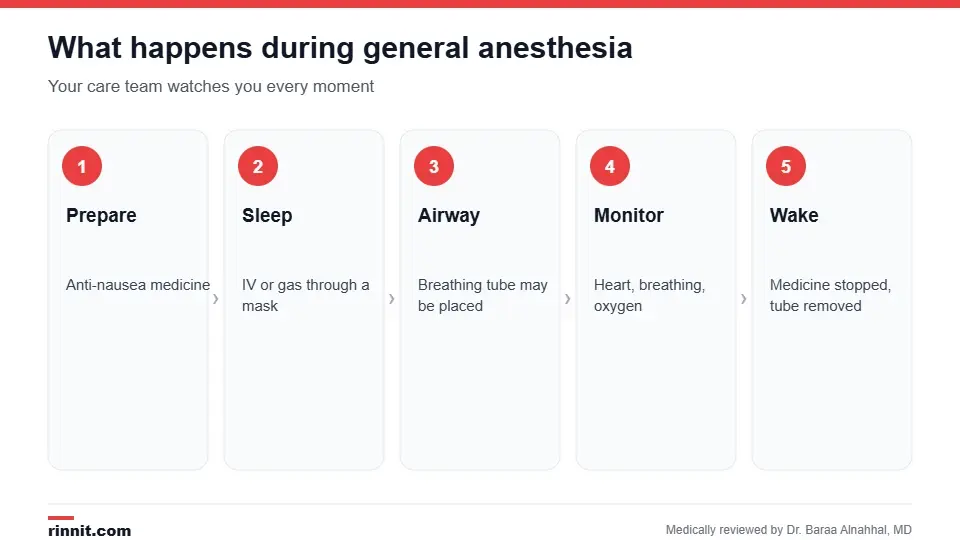
Your care team watches you every moment.
You may get anti-nausea medicine first.
Anesthesia is given through an IV or as a gas through a mask, and you fall asleep within a couple of minutes.
A breathing tube may be placed to protect your airway.
Your team monitors your heart, breathing, blood pressure and oxygen and manages any changes.
At the end of surgery, the medicine is stopped, and the breathing tube is removed as you wake up. Sources: [1]
Stage | What happens |
1. Induction | You start to fall asleep; lasts a couple of minutes |
2. Excitement | Brief movement and faster heart rate; kept short by fast-acting medicines |
3. Surgical anesthesia | The target stage; surgery happens here |
4. Overdose | Rare; the team quickly brings you back to stage 3 |
Sources: [1]
Risks
Risk | Notes |
Nausea and vomiting | Common; can be prevented with medicine |
Allergic reaction | Hives, swelling or trouble breathing; rare |
Anesthesia awareness | Waking during surgery; rare |
A rare inherited reaction with high fever and fast heart rate | |
Heart attack or pneumonia | More likely with poor health or long, complex surgery |
Postoperative cognitive dysfunction | Longer-term memory problems; more common over 65 |
Anesthesia-related deaths are rare. Tell your anesthesia provider if you or a relative ever had a bad reaction to anesthesia. Sources: [1, 3]
Recovery
Someone needs to drive you home.
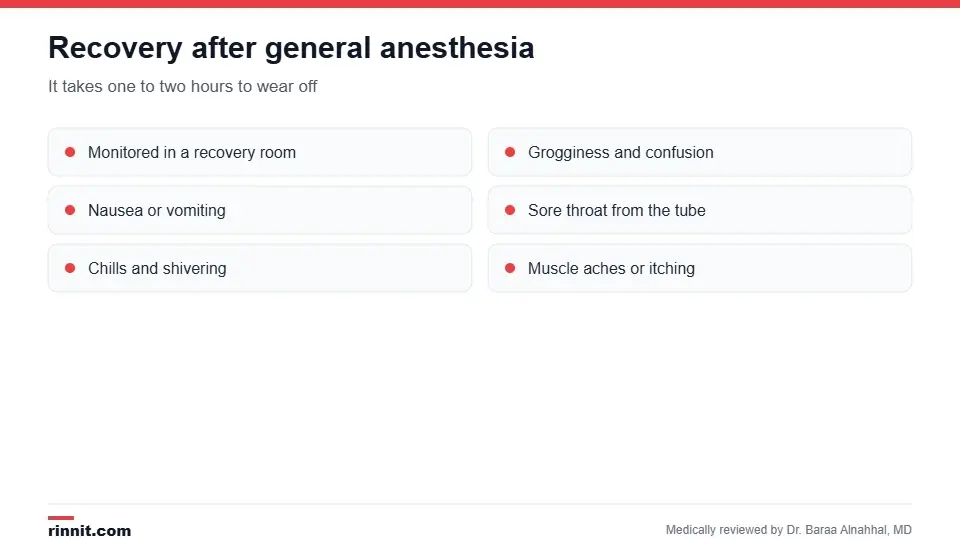
You're monitored in a recovery room until you're awake.
It takes one to two hours for the anesthesia to wear off.
Grogginess, confusion and mood swings are common and may not be remembered.
Nausea, vomiting, chills, shivering, muscle aches and itching can happen.
A sore throat is common if you had a breathing tube.
Your team will manage your pain from the surgery. Sources: [1]
Is general anesthesia safe?
General anesthesia is very safe, and serious complications are rare. In a large trial, a short anesthetic in infancy didn't affect children's development later. Your risk depends mostly on your overall health and the type of surgery. Sources: [1, 2]
Questions to ask
What type of anesthesia will I have and why?
Which medicines should I stop beforehand?
How will my pain and nausea be managed?
When can I eat, drive and go back to work? Sources: [1]
Conclusion
General anesthesia lets you sleep safely through surgery while a dedicated team watches over you. Following your preparation instructions and sharing your full health history help keep it as safe as possible.
Keep learning: read about local anesthesia and malignant hyperthermia.
Frequently asked questions
What is general anesthesia?
Medicines that make you unconscious and pain-free during surgery.
How is it given?
Through an IV or as a gas through a mask.
Will I have a breathing tube?
Often, to protect your airway while you're asleep.
Why can't I eat before surgery?
An empty stomach lowers the risk of breathing in stomach contents; usually no food for about eight hours, and clear liquids until about two hours before, as your team directs.
How long does it take to wake up?
It takes one to two hours for the effects to wear off.
What are common side effects?
Grogginess, nausea, sore throat, chills and muscle aches.
Can I wake up during surgery?
Anesthesia awareness is rare.
Is general anesthesia safe?
Yes. Serious complications are rare.
Who gives general anesthesia?
An anesthesiologist or certified registered nurse anesthetist.
Who is at higher risk?
Older adults and people with serious heart, lung or brain conditions.
Related Reading
Nitrous Oxide (Laughing Gas): Uses, Side Effects and Safety explains nitrous oxide (laughing gas).
Extubation: When a Breathing Tube Comes Out, Risks and Recovery explains how breathing tubes are removed.
Spinal Anesthesia: How It Works, Side Effects and Recovery explains spinal anesthesia for surgery below the waist.
Ketamine Therapy: Uses, How It Works and Side Effects explains ketamine therapy for depression and pain.
Anesthesia Essentials: A Guide to Types, Safety, and Recovery an overview of anesthesia types.
Local Anesthesia: Types, How It Works, Side Effects and Recovery numbing medicine for one area.
What Is Malignant Hyperthermia? The Anesthesia Reaction That Runs in Families — and How It Is Prevented and Treated a rare reaction to anesthesia.
Understanding Rapid Sequence Intubation: A Life-Saving Emergency Procedure placing a breathing tube quickly.
Understanding Sedation Dentistry: Options, Benefits, and What to Expect lighter sedation for dental care.
References
Cleveland Clinic. General Anesthesia: What It Is, How It Works & Side Effects. Cleveland Clinic. Last updated August 31, 2026. https://my.clevelandclinic.org/health/treatments/general-anesthesia
McCann ME, de Graaff JC, Dorris L, et al. Neurodevelopmental outcome at 5 years of age after general anaesthesia or awake-regional anaesthesia in infancy (GAS): an international, multicentre, randomised, controlled equivalence trial. Lancet. 2019;393(10172):664-677. PMID 30782342. https://doi.org/10.1016/S0140-6736(18)32485-1
Apfel CC, Korttila K, Abdalla M, et al. A factorial trial of six interventions for the prevention of postoperative nausea and vomiting. New England Journal of Medicine. 2004;350(24):2441-2451. PMID 15190136. https://doi.org/10.1056/NEJMoa032196
Medical disclaimer
This article is for general education only and does not replace advice from a qualified healthcare professional. Talk to your doctor about your own diagnosis and treatment, and seek emergency care right away for severe or sudden symptoms.



Comments