Spinal Anesthesia: How It Works, Side Effects and Recovery

Updated: 2 days ago
Written and medically reviewed by Dr. Baraa Alnahhal, MD · Last reviewed: November 2026 · How we review
Quick Answer
Spinal anesthesia is a common type of regional anesthesia that numbs the lower half of the body. A provider injects local anesthetic near the spine into the fluid around the spinal cord. It's used for surgery below the waist, such as C-sections and hip or knee replacement. Numbness lasts about 1.5 to three hours. Serious complications are rare.
What the research says
Spinal and general anesthesia gave similar results for hip surgery: in the REGAIN trial of 1,600 older adults having hip fracture surgery, death or inability to walk at 60 days was similar with spinal versus general anesthesia (18.5% vs. 18.0%), as were delirium rates (20.5% vs. 19.7%) (Neuman MD et al., New England Journal of Medicine, 2021) [2]
Delirium rates were similar: in the RAGA trial of 950 adults 65 and older having hip fracture surgery, delirium in the first 7 days was similar with regional anesthesia versus general anesthesia (6.2% vs. 5.1%) (Li T et al., JAMA, 2022) [3]
Key takeaways
Spinal anesthesia numbs the lower half of your body.
It's used for surgery below the waist, such as C-sections and joint replacements.
Numbness starts within minutes and lasts about 1.5 to three hours.
You breathe on your own, often with sedation.
Headache, backache and low blood pressure are common side effects.
What is spinal anesthesia?
Spinal anesthesia is one of several types of anesthesia. It's different from an epidural, which delivers medicine through a small tube that can be adjusted or continued longer. Spinal anesthesia is a single injection. Sources: [1]
When it's used
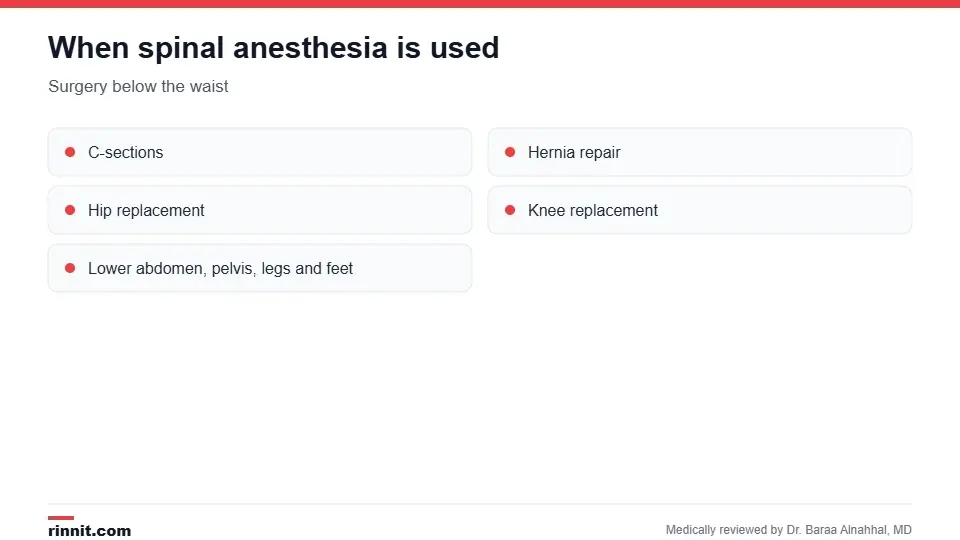
It can be used alone or with general anesthesia.
Hernia repair.
Hip and knee replacement.
Surgery on the lower abdomen, pelvis, legs, knees or feet. Sources: [1]
It can be used alone or with general anesthesia. Sources: [1]
Who may not be a good fit
People with bleeding disorders or who take blood thinners.
An infection where the injection would go.
Certain neurologic or serious heart conditions, such as severe aortic stenosis.
High pressure inside the skull.
Very low blood volume. Sources: [1]
What happens

Numbness lasts about 1.5 to three hours.
Your team reviews your history, including blood thinners, and places an IV.
Your blood pressure, heart rate and breathing are monitored; sedation may be given.
You sit up or lie on your side with your knees toward your chest.
Your lower back is cleaned, and a small numbing shot is given in the skin.
A very thin needle is guided between the spinal bones, and the anesthetic is injected.
Within minutes, your legs feel warm, tingly, heavy and numb. Sources: [1]
People having a C-section usually stay awake or lightly sedated. Most others are sedated to relax or sleep. Sources: [1]
Benefits
Benefit | Why it matters |
Strong pain control | Blocks pain signals from the lower body |
Less need for opioids | Less opioid pain medicine needed |
Earlier bowel function | Your bowels start working again sooner |
No breathing tube | You breathe on your own |
Works fast | Wears off the same day |
Sources: [1, 2]
Side effects
Type | Examples |
Common | Backache, headache, low blood pressure, nausea, vomiting, short-term hearing changes |
Rare but serious | Spinal hematoma, arachnoiditis, nerve injury |
A spinal headache can sometimes happen after a needle is placed in the spine. Sources: [1]
Recovery

You may need help walking at first.
Feeling usually returns the same day, sometimes with mild tingling.
Staff check that you can move your legs, feel touch, sit and stand safely and pee normally.
Tiredness, mild back soreness and headache are common and usually improve soon.
You may need help walking at first.
Your provider decides when you can walk, eat and go home. Sources: [1]
When to call your provider
Call your provider if anything feels wrong or unusual after spinal anesthesia. Get emergency care for severe back pain, new leg numbness or weakness after the numbness has worn off, or loss of bladder or bowel control. Tell your provider about a headache that gets worse when you sit or stand. Sources: [1]
Conclusion
Spinal anesthesia is a safe, fast-acting way to block pain for surgery below the waist without a breathing tube. Talking with your anesthesia team about your health history helps them choose the safest option for you.
Keep learning: read about epidurals and general anesthesia.
Frequently asked questions
What is spinal anesthesia?
An injection near the spine that numbs the lower half of the body.
How is it different from an epidural?
An epidural uses a small tube that can give medicine longer; spinal is one injection.
Will I be awake?
You may be awake or sedated to relax or sleep.
How long does spinal anesthesia last?
About 1.5 to three hours.
Does the injection hurt?
Your skin is numbed first with a small shot.
What surgeries use spinal anesthesia?
C-sections, hernia repair and hip or knee replacement.
What are common side effects?
Headache, backache, low blood pressure and nausea.
Is spinal anesthesia safe?
Yes, it's generally safe; serious complications are rare.
Is spinal anesthesia better than general anesthesia?
For hip fracture surgery, studies found similar results.
When will I feel my legs again?
Usually the same day.
Related Reading
External Cephalic Version (ECV): Turning a Breech Baby explains how ECV turns a breech baby.
Epidural: Types, Procedure, Side Effects and Recovery a related type of regional anesthesia.
General Anesthesia: How It Works, Risks and Recovery anesthesia that puts you fully to sleep.
Local Anesthesia: Types, How It Works, Side Effects and Recovery numbing a small area.
C-Section (Cesarean Delivery): Reasons, Procedure, Risks, and Recovery a common surgery using spinal anesthesia.
Anesthesia Essentials: A Guide to Types, Safety, and Recovery an overview of anesthesia types.
References
Cleveland Clinic. Spinal Anesthesia: What It Is, Side Effects & Complications. Cleveland Clinic. Last updated February 19, 2026. https://my.clevelandclinic.org/health/treatments/spinal-anesthesia
Neuman MD, Feng R, Carson JL, et al. Spinal anesthesia or general anesthesia for hip surgery in older adults. N Engl J Med. 2021;385(22):2025-2035. PMID 34623788. https://doi.org/10.1056/NEJMoa2113514
Li T, Li J, Yuan L, et al. Effect of regional vs general anesthesia on incidence of postoperative delirium in older patients undergoing hip fracture surgery: the RAGA randomized trial. JAMA. 2022;327(1):50-58. PMID 34928310. https://doi.org/10.1001/jama.2021.22647
Medical disclaimer
This article is for general education only and does not replace advice from a qualified healthcare professional. Talk to your doctor about your own diagnosis and treatment, and seek emergency care right away for severe or sudden symptoms.



Comments