Local Anesthesia: Types, How It Works, Side Effects and Recovery

Updated: 2 days ago
Written and medically reviewed by Dr. Baraa Alnahhal, MD · Last reviewed: November 2026 · How we review
Quick Answer: What is local anesthesia?
Local anesthesia is medicine that numbs a small area of the body so you do not feel pain during a minor procedure. You stay awake. It comes as injections, creams, gels, sprays, eye drops and skin patches, and the numbness lasts 30 minutes to 12 hours or more. Side effects are usually mild, and serious reactions are rare. [1]
What the research says
Serious whole-body reactions to local anesthetics are rare. Registries covering 251,325 nerve blocks found local anesthetic systemic toxicity in about 0.03% of cases, or 0.27 per 1,000 blocks, and a seizure was the most common first sign. (Gitman and Barrington, Regional Anesthesia and Pain Medicine, 2018) [2]
In a large registry, toxicity was extremely uncommon. Among 12,668 people who had ultrasound-guided nerve blocks over eight years, seizures occurred in 0.08 per 1,000 blocks and there were no cardiac arrests. (Sites et al., Regional Anesthesia and Pain Medicine, 2012) [3]
Most suspected allergies to local anesthetics are not true allergies. Of 331 people tested after a reaction, mostly during dental work, only 3 (0.91%) had a confirmed allergy; most reactions came from the drug's normal effects, drug combinations or anxiety. (Batinac et al., The Journal of Dermatology, 2013) [4]
Key takeaways
Local anesthesia numbs a small area while you stay awake and alert. [1]
It is used for dental work, minor biopsies, stitches, setting broken bones and some eye and orthopedic surgeries. [1]
Numbness usually lasts from 30 minutes to 12 hours or more, depending on the drug, dose and area. [1]
Most side effects are mild, such as soreness or bruising where it was injected. [1]
Allergic reactions and local anesthetic systemic toxicity (LAST) are rare, and LAST is treatable. [1] [2]
What is local anesthesia used for?
Local anesthesia numbs a small area of skin, the tissue just under the skin (subcutaneous tissue) and nearby peripheral nerves. Providers use it so you can have a minor procedure without pain. It can also treat some painful conditions and ease pain after surgery. [1]
Common uses include: [1]
Certain eye surgeries, such as cataract surgery
Some orthopedic (bone and joint) surgeries
Dental work
Minor biopsies
Setting broken bones
Stitching deep cuts
Minor cosmetic procedures
Epidurals for labor or a cesarean birth (C-section)
You can learn how it compares with general and regional anesthesia in our guide to anesthesia types, safety and recovery.
How does local anesthesia work?
Local anesthesia blocks pain and other sensory signals from traveling along peripheral nerves to your brain. Unlike general anesthesia, it does not slow down your central nervous system or make you lose consciousness. [1]
Because it only blocks pain, you may still feel pressure or movement during the procedure. Providers sometimes combine local anesthesia with sedation so you feel more relaxed. [1]
What are the types of local anesthesia?
Local anesthesia comes in several forms, and your provider picks the one that suits the area and the procedure. [1]
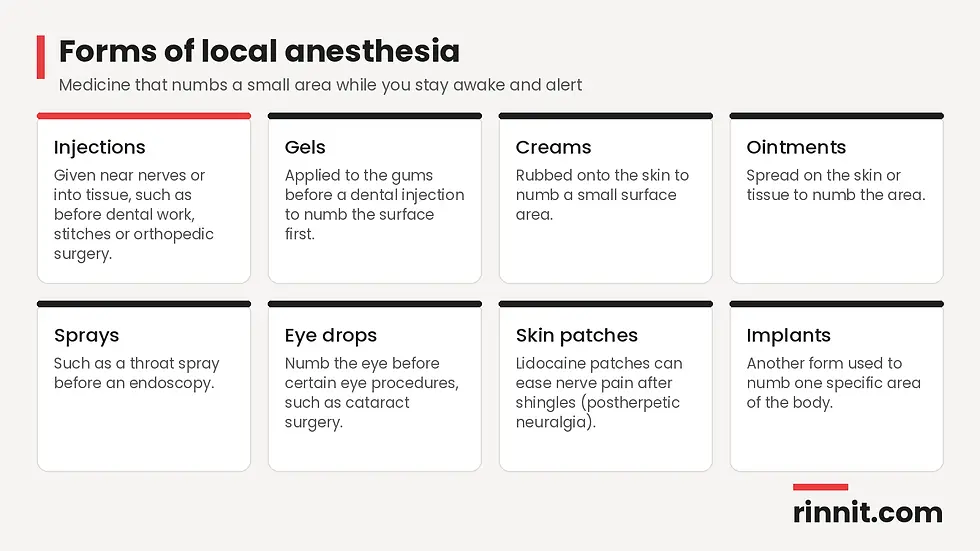
Local anesthesia comes in many forms, from injections to skin patches.
Form | Example of how it is used |
Injection | Given near nerves before orthopedic surgery, or into the gums for dental work |
Gel | Applied to the gums before a dental injection |
Cream or ointment | Applied to the skin to numb a small area |
Spray | Sprayed in the throat before an endoscopy |
Eye drops | Numb the eye before certain eye procedures |
Skin patch | Lidocaine patches for nerve pain after shingles (postherpetic neuralgia) |
Implant | Another form used to numb one area |
Source: [1]
Common local anesthetic drugs include benzocaine, bupivacaine, cocaine, lidocaine, mepivacaine, ropivacaine and tetracaine. Providers sometimes add epinephrine or steroids to improve safety and make the numbness last longer. [1]
Lidocaine patches are one way to ease the burning pain described in our guide to postherpetic neuralgia. [1]
Who can give local anesthesia?
Many types of healthcare providers can give local anesthesia, depending on the procedure. These include: [1]
Anesthesiologists and nurse anesthetists
Dentists
Dermatologists
Emergency care providers
Nurse practitioners and physician assistants
Ophthalmologists (eye doctors)
Primary care providers
Surgeons
How do you prepare for local anesthesia?
You usually do not need to do anything special to prepare for local anesthesia. [1]
Allergies and past reactions. Tell your provider about any allergies or problems you have had with anesthetics before. [1]
Fear of needles. Let your provider know if needles make you anxious. It is normal to feel nervous, especially about injections. [1] Our guide to trypanophobia explains ways to manage needle fear.
Eating and drinking. For minor procedures, eating beforehand is usually fine. You may need to fast for some digestive or bladder procedures, or for surgery where your provider might switch to general anesthesia. [1]
Pregnancy. Local anesthesia is generally safe during pregnancy, but check with your provider first. [1]
How is local anesthesia given?
How local anesthesia is given depends on the area being treated, but the overall process follows the same basic steps. [1]

You stay awake throughout, and your provider checks that the area is numb before starting.
Share your history: Tell your provider about allergies, past problems with anesthetics and any fear of needles.
Apply the medicine: The anesthetic is injected, sprayed, rubbed on as a gel or cream, dropped into the eye or placed on the skin as a patch.
Check the numbness: Your provider makes sure the area is numb. You may still feel pressure.
Do the procedure: You stay awake and alert. Sedation is sometimes added to help you relax.
Go home: Follow the recovery instructions you are given. If you had sedation, someone needs to drive you home.
Source: [1]
Examples of local anesthesia in practice
Dental work: A numbing gel is applied to the gums, followed by an injection. Learn what to expect in our guide to tooth extraction. [1]
Endoscopy: A spray numbs the throat before the scope is passed. [1]
Eye procedures: Eye drops numb the surface of the eye. [1]
Orthopedic surgery: Medicine is injected around the nerves that supply the area. [1]
Labor: An epidural uses a thin tube (catheter) to deliver anesthetic for pain relief. Read more in our guide to the epidural. [1]
Local anesthesia at a glance
Item | Typical detail |
Consciousness | You stay awake and alert |
What you feel | No pain, though you may still feel pressure |
Preparation | Usually none; fasting only for some procedures |
How long it lasts | About 30 minutes to 12 hours or more |
Sedation | Sometimes added to help you relax |
Driving afterward | Usually fine unless hands, feet or eyes were involved or sedation was given |
Who gives it | Anesthesiologists, dentists, surgeons and many other providers |
Source: [1]
How long does local anesthesia last?
Local anesthetics can last from about 30 minutes to 12 hours or more. Your provider will tell you when the numbness should wear off. [1]

Feeling returns gradually, and timing varies with the drug and the procedure.
How long it lasts depends on: [1]
The area being numbed
The dose
The type of local anesthetic
Whether additives such as epinephrine or steroids are used
Contact your provider if numbness or muscle weakness lasts longer than expected. [1]
What is recovery like after local anesthesia?
Recovery from local anesthesia is usually quick. It can take some time for feeling and normal movement to return, and this varies with the drug and the procedure. [1]
After dental work, it may be hard to speak clearly or eat for up to about seven hours. You may also find it hard to keep saliva in your mouth. To protect yourself while you are numb: [1]
Avoid chewing on the numb side of your mouth.
Be careful not to bite your cheek or injure your gums without noticing.
You can usually drive after local anesthesia alone. Do not drive if the procedure affected your hands, feet or eyes, or if you also received sedation. [1]
What are the benefits and risks of local anesthesia?
Compared with general anesthesia, local anesthesia needs less preparation, allows a shorter recovery and is generally safer, with fewer and milder side effects. [1]
Common side effects
Side effect | What it means |
Soreness or bruising | Tenderness or a bruise where the medicine was injected |
Dizziness | Feeling lightheaded during or after the procedure |
Headache | Mild head pain |
Blurred vision | Short-term change in vision |
Muscle twitches | Small, brief muscle movements |
Lasting numbness, weakness or tingling | Feeling takes longer than expected to return |
Source: [1]
Rare complications
Allergic reaction: Allergic reactions to local anesthetics are very rare. When they happen, they usually appear soon after the medicine is applied. [1] One study found that fewer than 1 in 100 people tested for a suspected reaction had a true allergy. [4] Learn about the most severe form of allergic reaction in our guide to anaphylaxis.
Local anesthetic systemic toxicity (LAST): This rare reaction happens when the anesthetic affects the whole body. It usually develops within one to five minutes of an injection. [1] Symptoms include: [1]
Agitation or confusion
Dizziness or drowsiness
Changes in hearing
A metallic taste
Slurred speech (dysarthria)
Without treatment, LAST can lead to seizures, heart problems, breathing that stops (respiratory arrest) and coma. LAST is treatable. [1] Read more in our guide to local anesthetic systemic toxicity.
When should you call a doctor after local anesthesia?
Contact your healthcare provider if: [1]
Numbness, weakness or tingling lasts longer than you were told to expect
Side effects such as dizziness, headache or blurred vision do not go away
You have any other problems related to the procedure
Get emergency help right away for signs of a serious reaction, such as confusion, slurred speech or a seizure.
Conclusion
Local anesthesia lets you have many minor procedures, from dental work to stitches and some surgeries, while staying awake and without feeling pain. It needs little preparation, recovery is usually quick, and most side effects are mild. [1]
Serious reactions such as allergy and local anesthetic systemic toxicity are rare and treatable. Tell your provider about past reactions, allergies or fear of needles so they can plan the safest approach for you. [1] [2]
Keep learning: Read our guide to anesthesia types, safety and recovery and our overview of local anesthetic systemic toxicity. For a plain-language overview of all anesthesia types, see this anesthesia guide from MedlinePlus.
FAQ
What is local anesthesia?
Local anesthesia is medicine that numbs a small area of the body for a minor procedure. You stay awake and alert, but you should not feel pain. [1]
Are you awake during local anesthesia?
Yes. Local anesthesia does not affect consciousness, though you may still feel pressure. Providers sometimes add sedation to help you relax. [1]
How long does local anesthesia last?
It can last from about 30 minutes to 12 hours or more. The timing depends on the area, the dose, the type of anesthetic and whether additives such as epinephrine or steroids are used. [1]
What are the types of local anesthesia?
Local anesthesia comes as injections, creams, gels, ointments, sprays, eye drops, skin patches and implants. Common drugs include lidocaine, bupivacaine, benzocaine and tetracaine. [1]
What is local anesthesia used for?
It is used for dental work, minor biopsies, stitching deep cuts, setting broken bones, cataract and some orthopedic surgeries, minor cosmetic procedures and epidurals for labor or a C-section. [1]
What are the side effects of local anesthesia?
Common side effects include soreness or bruising where it was injected, dizziness, headache, blurred vision, muscle twitches and numbness, weakness or tingling that lasts longer than expected. [1]
Can you be allergic to local anesthesia?
Allergic reactions are very rare. When they happen, they usually appear soon after the medicine is applied. [1] Most reactions people think are allergies turn out to have other causes. [4]
What is local anesthetic systemic toxicity?
Local anesthetic systemic toxicity (LAST) is a rare, treatable reaction that usually starts within one to five minutes of an injection. Signs include agitation, confusion, dizziness, a metallic taste and slurred speech. [1]
Can I eat before local anesthesia?
Usually yes for minor procedures. You may need to fast for some digestive or bladder procedures, or if there is a chance you will need general anesthesia. [1]
Can you drive after local anesthesia?
Usually yes, unless the procedure affected your hands, feet or eyes. You need someone to drive you home if you also had sedation. [1]
Is local anesthesia safe during pregnancy?
Local anesthesia is generally safe during pregnancy, but check with your healthcare provider before you have it. [1]
How do I prepare for local anesthesia?
You usually do not need to do anything special. Tell your provider about any allergies or past problems with anesthetics, and let them know if needles make you anxious. If sedation is added, someone needs to drive you home [1].
Does local anesthesia hurt?
Once it works, you should not feel pain in the numbed area, although you may still feel pressure. You may have some soreness or bruising where it was injected, and it is normal to feel nervous before an injection [1].
When should I call my doctor after local anesthesia?
Contact your provider if numbness, weakness or tingling lasts longer than you were told to expect, or if dizziness, headache or blurred vision does not go away. Get emergency help right away for signs of a serious reaction, such as confusion, slurred speech or a seizure [1].
Related Reading
Nitrous Oxide (Laughing Gas): Uses, Side Effects and Safety explains nitrous oxide (laughing gas).
Spinal Anesthesia: How It Works, Side Effects and Recovery explains spinal anesthesia for surgery below the waist.
General Anesthesia: How It Works, Risks and Recovery explains how general anesthesia works during surgery.
References
Cleveland Clinic. Local Anesthesia: What It Is, Uses, Side Effects & Types. Cleveland Clinic. Last updated March 25, 2025. https://my.clevelandclinic.org/health/procedures/local-anesthesia
Gitman M, Barrington MJ. Local Anesthetic Systemic Toxicity: A Review of Recent Case Reports and Registries. Reg Anesth Pain Med. 2018;43(2):124-130. PMID 29303925. https://doi.org/10.1097/AAP.0000000000000721
Sites BD, Taenzer AH, Herrick MD, et al. Incidence of local anesthetic systemic toxicity and postoperative neurologic symptoms associated with 12,668 ultrasound-guided nerve blocks: an analysis from a prospective clinical registry. Reg Anesth Pain Med. 2012;37(5):478-482. PMID 22705953. https://doi.org/10.1097/AAP.0b013e31825cb3d6
Batinac T, Sotošek Tokmadžić V, Peharda V, et al. Adverse reactions and alleged allergy to local anesthetics: analysis of 331 patients. J Dermatol. 2013;40(7):522-527. PMID 23682746. https://doi.org/10.1111/1346-8138.12168
Medical disclaimer
This article is for general education only and does not replace advice from a qualified healthcare professional. Talk to your doctor about your own diagnosis and treatment, and seek emergency care right away for severe or sudden symptoms.



Comments