Understanding Local Anesthetic Systemic Toxicity (LAST): A Critical Guide

Updated: 2 days ago
Medically reviewed by Dr. Baraa Alnahhal, MD · Last reviewed: October 2026
Local anesthetic systemic toxicity (LAST) is a rare, life-threatening complication that can develop within minutes of receiving a local anesthetic. It mainly affects the brain and the heart, and it is treatable when providers recognize it quickly and act at once [1].
Quick Answer: What is LAST?
Local anesthetic systemic toxicity (LAST) is a rare, life-threatening complication of local anesthetics that usually appears within five minutes and affects the brain, the heart or both. Signs range from a metallic taste and mouth numbness to seizures and cardiac arrest. It is a medical emergency, but airway support, seizure control and intravenous lipid emulsion often reverse it. [1]
What the research says
Lipid emulsion is the first-line antidote, but most of the evidence comes from animals and case reports. A meta-analysis of 58 animal studies found that lipid emulsion lowered the odds of death in models of local anesthetic toxicity (odds ratio 0.16, 95% CI 0.1 to 0.33) (Fettiplace and Pichurko, Clin Toxicol, 2020 [2]), and a systematic review concludes that it remains first-line therapy alongside standard resuscitation while calling for better human data (Harvey and Cave, Curr Opin Anaesthesiol, 2017 [3]).
Infants are especially vulnerable, and lipid emulsion appears to work in children. A systematic review of 21 pediatric case reports found that nearly 43% of patients were under 1 year old, about 67% of cases involved bupivacaine, and inadvertent injection into a blood vessel accounted for 52% of cases; lipid emulsion led to full recovery in 20 of the 21 patients, and the one death was due to an underlying disease (Lee et al., Medicine, 2024 [4]).
Dose and technique matter in high-risk blocks. A systematic review of 19 cases of LAST after penile nerve blocks found that overdose (47.4%) and inadvertent intravascular absorption (47.4%) were the main presumed causes, 73.7% of patients were under 1 year old, and all recovered; the authors advise staying within maximum recommended doses, injecting slowly with negative aspiration, and having lipid emulsion ready (Park et al., Medicine, 2025 [5]).
What Is Local Anesthetic Systemic Toxicity?
Local anesthetic systemic toxicity, commonly abbreviated as LAST, is a rare, life-threatening complication of local anesthetic medications. Local anesthetics temporarily block your peripheral nerves from sending pain and other sensory signals to your brain. Providers use them as injections, gels, and sprays to numb specific areas of the body for many procedures, and in rare cases they can cause toxicity within minutes of being given [1].
LAST is a medical emergency because it can disrupt the central nervous system (CNS) and the cardiovascular system. Symptoms can range from mild to severe, and it is impossible to predict how an episode will progress, so providers observe people closely after a local anesthetic, especially those with risk factors [1].
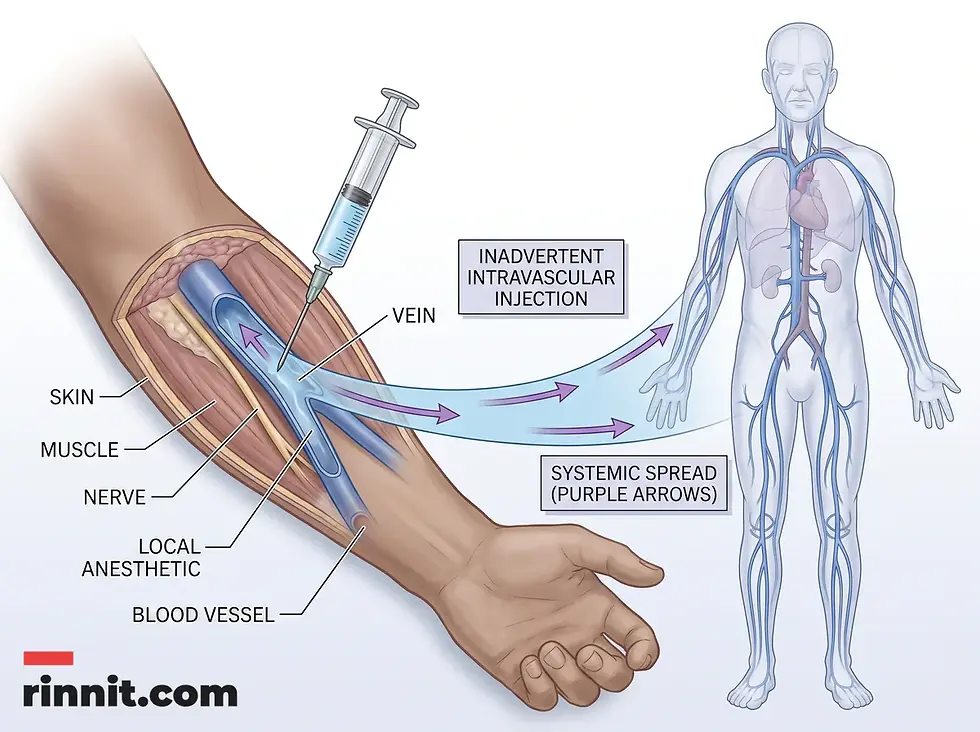
Accidental injection into a blood vessel lets local anesthetic spread through the whole body.
What are the symptoms of local anesthetic systemic toxicity (LAST)?
LAST most commonly affects the central nervous system first, and it can also affect the heart [1].
Central Nervous System Symptoms
Seizures are the most common sign. Other initial signs and symptoms may include [1]:
A metallic taste in the mouth.
Numbness around the mouth.
Ringing in the ears (tinnitus) or other auditory changes.
Abnormal eye movements.
Agitation or confusion.
Slurred speech (dysarthria).
Hallucinations.
Cardiovascular Symptoms
LAST can also cause cardiac toxicity. Signs and symptoms may include [1]:
Low blood pressure.
A slow heart rate (bradycardia), a fast heart rate (tachycardia), or other arrhythmias.
Shortness of breath.
Cardiac arrest, including asystole (failure of the heart's electrical system) or ventricular fibrillation.
Without quick treatment, LAST can progress to respiratory arrest or coma [1].
What causes local anesthetic systemic toxicity (LAST)?
The most common cause of LAST is accidental injection of the local anesthetic into a blood vessel. Nerve blocks that numb an arm or leg account for about 20% of cases, and LAST has also been reported after a local anesthetic gel applied to the skin and after local anesthetic applied to the lining of the mouth, esophagus, and trachea. In other words, LAST can develop with any use or form of local anesthetic [1].
Several factors increase the likelihood [1]:
Risk category | Specific factors |
Patient health | Metabolic acidosis, low oxygen levels (hypoxia), preexisting heart disease (especially ischemia, arrhythmias, conduction abnormalities, and low ejection fraction), pregnancy, and mitochondrial diseases. Liver or kidney disease may increase the risk of delayed LAST. |
Age | Adults over 65 and infants under 4 months. |
Medication | Higher doses and certain agents, such as bupivacaine. |
Technique and site | Injection into areas with many blood vessels, such as penile nerve blocks. In a study of 125 cases, infiltration accounted for 20% of cases, central neuraxial blocks (epidural and caudal) for 15%, and continuous infusion for 13%. |
How is local anesthetic systemic toxicity (LAST) diagnosed and treated?
Providers typically diagnose LAST from your symptoms. Because they must act quickly, they cannot delay treatment while waiting for test results, although in rare cases they may do an EKG to help with the diagnosis [1].
Immediate Medical Interventions
Because LAST is a medical emergency, treatment generally involves [1]:
Airway management: immediate ventilation and oxygen therapy to support breathing.
Seizure prevention or treatment: medication such as benzodiazepines.
Intravenous lipid emulsion: injected into a vein, it helps reverse LAST by absorbing local anesthetic from the blood and tissues, which lowers the concentration of anesthetic in the brain and heart.
CPR: if LAST affects the heart, providers perform CPR and use other methods to stabilize it.
After treatment, a provider monitors you for at least six hours to make sure the treatment is working and no other complications develop [1].

Intravenous lipid emulsion helps pull local anesthetic out of the blood and tissues.
What is the prognosis for LAST, and how is it prevented?
People who receive a quick diagnosis and treatment typically have a good outlook, and treatment often reverses LAST. Delayed treatment of severe LAST can result in coma or death, but this is rare; U.S. poison control center data recorded only four deaths from local anesthetics in 2016 [1].
LAST is not always preventable, but providers use guidelines and methods to lower the risk. They use the lowest effective dose of local anesthetic and may use ultrasound imaging to guide the injection and help avoid accidental placement in a blood vessel. If you have risk factors, your provider will carefully consider the safest medication, dose, and application for you [1].

Ultrasound guidance helps providers see the needle and avoid blood vessels.
What is the bottom line on local anesthetic systemic toxicity?
LAST is a rare but serious risk of a very common type of medication, and well-established emergency protocols exist to treat it. Quick recognition and treatment give most people a good outlook [1].
Your next step: if you are scheduled for a procedure that involves local anesthesia, tell your provider about any heart, liver, or kidney disease, pregnancy, or other health conditions, and ask questions if you have concerns. Your provider will watch you closely afterward and act quickly if signs of LAST develop [1].
Frequently Asked Questions
What is the most common sign of LAST?
Seizures are the most common sign of LAST.
How quickly does LAST usually occur?
Symptoms typically develop within five minutes of receiving a local anesthetic.
Is LAST always caused by an injection?
No. Accidental injection into a blood vessel is the most common cause, but LAST has also been reported after local anesthetic gels applied to the skin and local anesthetic applied to the lining of the mouth, esophagus, and trachea.
What is lipid emulsion therapy?
Lipid emulsion therapy is an intravenous treatment that helps reverse LAST by absorbing local anesthetic from the blood and tissues, which lowers the amount reaching the brain and heart.
Can LAST be fatal?
Delayed treatment of severe LAST can result in coma or death, but this is rare, and people who are treated quickly typically have a good outlook.
Who is at the highest risk for LAST?
Adults over 65, infants under 4 months, and people with metabolic acidosis, low oxygen levels, heart disease, liver or kidney disease, pregnancy, or mitochondrial disease have an increased risk.
Does LAST affect the heart?
Yes. It can cause low blood pressure, slow or fast heart rates, other arrhythmias, and in severe cases cardiac arrest.
How is LAST diagnosed?
Providers diagnose it from your symptoms because treatment cannot wait for test results. An EKG is occasionally used to help.
How long are people monitored after a LAST event?
Providers monitor you for at least six hours after treatment to make sure it is working and no other complications develop.
Can ultrasound help prevent LAST?
Yes. Providers can use ultrasound to guide injections and avoid accidental placement in a blood vessel, and using the lowest effective dose also lowers the risk.
Related Reading
References
Cleveland Clinic. Local Anesthetic Systemic Toxicity (LAST). Cleveland Clinic. March 25, 2025. https://my.clevelandclinic.org/health/diseases/local-anesthetic-systemic-toxicity-last
Fettiplace MR, Pichurko AB. Heterogeneity and bias in animal models of lipid emulsion therapy: a systematic review and meta-analysis. Clin Toxicol (Phila). 2020;59(1):1-11. PMID 33025830. https://doi.org/10.1080/15563650.2020.1814316
Harvey M, Cave G. Lipid emulsion in local anesthetic toxicity. Curr Opin Anaesthesiol. 2017;30(5):632-638. PMID 28692439. https://doi.org/10.1097/ACO.0000000000000498
Lee SH, Kim S, Sohn JT. Lipid emulsion treatment for local anesthetic systemic toxicity in pediatric patients: a systematic review. Medicine (Baltimore). 2024;103(11):e37534. PMID 38489714. https://doi.org/10.1097/MD.0000000000037534
Park M, Lee SH, Sohn JT. Local anesthetic systemic toxicity induced by penile nerve block: a systematic review. Medicine (Baltimore). 2025;104(37):e44582. PMID 40958228. https://doi.org/10.1097/MD.0000000000044582
Medical disclaimer
This article is for informational purposes only and is not a substitute for professional medical advice, diagnosis, or treatment. The clinical information in this guide reflects source material last reviewed in March 2025.



Comments