Nitrous Oxide (Laughing Gas): Uses, Side Effects and Safety

Updated: 2 days ago
Written and medically reviewed by Dr. Baraa Alnahhal, MD · Last reviewed: November 2026 · How we review
Quick Answer
Nitrous oxide, or laughing gas, is a mild sedative gas breathed through a mask or nosepiece to help you relax during medical and dental procedures. You stay awake, and effects wear off 5 to 10 minutes after the gas stops. Side effects like headache or nausea are temporary. Frequent exposure can cause vitamin B12 deficiency, and recreational misuse is dangerous.
What the research says
Laughing gas eased labor pain less than an epidural: a review of 58 publications found nitrous oxide gave less effective labor pain relief than an epidural; the main side effects were nausea, vomiting, dizziness and drowsiness, and newborn Apgar scores didn't differ (Likis FE et al., Anesthesia and Analgesia, 2014) [2]
Chronic misuse caused nerve damage: a review of 115 studies of long-term recreational misuse found mainly neurological problems, and blood B12 often looked normal, so other markers were needed to detect damage (Marsden P et al., Emergency Medicine Australasia, 2022) [3]
Key takeaways
Nitrous oxide is a mild inhaled sedative.
You stay awake but relaxed.
It works in minutes and wears off in minutes.
It's safe in a healthcare setting.
Recreational misuse can cause serious harm.
What is nitrous oxide?
Doctors and dentists have used it since the mid-1800s. It slows your nervous system, causing calm and mild euphoria. It's one form of sedation dentistry and is lighter than general anesthesia. Sources: [1]
What it's used for
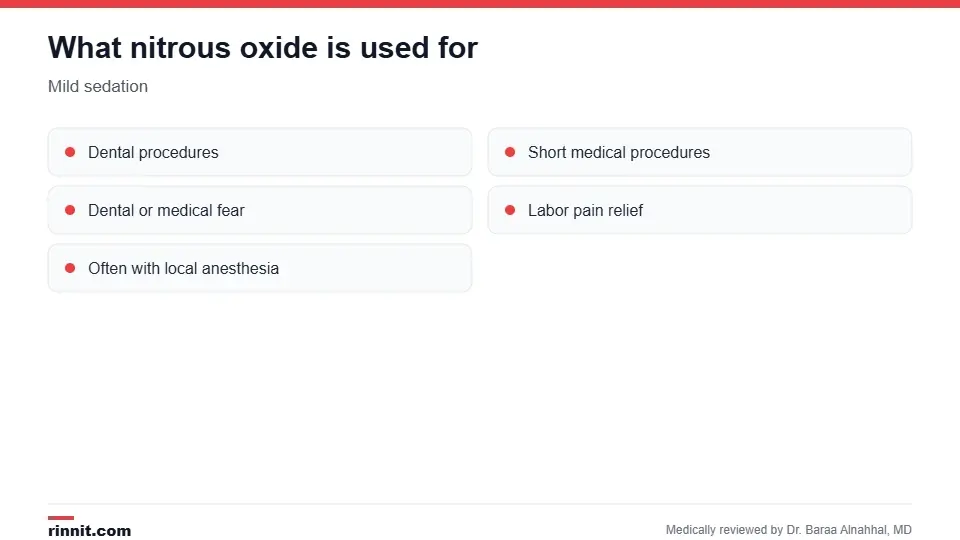
It reduces but doesn't remove pain.
Calming anxiety during dental and medical procedures.
Short or minor procedures.
People with fears of the dentist or doctor.
Pain relief during labor. Sources: [1, 2]
It's often paired with local anesthesia because it doesn't fully block pain. Sources: [1]
Who shouldn't use it
Children under 2.
People with COPD or a stuffy nose.
People with vitamin B12 deficiency.
People with severe psychiatric conditions. People with trapped air or gas in the body, such as a collapsed lung, a bowel blockage, recent middle ear surgery or a gas bubble in the eye after eye surgery. Sources: [1]
What to expect
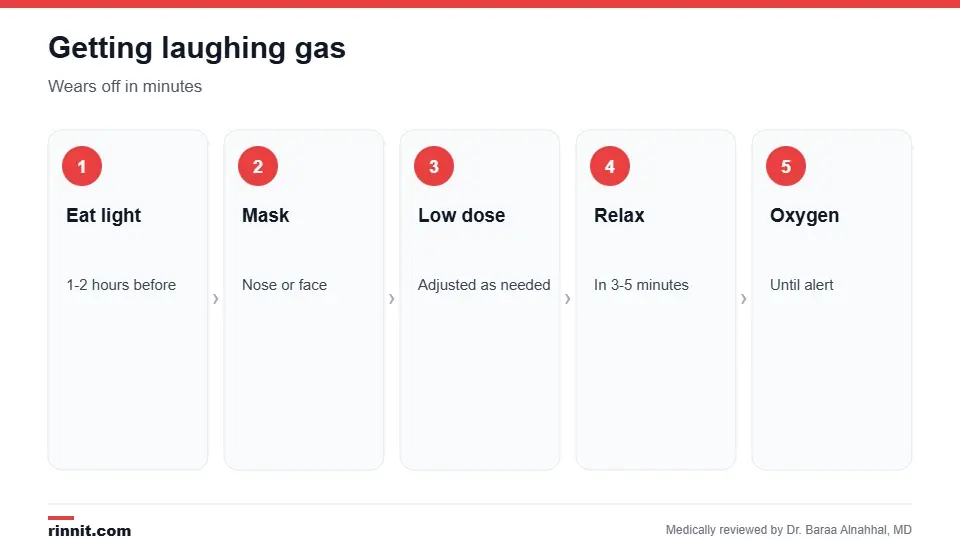
Effects wear off in 5 to 10 minutes.
Eat a light meal one to two hours before to lower nausea.
Your provider places a mask or nosepiece.
The gas starts at a very low dose and is adjusted.
You feel relaxed, tingly or giggly within three to five minutes.
Afterward, you breathe pure oxygen until you're alert. Sources: [1]
Side effects and risks

It's safe when given by a provider.
Situation | Possible effects |
Medical use | Temporary headache, nausea, vomiting or agitation |
Frequent exposure | |
Recreational misuse | Fainting, low oxygen, heart attack, nerve damage, memory loss, psychosis, loss of consciousness |
With several appointments, ask whether you should take a B12 supplement. Sources: [1, 3]
Recovery
The gas leaves your body in about 5 to 10 minutes, and your thinking returns to normal. Most people can drive shortly afterward. Sources: [1]
When to call your provider
Headaches and nausea usually happen before you leave the office and can be treated there. If your child has nausea or vomiting after you leave, call your provider. Sources: [1]
Conclusion
Nitrous oxide is a fast, needle-free way to feel calm during procedures, with effects that fade within minutes. Used under a provider's care, it's safe and effective.
Keep learning: read about sedation dentistry and types of anesthesia.
Frequently asked questions
What is nitrous oxide?
A mild inhaled sedative also called laughing gas.
Will I be asleep?
No. You stay awake and can respond.
How fast does it work?
Within three to five minutes.
Does it stop pain?
It eases pain; local anesthesia is often added.
How long does it last?
It wears off 5 to 10 minutes after the gas stops.
Can I drive afterward?
Usually, shortly afterward.
Is it safe for children?
Yes for most, but not for children under 2.
Can it be used during labor?
Yes, for pain relief.
What are the side effects?
Temporary headache, nausea or vomiting.
Is recreational use dangerous?
Yes. It can cause nerve damage and other serious harm.
Related Reading
Understanding Sedation Dentistry: Options, Benefits, and What to Expect sedation at the dentist.
Local Anesthesia: Types, How It Works, Side Effects and Recovery numbing medicine.
General Anesthesia: How It Works, Risks and Recovery full anesthesia.
Anesthesia Essentials: A Guide to Types, Safety, and Recovery types of anesthesia.
Understanding Vitamin B12 Deficiency: Causes, Symptoms, and Recovery a risk of frequent exposure.
References
Cleveland Clinic. Nitrous Oxide (Laughing Gas): Uses, Side Effects & Safety. Cleveland Clinic. Last updated November 20, 2023. https://my.clevelandclinic.org/health/treatments/nitrous-oxide-laughing-gas
Likis FE, Andrews JC, Collins MR, et al. Nitrous oxide for the management of labor pain: a systematic review. Anesthesia and Analgesia. 2014;118(1):153-167. PMID 24356165. https://doi.org/10.1213/ANE.0b013e3182a7f73c
Marsden P, Sharma AA, Rotella JA. Review article: clinical manifestations and outcomes of chronic nitrous oxide misuse: a systematic review. Emergency Medicine Australasia. 2022;34(4):492-503. PMID 35695047. https://doi.org/10.1111/1742-6723.13997
Medical disclaimer
This article is for general education only and does not replace advice from a qualified healthcare professional. Talk to your doctor about your own diagnosis and treatment, and seek emergency care right away for severe or sudden symptoms.



Comments