External Cephalic Version (ECV): Turning a Breech Baby

Updated: 2 days ago
Written and medically reviewed by Dr. Baraa Alnahhal, MD · Last reviewed: November 2026 · How we review
Quick Answer
External cephalic version (ECV) is a procedure to turn a breech baby head-down while in the uterus, usually around 37 weeks. A provider applies firm pressure on the belly to rotate the baby, making a vaginal delivery possible. It works about 58% of the time. It's done near an operating room in case an emergency C-section is needed.
What the research says
Pain relief raised ECV success: in 9 trials of 934 women, spinal or epidural pain relief raised ECV success from 43.1% to 58.4%, increased vaginal delivery from 44.6% to 54.0%, and lowered cesarean delivery from 55.3% to 46.0% (Magro-Malosso ER et al., American Journal of Obstetrics and Gynecology, 2016) [2]
ECV can work after a previous C-section: in 8 studies of 14,515 women, ECV succeeded in a median 74% of women with a previous cesarean versus 69% without, and after a successful ECV, 75% versus 92% delivered vaginally (Homafar M et al., Obstetrics and Gynecology, 2020) [3]
Key takeaways
ECV turns a breech baby head-down before birth.
It's usually done around 37 weeks.
Your provider turns the baby by pressing on your belly.
It succeeds about 58% of the time.
It's done near an operating room for safety.
What is external cephalic version?
External cephalic version, also called EV, is usually done by your obstetrician. A breech baby is positioned bottom- or feet-first instead of head-down. About 3 out of 100 babies are breech after 36 weeks; most turn on their own by then. Sources: [1]
Why it's done
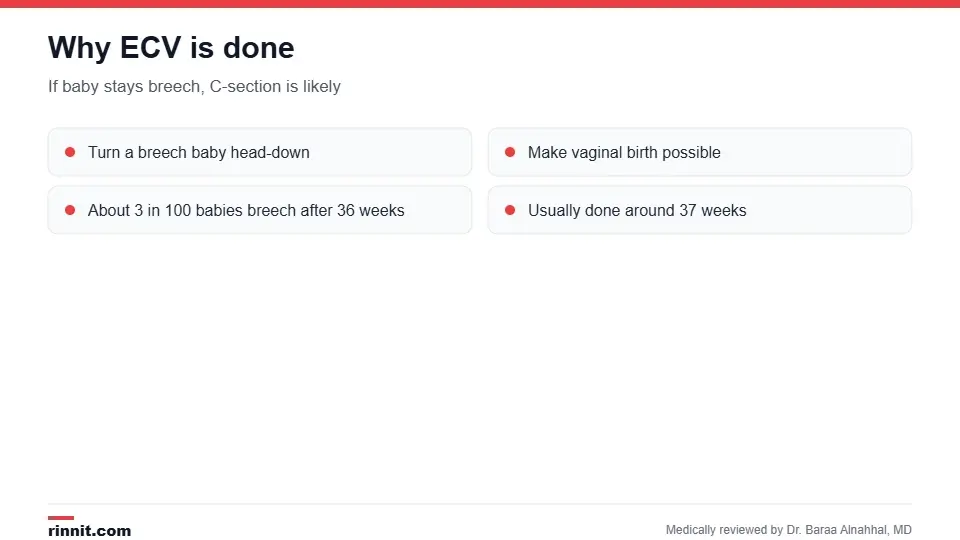
If the baby stays breech, a C-section is most likely.
ECV is done to make a vaginal birth possible. If the baby stays breech, a C-section is most likely. Being breech isn't dangerous until delivery. Sources: [1]
Who may not be a candidate

Your provider reviews your health history first.
Low amniotic fluid.
Vaginal bleeding.
Twins or more.
An abnormal fetal heart rate.
Placenta previa.
An irregularly shaped uterus.
High blood pressure or diabetes.
A C-section needed for another reason.
Being unable to take medicine that stops contractions. Sources: [1]
What happens during ECV
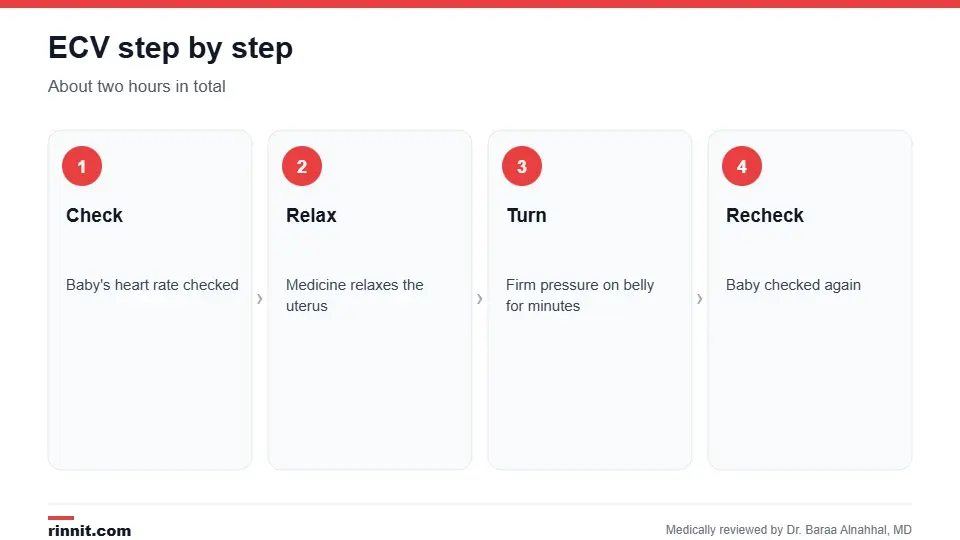
The whole visit takes about two hours.
Your baby is checked before the procedure.
You get medicine to relax your uterus; pain medicine is optional.
Your provider places their hands on your belly and presses firmly for several minutes to turn the baby.
Your baby is checked again afterward. If you're Rh-negative, you'll get an Rh immune globulin shot. After you go home, call your provider or go to the hospital for vaginal bleeding, leaking fluid, contractions, severe belly pain or less movement from your baby. Sources: [1]
You may feel cramping and discomfort. The visit takes about two hours. Sources: [1]
Risks
Risk | Notes |
Water breaking early | Premature rupture of membranes |
Placental abruption | The placenta separates from the uterus |
Preterm labor | ECV can trigger labor |
Fetal distress | Changes in the baby's heart rate |
Vaginal bleeding | Possible |
A C-section, as surgery, carries slightly more risk than ECV, though the two are hard to compare. Sources: [1]
Results
The average success rate is about 58%. Pain relief such as an epidural may raise success rates. If ECV doesn't work, some providers may deliver a breech baby vaginally, depending on their expertise and your history. Sources: [1, 2, 3]
Conclusion
External cephalic version can turn a breech baby and give you the chance of a vaginal birth. Talk with your provider about whether you're a good candidate and what your delivery options are.
Keep learning: read about breech babies and C-sections.
Frequently asked questions
What is external cephalic version?
A procedure to turn a breech baby head-down before birth.
When is ECV done?
Usually around 37 weeks of pregnancy.
Does ECV hurt?
It can cause cramping and discomfort; pain medicine is an option.
How long does ECV take?
The visit takes about two hours.
How successful is ECV?
It works about 58% of the time.
Is anything inserted into the vagina?
No.
What are the risks?
Early water breaking, placental abruption, preterm labor and heart rate changes.
What if ECV doesn't work?
A C-section is most likely.
Can I have ECV after a previous C-section?
Studies show it can still work.
Why is it done near an operating room?
In case an emergency C-section is needed.
Related Reading
Breech Baby: What It Means, the Types of Breech Positions, and How Delivery Works babies positioned bottom- or feet-first.
C-Section (Cesarean Delivery): Reasons, Procedure, Risks, and Recovery delivery by surgery.
High-Risk Pregnancy: Understanding Management, Factors, and Care managing complicated pregnancies.
Pregnancy Ultrasound: Why It's Done, When You'll Have One, What to Expect and Results checking your baby's position.
Spinal Anesthesia: How It Works, Side Effects and Recovery pain relief that may help ECV succeed.
References
Cleveland Clinic. External Cephalic Version (ECV): Procedure & Risks. Cleveland Clinic. Last updated August 27, 2025. https://my.clevelandclinic.org/health/treatments/22979-ecv
Magro-Malosso ER, Saccone G, Di Tommaso M, et al. Neuraxial analgesia to increase the success rate of external cephalic version: a systematic review and meta-analysis of randomized controlled trials. Am J Obstet Gynecol. 2016;215(3):276-286. PMID 27131581. https://doi.org/10.1016/j.ajog.2016.04.036
Homafar M, Gerard J, Turrentine M. Vaginal delivery after external cephalic version in patients with a previous cesarean delivery: a systematic review and meta-analysis. Obstet Gynecol. 2020;136(5):965-971. PMID 33030882. https://doi.org/10.1097/AOG.0000000000004065
Medical disclaimer
This article is for general education only and does not replace advice from a qualified healthcare professional. Talk to your doctor about your own diagnosis and treatment, and seek emergency care right away for severe or sudden symptoms.



Comments