Breech Baby: What It Means, the Types of Breech Positions, and How Delivery Works

Updated: 3 days ago
Medically reviewed by Dr. Baraa Alnahhal, MD. Last reviewed October 13, 2026. This content is for educational purposes and is not medical advice.
Quick Answer
A breech baby is a baby positioned feet or buttocks first toward the vagina, with its head up [1]. Breech occurs in about 3% to 4% of full-term pregnancies, and most fetuses turn head-down by 36 weeks [1]. If still breech at 37 weeks, providers typically offer an external cephalic version (ECV) or a planned C-section [1].
What the research says
Attempting an external cephalic version (ECV) at term makes a head-down birth more likely. In a Cochrane review of 7 trials and 1,245 women, attempting ECV lowered the chance of a non-cephalic birth (risk ratio 0.46, 95% CI 0.31 to 0.66) and of caesarean section (risk ratio 0.63, 95% CI 0.44 to 0.90). Large observational studies suggest complications are rare (Hofmeyr and Kulier, Cochrane Database Syst Rev, 2012) [2].
ECV is not risk-free for the baby. A systematic review of 9 articles covering 184,704 breech pregnancies found that ECV attempts reduced caesarean section (risk ratio 0.57, 95% CI 0.50 to 0.64), but slightly raised the chance of a low Apgar score (below 7) at 5 minutes (risk ratio 1.29, 95% CI 1.10 to 1.52), which is why it is offered after a careful discussion (Devold Pay et al., Eur J Midwifery, 2020) [3].
Home positions have not been shown to work. A Cochrane review of 6 studies and 417 women found similar rates of non-cephalic birth (risk ratio 0.98, 95% CI 0.84 to 1.15) and caesarean section (risk ratio 1.10, 95% CI 0.89 to 1.37) with and without postural management, and concluded there is insufficient evidence to support it (Hofmeyr and Kulier, Cochrane Database Syst Rev, 2012) [4].
What Is a Breech Baby?
A breech baby — also called a breech birth or breech presentation — is when a baby's feet or buttocks are positioned to come out of the vagina first [1]. This means its head is up toward your chest and its lower body is closest to your vagina.
Ideally, your baby is in a head-down, or vertex presentation, at delivery. While most babies do eventually turn into this position, some will not. If a baby is still breech at 37 weeks of pregnancy, your options for delivery may change, because there are risks to a vaginal delivery when a baby is breech. In many cases, a C-section is the best and safest option for birth [1].
When does a baby turn head down?
Breech is common in early pregnancy, but most fetuses will move to a head-down position by 36 weeks of pregnancy [1].
Is a breech baby normal?
Breech position isn't a typical position for full-term pregnancies — it accounts for 3% to 4% of all full-term pregnancies (39 and 40 weeks) [1].
What Are the Types of Breech Positions?
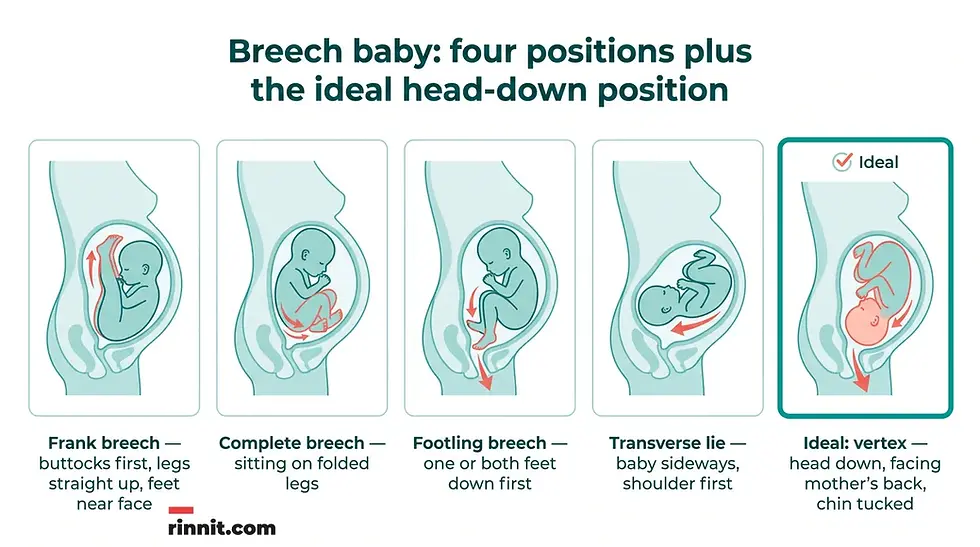
A breech baby can be in one of four different breech positions [1], all of which differ from the ideal head-down position.
Position | What it means |
Frank breech | The baby's buttocks aim toward your vagina, with its legs sticking straight up in front of its body (its feet are near its face). |
Complete breech | The baby's buttocks point downward, and both its hips and knees are flexed (the fetus is sitting on its folded legs). |
Footling breech | One or both of the baby's feet point downward and will deliver before the rest of its body. |
Transverse lie | The baby lies across your uterus horizontally; this is not technically breech (it is called a transverse lie), but it is handled in a similar way because the shoulder would enter your vagina first. |
Ideal position (vertex) | The baby is head down, facing your back, with its chin tucked to its chest, and the back of its head ready to enter your vagina. |
Is a breech birth safe?
If you're planning a vaginal delivery, a breech birth could change these plans. When your baby is breech, a vaginal delivery can be complicated and dangerous. Your healthcare provider may feel comfortable attempting a vaginal breech delivery, but in most cases, they'll recommend a C-section.
What Are the Symptoms of a Breech Baby?
Signs of a breech baby include feeling kicks in your pelvis instead of under your ribs and a hard lump at your ribs, and your provider can check by pressing on your belly.
How can you tell if your baby is breech?
You may be able to tell if the fetus is breech, especially if you've had past pregnancies where your baby was head down. The places where you feel lumps and kicks might indicate that the fetus is breech. For example, you may feel kicks in your pelvis instead of under your ribs, and you may feel one hard lump at your ribs [1].
Beginning around the third trimester, your provider will press certain areas of your belly to determine if the fetus is breech. If they detect a breech position before 36 weeks, they'll allow some time for it to turn into a preferable position.
Are breech babies more painful to carry?
No, the position of the fetus doesn't usually affect your pain or discomfort during pregnancy [1]. The movements you feel are just different from if the fetus was head down.
What Causes a Baby to Be Breech?
The cause of a breech baby is not always known, but birth defects, including muscular or skeletal conditions that limit movement, can keep a fetus from turning head down. Several factors may contribute to a fetus being breech:
Factor | Why it can lead to breech |
Expecting twins, triplets, or more | Less room and shared space in the uterus |
Previous pregnancies | Muscles and uterus have been stretched before |
Too much or too little amniotic fluid | Affects how easily the baby can move and turn |
Irregularly shaped uterus | Growths like fibroids, a uterine septum, or other conditions |
Placenta previa | The placenta covers all or part of your cervix |
Preterm baby | The baby may not have turned head-first yet |
Fetal condition | A condition that prevents the baby from turning head down |
Do birth defects cause breech position?
Yes, a birth defect can cause a fetus to be breech [1]. Certain muscular or skeletal conditions can increase the chance that a fetus is breech because they can't move to the head-down position when they have a condition that affects their movement.
What are some complications of having a breech baby?
A breech baby doesn't usually affect your pregnancy. The complications mainly occur when it's time to deliver [1]. Some breech births can happen vaginally, but there are risks. The risks of a vaginal breech birth include:
Risk | What it involves |
Limb injuries | Injuries to your baby's legs or arms, such as dislocated or broken bones |
Head entrapment | Your baby's head can get stuck or trapped |
Umbilical cord problems | The cord can flatten or twist during delivery, which can cause nerve or brain damage due to a lack of oxygen to your baby's brain |
How Is a Breech Baby Diagnosed?
Your pregnancy care provider may be able to tell which way the fetus is facing by placing their hands at certain spots on your abdomen. By feeling where the head, back, and buttocks are, it's usually possible to find out what part of the baby is positioned to deliver first. An ultrasound can confirm if a baby is in a breech position [1].
When is a breech baby diagnosed?
A fetus is typically breech at some point during pregnancy, but a breech position matters when you approach 36 weeks of pregnancy. Up until this point, fetuses often move into a head-down position. Your provider will feel your belly during your appointments in the third trimester to check if the fetus is in a breech position. An "official" diagnosis isn't typically made until 37 weeks [1].
How late can a breech baby turn?
After 37 weeks, a baby usually doesn't turn on its own due to having limited space [1]. Your healthcare provider will discuss delivery options with you.

How Is a Breech Baby Treated?
A breech baby may be treated by having a provider turn it head down with an external cephalic version (ECV), and if that does not work, a C-section is scheduled.
What are the options for delivering a breech baby?
If a baby is breech at 37 weeks of pregnancy, there are three possible options:
Option | Timing | What happens |
Turn the baby (ECV) | 37 to 38 weeks | Provider uses firm pressure on your abdomen to turn the baby head down |
Planned C-section | 39 to 40 weeks | A scheduled surgical birth |
Vaginal breech birth | If labor progresses | Most providers will avoid it unless the baby is crowning and ready to deliver |

Will my provider try to flip my baby if it's breech?
If the baby is breech, your provider may consider turning it so that you can have a vaginal delivery. It really depends on your health history, pregnancy, and desires for childbirth. In some cases, trying to turn a baby is too risky and unsafe.
An external cephalic version (ECV) is the most common method providers use to turn a baby [1]. Your pregnancy care provider performs this procedure in a hospital. It involves placing hands on your abdomen and applying firm pressure to turn your baby into a head-down position while it's still in your uterus. There are risks to ECV, and it doesn't always work. If the maneuver works, you'll be able to have a vaginal delivery. If it doesn't work, your provider will schedule a C-section at a later date [1].
Will a breech baby flip on their own?
Most fetuses will flip to a head-down position before they reach full-term (37 weeks). If a baby is still in a breech position at this time, your healthcare provider will monitor you with routine prenatal care and determine a time to schedule an ECV or a C-section.
How can I flip my baby if it's breech?
You can try to nudge your baby into a head-first position on your own at home. Keep in mind, there isn't any scientific evidence that these methods work [1] [4]:
Home method | How it's done |
Bridge position | Lie on the floor with legs bent and feet flat on the ground, raise your hips and pelvis into a bridge position, and hold for 10 or 15 minutes several times a day |
Child's pose | Rest in the child's pose for 10 to 15 minutes to help relax your pelvic muscles and uterus; you can also rock back and forth on your hands and knees or make circles with your pelvis |
On all fours | Get on your hands and knees to dangle your pregnant uterus; you can also rock back and forth or side to side |
Music | Place headphones or a speaker at the bottom of your uterus to encourage your baby to turn |
Temperature | Place something cold at the top of your stomach where your baby's head is, then place something warm at the bottom of your stomach |
A chiropractic technique called the Webster technique can also help your uterus relax, and some providers even recommend acupuncture. Both techniques need to be done by a professional that your healthcare provider recommends [1].
What is the outlook and long-term health for a breech baby?
Most children who were breech at delivery are healthy without later health problems, although a vaginal breech birth carries a much higher risk of injury.
Can you deliver vaginally with a breech baby?
It's possible to deliver vaginally when a baby is breech, but it can be more dangerous, and the risk of injury is much higher. The biggest risks involve injury to your baby's limbs and oxygen deprivation due to issues with the umbilical cord (compressing it or twisting it) or difficulty delivering your baby's shoulders and head [1].
Healthcare providers have various levels of expertise with vaginal deliveries when a baby is breech. Talk to your provider about the risks and benefits of different types of birth and what they recommend based on your situation.
Are C-sections more difficult when a baby is breech?
Performing a C-section when a baby is breech might be slightly more difficult, but obstetricians are usually familiar with doing a C-section this way [1]. It involves a few different steps, such as making a wider incision (cut) or maneuvering your baby in a different way than they would if your baby wasn't breech.
Do breech babies have health problems later in life?
No. Most children who were breech at delivery are healthy without health complications due to their presentation at birth. Pediatricians will examine your breech baby's hips after delivery and make follow-up recommendations if needed [1].
Can a Breech Baby Be Prevented?
A breech baby cannot be prevented, because there is nothing you can do to stop a fetus from being in a breech position [1].
How can you cope with learning your baby is breech?
Learning your baby is breech can raise natural concerns about delivery, and asking your doctor questions and knowing which symptoms need care can help you cope. Useful questions to ask your doctor include:
What are the benefits and risks of turning my baby?
Do you recommend a C-section if my baby stays breech?
What are the health risks to me and my baby if they're born vaginally?
When should I see my healthcare provider?
Contact your healthcare provider if you experience any of the following symptoms during pregnancy:
Severe pelvic cramping or contractions
Vaginal bleeding
Your water breaks [1]
What happens when labor starts with a breech baby?
Having a breech baby doesn't change some of the first signs of labor, like contractions or your water breaking. If your provider schedules a C-section because your baby is breech, they typically schedule it around 39 weeks to reduce the chances of you going into labor [1] (and needing an emergency C-section).
Will I need a C-section if my baby is breech?
Most of the time, a C-section is the safest way to deliver. Your risk of developing complications is much higher if your provider tries to deliver vaginally. But some providers feel comfortable performing a vaginal breech birth. You should discuss the risks with your provider.
Conclusion
A breech baby simply means your baby is positioned feet or buttocks first toward the birth canal instead of head-down. It's common early in pregnancy, but most fetuses turn on their own by 36 weeks, and only about 3% to 4% of babies remain breech at full term [1]. Position alone doesn't cause extra pain, and it's usually found through a third-trimester belly exam and confirmed with ultrasound. If your baby is still breech at 37 weeks, the usual path is an external cephalic version (ECV) at 37–38 weeks or a planned C-section around 39 to 40 weeks, since vaginal breech birth carries higher risks for the baby, including limb injury and umbilical cord problems. The reassuring news: most children who were breech at delivery grow up completely healthy, with no long-term problems from their birth position [1]. If labor signs appear before a planned C-section, contact your provider right away.
Want more plain-language answers about pregnancy and birth? Visit Rinnit.com for clear, trustworthy guides to understanding your health.
Frequently Asked Questions
What is a breech baby?
A breech baby (breech birth or breech presentation) is when a baby's feet or buttocks are positioned to come out of your vagina first. This means its head is up toward your chest and its lower body is closest to your vagina.
How common is breech position?
Breech is common in early pregnancy, but most fetuses will move to a head-down position by 36 weeks. Breech position isn't typical for full-term pregnancies — it accounts for 3% to 4% of all full-term pregnancies (39 and 40 weeks).
What are the types of breech positions?
There are four breech positions: frank breech (buttocks first, legs straight up with feet near the face), complete breech (buttocks first, sitting on folded legs), footling breech (one or both feet point downward), and transverse lie (baby lies horizontally, shoulder first). The ideal position is vertex — head down, facing your back, chin tucked.
Can I feel if my baby is breech?
Sometimes. You may feel kicks in your pelvis instead of under your ribs, or one hard lump at your ribs — especially if past babies were head down. Your provider confirms position by pressing on your belly and with ultrasound.
Does breech position hurt more during pregnancy?
No, the position of the fetus doesn't usually affect your pain or discomfort during pregnancy. The movements you feel are just different from if the fetus was head down.
What causes a baby to be breech?
It's not always known. Contributing factors include expecting twins or more, previous pregnancies, too much or too little amniotic fluid, an irregularly shaped uterus (such as from fibroids or a uterine septum), placenta previa, a preterm baby that hasn't turned yet, or a fetal condition that prevents turning.
Can a breech baby be a sign of a birth defect?
Yes, a birth defect can cause a fetus to be breech. Certain muscular or skeletal conditions can increase the chance of breech position because they affect the baby's ability to move to a head-down position.
What are the risks of a vaginal breech birth?
The risks include injuries to your baby's legs or arms (such as dislocated or broken bones), the baby's head getting stuck or trapped, and umbilical cord problems — the cord can flatten or twist during delivery, causing nerve or brain damage from lack of oxygen.
How is breech position diagnosed?
Your provider feels certain spots on your abdomen to find the head, back, and buttocks, and an ultrasound can confirm the breech position. An "official" diagnosis isn't typically made until 37 weeks.
Can a breech baby still turn after 37 weeks?
Usually not. After 37 weeks, a baby typically doesn't turn on its own due to limited space, and your provider will discuss delivery options with you.
What is external cephalic version (ECV)?
ECV is the most common method providers use to turn a breech baby. It's performed in a hospital: the provider places hands on your abdomen and applies firm pressure to turn the baby into a head-down position while it's still in your uterus. It carries risks, doesn't always work, and isn't right for every pregnancy.
What are my delivery options if my baby is breech at 37 weeks?
There are three options: turn the baby at 37 to 38 weeks (ECV), plan a C-section birth at 39 to 40 weeks, or attempt a vaginal breech birth — which most providers avoid unless the baby is crowning and ready to deliver.
Do home positions like the bridge pose work to flip a breech baby?
You can try methods like the bridge position, child's pose, getting on all fours, music, or temperature changes at home, but there isn't any scientific evidence that these methods work. Chiropractic (Webster technique) and acupuncture may also be offered by professionals your provider recommends.
Do breech babies have health problems later in life?
No. Most children who were breech at delivery are healthy without health complications due to their presentation at birth. Pediatricians will examine your breech baby's hips after delivery and make follow-up recommendations if needed.
Can I prevent my baby from being breech?
There is nothing you can do to prevent a fetus from being in a breech position.
Related Reading
External Cephalic Version (ECV): Turning a Breech Baby explains how ECV turns a breech baby.
Fundal Height: How It's Measured, Normal Range by Week and What It Means explains how fundal height tracks your baby's growth.
Pregnancy Ultrasound: Why It's Done, When You'll Have One, What to Expect and Results explains when pregnancy scans are done, what they check and why some people need extra ultrasounds.
References
Cleveland Clinic. Breech Baby. Cleveland Clinic. Updated April 4, 2024. https://my.clevelandclinic.org/health/diseases/21848-breech-baby
Hofmeyr GJ, et al. External cephalic version for breech presentation at term. Cochrane Database of Systematic Reviews. 2012;10:CD000083. PMID 23076883. https://doi.org/10.1002/14651858.CD000083.pub2
Devold Pay AS, et al. Effects of external cephalic version for breech presentation at or near term in high-resource settings: a systematic review of randomized and non-randomized studies. European Journal of Midwifery. 2020;4:44. PMID 33537645. https://doi.org/10.18332/ejm/128364
Hofmeyr GJ, et al. Cephalic version by postural management for breech presentation. Cochrane Database of Systematic Reviews. 2012;10(10):CD000051. PMID 23076882. https://doi.org/10.1002/14651858.CD000051.pub2
Medical disclaimer
This article is for general informational purposes only and is not a substitute for professional medical advice, diagnosis, or treatment. Always consult your obstetric provider about breech presentation and delivery planning, and contact them immediately for severe cramping, contractions, vaginal bleeding, or if your water breaks.



Comments