Fundal Height: How It's Measured, Normal Range by Week and What It Means

Updated: 2 days ago
Written and medically reviewed by Dr. Baraa Alnahhal, MD · Last reviewed: November 2026 · How we review
Quick Answer: What is fundal height?
Fundal height is the distance in centimeters from the top of the uterus (the fundus) to the pubic bone. A provider measures it at each prenatal visit to check the baby's size, growth and position. From 20 to 36 weeks, the number of centimeters should be close to the number of weeks of pregnancy, give or take 2 cm. [1]
What the research says
Tape measurement alone has limited proof of better outcomes. A Cochrane review found only one trial (1,639 women) comparing fundal height measurement with feeling the abdomen by hand, and it showed no clear difference in small-for-gestational-age babies (risk ratio 1.32) or perinatal deaths. (Robert Peter et al., Cochrane Database of Systematic Reviews, 2015) [2]
Fundal height is not accurate for dating a pregnancy. In a meta-analysis, only 71% of pregnancies dated by fundal height were within 14 days of ultrasound dating (5 studies, 5,838 pregnancies), and the "1 cm per week" rule underestimated pregnancy age by an average of 14 days. (Whelan et al., PLOS ONE, 2022) [3]
Key takeaways
Fundal height is measured from the top of the uterus to the pubic bone, in centimeters. [1]
It is checked at every prenatal visit from about 20 weeks. [1]
From 20 to 36 weeks, centimeters should roughly match weeks of pregnancy, within about 2 cm. [1]
It helps track growth and position but is not used to set your due date. [1]
If the measurement is off, an ultrasound gives a more accurate estimate of size. [1]
What is fundal height?
Fundal height is the distance from the top of your uterus (the fundus) to your pubic bone, measured in centimeters. Providers use it to check your baby's size, growth and position and to help confirm how far along you are. It is not used to determine your due date. [1]
How is fundal height measured?
You lie back on the exam table. Your provider finds the symphysis pubis (the cartilage joint between your pubic bones) and the fundus, pressing gently on your belly if needed. They then run a paper or plastic tape measure between these two points. [1]
No preparation or aftercare is needed. Fundal height is a routine part of prenatal visits in the second and third trimesters. [1]
When is fundal height measured?
Measurements start at about 20 weeks of pregnancy and are taken at each prenatal visit. Around this point, fundal height and the weeks of pregnancy begin to match. Before 20 weeks, the fundus is too low for the measurement to be useful. [1]
Where is the top of the uterus during pregnancy?
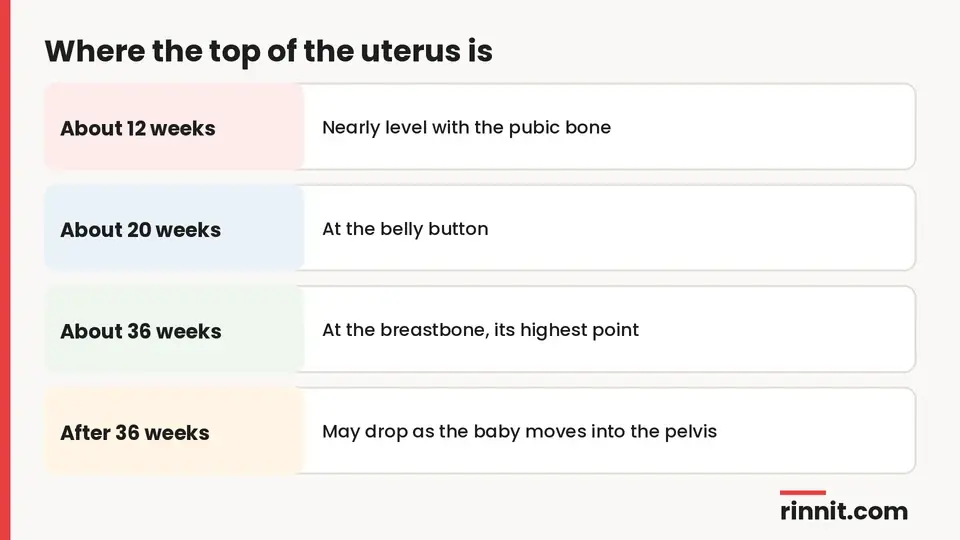
Weeks of pregnancy | Where the fundus usually is |
About 12 weeks | Nearly level with the pubic bone |
About 20 weeks | At the belly button |
About 36 weeks | At the breastbone (sternum), its highest point |
After 36 weeks | It may drop as the baby moves down into the pelvis before labor |
Sources: [1]
What is a normal fundal height?
From about 20 to 36 weeks, your fundal height in centimeters should be close to the number of weeks you are pregnant. At 24 weeks, for example, you can expect about 24 cm. [1]
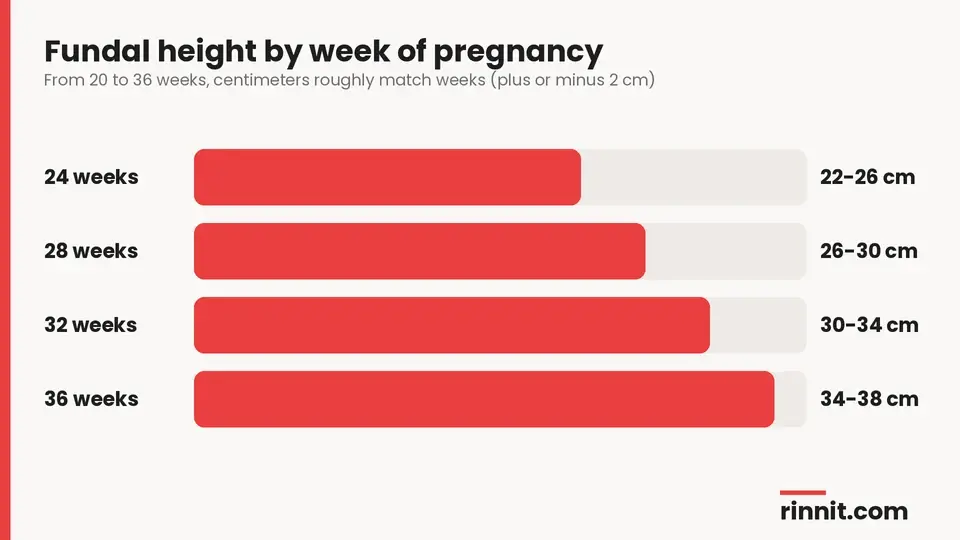
A difference of plus or minus 2 cm is normal. At 32 weeks, a measurement of 30 to 34 cm is acceptable. A difference of 2 weeks or 2 cm is generally not a cause for concern. [1]
Weeks of pregnancy | Expected fundal height | Acceptable range |
24 weeks | About 24 cm | 22 to 26 cm |
28 weeks | About 28 cm | 26 to 30 cm |
32 weeks | About 32 cm | 30 to 34 cm |
36 weeks | About 36 cm | 34 to 38 cm |
Sources: [1]
What if fundal height measures larger or smaller?
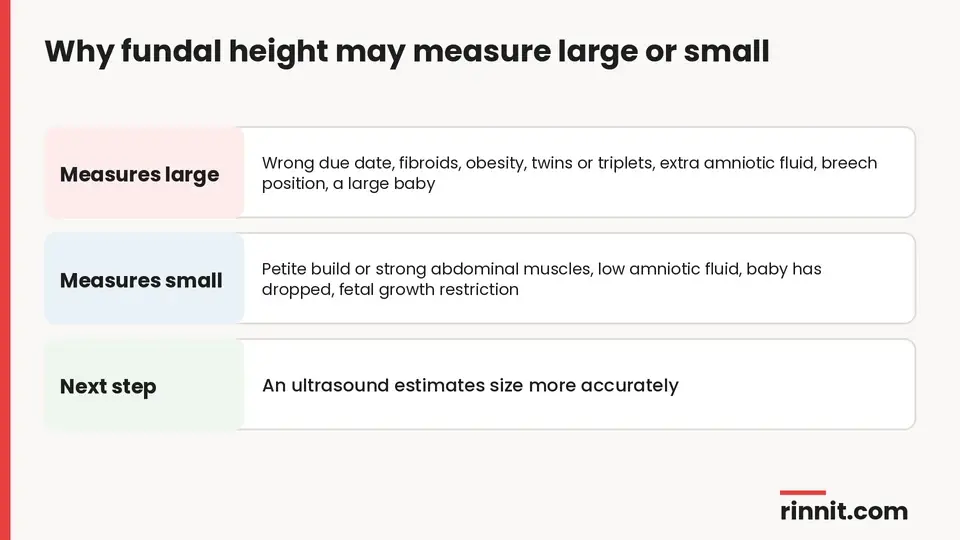
Measures large (ahead of your weeks) | Measures small (behind your weeks) |
Incorrect due date | Petite build or strong abdominal muscles |
Uterine fibroids | Low amniotic fluid (oligohydramnios) |
Obesity | Baby has already dropped into the pelvis |
Twins or triplets | Fetal growth restriction |
Too much amniotic fluid (polyhydramnios) | |
Breech position | |
A large baby (fetal macrosomia) |
Sources: [1]
Sometimes no cause is found for a larger measurement. After 36 weeks, a smaller measurement can happen as the baby drops, but your provider may order tests to rule out other causes. [1]
How accurate is fundal height?
Fundal height is one of the simplest, least invasive ways to track your baby's growth, and it can be the first sign of a growth or position problem. But it is an estimate, and a difference of a centimeter or two is common. [1]
If your measurement raises a concern, your provider may order an ultrasound, which estimates your baby's size more accurately. Providers also feel your abdomen to estimate size and position and review your medical history before deciding on more tests. Routine ultrasounds are recommended two times during pregnancy unless more are medically needed. [1]
Conclusion
Fundal height is a quick tape-measure check of your uterus that helps your provider follow your baby's growth from about 20 weeks. A measurement within about 2 cm of your weeks of pregnancy is normal.
If your measurement is larger or smaller than expected, an ultrasound can give a clearer picture. Keep up with your prenatal visits so changes are caught early.
Keep learning: Read our guides to the due date calculator and ultrasound, or learn about prenatal genetic testing.
FAQ
What is fundal height?
The distance in centimeters from the top of your uterus to your pubic bone, used to track your baby's growth. [1]
When do doctors start measuring fundal height?
At about 20 weeks of pregnancy, then at each prenatal visit. [1]
What is a normal fundal height?
From 20 to 36 weeks, the centimeters should be close to your weeks of pregnancy, within about 2 cm. [1]
Is fundal height used to set the due date?
No; it helps confirm gestational age but does not determine the due date. [1]
Why would fundal height measure large?
An incorrect due date, fibroids, obesity, twins, extra amniotic fluid, breech position or a large baby. [1]
Why would fundal height measure small?
A petite build, strong abdominal muscles, low amniotic fluid, the baby dropping or fetal growth restriction. [1]
How is fundal height measured?
With a paper or plastic tape measure from the pubic bone to the top of the uterus while you lie back. [1]
Is a 2 cm difference in fundal height a concern?
Generally not; a difference of 2 weeks or 2 cm is common. [1]
What happens if my fundal height is off?
Your provider may order an ultrasound to estimate your baby's size more accurately. [1]
Why does fundal height drop after 36 weeks?
The baby may move down into the pelvis before labor. [1]
Related Reading
Intrauterine Growth Restriction (IUGR): Causes, Risks, and Management explains a key cause of a small measurement.
Fetal Macrosomia: What It Means When Your Baby Is Larger Than Average covers a cause of a large measurement.
Understanding Polyhydramnios: Managing Excess Amniotic Fluid explains how extra fluid can raise fundal height.
What Is Oligohydramnios? Causes, Signs, and Treatment explains how low fluid can lower fundal height.
Breech Baby: What It Means, the Types of Breech Positions, and How Delivery Works covers a baby position that can change the measurement.
References
Cleveland Clinic. Fundal Height: Measurement, What It Means & Accuracy. Cleveland Clinic. Last updated June 12, 2025. https://my.clevelandclinic.org/health/diagnostics/22294-fundal-height
Robert Peter J, Ho JJ, Valliapan J, et al. Symphysial fundal height (SFH) measurement in pregnancy for detecting abnormal fetal growth. Cochrane Database Syst Rev. 2015;2015(9):CD008136. PMID 26346107. https://doi.org/10.1002/14651858.CD008136.pub3
Whelan R, Schaeffer L, Olson I, et al. Measurement of symphysis fundal height for gestational age estimation in low-to-middle-income countries: A systematic review and meta-analysis. PLoS One. 2022;17(8):e0272718. PMID 36007078. https://doi.org/10.1371/journal.pone.0272718
Medical disclaimer
This article is for general education only and does not replace advice from a qualified healthcare professional. Talk to your doctor about your own diagnosis and treatment, and seek emergency care right away for severe or sudden symptoms.



Comments