Prenatal Genetic Testing: Screening vs Diagnostic Tests, Timing and Accuracy

Updated: 2 days ago
Written and medically reviewed by Dr. Baraa Alnahhal, MD · Last reviewed: November 2026 · How we review
Quick Answer: What is prenatal genetic testing?
Prenatal genetic testing checks a pregnancy for certain genetic disorders and birth defects caused by changes in genes or chromosomes. Screening tests, like blood tests and ultrasounds, estimate the chance of a condition with little risk. Diagnostic tests, like amniocentesis and chorionic villus sampling (CVS), confirm whether the baby has a condition but carry some risk. Testing is optional. [1]
What the research says
Cell-free DNA screening catches almost all cases of the main trisomies. Pooling 35 studies, cell-free DNA (NIPT) detected 99.7% of Down syndrome cases, 97.9% of trisomy 18 and 99.0% of trisomy 13, with a false-positive rate of about 0.04% for each. (Gil et al., Ultrasound in Obstetrics & Gynecology, 2017) [2]
The miscarriage risk from diagnostic tests is lower than often quoted. In a meta-analysis of 63,723 amniocentesis and 13,011 CVS procedures, the extra miscarriage risk caused by the procedure was about 0.30% for amniocentesis and 0.20% for CVS, and close to zero when compared with similar-risk pregnancies. (Salomon et al., Ultrasound in Obstetrics & Gynecology, 2019) [3]
Key takeaways
Screening tests estimate risk; diagnostic tests confirm a diagnosis. [1]
Screening usually comes first and is very low risk because it's mostly blood tests and ultrasound. [1]
NIPT can't be done before 10 weeks and is about 99% accurate for Down syndrome. [1]
Amniocentesis (16 to 20 weeks) and CVS (about 11 to 13 weeks) are usually over 99% accurate. [1]
Providers offer genetic screening to all pregnant patients, but whether to test is a personal choice. [1]
What conditions can prenatal genetic testing find?
Prenatal tests can detect several types of genetic changes: [1]
Type of change | Examples |
Extra or missing chromosomes | Down syndrome, trisomy 18, trisomy 13 |
Single-gene changes | Cystic fibrosis, spinal muscular atrophy (SMA), sickle cell disease |
Missing chromosome pieces | DiGeorge syndrome |
Sources: [1]
Screening vs diagnostic tests
Screening tests | Diagnostic tests | |
What they tell you | The chance of a condition | Whether the baby has a condition |
How they're done | Your blood and/or an ultrasound | Cells from amniotic fluid or the placenta |
Risk | Very low | Small risk of infection, bleeding and miscarriage |
Accuracy | Lower; varies by test | Usually over 99% |
When offered | To all pregnant patients | After an abnormal screen or with higher risk |
Sources: [1]

Prenatal screening tests
Screenings don't diagnose a condition; they only show how likely it is. If a result is concerning, your provider may recommend a diagnostic test. [1]
Carrier screening
A blood test checks whether you carry small gene changes that raise the risk of single-gene conditions. If you're a carrier, your partner should be tested too. If you both carry the same condition, your baby could inherit it. It can be done before or during pregnancy. [1]
Screening for an abnormal number of chromosomes
This blood screening is offered in each pregnancy and looks for conditions such as Down syndrome (an extra chromosome 21) or Turner syndrome (a missing X chromosome). [1]
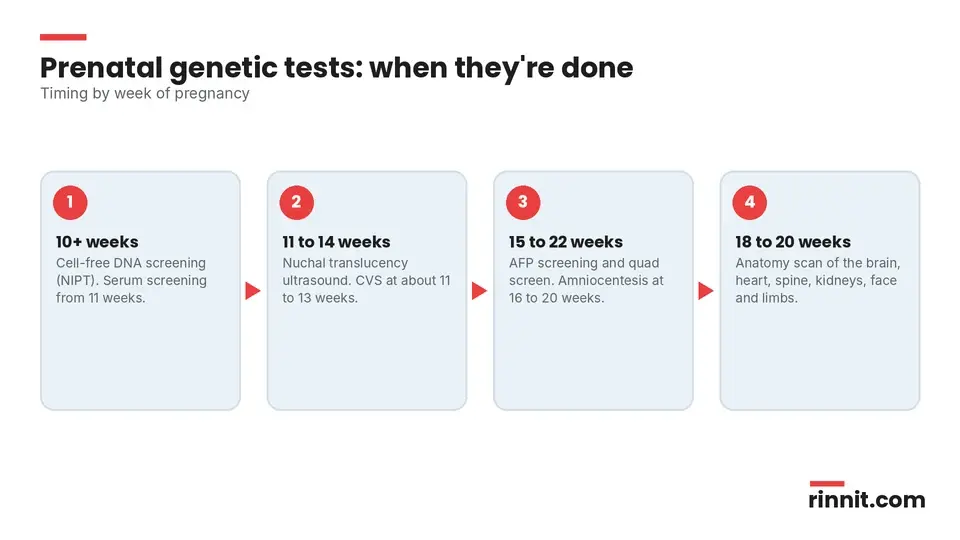
Cell-free DNA screening (NIPT): looks for fragments of the baby's DNA in your blood. It can't be done before 10 weeks.
Serum screening: measures proteins in your blood, such as first-trimester, sequential and quad screening. It can't be done before 11 weeks.
Screening for physical differences
Test | What it checks | When |
Nuchal translucency ultrasound | Thickness at the back of the baby's neck; a thick result can suggest a chromosome or heart problem | About 11 to 14 weeks |
AFP blood screening | Alpha-fetoprotein; high levels may point to problems with the abdomen, face or spine | 15 to 22 weeks |
Quad screen | Four substances in your blood; estimates risk of chromosome conditions and neural tube defects | 15 to 22 weeks |
Anatomy scan | Ultrasound of the brain, skeleton, heart, kidneys, abdomen, face, arms and legs | Usually 18 to 20 weeks |
Sources: [1]
Prenatal diagnostic tests
Diagnostic tests look at the baby's cells from the amniotic fluid or placenta to confirm specific disorders. They're usually done only after an abnormal screening result or if you're at high risk. [1]
Test | How it's done | When |
Amniocentesis | A needle through the belly into the uterus collects amniotic fluid | 16 to 20 weeks |
Chorionic villus sampling (CVS) | A needle collects placental cells, through the belly or the vagina | About 11 to 13 weeks |
Sources: [1]
Samples go to a lab. Some results come back in about 72 hours; others take more than two weeks. [1]
Who should get prenatal genetic testing?
Testing is a personal choice. Providers offer genetic screening to all pregnant patients as part of routine care. Common reasons families choose diagnostic testing include: [1]
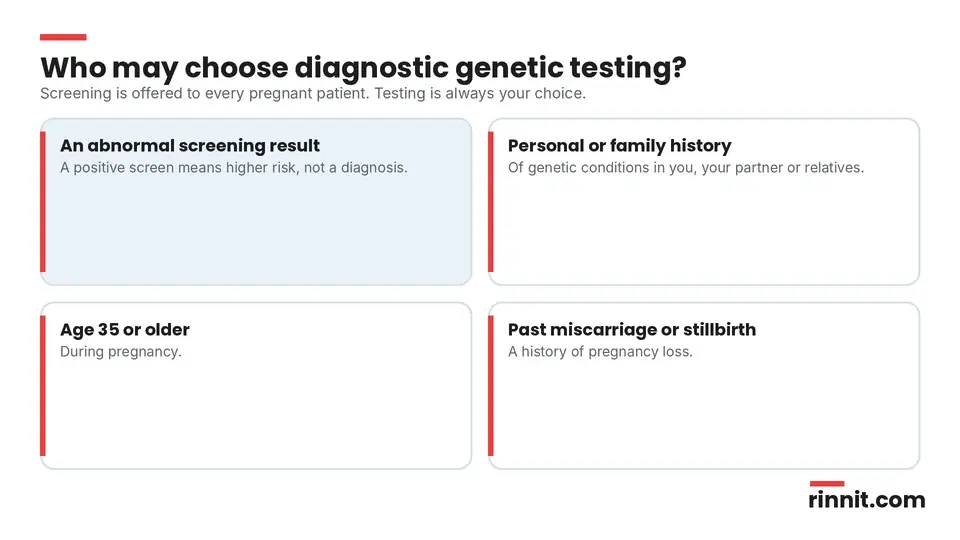
An abnormal screening result
A personal or family history of genetic conditions
Being 35 or older during pregnancy
A history of miscarriage or stillbirth
What are the risks?
Screening tests are very low risk because they use a blood sample or ultrasound. Diagnostic tests carry risks, including infection, bleeding and miscarriage. [1] Research suggests the added miscarriage risk is small. [3]
Understanding your results
Screening results take several days; diagnostic results can take days to weeks. Try not to panic over results you see in your medical record before your provider reviews them with you. [1]
Screening result | What it means |
Positive | A higher chance than the general population, not a diagnosis |
Negative | A lower chance than the general population |
Sources: [1]
After a positive screen, your provider may suggest a diagnostic test or refer you to a genetic counselor. [1]
How accurate are prenatal genetic tests?
Screening tests are less accurate, and accuracy varies by test. NIPT is about 99% accurate for detecting Down syndrome, and diagnostic tests such as amniocentesis or CVS are usually over 99% accurate. [1]
Can genetic testing tell the baby's sex?
NIPT can give fetal sex information, and so can ultrasound. But learning the sex isn't the main purpose of genetic testing. [1]
Questions to ask your provider
Which screening tests do you recommend for my health history?
What are the next steps if a screening result is positive?
What is the chance of a false positive?
What are the risks of each test?
Sources: [1]
Conclusion
Prenatal genetic testing gives you information, not obligations. Screening tests estimate your baby's chance of certain conditions with very little risk, while diagnostic tests give near-certain answers with a small added risk.
There's no right or wrong choice. Talk with your provider, and a genetic counselor if you'd like, about which tests fit your history and what you'd do with the results.
Keep learning: Read our guide to the nuchal translucency scan or learn about Down syndrome. For more background, see the ACOG guide to prenatal genetic screening tests.
FAQ
What is prenatal genetic testing?
It's testing during pregnancy that screens for or diagnoses certain genetic disorders and birth defects in the baby.
What is the difference between screening and diagnostic tests?
Screening estimates the chance of a condition; diagnostic tests confirm whether the baby has it.
Is prenatal genetic testing required?
No. Testing is optional, and the decision belongs to you and your family.
When can NIPT be done?
Cell-free DNA screening (NIPT) can't be done before 10 weeks of pregnancy.
How accurate is NIPT?
It's about 99% accurate for detecting Down syndrome, but it's still a screening test.
When are amniocentesis and CVS done?
Amniocentesis is done at 16 to 20 weeks, and CVS at about 11 to 13 weeks.
What are the risks of amniocentesis and CVS?
They carry small risks of infection, bleeding and miscarriage.
What does a positive screening result mean?
It means a higher chance than average, not a diagnosis; a diagnostic test can confirm.
Who should consider diagnostic testing?
People with an abnormal screen, a family history of genetic conditions, age 35 or older, or past miscarriage or stillbirth.
How long do prenatal genetic test results take?
Screening takes several days; diagnostic results take from about 72 hours to more than two weeks.
What is carrier screening?
A blood test showing whether you carry a gene change for a single-gene condition you could pass on.
Related Reading
Cordocentesis (PUBS): Umbilical Cord Blood Test, Risks and Results explains the umbilical cord blood test used when other prenatal tests are unclear.
Down Syndrome: Symptoms, Causes, Types & Life Expectancy — Complete Guide explains the most common condition prenatal screening looks for.
Edwards Syndrome (Trisomy 18): Symptoms, Causes, Diagnosis, Treatment, Survival Rates and When to Seek Emergency Care — What You Need to Know covers trisomy 18, which screening and diagnostic tests can detect.
Cystic Fibrosis: Symptoms, Causes, Diagnosis, and Treatment (2026 Guide) covers a single-gene condition found through carrier screening.
Understanding Spinal Muscular Atrophy: Types, Causes, and Management explains SMA, another condition included in carrier screening.
Understanding Neural Tube Defects: Types, Causes, and Prevention covers spine and brain defects that the quad screen and anatomy scan look for.
Nuchal Translucency (NT) Scan: Timing, Procedure, Accuracy and Results explains the first-trimester ultrasound used in prenatal screening.
Alpha-Fetoprotein (AFP) Test: Pregnancy Screening, Cancer Marker and What Results Mean explains the blood test used in pregnancy screening and as a liver cancer marker.
Carrier Screening: Genetic Testing Before or During Pregnancy explains the genetic test that shows whether you carry an inherited condition.
References
Cleveland Clinic. Genetic Testing During Pregnancy: What To Know. Cleveland Clinic. Last updated May 11, 2026. https://my.clevelandclinic.org/health/diagnostics/24136-pregnancy-genetic-testing
Gil MM, Accurti V, Santacruz B, et al. Analysis of cell-free DNA in maternal blood in screening for aneuploidies: updated meta-analysis. Ultrasound Obstet Gynecol. 2017;50(3):302-314. PMID 28397325. https://doi.org/10.1002/uog.17484
Salomon LJ, Sotiriadis A, Wulff CB, et al. Risk of miscarriage following amniocentesis or chorionic villus sampling: systematic review of literature and updated meta-analysis. Ultrasound Obstet Gynecol. 2019;54(4):442-451. PMID 31124209. https://doi.org/10.1002/uog.20353
Medical disclaimer
This article is for general education only and does not replace advice from a qualified healthcare professional. Talk to your doctor about your own diagnosis and treatment, and seek emergency care right away for severe or sudden symptoms.



Comments