Cordocentesis (PUBS): Umbilical Cord Blood Test, Risks and Results

Updated: 3 days ago
Written and medically reviewed by Dr. Baraa Alnahhal, MD · Last reviewed: November 2026 · How we review
Quick Answer
Cordocentesis, also called percutaneous umbilical blood sampling (PUBS), is a prenatal test that takes a sample of blood from the umbilical cord using a needle guided by ultrasound. It can check the fetus for anemia, infections and chromosome conditions. It's done after 17 weeks. The main risk is pregnancy loss, in about 1 to 2 of every 100 procedures.
What the research says
Fetal loss may be lower in experienced centers: in 6,650 cordocentesis procedures at one center, fetal loss related to the procedure was only 0.6%, and risk factors included passing through the placenta, prolonged bleeding and a slow fetal heart rate (Tanvisut R et al., Ultrasound in Obstetrics & Gynecology, 2020) [2]
Experts recommend it mainly for suspected fetal anemia: a Society for Maternal-Fetal Medicine review found blood samples are obtained in more than 98% of cases and listed risks of bleeding at the puncture site (20% to 30%), slow fetal heart rate (5% to 10%) and pregnancy loss of at least 1.3% (Berry SM et al., American Journal of Obstetrics and Gynecology, 2013) [3]
Key takeaways
Cordocentesis samples fetal blood from the umbilical cord.
It's done after 17 weeks when other tests are unclear.
It can also deliver blood transfusions to the fetus.
Pregnancy loss occurs in about 1 to 2 in 100 procedures.
Results usually take a few days.
What is cordocentesis?
The umbilical cord carries blood between the placenta and the fetus. Cordocentesis is the only test that gives direct access to the fetal bloodstream. A provider, usually an obstetrician or maternal-fetal medicine specialist, uses ultrasound to guide a needle through your belly into a blood vessel in the cord. It's also called funipuncture. Sources: [1, 3]
Why it's done
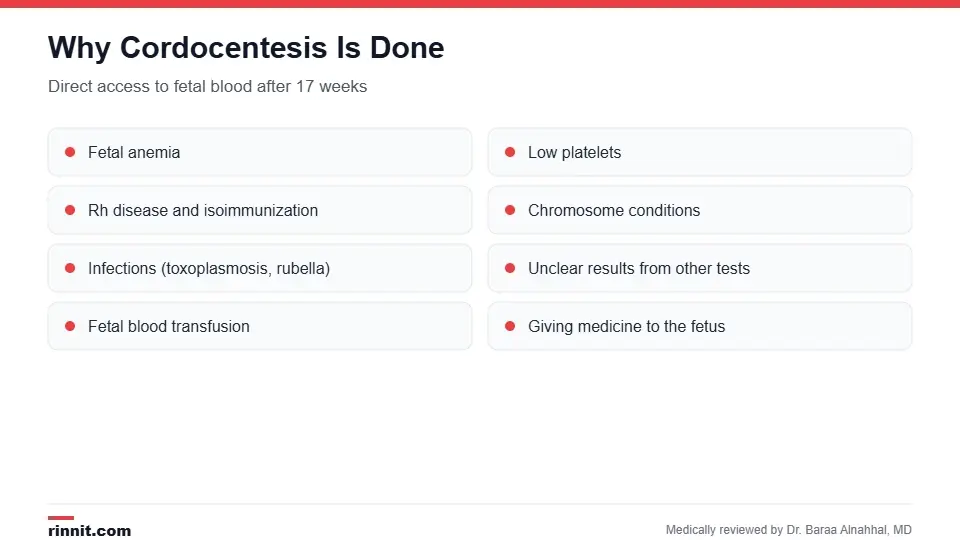
Cordocentesis can both diagnose and treat.
Fetal anemia and thrombocytopenia (low platelets).
Hemolytic disease and isoimmunization, such as Rh incompatibility.
Chromosome conditions such as Down syndrome.
Infections such as toxoplasmosis and rubella.
Treatment: giving blood transfusions or medicine directly to the fetus. Sources: [1, 3]
Compared with other prenatal tests
Test | What's sampled | Typical timing |
Parent's blood (screening only) | From 10 weeks | |
CVS | Placenta tissue | 10 to 13 weeks |
Amniocentesis | Amniotic fluid | 15 weeks or later |
Cordocentesis | Fetal blood from the cord | After 17 weeks |
Cordocentesis is usually reserved for questions the other tests can't answer. Sources: [1, 3]
How to prepare
You may be asked not to eat or drink for several hours in case an emergency C-section is needed.
You may get IV antibiotics to prevent infection.
A sample of your blood may be taken to compare with the fetal blood.
Bring a support person to drive you home. Sources: [1]
What happens during the test
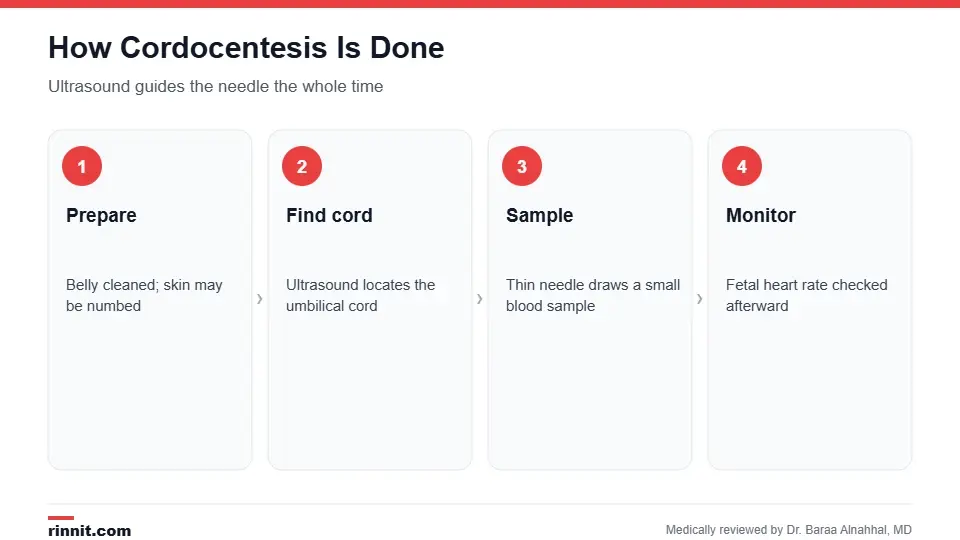
Ultrasound guides the needle the whole time.
You lie on an exam table and your belly is cleaned.
Local anesthetic may numb your skin.
Ultrasound shows the umbilical cord, often near where it joins the placenta.
A thin needle enters a cord blood vessel and draws a small blood sample.
The needle is removed and the sample goes to a lab.
The fetal heart rate is monitored for a short time afterward. Sources: [1]
Rest for the rest of the day. Mild cramping is common. Sources: [1]
Risks
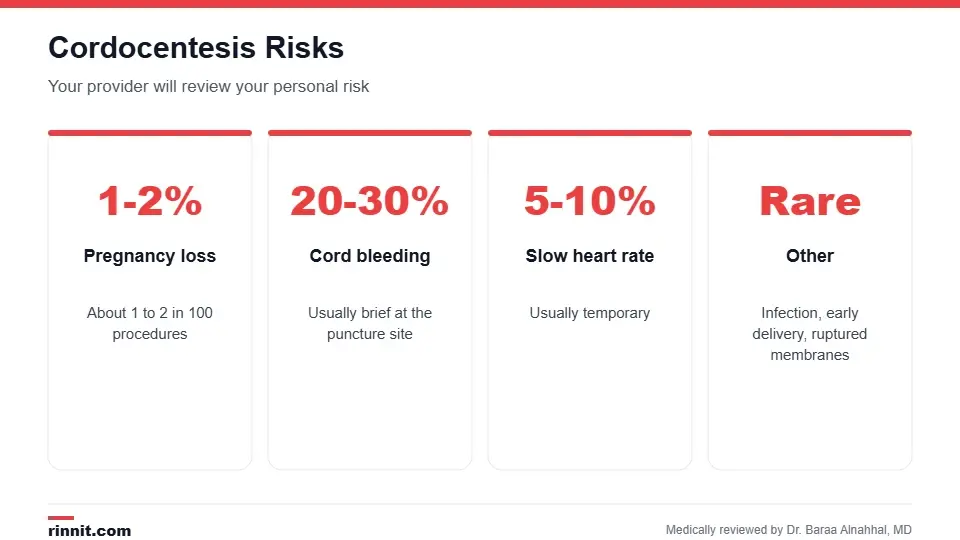
Your provider will review risks for your situation.
Miscarriage or pregnancy loss, about 1 to 2 in every 100 procedures.
Bleeding from the puncture site or a cord hematoma.
A temporary slow fetal heart rate.
Infection, premature rupture of membranes, placental separation and early delivery, sometimes by emergency C-section. Sources: [1, 2, 3]
Call your provider for fever, chills, ongoing cramps, leaking fluid, vaginal bleeding or less fetal movement. Sources: [1]
Results
Results are usually ready in a few days. Abnormal results may lead to treatment such as antibiotics or antivirals, fetal blood transfusions, closer monitoring or, in some cases, decisions about the pregnancy. Normal results may still need follow-up visits. Sources: [1]
Conclusion
Cordocentesis gives a direct look at fetal blood when other prenatal tests aren't enough, and it can also be used to treat the fetus. Because it carries a small risk of pregnancy loss, it's done only when the benefits clearly outweigh the risks, ideally at an experienced center.
Keep learning: read about prenatal genetic testing and amniocentesis.
Frequently asked questions
What is cordocentesis?
A test that takes a blood sample from the umbilical cord during pregnancy.
What is PUBS?
Percutaneous umbilical blood sampling, another name for cordocentesis.
When is cordocentesis done?
After 17 weeks of pregnancy.
Why would I need cordocentesis?
To check for fetal anemia, infections or chromosome conditions when other tests are unclear.
Can cordocentesis treat the baby?
Yes. It can be used to give blood transfusions or medicine.
Does cordocentesis hurt?
You may feel pressure and cramping; your skin may be numbed.
What is the miscarriage risk?
About 1 to 2 in 100 procedures.
Do I need to fast?
Possibly, in case an emergency C-section is needed.
When will I get results?
Usually within a few days.
What should I watch for afterward?
Fever, leaking fluid, bleeding, cramps or less fetal movement.
Related Reading
Amniocentesis: Why It's Done, What Happens, Risks and What Your Results Mean the amniotic fluid test used more often.
Chorionic Villus Sampling (CVS): What It Is, Why It's Done, Risks and Results an earlier prenatal diagnostic test.
NIPT Test (Noninvasive Prenatal Testing): What It Screens For, Accuracy and Results a blood screening test with no risk to the pregnancy.
Prenatal Genetic Testing: Screening vs Diagnostic Tests, Timing and Accuracy an overview of screening and diagnostic options.
Understanding the Rh Factor: Clinical Significance and Pregnancy Management a cause of fetal anemia.
Understanding Hydrops Fetalis: Causes, Symptoms, and Management a serious condition linked to fetal anemia.
References
Cleveland Clinic. Cordocentesis: Purpose, Procedure, Risks & Results. Cleveland Clinic. Last updated October 31, 2022. https://my.clevelandclinic.org/health/diagnostics/24398-cordocentesis
Tanvisut R, Wanapirak C, Piyamongkol W, et al. Cordocentesis-associated fetal loss and risk factors: single-center experience with 6650 cases. Ultrasound in Obstetrics & Gynecology. 2020;56(5):664-671. PMID 31975486. https://doi.org/10.1002/uog.21980
Society for Maternal-Fetal Medicine, Berry SM, Stone J, et al. Fetal blood sampling. American Journal of Obstetrics and Gynecology. 2013;209(3):170-180. PMID 23978246. https://doi.org/10.1016/j.ajog.2013.07.014
Medical disclaimer
This article is for general education only and does not replace advice from a qualified healthcare professional. Talk to your doctor about your own diagnosis and treatment, and seek emergency care right away for severe or sudden symptoms.



Comments