Chorionic Villus Sampling (CVS): What It Is, Why It's Done, Risks and Results

Updated: 2 days ago
Written and medically reviewed by Dr. Baraa Alnahhal, MD · Last reviewed: November 2026 · How we review
Quick Answer: What is chorionic villus sampling (CVS)?
Chorionic villus sampling (CVS) is an optional prenatal test that collects a sample of cells from the placenta to check the fetus for chromosomal and genetic conditions, such as Down syndrome. It's done between weeks 10 and 13 of pregnancy and takes less than 30 minutes. The test is about 99% accurate at showing whether a condition is present. [1]
What the research says
The extra miscarriage risk linked to CVS itself appears very small. In a meta-analysis that included 13,011 CVS procedures, pregnancy loss was 1.39% after CVS versus 1.23% in comparison pregnancies, a procedure-related difference of about 0.20%; in studies with similar-risk groups the difference was essentially zero (-0.11%). (Salomon et al., Ultrasound in Obstetrics & Gynecology, 2019) [2]
The belly and cervix approaches showed no clear difference in pregnancy loss. A review of 16 randomized trials (33,555 women) found five trials (7,978 women) comparing the two CVS routes with no clear difference in losses, though the cervical route failed to get a sample more often (2.0% versus 1.1%). (Alfirevic et al., Cochrane Database of Systematic Reviews, 2017) [3]
Most mosaic CVS findings turn out to involve only the placenta. Among 90,973 CVS samples in Denmark, 528 showed mosaicism for an extra chromosome with follow-up, and the fetus was affected in 13%, ranging from 0% for trisomy 7 to 46% for trisomy 21. (Thomsen et al., American Journal of Obstetrics & Gynecology MFM, 2024) [4]
Key takeaways
CVS checks cells from the placenta, which usually carry the same genetic makeup as the fetus. [1]
It is typically done between weeks 10 and 13, earlier than amniocentesis. [1]
It can find conditions such as Down syndrome, trisomy 18, trisomy 13, cystic fibrosis, sickle cell disease and Tay-Sachs disease. [1]
It does not detect neural tube defects or structural problems such as heart defects or cleft lip. [1]
The risk of miscarriage from CVS is less than 1%, and cramping or light spotting afterward is common. [1]
Genetic counseling happens before the test and again when your results are ready. [1]
What is chorionic villus sampling?
CVS is a diagnostic prenatal test. It looks for some birth defects and genetic conditions in a developing fetus. [1]
The test takes a sample of chorionic villi, tiny finger-like pieces of tissue in the placenta. These cells usually share the fetus's genes, so testing them gives information about the fetus. [1]
CVS is not a routine part of prenatal care. It is a choice you can make after talking with your care team. [1]
The test can also reveal the sex of the fetus. [1]
CVS compared with amniocentesis
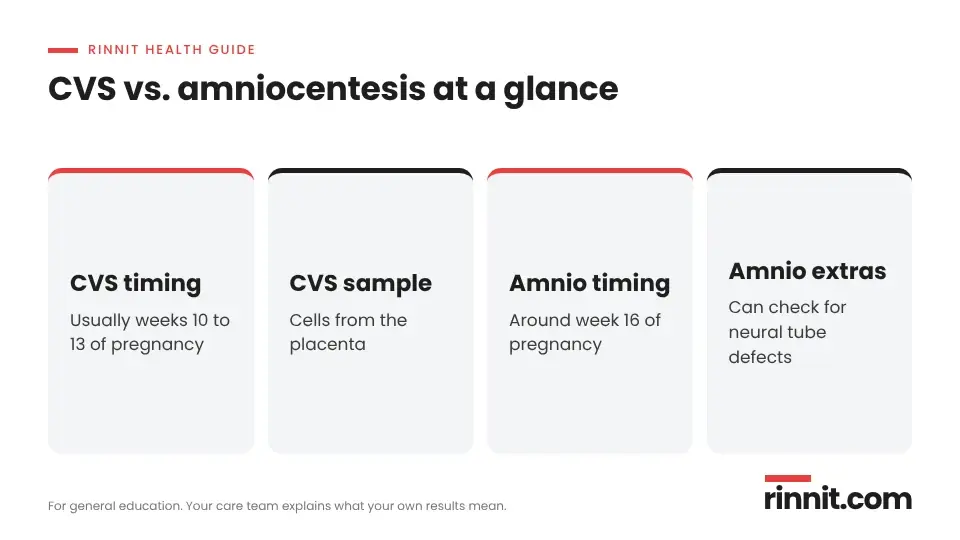
Both tests give diagnostic answers, but CVS gives them earlier in pregnancy.
Feature | Chorionic villus sampling (CVS) | Amniocentesis |
Usual timing | Weeks 10 to 13 | Around week 16 |
What is sampled | Placenta cells (chorionic villi) | Amniotic fluid |
Neural tube defects | Not detected | Can be checked |
Rh incompatibility | Not checked | Can be checked |
Pregnancy loss risk | Less than 1% | Slightly lower than CVS |
Sources: [1]
Sometimes amniocentesis is needed later to confirm a CVS result. [1]
Why is CVS done?
The main benefit of CVS is timing. Because results come early in pregnancy, you have more time to make decisions. [1]
Those decisions may include preparing for treatment your baby could need after birth or deciding whether to continue the pregnancy. [1]
What conditions can CVS find?
CVS looks for chromosomes that are extra, missing or changed in structure, along with some single-gene conditions. [1]
What CVS cannot find
CVS does not detect neural tube defects such as spina bifida. An AFP blood test or amniocentesis can screen for these instead. [1]
It also cannot find structural problems such as heart defects or cleft lip and palate. A detailed ultrasound at about 18 to 20 weeks looks for these. [1]
CVS can show that a condition is present, but it cannot show how mild or severe it will be. [1]
Who might be offered CVS?
Your provider may suggest CVS when something raises the chance of a genetic or chromosomal condition. Common reasons include: [1]
When CVS may not be advised
Your provider may recommend against CVS if you have vaginal bleeding during the pregnancy. [1]
An active infection, such as a sexually transmitted infection, may also be a reason to skip or delay the test. [1]
How do you prepare for CVS?
Before the test, you meet with a certified genetic counselor or a maternal-fetal medicine specialist. They explain the benefits and risks and help you decide if CVS is right for you. [1]
You also have an ultrasound to confirm how far along the pregnancy is. This helps set the right date for the test. [1]
Questions you may want to ask your provider include: [1]
Is prenatal genetic testing right for me? [1]
What is my risk of a chromosomal or genetic condition? [1]
Is CVS or amniocentesis the better choice for me? [1]
What is my risk of miscarriage, and what warning signs should I watch for? [1]
What will the results tell me, and what will they not tell me? [1]
What happens during CVS?

The whole procedure usually takes less than 30 minutes.
CVS can be done in one of two ways. Your provider chooses the route based on where the placenta sits and other factors. [1]
Transcervical CVS (through the cervix)
Your provider places a speculum in your vagina, as in a pelvic exam. A thin plastic tube passes through the cervix, and ultrasound guides it to the placenta to collect a small sample. [1]
Transabdominal CVS (through the belly)
Your provider uses ultrasound to guide a thin needle through the skin of your belly and into the placenta. You may receive a local anesthetic to numb the skin first. [1]
Does CVS hurt?
The test is not usually painful, but you may feel some pressure or discomfort. It takes less than 30 minutes. [1]
What happens after CVS?
You can usually go home soon after the procedure. You may want to rest for several hours, and most people return to normal activities the next day. [1]
Your provider may advise you to avoid sex, exercise and strenuous activity for 48 to 72 hours. [1]
Sometimes a repeat test is needed. This can happen if too few cells were collected or if you are carrying twins with separate placentas. [1]
What are the risks of CVS?
Mild cramping and light vaginal spotting are common after CVS. Belly soreness can occur after the transabdominal approach. [1]
The risk of miscarriage after CVS is less than 1%. [1]
Other possible risks include: [1]
Infection. [1]
Heavy bleeding. [1]
Leaking of amniotic fluid. [1]
Rh sensitization, when Rh-negative blood mixes with Rh-positive fetal blood. If you are Rh-negative, you will usually get an Rh immune globulin shot after the test to prevent this. [1]
Limb defects, which are rare and more likely if CVS is done before 10 weeks. [1]
When to call your provider

Call your provider promptly if any of these happen after your test.
Contact your provider if you notice any of the following after CVS: [1]
What do CVS results mean?
Preliminary results usually come back within a few days. Results for some conditions can take about 10 days to two weeks. [1]
A genetic counselor contacts you with the final results and talks through any follow-up testing you may need. [1]
Result | What it generally means | Common next step |
Normal (negative) | No sign of the conditions tested | Routine prenatal care, plus an ultrasound at 18 to 20 weeks |
Abnormal (positive) | A tested condition is likely present | Counseling to discuss options and care planning |
Placenta-only change | Abnormal cells may be limited to the placenta | Follow-up testing, often amniocentesis |
Not enough cells | The sample could not be fully tested | A repeat test |
Sources: [1]
Confined placental mosaicism
In about 1% to 2% of cases, the abnormal cells are found only in the placenta and not in the fetus. This is called confined placental mosaicism. [1]
In this situation, amniocentesis may be used to check whether the fetus is affected. [1]
If your results are positive
A positive result can bring up many feelings and questions. You can decide on next steps together with your genetic counselor, your partner and your provider. [1]
Conclusion
Chorionic villus sampling is an early, optional diagnostic test that checks placenta cells for Down syndrome, other chromosome changes and certain inherited conditions. It is about 99% accurate, and the risk of miscarriage is less than 1%. [1]
CVS works best as part of a plan made with your genetic counselor and care team. They can help you weigh the timing, risks and what the results can and cannot tell you. [1]
Keep learning: Read our complete guide to prenatal genetic testing or our guide to NIPT, the noninvasive prenatal blood test. For more background, see the MedlinePlus page on chorionic villus sampling.
FAQ
What is chorionic villus sampling?
CVS is a prenatal test that takes a small sample of placenta cells to check the fetus for certain chromosomal and genetic conditions.
When is CVS done during pregnancy?
CVS is usually done between weeks 10 and 13 of pregnancy, which is earlier than amniocentesis.
Why would my provider offer CVS?
It may be offered if you are 35 or older at delivery, had an abnormal screening result, or have a personal or family history of a genetic condition.
Does CVS hurt?
Most people do not find it painful, though you may feel pressure, discomfort or mild cramping during and after the test.
How do I prepare for CVS?
You meet with a genetic counselor first, and you have an ultrasound to confirm how many weeks pregnant you are.
How long does the CVS procedure take?
The procedure usually takes less than 30 minutes, and you can typically go home soon afterward.
How accurate is CVS?
CVS is about 99% accurate at showing whether a tested condition is present, but it does not show how severe the condition will be.
What are the risks of CVS?
Cramping and spotting are common. Less common risks include miscarriage (under 1%), infection, bleeding, fluid leaking and Rh sensitization.
How long do CVS results take?
Preliminary results usually come within a few days. Some results take about 10 days to two weeks.
What happens if my CVS result is abnormal?
Your genetic counselor explains the result and options. You may be offered amniocentesis to confirm it, especially if the change may be in the placenta only.
Related Reading
Cordocentesis (PUBS): Umbilical Cord Blood Test, Risks and Results explains the umbilical cord blood test used when other prenatal tests are unclear.
Down Syndrome: Symptoms, Causes, Types & Life Expectancy — Complete Guide explains the most common chromosomal condition that CVS can detect early in pregnancy.
Cystic Fibrosis: Symptoms, Causes, Diagnosis, and Treatment (2026 Guide) covers an inherited condition that CVS can identify when parents carry the gene.
Sickle Cell Anemia: Symptoms, Causes, Treatment & Complete Guide explains a blood disorder that CVS can check for in at-risk pregnancies.
Thalassemia: Symptoms, Causes, Treatment & Complete Guide covers another inherited blood condition families often discuss during prenatal genetic counseling.
Tay-Sachs Disease: Symptoms, Causes, Testing, and Supportive Care explains a rare genetic condition that CVS can detect before birth.
Trisomy Explained: Understanding Extra Chromosomes and Genetic Health covers the extra-chromosome conditions, such as trisomy 13, 18 and 21, that CVS looks for.
References
Cleveland Clinic. Chorionic Villus Sampling (CVS): What It Is, Benefits & Risks. Cleveland Clinic. Last updated August 8, 2024. https://my.clevelandclinic.org/health/diagnostics/4028-chorionic-villus-sampling-for-prenatal-diagnosis
Salomon LJ, Sotiriadis A, Wulff CB, et al. Risk of miscarriage following amniocentesis or chorionic villus sampling: systematic review of literature and updated meta-analysis. Ultrasound Obstet Gynecol. 2019;54(4):442-451. PMID 31124209. https://doi.org/10.1002/uog.20353
Alfirevic Z, Navaratnam K, Mujezinovic F. Amniocentesis and chorionic villus sampling for prenatal diagnosis. Cochrane Database Syst Rev. 2017;9(9):CD003252. PMID 28869276. https://doi.org/10.1002/14651858.CD003252.pub2
Thomsen SH, Lund ICB, Bache I, et al. Placental mosaicism for autosomal trisomies: comprehensive follow-up of 528 Danish cases (1983-2021). Am J Obstet Gynecol MFM. 2024;6(11):101497. PMID 39303978. https://doi.org/10.1016/j.ajogmf.2024.101497
Medical disclaimer
This article is for general education only and does not replace advice from a qualified healthcare professional. Talk to your doctor about your own diagnosis and treatment, and seek emergency care right away for severe or sudden symptoms.



Comments