NIPT Test (Noninvasive Prenatal Testing): What It Screens For, Accuracy and Results

Updated: 2 days ago
Written and medically reviewed by Dr. Baraa Alnahhal, MD · Last reviewed: November 2026 · How we review
Quick Answer: What is an NIPT test?
NIPT (noninvasive prenatal testing) is a screening blood test in pregnancy that checks fetal DNA in the pregnant person's blood to estimate the chance of chromosome conditions such as Down syndrome, trisomy 18 and trisomy 13. It can be done from 10 weeks and carries no risk to the pregnancy. A high-chance result is confirmed with a diagnostic test. [1]
What the research says
NIPT detects nearly all cases of the three main trisomies with very few false alarms. A meta-analysis of 35 studies found cell-free DNA screening in single pregnancies detected 99.7% of trisomy 21, 97.9% of trisomy 18 and 99.0% of trisomy 13, each with a false-positive rate of 0.04%. (Gil et al., Ultrasound in Obstetrics & Gynecology, 2017) [2]
Accuracy is lower in twin pregnancies and early pregnancy. A meta-analysis of 41 studies reported pooled sensitivity of 99.3% for Down syndrome and specificity of 99.9%. Sensitivity was lower in twins (by 9% for Down syndrome) and in the first trimester. (Taylor-Phillips et al., BMJ Open, 2016) [3]
Key takeaways
NIPT is a simple blood draw that screens fetal DNA in the pregnant person's blood. [1]
It can be done from 10 weeks of pregnancy until delivery and has no risk to the pregnancy. [1]
Most NIPT tests screen for trisomies 21, 18 and 13 and for sex chromosome differences. [1]
It estimates the chance of a condition; amniocentesis or chorionic villus sampling (CVS) confirms it. [1]
Having NIPT is a personal choice, and a genetic counselor can help you decide. [1]
What is NIPT?
NIPT stands for noninvasive prenatal testing. It's a screening test that shows whether the fetus may be at higher risk for certain chromosomal disorders. Your blood contains small pieces of the fetus's DNA, and a lab tests these fragments for specific conditions. NIPT can't screen for every chromosomal or genetic condition. [1]
It's also called cell-free DNA (cfDNA) screening or noninvasive prenatal screening (NIPS). Providers offer it to all pregnant women, but whether to have it is entirely your choice. [1]
What conditions does NIPT screen for?
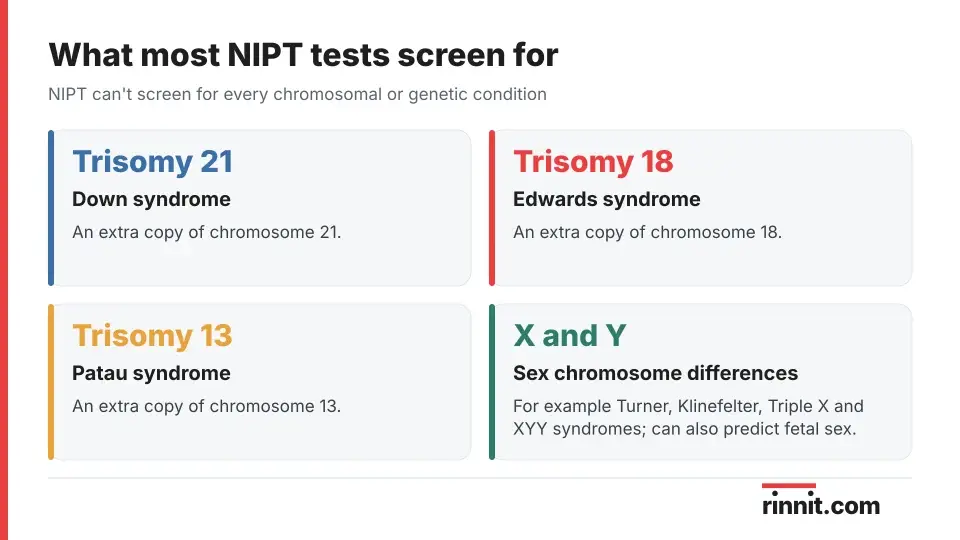
Condition | What it is |
Down syndrome (trisomy 21) | An extra copy of chromosome 21 |
Edwards syndrome (trisomy 18) | An extra copy of chromosome 18 |
Patau syndrome (trisomy 13) | An extra copy of chromosome 13 |
Sex chromosome conditions | Differences in the usual number of X or Y chromosomes, such as Turner, Klinefelter, Triple X and XYY syndromes |
Sources: [1]
Because it screens the sex chromosomes, NIPT can also show whether XX or XY chromosomes are present, which predicts the sex of the fetus. This is highly accurate, but not 100% accurate. [1]
Why is NIPT done?
NIPT helps estimate your child's chance of having certain conditions. Your provider may especially recommend it if you: [1]
Already have a child with a chromosomal condition
Have a family history of chromosomal conditions
Had an ultrasound that found a possible problem
Had an earlier screening test showing a higher chance of a chromosome condition
Are older than 35
When can you have NIPT?
NIPT can be done as early as 10 weeks of pregnancy and up until delivery. It takes about 10 weeks for enough fetal DNA to circulate in your blood, which is why it isn't offered earlier. [1]

What happens during NIPT?
NIPT is a blood test. Your provider takes a sample from a vein in your arm, which takes just a few minutes, and the lab looks for changes in the fetal DNA fragments in your blood. [1]
Are there any risks?
NIPT is safe. It only needs a blood sample from you, so there's no risk to the pregnancy. [1]
Do you have to have it?
No. It's a personal choice, and it's normal to have questions. Your provider will go over all your prenatal screening options, and a genetic counselor can help you understand them and decide what fits you. [1]
How accurate is NIPT?
Accuracy depends on the condition being screened, and factors such as carrying twins or more can affect results. NIPT detects about 99% of Down syndrome cases and about 97% to 98% of trisomy 18 cases, and it gives fewer false positives than other prenatal screens such as the quad screen. [1] [2] [3]
Condition (single pregnancies) | Detection rate | False-positive rate |
Trisomy 21 (Down syndrome) | 99.7% | 0.04% |
Trisomy 18 (Edwards syndrome) | 97.9% | 0.04% |
Trisomy 13 (Patau syndrome) | 99.0% | 0.04% |
Sources: [2]
When will you get NIPT results?
Results can take up to two weeks, though they're often ready sooner. Your provider receives them first and then shares them with you. [1]
What do NIPT results mean?
NIPT is only a screening test. It doesn't give a yes-or-no answer about whether your child has a condition; it shows whether there's an increased chance. Most labs give a separate result for each condition, so you might get a high-risk result for trisomy 13 and a low-risk result for Down syndrome. Ask your provider to help you understand results that are hard to interpret. [1]
Sometimes there isn't enough fetal DNA in the sample, or it's hard to detect. If that happens, you can have the screening again. [1]
What happens after a high-chance result?
If NIPT shows a higher chance of a condition, your provider may recommend a diagnostic test, which can confirm whether the condition is present: [1]

Test | Type | How it's done | When |
NIPT | Screening | Blood sample from your arm | From 10 weeks to delivery |
Chorionic villus sampling (CVS) | Diagnostic | Cells taken from the placenta | 10 to 13 weeks |
Amniocentesis | Diagnostic | A small amount of amniotic fluid taken from the uterus | After 15 weeks |
Sources: [1]
Is NIPT worth getting?
Prenatal genetic screening is a personal choice. Your provider can explain the benefits, limits and possible results, but the decision is yours. Questions to ask yourself include: [1]
How would I feel about a positive screening result?
Would I want diagnostic testing if the result is positive?
Would knowing help me prepare for a child with a genetic condition?
Would the result make me feel more prepared or more anxious?
Would it change my pregnancy care or delivery plan?
Questions to ask your provider
What conditions does this NIPT screen for?
How accurate is it for my pregnancy?
If my result is positive, what are the next steps?
Is genetic counseling available?
How long will it take to get my results?
Conclusion
NIPT is a safe, simple blood test from 10 weeks of pregnancy that screens fetal DNA for Down syndrome, trisomies 18 and 13 and sex chromosome differences. It detects most cases with few false positives, but it estimates risk rather than giving a diagnosis. [1] [2]
A high-chance result is confirmed with CVS or amniocentesis, and your provider or a genetic counselor can help you decide whether screening is right for you. [1]
Keep learning: Read our guides to Down syndrome, trisomy and Turner syndrome. For more, see ACOG: Prenatal Genetic Screening Tests.
FAQ
What is an NIPT test?
NIPT is a prenatal blood test that screens fetal DNA in the pregnant person's blood for chromosome conditions such as Down syndrome. [1]
When can NIPT be done?
NIPT can be done from 10 weeks of pregnancy until delivery. [1]
What does NIPT screen for?
Most NIPT tests screen for Down syndrome (trisomy 21), trisomy 18, trisomy 13 and sex chromosome differences. [1]
How accurate is NIPT?
NIPT detects about 99% of Down syndrome cases and about 97% to 98% of trisomy 18 cases, with fewer false positives than other screens. [1]
Is NIPT safe for the baby?
Yes. NIPT only needs a blood sample from the pregnant person, so there is no risk to the pregnancy. [1]
Can NIPT tell the baby's sex?
Yes. Because it screens sex chromosomes, NIPT can show whether XX or XY chromosomes are present. It is highly accurate but not 100%. [1]
Does a positive NIPT mean my baby has a condition?
No. NIPT shows an increased chance; a diagnostic test such as amniocentesis or CVS is needed to confirm. [1]
How long do NIPT results take?
Results can take up to two weeks, though they are often available sooner. [1]
What if there is not enough fetal DNA?
If there is not enough fetal DNA in the sample, you can have the NIPT screening again. [1]
Is NIPT required in pregnancy?
No. NIPT is offered to all pregnant women, but having it is a personal choice. [1]
Related Reading
Cordocentesis (PUBS): Umbilical Cord Blood Test, Risks and Results explains the umbilical cord blood test used when other prenatal tests are unclear.
Learn more in our guide to Down Syndrome: Symptoms, Causes, Types & Life Expectancy — Complete Guide.
Learn more in our guide to Edwards Syndrome (Trisomy 18): Symptoms, Causes, Diagnosis, Treatment, Survival Rates and When to Seek Emergency Care — What You Need to Know.
Learn more in our guide to Trisomy Explained: Understanding Extra Chromosomes and Genetic Health.
Learn more in our guide to Turner Syndrome: A Comprehensive Guide to Symptoms and Care.
Quad Screen: What the Second-Trimester Blood Test Checks For and What Results Mean explains the second-trimester blood screen for Down syndrome and neural tube defects.
References
Cleveland Clinic. NIPT Test (Noninvasive Prenatal Testing): What To Expect. Cleveland Clinic. Last updated July 24, 2026. https://my.clevelandclinic.org/health/diagnostics/21050-nipt-test
Gil MM, Accurti V, Santacruz B, et al. Analysis of cell-free DNA in maternal blood in screening for aneuploidies: updated meta-analysis. Ultrasound Obstet Gynecol. 2017;50(3):302-314. PMID 28397325. https://doi.org/10.1002/uog.17484
Taylor-Phillips S, Freeman K, Geppert J, et al. Accuracy of non-invasive prenatal testing using cell-free DNA for detection of Down, Edwards and Patau syndromes: a systematic review and meta-analysis. BMJ Open. 2016;6(1):e010002. PMID 26781507. https://doi.org/10.1136/bmjopen-2015-010002
Medical disclaimer
This article is for general education only and does not replace advice from a qualified healthcare professional. Talk to your doctor about your own diagnosis and treatment, and seek emergency care right away for severe or sudden symptoms.



Comments