Turner Syndrome: A Comprehensive Guide to Symptoms and Care

Updated: 3 days ago
Medically reviewed by Dr. Baraa Alnahhal, MD | Last reviewed: October 7, 2026
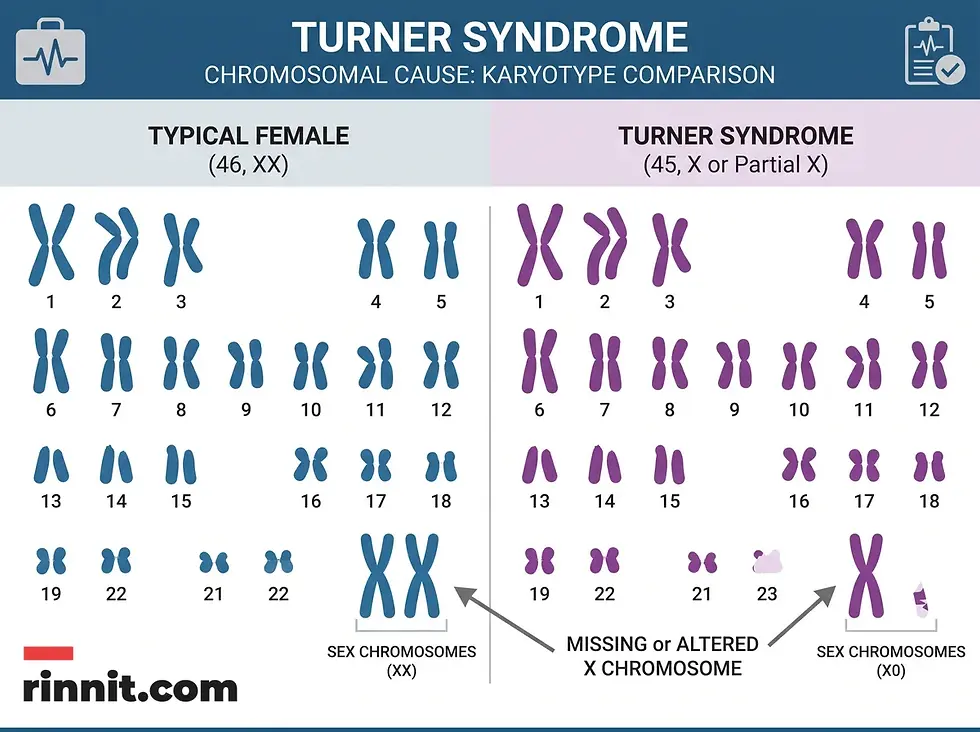
Quick Answer: What is Turner syndrome?
Turner syndrome is a chromosomal condition affecting females, caused by a missing or partial X chromosome [1]. Its hallmarks are short height and low-functioning ovaries [1], often leading to delayed puberty and infertility [1]. It can be diagnosed prenatally or in childhood through genetic testing [1]. Treatment centers on hormone therapy plus regular monitoring for heart, bone and autoimmune conditions [1].
What the research says
Turner syndrome affects many organs across a lifetime, so care is multidisciplinary. A 2024 international clinical practice guideline, which cites a frequency of 50 per 100,000 females, covers diagnosis and genetics, growth, puberty and estrogen treatment, cardiovascular health, fertility, health surveillance for comorbidities and neurocognition, with four questions formally evaluated through GRADE-based systematic review (Gravholt et al., European Journal of Endocrinology, 2024) [2].
Aortic dilation is common in adult women with Turner syndrome. A systematic review and meta-analysis of 21 studies found ascending aortic dilatation in 23% (95% CI 19–26%) at a mean age of 29 years and an aortic dissection incidence of 164 per 100,000 patient-years (95% CI 95–284), with older age, bicuspid aortic valve, aortic coarctation and hypertension as risk factors (Meccanici et al., Expert Review of Cardiovascular Therapy, 2023) [3].
The Genetic Basis and Types of Turner Syndrome
Turner syndrome is a unique chromosomal condition that exclusively affects females [1]. In a typical genetic profile, humans have 23 pairs of chromosomes, with the 23rd pair determining biological sex [1]. While most females have two X chromosomes (XX), those with Turner syndrome are born with only one functional X chromosome or a partially missing one [1]. This genetic variation occurs randomly during the formation of reproductive cells or early fetal development and is not caused by any actions taken by the parents.
Clinically, the condition is categorized into two primary forms based on the extent of the chromosomal difference. The most common form is Monosomy X, where one X chromosome is entirely absent from every cell in the body. The second form, Mosaic Turner syndrome, occurs when the chromosomal error happens during fetal development, resulting in some cells having two X chromosomes while others have only one. Mosaicism often leads to milder symptoms and may remain undiagnosed until adulthood [1].
Type of Turner syndrome | Genetic characteristic | Clinical presentation |
Monosomy X | One X chromosome is completely missing from all cells | Typically more severe and easily recognizable symptoms [1] |
Mosaic Turner syndrome | An X chromosome is missing or altered in only some cells | Often presents with milder features [1] and may be diagnosed later |
Identifying Symptoms Across Different Life Stages
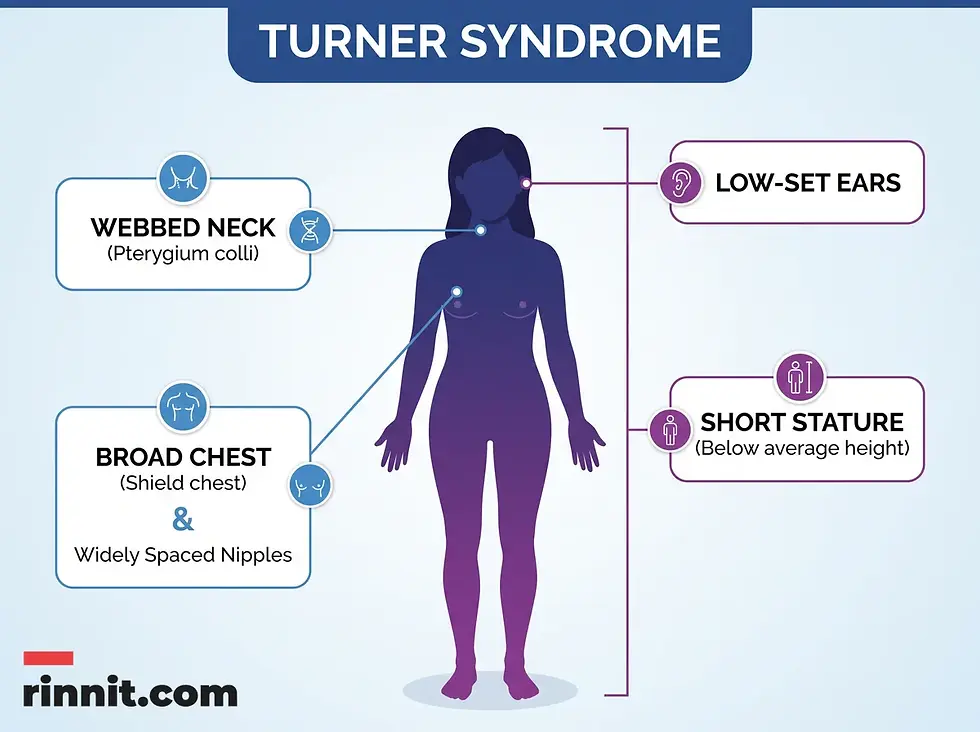
The features of Turner syndrome can appear at different times, from before birth to adulthood. Prenatally, ultrasound may reveal signs such as fluid accumulation around the neck or structural heart and kidney issues [1]. At birth, physical indicators might include a webbed neck, low-set ears, and a broad chest with widely spaced nipples [1]. Some infants also present with swelling in the hands and feet or narrow fingernails that turn upward.
As children with Turner syndrome grow, the most consistent feature is a slower growth rate compared with their peers [1]. By age five, short stature becomes increasingly noticeable, and the typical adolescent growth spurt is often absent [1]. Puberty is frequently delayed or absent because the ovaries do not produce enough sex hormones like estrogen. This lack of ovarian function, known as primary ovarian insufficiency, is a primary cause of infertility in women with the condition.
Developmental stage | Common symptoms and signs |
Infancy | Webbed neck, low-set ears, broad chest and receding lower jaw [1] |
Childhood | Noticeably slow growth by age 5 and lack of an adolescent growth spurt [1] |
Adolescence | Delayed breast development and absent menstrual periods [1] |
Adulthood | Persistent short stature and primary ovarian insufficiency (infertility) [1] |
Management, Complications, and Long-Term Outlook
While Turner syndrome cannot be cured [1], modern medicine offers effective ways to manage its symptoms and prevent complications. The two primary pillars of treatment are growth hormone therapy and estrogen replacement therapy [1]. Growth hormone is typically started in early childhood to help the child reach a more typical adult height. Estrogen therapy is usually started around the time of puberty to stimulate breast development, support bone health and eventually trigger menstrual periods.
Because Turner syndrome increases the risk for various health issues, regular monitoring by a team of specialists is essential [2]. Up to half of those affected are born with heart structure differences, particularly involving the aorta [1], which requires lifelong cardiovascular checkups. Other common complications include hearing loss due to frequent ear infections, skeletal issues like scoliosis or osteoporosis, and an increased likelihood of developing autoimmune conditions such as celiac disease or thyroid disorders [1].
Key Management Strategies
Hormone therapy: growth hormone for height and estrogen for sexual development [1]
Cardiovascular care: regular screening for congenital heart defects and aortic health
Bone health: monitoring for scoliosis and ensuring adequate calcium and vitamin D intake
Specialist coordination: ongoing care from endocrinologists, cardiologists and audiologists

Conclusion
Turner syndrome is a complex condition that requires a personalized, multidisciplinary approach to care. Although the challenges of short stature and infertility are significant, most girls and women with Turner syndrome lead healthy, productive and independent lives. Early diagnosis and consistent medical management are the most effective ways to address the physical and developmental aspects of the condition, ensuring that every individual has the support they need to thrive.
Next Steps
If you notice that your daughter is growing significantly slower than her peers or has not begun puberty by age 13, consult a pediatrician or a pediatric endocrinologist. Early screening and genetic testing can provide the answers needed to start a comprehensive care plan.
Frequently Asked Questions
What is Turner syndrome?
Turner syndrome is a chromosomal condition in females in which one X chromosome is partially or completely missing.
How common is Turner syndrome?
Turner syndrome affects approximately 1 in every 2,000 to 2,500 infant girls born worldwide.
What causes the condition?
Turner syndrome is caused by a random genetic error during the formation of reproductive cells or early fetal development.
Is Turner syndrome hereditary?
No. It is not typically passed down from parents; it occurs as a random genetic event.
What are the most common features?
Short stature and low-functioning ovaries (ovarian insufficiency) are the two most common features.
Can Turner syndrome be diagnosed before birth?
Yes. It can be detected through prenatal tests like NIPT, ultrasound or amniocentesis.
What is a “webbed neck”?
A webbed neck is a fold of skin that runs from the top of the shoulders to the sides of the neck, a common sign of Turner syndrome.
How does Turner syndrome affect growth?
Most girls with Turner syndrome grow slowly and do not have a typical adolescent growth spurt without hormone therapy.
Why is estrogen therapy important?
Estrogen therapy helps stimulate puberty, supports breast development and is vital for maintaining strong bone health.
Does Turner syndrome affect intelligence?
Most people have typical intelligence, though some may face specific learning challenges in spatial reasoning.
Can women with Turner syndrome have children?
While most face infertility, some may become pregnant through assisted reproductive technologies like egg donation.
What heart problems are associated with Turner syndrome?
Up to 50% are born with heart defects, often involving the aorta (the body’s main artery).
Are there different types of Turner syndrome?
Yes. The two main types are Monosomy X (completely missing X) and Mosaic Turner syndrome (partially missing X).
Does Turner syndrome increase the risk of other diseases?
Yes. It increases the risk of autoimmune diseases, type 2 diabetes and hearing loss.
Is there a cure for Turner syndrome?
There is no cure for the chromosomal difference, but the symptoms and complications are highly manageable.
Related Reading
Learn more in our guide to NIPT Test (Noninvasive Prenatal Testing): What It Screens For, Accuracy and Results.
Testosterone Test: Types, Why It's Done, How to Prepare and What Results Mean explains how testosterone is measured and the conditions linked to low levels in women.
Karyotype Test: What It Shows, Sample Types, Results and Limits explains the chromosome test used to diagnose this and other genetic conditions.
Sources
Cleveland Clinic. Turner Syndrome. Cleveland Clinic. Last updated May 13, 2025. https://my.clevelandclinic.org/health/diseases/15200-turner-syndrome
Gravholt CH, Andersen NH, Christin-Maitre S, et al. Clinical practice guidelines for the care of girls and women with Turner syndrome. Eur J Endocrinol. 2024;190(6):G53-G151. PMID 38748847. https://doi.org/10.1093/ejendo/lvae050
Meccanici F, de Bruijn JWC, Dommisse JS, et al. Prevalence and development of aortic dilation and dissection in women with Turner syndrome: a systematic review and meta-analysis. Expert Rev Cardiovasc Ther. 2023;21(2):133-144. PMID 36688313. https://doi.org/10.1080/14779072.2023.2172403
Medical disclaimer
This information is for educational purposes only and does not constitute medical advice. Always consult a qualified healthcare provider about any chromosomal conditions or developmental concerns.



Comments