Testosterone Test: Types, Why It's Done, How to Prepare and What Results Mean

Updated: 5 days ago
Written and medically reviewed by Dr. Baraa Alnahhal, MD · Last reviewed: November 2026 · How we review
Quick Answer: What is a testosterone test?
A testosterone test is a blood test that measures the level of testosterone, a hormone, in your blood. Providers usually order it when your symptoms suggest your level is too high or too low. The most common version measures total testosterone, and the blood draw takes less than five minutes. [1]
What the research says
Low testosterone alone is not enough to diagnose late-onset hypogonadism. In a European study of 3,369 men aged 40 to 79, only three sexual symptoms (poor morning erections, low sexual desire and erectile dysfunction) were tied to low testosterone as a syndrome. The authors proposed diagnosis only when all three occur with total testosterone below 11 nmol/L (3.2 ng/mL) and free testosterone below 220 pmol/L. (Wu et al., The New England Journal of Medicine, 2010) [2]
The time of day changes the result. In 66 men tested at five or six separate visits, testosterone in men aged 30 to 40 was 20% to 25% lower at 4 p.m. than at 8 a.m. Seventeen men who had at least one reading below 300 ng/dL after noon had normal levels at every morning visit. (Brambilla et al., The Journal of Clinical Endocrinology & Metabolism, 2009) [3]
Key takeaways
A testosterone test is a blood test, usually done in the morning, that checks whether your hormone level is too high or too low. [1]
Total testosterone is the most common type; free and bioavailable testosterone tests are used less often. [1]
Low levels in men can point to a problem in the testicles or in the pituitary gland or hypothalamus. [1]
High levels in women can be linked to conditions such as PCOS or congenital adrenal hyperplasia. [1]
Testosterone changes from day to day, so providers often repeat the test before drawing conclusions. [1]
What is a testosterone test?
A testosterone test measures the amount of testosterone in your blood. Your provider will most likely order one if you have symptoms that suggest your level is higher or lower than it should be. [1]
Your provider chooses the type of test based on your age, your symptoms and your overall health. [1]
What are the types of testosterone tests?

There are three ways to measure testosterone in your blood.
Most testosterone in your blood is attached to proteins, and a small part floats freely. The three tests differ in which forms they count. [1]
Test type | What it measures | How often it is used |
Total testosterone | Free testosterone plus testosterone bound to proteins | The most common test |
Free testosterone | Only testosterone that is not attached to any protein | Less common; may help diagnose certain conditions |
Bioavailable testosterone | Free testosterone plus testosterone bound to proteins other than SHBG | Less common |
Sources: [1]
Why would you need a testosterone test?
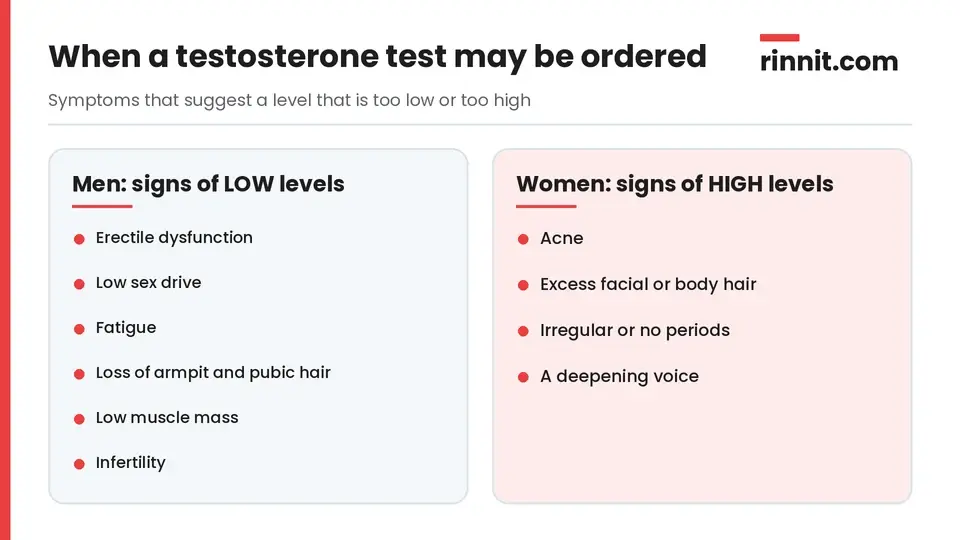
Symptoms often guide whether a provider orders the test.
Symptoms of low testosterone in men
Your provider may suggest a test if you have signs of low testosterone, such as: [1]
Erectile dysfunction or a low sex drive
Fatigue
Loss of armpit and pubic hair
Low muscle mass
Infertility
Enlarged breast tissue
Symptoms of high testosterone in women
In women, a test may be ordered for signs of high testosterone, such as: [1]
Acne
Excess facial or body hair
Irregular periods or no periods
A deepening voice
Other reasons for testing
You may also need a testosterone test if you are on hormone therapy, have had irregular results in the past or take other medications that affect testosterone. [1]
Children may be tested if puberty seems to start too early or too late. A high level can suggest precocious (early) puberty, and a low level can suggest delayed sexual development. [1]
How do you prepare for a testosterone test?
Testosterone tests are usually done in the morning. Your provider may ask you to fast for several hours or to stop certain medications before the test, so ask exactly how to prepare. [1]
Morning timing matters because testosterone falls as the day goes on, especially in younger men. [3]
What happens during a testosterone test?
Most tests are done at a medical facility. A healthcare provider draws blood from a vein, usually in your arm, and the draw takes less than five minutes. [1]
At-home kits that use saliva or a blood sample mailed to a lab are sold at pharmacies and online. Check with your provider before using one. [1]
Results usually come back within two to three business days, although they can take longer. [1]
What do testosterone test results mean?
Your report lists the test name, your value, the reference range and whether your result is normal, high or low. Reference ranges vary by lab, age and sex, so compare your number with the range printed on your own report. [1]
Because testosterone varies from day to day, your provider will often repeat the test to confirm an abnormal result. An abnormal result does not necessarily mean you have a medical condition. [1]
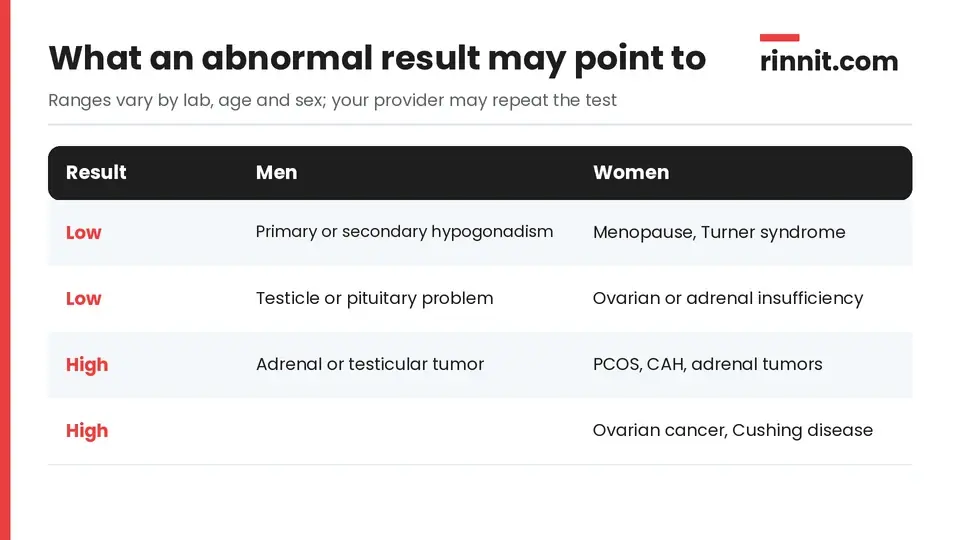
An abnormal result is a starting point for more questions, not a diagnosis.
Result | In men, it may point to | In women, it may point to |
Low | Primary hypogonadism (a testicle problem) or secondary hypogonadism (a pituitary or hypothalamus problem) | Menopause, Turner syndrome, ovarian insufficiency, adrenal insufficiency or malnutrition |
High | A tumor in the adrenal glands or testicles | PCOS (also called PMOS), congenital adrenal hyperplasia, ovarian cancer, adrenal tumors or Cushing disease |
Sources: [1]
In women, some medications can also raise testosterone, including anabolic steroids, progestins and some antiseizure medications. [1]
Conclusion
A testosterone test is a simple morning blood test that helps your provider check whether symptoms such as low sex drive, unwanted hair growth or changes in puberty have a hormonal cause.
One result is rarely the whole story. Ask your provider whether to repeat the test and what the next step is if your level is outside the range.
Keep learning: Read our guide to low testosterone or our guide to male hypogonadism. For more trusted, doctor-reviewed health guides, visit Rinnit.com.
FAQ
What is a testosterone test?
It is a blood test that measures the level of testosterone in your blood to check whether it is too high or too low.
What are the types of testosterone tests?
Total testosterone, the most common, plus free testosterone and bioavailable testosterone tests.
Why would a man need a testosterone test?
For signs of low testosterone such as erectile dysfunction, low sex drive, fatigue, low muscle mass or infertility.
Why would a woman need a testosterone test?
For signs of high testosterone such as acne, excess facial or body hair, irregular periods or a deepening voice.
Do I need to fast for a testosterone test?
Sometimes; your provider may ask you to fast for several hours or pause certain medications, so ask how to prepare.
What time of day should a testosterone test be done?
Usually in the morning, because levels drop later in the day.
How long do testosterone test results take?
Usually two to three business days, although it can take longer.
What is a normal testosterone level?
Normal ranges vary by lab, age and sex, so compare your result with the range on your report.
What causes low testosterone in men?
A problem in the testicles (primary hypogonadism) or in the pituitary gland or hypothalamus (secondary hypogonadism).
Can I use an at-home testosterone test?
At-home saliva and blood kits exist, but check with your provider before using one.
Related Reading
Understanding Low Testosterone: Symptoms, Causes, and Modern Treatments explains the symptoms of low testosterone and how it is treated.
Male Hypogonadism: Symptoms, Causes & Treatment Guide covers primary and secondary hypogonadism, the main causes of low results in men.
Polycystic Ovary Syndrome (PCOS): Symptoms, Causes, Diagnosis, and Treatment explains a common reason for high testosterone in women.
What Is Congenital Adrenal Hyperplasia (CAH)? Symptoms, Causes, Diagnosis & Treatment Explained describes an inherited adrenal condition that can raise testosterone.
Precocious Puberty: Complete Guide to Signs, Causes, and Treatment explains early puberty, one reason children are tested.
Delayed Puberty in Children: Causes, Signs, and Treatment Guide covers late sexual development in children.
Turner Syndrome: A Comprehensive Guide to Symptoms and Care describes a genetic condition linked to low testosterone in women.
References
Cleveland Clinic. Testosterone Test: Why It's Done, How & Results. Cleveland Clinic. Last updated October 9, 2026. https://my.clevelandclinic.org/health/diagnostics/24215-testosterone-test
Wu FC, Tajar A, Beynon JM, et al. Identification of late-onset hypogonadism in middle-aged and elderly men. N Engl J Med. 2010;363(2):123-135. PMID 20554979. https://doi.org/10.1056/NEJMoa0911101
Brambilla DJ, Matsumoto AM, Araujo AB, et al. The effect of diurnal variation on clinical measurement of serum testosterone and other sex hormone levels in men. J Clin Endocrinol Metab. 2009;94(3):907-913. PMID 19088162. https://doi.org/10.1210/jc.2008-1902
Medical disclaimer
This article is for general education only and does not replace advice from a qualified healthcare professional. Talk to your doctor about your own diagnosis and treatment, and seek emergency care right away for severe or sudden symptoms.



Comments