
Precocious Puberty: Complete Guide to Signs, Causes, and Treatment

Updated: 2 days ago
Medically reviewed by Dr. Baraa Alnahhal, MD · Last reviewed: September 2026
Precocious puberty is when a child's body begins changing into an adult body too soon — before age 8 in girls and before age 9 in boys. Most of the time no cause is found, and treatment (if needed) uses medicines that pause puberty until the usual age. The two main risks if left unmanaged are shorter adult height and emotional strain from early body changes. If your child shows early signs, a healthcare professional can confirm the type with hormone and imaging tests.
What Is Precocious Puberty?
Puberty is the process through which a child's body changes into an adult body. Muscles and bones grow quickly, body shape and size change, and the body gains the ability to have children. Precocious puberty is simply when that process begins too early for the child going through it.
The timing thresholds are the heart of the definition. Most of the time, puberty occurs after age 8 in girls and after age 9 in boys. Precocious puberty is when changes start before those ages.

One nuance matters for accuracy: timing norms differ across populations. Black, Hispanic, and Native American children might naturally reach puberty earlier, so pediatric evaluation always considers what is normal for the individual child.
Even when the cause cannot be found, precocious puberty is a medical topic worth taking seriously. Left unmanaged, it can shorten a child's adult height and create social and emotional strain. When treatment is appropriate, medicines can delay puberty safely.
Signs of Precocious Puberty
The signs split naturally into those specific to girls, those specific to boys, and those any child can develop.
In girls, precocious puberty shows up as breast growth and a first period. In boys, it shows up as testicle and penis growth, facial hair, and a deeper voice. Pubic or underarm hair can appear in either child.
Three additional signs apply to both girls and boys: rapid growth, acne, and adult body odor.

When to see a doctor. Make an appointment with your child's healthcare professional if your child has symptoms of precocious puberty. Early evaluation protects both final adult height and emotional well-being.
Sign | More Common In | What It Looks Like |
Breast growth | Girls | Early development of breast tissue |
First period | Girls | Menstruation starting before age 8 |
Testicle and penis growth | Boys | Enlargement starting before age 9 |
Facial hair and deeper voice | Boys | Early facial hair; voice deepening |
Pubic or underarm hair | Either | Hair growth in either area |
Rapid growth | Either | Noticeably faster height increase than peers |
Acne | Either | Early breakouts |
Adult body odor | Either | Mature body odor appearing early |
How Puberty Starts — and How It Can Start Too Soon
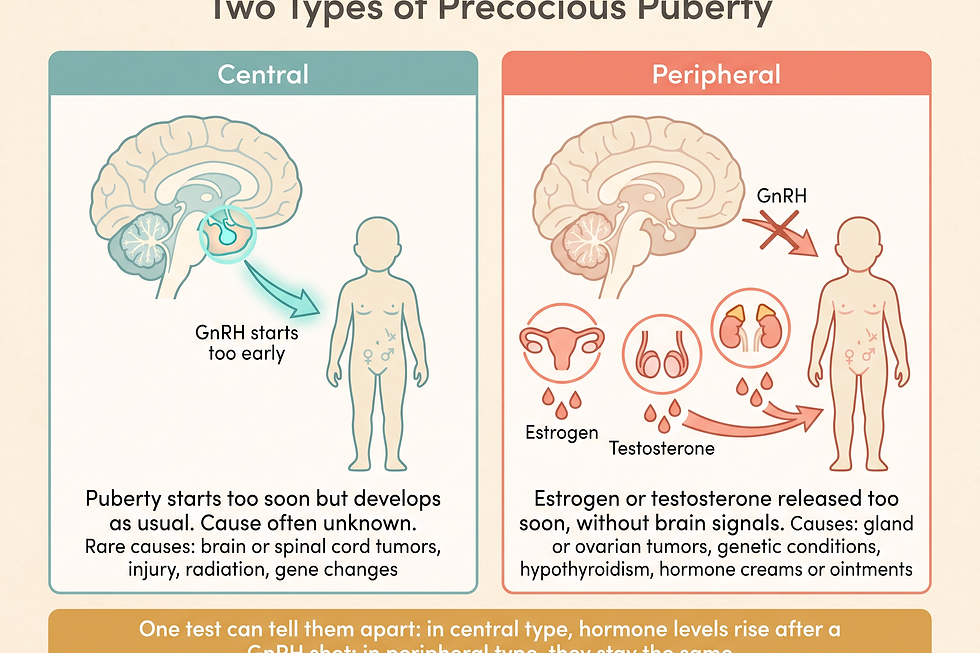
Understanding the mechanism explains the two types of precocious puberty. The brain starts the process by making a hormone called gonadotropin-releasing hormone (GnRH). When this hormone reaches the small, bean-shaped pituitary gland at the base of the brain, it triggers more estrogen in the ovaries and more testosterone in the testicles. Estrogen creates female sex traits, and testosterone creates male sex traits.
Something in that chain can start too early — and which part of the chain starts early determines the type.
Central vs. Peripheral: The Two Types
Central Precocious Puberty
In central precocious puberty, puberty starts too soon but develops as usual — the same sequence, just earlier. For most children with this condition, there is no medical problem or other known reason for the early start.
Rarely, specific factors can drive central precocious puberty:
Rare Cause | What It Is |
Brain or spinal cord tumor | A growth that triggers early hormonal signaling |
Brain change present at birth | Fluid buildup (hydrocephalus) or a noncancerous tumor (hamartoma) |
Gene changes | Certain inherited genetic changes |
Radiation to brain or spinal cord | Prior radiation treatment affecting the area |
Brain or spinal cord injury | Physical injury triggering early activation |
Peripheral Precocious Puberty
In peripheral precocious puberty, estrogen or testosterone is released into the body too soon — and the brain's GnRH hormone that normally starts puberty is not involved at all. Instead, a problem in the ovaries, testicles, adrenal glands, or pituitary gland causes the hormone release.
Cause | What Happens |
Adrenal or pituitary tumor | Releases estrogen or testosterone |
McCune-Albright syndrome | A rare genetic disease affecting bones and skin color that causes hormonal problems |
Congenital adrenal hyperplasia | Genetic issues causing the adrenal gland to make atypical hormones |
Hypothyroidism | The thyroid gland doesn't make enough hormones |
Hormone creams or ointments | Exposure to products containing estrogen or testosterone |
Ovarian cysts or tumors | In girls, can trigger early estrogen release |
Testicular tumors | In boys, tumors in sperm-making or testosterone-making cells |
Gonadotropin-independent familial sexual precocity | A rare genetic condition causing boys, usually ages 1 to 4, to make testosterone too early |
Risk Factors
Two factors measurably increase the chance of precocious puberty. Girls are more likely than boys to have it. And carrying extra weight increases the risk in either child.
Risk Factor | Details |
Gender | Girls are more likely than boys to have precocious puberty |
Obesity | Carrying extra weight increases the risk |
Complications of Untreated Early Puberty
The complications are why early evaluation matters.
Short height is the most direct physical consequence. Children with precocious puberty might grow quickly at first and be taller than others their age. But their bones mature too soon, so they stop growing earlier than usual. This can leave them shorter than average as adults.
Social and emotional problems are the second major risk. Children who begin puberty long before others their age might be upset about the changes in their bodies. Dealing with early periods, for example, can cause distress. This might affect self-esteem and raise the risk of depression or using illegal drugs or alcohol.
How Precocious Puberty Is Diagnosed
Diagnosis starts with the basics: reviewing the child's and family's medical histories, doing a physical exam, and running blood tests to measure hormone levels.
X-rays of the hands and wrists play a specific role — they show whether the bones are growing too quickly, a key sign that early puberty is advancing bone maturity.
The GnRH Stimulation Test
A test called a gonadotropin-releasing hormone (GnRH) stimulation test helps identify which of the two types the child has. The test involves taking a blood sample, giving the child a shot containing the GnRH hormone, and then taking more blood samples over time to see how the body's hormones react.
Test Result | Type of Precocious Puberty |
Other hormone levels rise after the GnRH shot | Central precocious puberty |
Other hormone levels stay the same | Peripheral precocious puberty |
Additional Tests by Type
For central precocious puberty, an MRI of the brain can show whether brain issues are causing the early start. Thyroid testing can show whether the thyroid isn't making enough hormone (hypothyroidism), especially in children with symptoms like being tired, reacting to cold, doing poorly in school, or having pale, dry skin.
For peripheral precocious puberty, more testing finds the underlying cause. This might include additional blood tests to check hormone levels or, in girls, an ultrasound to check for an ovarian cyst or tumor.
Test | Purpose |
Medical history and physical exam | Establish symptom timeline and context |
Hormone blood tests | Measure estrogen, testosterone, and related levels |
Hand and wrist X-ray | Show whether bones are maturing too quickly |
GnRH stimulation test | Distinguish central from peripheral type |
Brain MRI | Look for brain issues causing central type |
Thyroid testing | Check for hypothyroidism |
Ovarian ultrasound (girls) | Check for cysts or tumors in peripheral type |
Treatment: The Goal Is Reaching Full Adult Height
The primary goal of treatment is for children to grow to adult height.
Treatment depends on the cause. When no cause can be found, treatment may not be needed — it depends on the child's age and how fast puberty is moving. Watching the child for several months might be an option.
Treating Central Precocious Puberty
The standard treatment is a medicine called GnRH analogue therapy, which delays further development. It may be a monthly shot with medicines such as leuprolide acetate or triptorelin, and some newer formulations can be given at longer intervals.
Children keep getting this medicine until they reach the usual age of puberty. After the treatment stops, puberty starts again on its normal track.
Another option is a histrelin implant, which lasts up to a year. This avoids monthly shots but does involve minor surgery to place the implant under the skin of the upper arm. After a year, the implant is removed, and a new one takes its place if needed.
Treatment Option | How It Works | Duration |
GnRH analogue injections | Monthly shots (e.g., leuprolide acetate, triptorelin) that pause development | Until the usual age of puberty |
Newer GnRH formulations | Same medicine given at longer intervals | Until the usual age of puberty |
Histrelin implant | Placed under the skin of the upper arm via minor surgery | Up to a year, then replaced if needed |
Watchful waiting | No treatment; monitor for several months | Used when no cause is found and puberty is slow-moving |
Treating an Underlying Condition
If another medical condition is causing the precocious puberty, stopping the early puberty means treating that condition. For example, if a tumor makes hormones that drive the early start, puberty usually stops after the tumor is removed.
Coping and Emotional Support
Children who begin puberty early may feel unlike other children their age. Few studies have examined the emotional effects, but early puberty can lead to social and emotional problems. Counseling can help families better understand and handle the feelings and issues that may come with precocious puberty. For help finding a counselor, talk with a member of your child's healthcare team.
What to Do Before the Appointment
You are likely to start by seeing your child's primary care professional, or you might be referred to a pediatric endocrinologist — a specialist in hormone-related conditions in children.
Before the visit, prepare the following: your child's symptoms and when you noticed them, any major stresses or recent life changes, all medicines, vitamins, or supplements the child takes (including doses and what others in the home take), a list of family members' heights noting any short adults, and family medical history noting any precocious puberty or endocrine problems. If you are seeing a new healthcare professional, bring a copy of your child's growth record.
It is also wise to talk to your child about what to expect — the exam will likely include an exam of the genitals and breasts, and children do better when they are prepared for it.
Conclusion and Next Step
Precocious puberty is early body development — before age 8 in girls or before age 9 in boys — and while a cause is often never found, it is manageable. The two stakes are real but addressable: full adult height and healthy emotional development. Diagnosis is straightforward with hormone tests, a hand X-ray, and a GnRH stimulation test, and treatment with GnRH analogue therapy effectively pauses development until the normal age.
Next step. If your child is showing any signs of early puberty — breast growth or an early first period in girls, testicle and penis growth or a deepening voice in boys, or rapid growth, early acne, or adult body odor in either — make an appointment with your child's healthcare professional now. Bring your child's growth record and a list of all medicines and supplements in your home, including adult hormone creams or ointments, which can contribute to the peripheral type.
This guide is for educational purposes only and is not a substitute for professional medical advice, diagnosis, or treatment. Always consult a qualified healthcare professional about your child's health.
Frequently Asked Questions
What age is considered precocious puberty?
Puberty is precocious when body changes begin before age 8 in girls and before age 9 in boys. Puberty normally starts after those ages, though Black, Hispanic, and Native American children may naturally begin earlier.
Is precocious puberty dangerous?
The condition itself is usually not dangerous, but untreated precocious puberty can cause shorter adult height and social or emotional problems, including lower self-esteem and higher risk of depression. Evaluation protects both outcomes.
Can precocious puberty be cured?
When an underlying condition causes it — such as a hormone-producing tumor or hypothyroidism — treating that condition usually resolves the early puberty. When no cause is found, GnRH analogue therapy pauses development until the normal age of puberty, after which puberty resumes naturally.
How do doctors tell central from peripheral precocious puberty?
A GnRH stimulation test measures hormone levels before and after a shot of the GnRH hormone. Levels that rise indicate central precocious puberty; levels that stay the same indicate peripheral precocious puberty.
What medicines treat central precocious puberty?
The standard is GnRH analogue therapy, given as monthly injections (such as leuprolide acetate or triptorelin) or through a histrelin implant placed under the skin of the upper arm that lasts up to a year. Treatment continues until the child reaches the usual age of puberty.
Will my child be shorter as an adult?
Children with precocious puberty often grow quickly at first and tower over peers, but their bones mature too soon and growth stops earlier than usual. Evaluation and treatment aim to protect full adult height.
Can hormone creams cause precocious puberty?
Yes. Exposure to creams or ointments containing estrogen or testosterone — including some adult prescription medicines and dietary supplements — can trigger peripheral precocious puberty. Keeping such products away from children is a recommended prevention step.
Does precocious puberty run in families?
A family history of precocious puberty or endocrine problems is one of the things a healthcare professional will ask about, since certain gene changes and rare genetic conditions can contribute. If early puberty occurred in family members, mention it at the appointment.
Comments