Delayed Puberty in Children: Causes, Signs, and Treatment Guide

Updated: 3 days ago
Medically reviewed by Dr. Baraa Alnahhal, MD · Last reviewed: November 2026
Quick Answer
Delayed puberty is sexual development that doesn't start when expected or proceeds slowly, such as no breast development by age 13 in girls or no testicular growth by age 14 in boys [1]. The most common cause is an inherited late bloomer pattern that needs no treatment [1] [2]. Diagnosis uses an exam, blood tests and imaging [1], and most children are simply monitored.
What the research says
Most late puberty is a self-limited, family-linked pattern. A review of the genetics of delayed puberty reports that, on average, two-thirds of patients presenting with late puberty have self-limited (constitutional) delayed puberty, which often has a strong familial basis and most commonly follows an autosomal dominant pattern of inheritance (PubMed: Howard, Front Endocrinol, 2019 [2]).
A late bloomer can be hard to tell apart from a hormone disorder. In a retrospective cohort of 46 UK adolescents with delayed puberty, 54% ended up with a diagnosis of self-limited delayed puberty and 46% with idiopathic hypogonadotropic hypogonadism (a hormone-signaling disorder). Red-flag signs of the hormone disorder were present in only three patients, and gene-panel testing identified three patients with the hormone disorder who had previously been labeled as simply late (PubMed: Saengkaew et al., Eur J Endocrinol, 2021 [3]).
New tests to predict who will start puberty are promising but still early. A small study found that a rise in inhibin B after a dose of FSH predicted pubertal onset with 100% accuracy in a 19-child validation group, but the authors state that further validation is required before it can be used routinely (PubMed: Chaudhary et al., J Clin Endocrinol Metab, 2021 [4]).
What Is Delayed Puberty?
Delayed puberty is when your child doesn't show signs of sexual development at the expected age [1]. This is sometimes called "delayed sexual development" or being a "late bloomer."
But delayed puberty doesn't just mean a late start. It can also mean puberty starts on time but then stops or slows down so your child doesn't complete all the stages as expected [1].
Delayed puberty often runs in families, and there's no underlying medical issue causing it [1] [2]. It's just the way your child's body is wired. In some cases, though, delayed puberty is a sign of a medical condition that needs treatment [1].
Quick Facts | Details |
What it is | Sexual development that starts late, slows down, or stalls before all stages complete [1] |
Also called | Delayed sexual development; "late bloomer"; constitutional delay of growth and puberty (CDGP) |
Girls | No breast development by age 13, or no period by age 15 [1] |
Boys | No testicular growth by age 14 [1] |
Most common cause | Harmless inherited gene variant (CDGP) — needs no treatment [1] |
Other causes | Chronic illness, genetic disorders, malnutrition, excessive exercise, hormone issues, medications |
Outlook | Temporary and treatable; most children with CDGP start puberty by age 18 [1] |

What are the symptoms and causes of delayed puberty in children?
Delayed puberty is defined by sex: in girls, no breast development by age 13, and in boys, no testicle enlargement by age 14 [1].
What Age Is Considered Delayed Puberty?
It varies by sex. Healthcare providers use specific definitions to identify delayed puberty.
For girls, delayed puberty means breasts don't begin developing by age 13, or menstruation doesn't begin by age 15 or within three years of breast development [1].
For boys, it means testicles don't begin enlarging by age 14, or it has been at least five years since the testes began enlarging but puberty is not yet complete [1].
What Are the Signs and Symptoms?
Lack of breast development and testicular growth are the main signs of delayed puberty [1]. Other possible signs include your child being shorter than expected for their age, because puberty comes with a growth spurt that your child hasn't hit yet [1].
Your child's bones may not be as mature as expected for their age — a sign called delayed bone age. This is something only a provider can notice through an X-ray [1]. Your child may also not develop pubic hair [1].
It's possible for your child to have pubic hair but still meet the definition of delayed puberty. They might have underarm hair or begin to have body odor. These features are part of a natural process called adrenarche, which happens before puberty [1]. The hormones that jumpstart adrenarche are different than the ones that control puberty [1]. So, your child might go through adrenarche but still not start puberty at the expected time.
Sign | What It Means |
No breast development (girls) / no testicular growth (boys) | The main diagnostic signs of delayed puberty |
Shorter than expected height | The puberty growth spurt hasn't happened yet |
Delayed bone age | Bones less mature than expected for age; only visible on X-ray |
No pubic hair | Puberty has not progressed as expected |
Underarm hair or body odor still present | Adrenarche (a separate pre-puberty process) can occur even when puberty is delayed |

What Is the Most Common Cause?
The most common cause of delayed puberty is a harmless gene variant [1]. In other words, delayed puberty runs in the family. Some kids inherit genes that tell their bodies to start puberty a bit later than expected [1].
There's nothing wrong with your child's organs, glands, or hormones. Everything is capable of working just fine [1]. Your child's body is just following a different schedule from most other kids.
Constitutional delay of growth and puberty (CDGP) is the medical name for this inherited tendency. Some providers prefer to call it self-limited delayed puberty [1] [2]. Puberty will still happen and proceed normally without medical treatment [1].
Other Causes
Sometimes, other things happening in your child's body affect when puberty starts or how it progresses. These causes of delayed puberty typically need treatment.
Medical Cause | How It Affects Puberty |
Addison's disease [1] | Adrenal disorder disrupting hormone balance |
Chronic kidney disease [1] | Long-term illness affecting growth and hormones |
Cystic fibrosis [1] | Chronic condition interfering with development |
Genetic and chromosomal disorders | Turner syndrome and Klinefelter syndrome [1] directly affect sex gland development |
Excessive exercise | Greatly reduces body fat [1] and disrupts hormone function |
Growth hormone deficiency [1] | Growth signals are insufficient |
Hypothyroidism [1] | Underactive thyroid slows development |
Inflammatory bowel disease [1] | Chronic inflammation affects growth and hormones |
Malnutrition (including eating disorders) [1] | Insufficient nutrition stalls hormone production |
Medications and treatments | Corticosteroids, chemotherapy, or radiation therapy can delay puberty [1] |
Trauma | Injury to the brain or sex glands (testes or ovaries) [1] |
Tumors | Tumors affecting the brain or spinal cord [1] can disrupt hormone signals |
Type 1 diabetes [1] | Chronic condition affecting development |
The Role of Hormones in Delayed Puberty
You might wonder how such a wide variety of things can affect puberty. The answer has to do with hormones.
Hormones are chemical messengers that work behind the scenes to make puberty start and continue. Endocrine glands release these hormones. Your child might notice visible changes, like breast development or underarm hair. But the system behind them involves a chain of glands:
Your child's hypothalamus — part of their brain — makes and releases gonadotropin-releasing hormone (GnRH) [1]. GnRH then tells the pituitary gland to make and release luteinizing hormone (LH) and follicle-stimulating hormone (FSH). Together, these are known as gonadotropins [1].
Finally, gonadotropins tell your child's sex glands — ovaries or testes — to release sex hormones, estrogen or testosterone [1]. The release of these sex hormones causes the physical signs of puberty, like breast or testicle growth [1].
That's a big team of glands and hormones. And anything that affects one teammate can have a ripple effect.
Term | What's Happening Behind the Scenes | Common Causes |
Hypogonadotropic hypogonadism | The hypothalamus or pituitary gland isn't working right and isn't making or releasing enough hormones [1] | Often a medical condition; once treated, puberty can proceed normally. Intense exercise and malnutrition are other common causes [1] |
Hypergonadotropic hypogonadism | The hypothalamus and pituitary gland work fine, but the sex glands (testicles or ovaries) don't [1] | Turner syndrome, Klinefelter syndrome, and complications of cancer treatments [1] |
How is delayed puberty diagnosed, and what tests are used?
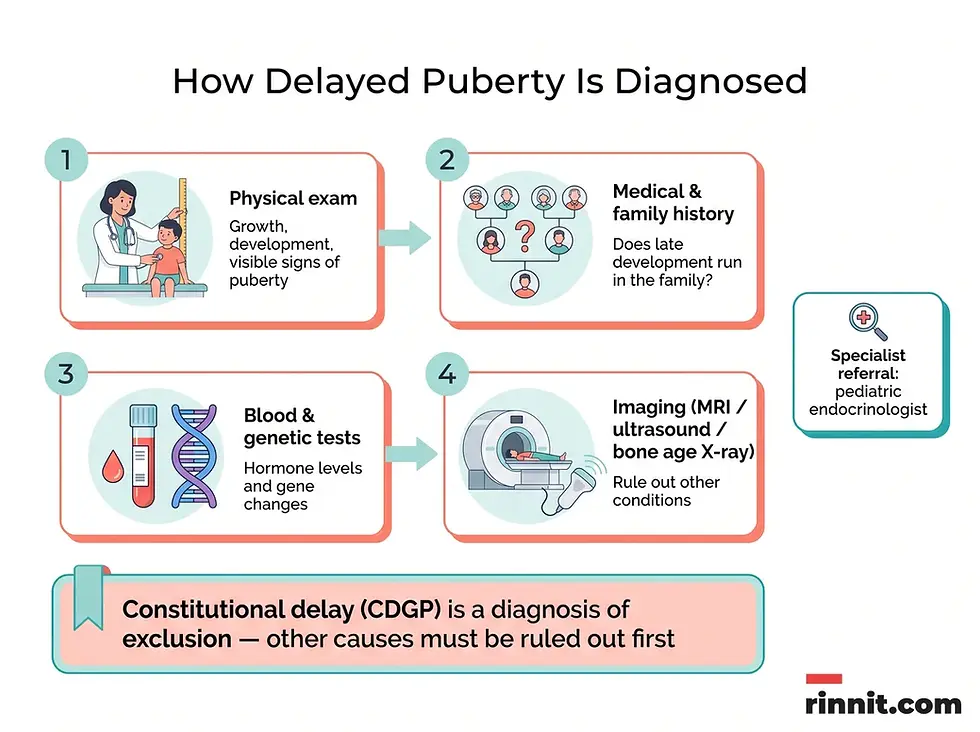
Delayed puberty is diagnosed with a physical exam, a review of the child's medical and biological family history, and tests to rule out other causes.
How Is Delayed Puberty Diagnosed?
Healthcare providers diagnose delayed puberty by doing a physical exam, talking with you about your child's medical history and biological family history, and running some tests [1].
One of the main things providers will want to know is whether delayed puberty runs in your child's biological family. If so, then it's likely that your child is a "late bloomer," and there's no medical condition causing the delay.
But providers often run tests to rule out other causes, even if they think it just runs in the family. This is because constitutional delay of growth and puberty is what providers call a "diagnosis of exclusion." [1] The only way to know that's what's happening is by ruling out all other possible scenarios.
Tests are also important when delayed puberty doesn't run in the family and providers are trying to figure out the cause.
Test | What It Checks |
Physical exam | Growth, development, and visible signs of puberty |
Medical and family history review | Whether late development runs in the family |
Blood tests [1] | Hormone levels and signs of certain medical conditions |
Gene changes known to cause delayed puberty | |
MRI or ultrasound [1] | Imaging to diagnose or rule out certain conditions |
Bone age X-ray [1] | Whether bones are as mature as expected for age |
Your pediatrician may refer you to a pediatric endocrinologist or other specialists [1] to help with diagnosis and treatment.
How is delayed puberty managed and treated?
Delayed puberty treatment depends on what's causing the delay, and a wait-and-see approach is common for adolescents with no medical condition behind it.
How Is Delayed Puberty Treated?
Treatment depends on what's causing the delay. Your child's care team might recommend one or more of the following approaches.
A "wait and see" approach is common for adolescents with no medical conditions or other known causes for the delay [1]. Providers want to see if puberty can start naturally on its own. If so, then your child likely won't need any treatment, and puberty should progress as expected.
Treatment for medical conditions applies when a specific condition is causing the delay. Providers treat that condition, which should help puberty start and continue as expected [1].
Hormone replacement therapy may be needed if your child's body isn't able to make enough testosterone or estrogen to support puberty [1]. Your child's care team will explain how long they'll need hormone therapy based on their unique needs.
Treatment Approach | When It's Used | What Happens |
Wait and see | No known medical cause | Providers monitor whether puberty starts naturally; if so, no treatment is needed |
Treat the underlying condition | A specific illness causes the delay | Treating the condition helps puberty start and continue as expected |
Hormone replacement therapy | Body can't make enough testosterone or estrogen | Medicines supply the hormones needed to support puberty |
Hormone therapy as an option | "Late bloomer" with no medical cause | Not medically required, but available if the delay is very upsetting to your child |
Adolescents who appear to be "late bloomers" without a known medical cause don't need hormone therapy [1]. But it may be an option if delayed puberty is very upsetting for your child [1]. Some teens have a hard time waiting for puberty to happen, and the delay might cause social issues or affect their self-confidence. If you're concerned this is happening with your child, talk to their care team.
When Should I Seek Medical Care?
Take your child to their routine well-checks and share any concerns with your pediatrician. They'll check your child's growth and development and may ask questions about family history. If your child doesn't start puberty at the expected time, your pediatrician will explain what tests and follow-ups they might need.
Care for Your Child's Mental Health
Delayed puberty can take a toll on your teen's mental health [1] — and at a time when they're already going through lots of emotions and changes. You may want to arrange for your child to speak with a therapist. Therapy may help your child work through their feelings about puberty and anything else that's on their mind.
What questions should you ask your child's providers about delayed puberty?
Delayed puberty is a unique experience for every child, so asking your child's providers targeted questions helps you understand your child's situation. Your pediatrician and any specialists providing care can share details specific to your child. Consider these questions to start the conversation:
How can I know if my child is starting puberty?
How can I know if puberty has stopped moving along as it should?
Does my child have delayed puberty? If so, what signs show this?
Does my child need any tests?
Do you recommend any treatments?
How can I best support my child?
What is the outlook for children with delayed puberty?
The outlook for delayed puberty depends on its cause and any treatments, and delayed puberty is temporary and, if necessary, treatable.
What Can I Expect?
Your child's care team can tell you more about what you might expect based on the causes of delayed puberty and any treatments your child receives. It's hard to predict when puberty will begin [1].
Adolescents with constitutional delay of growth and puberty typically start puberty by age 18 [1]. But your child may start much sooner than this. Each child's experience is a little different.
Just remember that delayed puberty is temporary and, if necessary, treatable [1].
Does Delayed Puberty Make You Taller?
It's difficult to predict how delayed puberty might affect your child's adult height [1]. Some adolescents reach an adult height that's shorter than expected based on their biological parents' height. But for other adolescents, delayed puberty doesn't seem to affect their adult height [1].
Providers sometimes do an imaging test called a bone age X-ray to help predict your child's adult height [1]. Your pediatrician can tell you more about this test and what it shows.
Scenario | Adult Height Expectation |
Some adolescents | Reach an adult height shorter than expected from their parents' height |
Other adolescents | Delayed puberty doesn't affect adult height at all |
Prediction tool | Bone age X-ray helps providers estimate adult height [1] |
Does Melatonin Delay Puberty?
Melatonin may delay puberty, but more research is needed to know for sure [1]. Researchers continue to study the adverse (unwanted) effects of melatonin treatments on children and adolescents. Talk to your pediatrician about the benefits and risks of melatonin for your child.
Key Takeaways
Delayed puberty means a child's sexual development starts later than expected or stalls before completion — defined as no breast development by 13 or no period by 15 in girls, and no testicular growth by 14 in boys. Most often, it's simply an inherited "late bloomer" pattern that resolves on its own, typically by age 18. Because it can also signal conditions like Turner syndrome, hypothyroidism, malnutrition, or hormone disorders, providers confirm the cause through exams, blood tests, genetic testing, and imaging. Treatment ranges from watchful waiting to hormone therapy, and support for your child's emotional well-being matters just as much as the medical plan.
Take the Next Step
If your child shows no signs of puberty by the ages above, or if development seems to have stopped, talk to your pediatrician. An early evaluation can confirm whether your child is simply on their own schedule — or whether treatment can help their development get back on track.
Related reading: hypothyroidism, Turner syndrome
Frequently Asked Questions
1. What is delayed puberty?
Delayed puberty is when your child doesn't show signs of sexual development at the expected age, or when puberty starts on time but stops or slows down so your child doesn't complete all the stages. It's sometimes called delayed sexual development or being a late bloomer.
2. What age is considered delayed puberty?
For girls, it means no breast development by age 13, or no menstruation by age 15 or within three years of breast development. For boys, it means no testicular growth by age 14, or at least five years since the testes began enlarging with puberty still incomplete.
3. What causes delayed puberty?
The most common cause is a harmless inherited gene variant called constitutional delay of growth and puberty (CDGP). Other causes include Addison's disease, chronic kidney disease, cystic fibrosis, Turner or Klinefelter syndrome, excessive exercise, growth hormone deficiency, hypothyroidism, inflammatory bowel disease, malnutrition, corticosteroids, chemotherapy, radiation, brain or sex gland trauma, tumors, and Type 1 diabetes.
4. What is constitutional delay of growth and puberty (CDGP)?
CDGP is the medical name for an inherited tendency to start puberty later than most children. Some providers call it self-limited delayed puberty. There's nothing wrong with the child's organs, glands, or hormones, and puberty happens and proceeds normally without medical treatment.
5. What are the signs of delayed puberty?
The main signs are lack of breast development in girls and lack of testicular growth in boys. Other signs include shorter-than-expected height (no growth spurt yet), delayed bone age visible on X-ray, and lack of pubic hair. Underarm hair or body odor can still appear, because adrenarche is a separate pre-puberty process.
6. How is delayed puberty diagnosed?
Providers use a physical exam, a review of medical and family history, blood tests for hormone levels, genetic testing for known gene changes, and imaging like MRI, ultrasound, or a bone age X-ray. CDGP is a diagnosis of exclusion, meaning other causes must be ruled out first.
7. How is delayed puberty treated?
Treatment depends on the cause. Options include a wait and see approach for healthy late bloomers, treatment of any underlying medical condition, and hormone replacement therapy with testosterone or estrogen if the body can't make enough hormones to support puberty.
8. Do late bloomers need hormone therapy?
No - adolescents who are late bloomers without a known medical cause don't need hormone therapy. It may be an option, though, if the delay is very upsetting to the child, causes social issues, or affects self-confidence.
9. When does puberty usually start for children with CDGP?
Adolescents with constitutional delay of growth and puberty typically start puberty by age 18, though many start much sooner. It's hard to predict exactly when, and each child's experience is different. Delayed puberty is temporary and, if necessary, treatable.
10. Does delayed puberty affect adult height?
It's difficult to predict. Some adolescents end up shorter than expected based on their parents' height, while others are unaffected. Providers sometimes use a bone age X-ray to help predict adult height.
11. Can melatonin delay puberty?
Melatonin may delay puberty, but more research is needed to know for sure. Researchers continue to study the adverse effects of melatonin treatments on children and adolescents, so talk to your pediatrician about the benefits and risks for your child.
Related Reading
Testosterone Test: Types, Why It's Done, How to Prepare and What Results Mean explains the blood test that can show a low testosterone level when sexual development is delayed.
References
Cleveland Clinic. Delayed Puberty. Cleveland Clinic. March 28, 2025. https://my.clevelandclinic.org/health/diseases/delayed-puberty
Howard SR. The genetic basis of delayed puberty. Front Endocrinol (Lausanne). 2019;10:423. doi:10.3389/fendo.2019.00423. PMID: 31293522.
Saengkaew T, Patel HR, Banerjee K, et al. Genetic evaluation supports differential diagnosis in adolescent patients with delayed puberty. Eur J Endocrinol. 2021;185(5):617-627. doi:10.1530/EJE-21-0387. PMID: 34403359.
Chaudhary S, Walia R, Bhansali A, Dayal D, Sachdeva N, Singh T, Bhadada SK. FSH-stimulated inhibin B (FSH-iB): a novel marker for the accurate prediction of pubertal outcome in delayed puberty. J Clin Endocrinol Metab. 2021;106(9):e3495-e3505. doi:10.1210/clinem/dgab357. PMID: 34010394.
Medical Disclaimer
This article is for informational purposes only and does not constitute medical advice. Always seek the advice of your physician or other qualified health provider with any questions you may have regarding a medical condition. Never disregard professional medical advice or delay in seeking it because of something you have read here.



Comments