Karyotype Test: What It Shows, Sample Types, Results and Limits

Updated: 2 days ago
Written and medically reviewed by Dr. Baraa Alnahhal, MD · Last reviewed: November 2026 · How we review
Quick Answer
A karyotype test looks at the chromosomes, the structures inside cells that carry your genes, to check their number, size and shape. It can find extra, missing or rearranged chromosomes that cause conditions such as Down syndrome and Turner syndrome, and changes linked to some blood cancers. Results usually take a few weeks.
What the research says
Microarray finds more than a karyotype for developmental conditions: a consensus review of 33 studies with 21,698 patients found chromosomal microarray identified a cause in 15–20% of people with developmental disabilities or birth defects, compared with about 3% for a standard karyotype; karyotype is still preferred for obvious chromosome syndromes, family rearrangements and recurrent miscarriage (Miller DT et al., American Journal of Human Genetics, 2010) [2]
Each test catches things the other misses in pregnancy: in 4,406 pregnant women, microarray detected all common chromosome number changes found by karyotype and found extra meaningful changes in 6.0% of pregnancies with ultrasound anomalies, but it missed balanced translocations and triploidy, which karyotype can see (Wapner RJ et al., New England Journal of Medicine, 2012) [3]
Key takeaways
Checks the number and structure of your 46 chromosomes.
Finds conditions such as Down, Edwards, Patau, Turner and Klinefelter syndromes and some cancer-related changes.
Samples: blood (most common), bone marrow, amniotic fluid (15–20 weeks) or placental tissue (10–13 weeks).
Results usually take a few weeks because cells must grow in the lab.
Genetic counseling helps you understand the results and what they mean for your family.
What is a karyotype?
A karyotype is a picture of all your chromosomes, arranged in pairs from largest to smallest. Lab specialists grow cells from your sample, stop them at the stage of cell division when chromosomes are most visible, stain them and examine them under a microscope. Pairs 1–22 are the same in everyone; the 23rd pair are the sex chromosomes (usually XX or XY). Sources: [1]
Why is it done?
To look for a cause of infertility, including male infertility, or repeated miscarriage or stillbirth.
To diagnose or monitor some cancers and blood disorders, such as leukemia, lymphoma, myeloma and certain anemias.
When a baby or child has signs of a genetic condition, such as birth defects or developmental delay.
During pregnancy, after an abnormal screening result, when a parent is over 35 or when there's a family history of a chromosome condition. Sources: [1]
Sample types
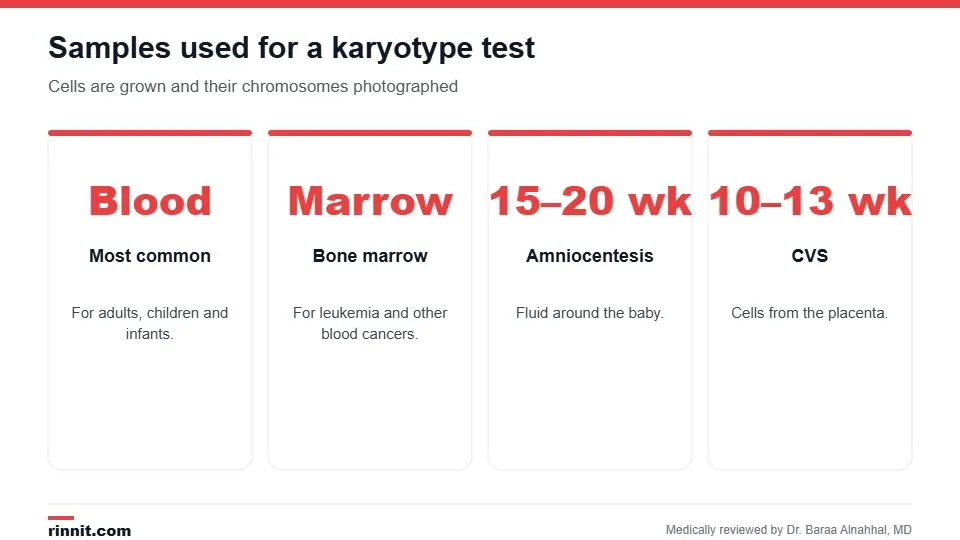
The sample depends on why the test is done.
Sample | How it's collected | When it's used |
Blood | Needle in an arm vein | Most common; adults and children |
Bone marrow | Bone marrow biopsy, usually from the hip | Blood cancers and disorders |
Amniotic fluid | Amniocentesis at 15–20 weeks | Pregnancy |
Placental tissue | Chorionic villus sampling at 10–13 weeks | Earlier pregnancy testing |
Sources: [1]
Conditions a karyotype can find
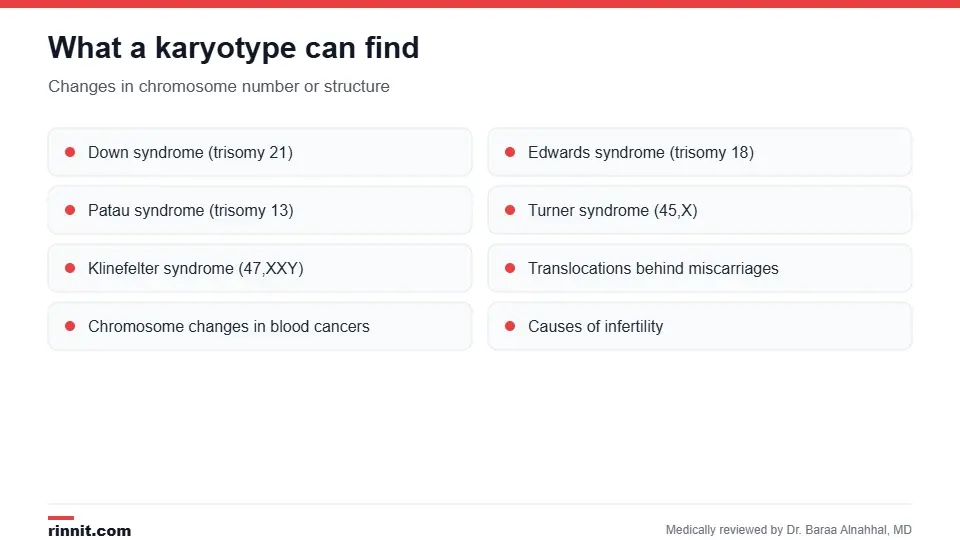
Common chromosome conditions found by karyotype.
Down syndrome (trisomy 21): an extra chromosome 21.
Edwards syndrome (trisomy 18).
Patau syndrome (trisomy 13).
Turner syndrome (45,X): one X chromosome is missing.
Klinefelter syndrome (47,XXY): an extra X chromosome in males.
Large deletions, duplications and translocations, including the Philadelphia chromosome in chronic myeloid leukemia. Sources: [1, 2]
How do I prepare?
Usually no preparation is needed. Tell your provider if you've had a recent blood transfusion, which can affect results. Genetic counseling before and after the test is recommended so you understand what the results can and can't tell you. Sources: [1]
Risks
Blood draw: minor bruising or soreness.
Bone marrow: bleeding, infection or pain at the site.
CVS: a small risk of miscarriage, about 1 in 450 in recent studies.
Amniocentesis: a small risk of miscarriage, about 1 in 300 to 1 in 1,000 in recent studies. Sources: [1]
Karyotype vs chromosomal microarray
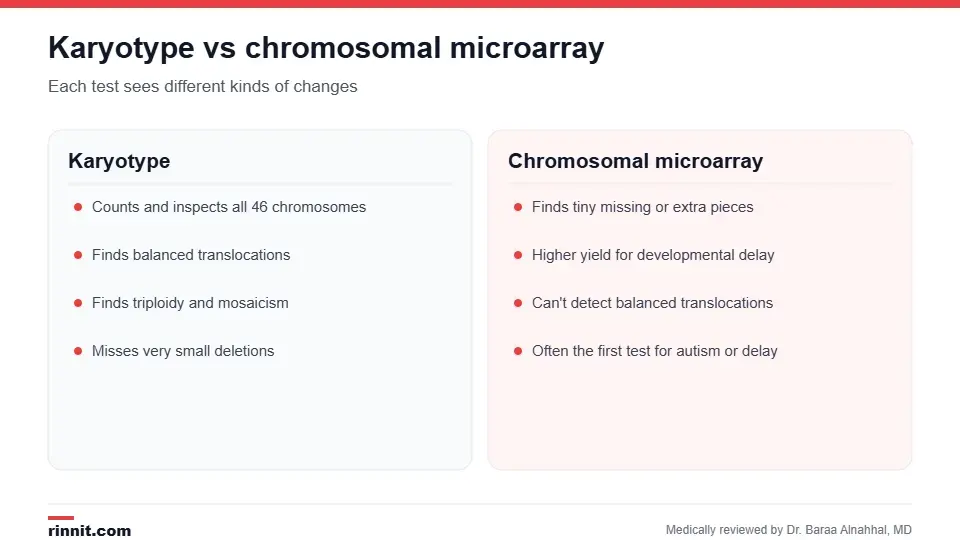
Karyotype and microarray answer different questions.
A karyotype sees whole chromosomes and large changes, including balanced translocations where pieces swap places. A chromosomal microarray, a type of genetic test, detects much smaller missing or extra pieces but can't see balanced rearrangements or triploidy. Many children with developmental delay now get microarray first; karyotype is still used for suspected chromosome syndromes, infertility and recurrent miscarriage. Sources: [2, 3]
Understanding your results
A normal result shows 46 chromosomes with no visible structural changes: 46,XX or 46,XY. An abnormal result describes the change, for example 47,XY,+21 for Down syndrome. Results usually take a few weeks. A normal karyotype doesn't rule out all genetic conditions, because many are caused by changes too small to see. Sources: [1, 2]
Conclusion
A karyotype test gives a full view of your chromosomes and remains a key test for chromosome syndromes, infertility, pregnancy loss and some blood cancers. Talk with a genetic counselor about what the test can show, and whether microarray or other genetic testing would add information.
Keep learning: read about Down syndrome and genetic testing.
Frequently asked questions
What does a karyotype test show?
The number, size and shape of your chromosomes.
How many chromosomes are normal?
46 chromosomes, in 23 pairs.
How is the test done?
Usually with a blood sample; sometimes bone marrow, amniotic fluid or placental tissue.
How long do results take?
Usually a few weeks, because cells must grow in the lab.
Can a karyotype detect Down syndrome?
Yes. It shows the extra chromosome 21.
Is a karyotype the same as genetic testing?
It's one type of genetic test that looks at whole chromosomes, not individual genes.
Why is a karyotype done for infertility?
Chromosome changes such as balanced translocations or Klinefelter syndrome can cause infertility or miscarriage.
Is prenatal karyotyping risky?
Both carry a small miscarriage risk: about 1 in 450 for CVS and about 1 in 300 to 1 in 1,000 for amniocentesis in recent studies.
Can a normal karyotype miss a genetic condition?
Yes. Small changes and single-gene conditions aren't visible on a karyotype.
Do I need to prepare?
Usually not. Mention any recent blood transfusion.
Related Reading
Down Syndrome: Symptoms, Causes, Types & Life Expectancy — Complete Guide the most common chromosome condition found by karyotype.
Turner Syndrome: A Comprehensive Guide to Symptoms and Care a missing X chromosome seen on karyotype.
Edwards Syndrome (Trisomy 18): Symptoms, Causes, Diagnosis, Treatment, Survival Rates and When to Seek Emergency Care — What You Need to Know an extra chromosome 18.
What Is a Miscarriage? A Plain-Language Guide to Causes, Symptoms, and Recovery pregnancy loss, sometimes caused by chromosome changes.
Genetic Testing (DNA Tests): Types, Uses, Risks and What Results Mean other genetic tests that look at genes and DNA.
FISH Test: How Fluorescence In Situ Hybridization Finds Gene Changes explains the glowing-probe lab test that finds gene and chromosome changes.
References
Cleveland Clinic. Karyotype Test: Test & What Is It. Cleveland Clinic. Last updated June 3, 2021. https://my.clevelandclinic.org/health/diagnostics/21556-karyotype-test
Miller DT, Adam MP, Aradhya S, et al. Consensus statement: chromosomal microarray is a first-tier clinical diagnostic test for individuals with developmental disabilities or congenital anomalies. Am J Hum Genet. 2010;86(5):749-764. PMID 20466091. https://doi.org/10.1016/j.ajhg.2010.04.006
Wapner RJ, Martin CL, Levy B, et al. Chromosomal microarray versus karyotyping for prenatal diagnosis. N Engl J Med. 2012;367(23):2175-2184. PMID 23215555. https://doi.org/10.1056/NEJMoa1203382
Medical disclaimer
This article is for general education only and does not replace advice from a qualified healthcare professional. Talk to your doctor about your own diagnosis and treatment, and seek emergency care right away for severe or sudden symptoms.



Comments