Genetic Testing (DNA Tests): Types, Uses, Risks and What Results Mean

Updated: 2 days ago
Written and medically reviewed by Dr. Baraa Alnahhal, MD · Last reviewed: November 2026 · How we review
Quick Answer: What is genetic testing?
Genetic testing (a DNA test) looks for changes in your genes, chromosomes and DNA, using a sample of blood, hair, skin, tissue or amniotic fluid. It can confirm or rule out a genetic condition, show whether you have a higher risk of a disease, or reveal whether you carry an altered gene you could pass to a child. [1]
What the research says
Raw data from home DNA kits can be wrong. When a clinical lab rechecked 49 people whose direct-to-consumer raw data had flagged a health-related gene change, 40% of those variants turned out to be false positives, and some "increased risk" variants were actually benign. (Tandy-Connor et al., Genetics in Medicine, 2018) [2]
Uncertain results that get updated are usually downgraded to harmless. In about 1.45 million people tested for hereditary cancer genes, 7.7% of unique variants of uncertain significance were later reclassified, and 91.2% of those were downgraded to benign or likely benign. (Mersch et al., JAMA, 2018) [3]
Key takeaways
DNA tests can diagnose a condition, estimate future risk, check carrier status or guide medication choices. [1]
There are gene, genomic, chromosomal and gene expression tests. [1]
Results can be positive, negative or uncertain, and no test finds every genetic condition. [1]
Physical risks are usually small; emotional, financial and insurance effects matter too. [1]
Results take from a few days to a month or two. [1]
Types of genetic tests
Different DNA tests look at your genetic material at different scales: [1]
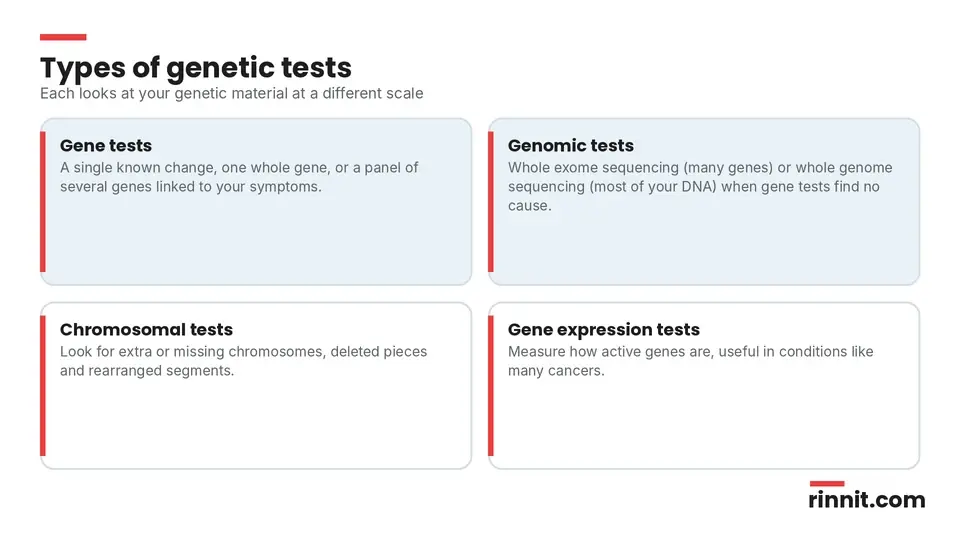
Type | What it looks at | When it's used |
Targeted single variant | One known change in one gene | Checking for a change that runs in your family |
Single gene | One gene, for any change | Confirming or ruling out a specific condition |
Gene panel | Several genes at once | When changes in any of them could cause your symptoms |
Whole exome sequencing | Changes across many genes | When gene tests find no cause or the condition is complex |
Whole genome sequencing | Most of your DNA | When gene tests find no cause or the condition is complex |
Chromosomal testing | Extra, missing, deleted or rearranged chromosomes and pieces | Suspected chromosome conditions |
Gene expression testing | How active genes are | Conditions like many cancers, where genes are over- or underactive |
Sources: [1]
What is genetic testing used for?
Genetic tests serve several purposes: [1]
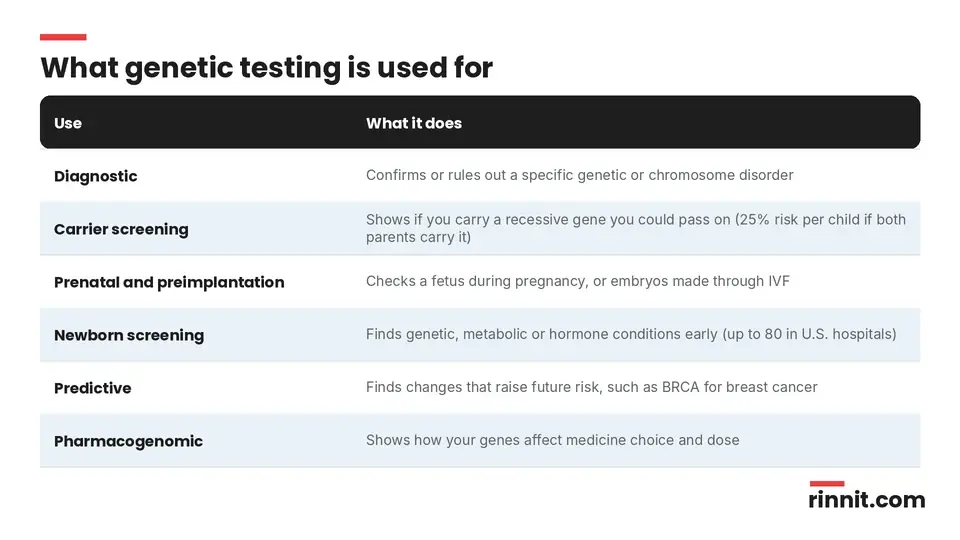
Prenatal testing: checks a fetus's genes or chromosomes to estimate the chance of certain conditions.
Diagnostic testing: confirms or rules out a specific genetic or chromosomal disorder. It doesn't test for every genetic condition.
Carrier screening: shows whether you carry an altered gene for an autosomal recessive condition, often with no symptoms. It's offered to anyone planning a pregnancy or in early pregnancy.
Preimplantation testing: tests embryos made through assisted reproduction, such as IVF, before one is implanted.
Newborn screening: checks newborns for genetic, metabolic or hormone conditions so treatment can start early. U.S. hospitals can screen for up to 80 conditions, and each state chooses which ones.
Predictive and pre-symptomatic testing: finds changes that raise your chance of a condition later in life, such as BRCA testing for breast and other cancers. These tests don't always give full certainty.
Pharmacogenomic testing: looks at genes that affect how your body handles medicines, to help choose a drug and the safest dose.
If both parents carry the same recessive condition, each child has a 25% risk of having it. [1]
Conditions genetic testing can detect
Examples include cystic fibrosis, Down syndrome, Huntington's disease, phenylketonuria (PKU), sickle cell disease, hereditary breast cancer, hereditary colorectal cancer, familial adenomatous polyposis, juvenile polyposis syndrome and MUTYH-associated polyposis. [1]
How is a genetic test done?
Your provider collects a sample of blood, hair, skin, tissue or amniotic fluid and sends it to a lab. A pathologist looks for changes in your genes, chromosomes and DNA and sends the results to your provider. [1]
Some results come back in a few days; others take several weeks to a month or two. Your provider will tell you what to expect for your test. [1]
What are the risks and limits of genetic testing?
Type of risk | What to know |
Physical | Usually small. Prenatal tests that collect amniotic fluid carry a small risk of infection, bleeding and miscarriage |
Emotional | Unexpected results may bring anger, fear, anxiety, depression or guilt |
Financial | Costs range from hundreds to thousands of dollars; insurance coverage depends on the test and the reason |
Limits | Tests don't cover every disorder, aren't 100% accurate and can't reliably show how severe a condition will be or when it will start |
Sources: [1]
Results may also affect your ability to get certain types of insurance. A genetic counselor can talk through these concerns with you before you test. [1]
What do genetic test results mean?
Genetic test results usually fall into one of three groups: [1]

Result | What it means |
Positive | A known disease-causing change was found. It may confirm a diagnosis, show you're a carrier or point to higher risk |
Negative | No known disease-causing change was found. It may rule out a diagnosis or carrier status, or show no sign of higher risk |
Uncertain | A change was found, but there isn't enough information yet to know whether it's harmless or causes disease |
Sources: [1]
Everyone has normal DNA variations that don't affect health. A positive result doesn't always mean you'll develop the disease. [1]
How accurate are DNA tests?
Accuracy has two parts: analytical validity (whether the test correctly detects a gene change) and clinical validity (whether that change is linked to a specific disease). Labs that run tests ordered by genetic counselors or geneticists follow federal and/or state standards, but some direct-to-consumer companies don't. [1]
What happens if your results are abnormal?
Talk with your provider or a genetic counselor. You may need more tests to understand the condition and your treatment options, a referral to a specialist, or support from a social worker. [1]
Should you use a home DNA testing kit?
It's better to find a healthcare provider or genetic counselor who can order the right test and explain the results. Direct-to-consumer tests are risky when you have no one to discuss the results with. [1] [2]
What about DNA paternity tests?
A paternity test identifies a child's biological father using a cheek swab or blood sample. [1]
Conclusion
Genetic testing can answer big questions: whether you have a genetic condition, how likely you are to develop one, whether you could pass one on and even which medicine suits you best. It also has limits, from uncertain results to emotional and insurance effects.
Before you test, talk with your provider about a referral to a genetic counselor, who can help you pick the right test and understand what the results will mean for you and your family.
Keep learning: Read our guide to genetic disorders or learn how the PKU newborn screening test works. For more background, see the MedlinePlus guide to genetic testing.
FAQ
What is a DNA test?
It's a test that looks for changes in your genes, chromosomes and DNA to diagnose, predict or rule out genetic conditions.
What are the main types of genetic tests?
Gene tests, genomic tests like whole exome or genome sequencing, chromosomal tests and gene expression tests.
How is a genetic test done?
A sample of blood, hair, skin, tissue or amniotic fluid goes to a lab, where a pathologist looks for DNA changes.
How long do genetic test results take?
From a few days to several weeks, or a month or two for some tests.
What does a positive genetic test mean?
A known disease-causing change was found; it may confirm a diagnosis, show carrier status or mean higher risk.
Does a positive result mean I will get the disease?
Not always. A positive result can mean higher risk without certainty that the disease will develop.
What is a variant of uncertain significance?
It's a DNA change without enough evidence yet to say whether it's harmless or disease-causing.
What is carrier screening?
It checks whether you carry an altered gene for a recessive condition you could pass to a child, often with no symptoms yourself.
What are the risks of genetic testing?
Physical risks are usually small; emotional stress, cost and insurance effects are the main concerns.
Are home DNA test kits accurate for health?
They can be wrong; testing through a provider with a regulated lab and a genetic counselor is safer.
What is pharmacogenomic testing?
It checks genes that affect how your body handles medicines, to guide drug choice and dosing.
Related Reading
Genetic Disorders: Understanding Types, Causes, and Diagnosis explains the main types of genetic conditions that DNA tests look for.
Cystic Fibrosis: Symptoms, Causes, Diagnosis, and Treatment (2026 Guide) covers a recessive condition found through carrier and diagnostic testing.
Down Syndrome: Symptoms, Causes, Types & Life Expectancy — Complete Guide explains a chromosome condition that chromosomal and prenatal testing can detect.
Sickle Cell Anemia: Symptoms, Causes, Treatment & Complete Guide covers an inherited blood disorder identified by genetic testing.
Lynch Syndrome and HNPCC: Symptoms, Testing and Screening explains a hereditary colorectal cancer syndrome that gene testing can find.
Karyotype Test: What It Shows, Sample Types, Results and Limits explains the chromosome test used to diagnose this and other genetic conditions.
APOE Gene Test: What APOE4 Means for Alzheimer's Risk and How Testing Works explains the genetic test for APOE4 and what it means for Alzheimer's risk.
Sweat Test for Cystic Fibrosis: How It Works and What Results Mean explains the sweat chloride test used to diagnose cystic fibrosis.
Carrier Screening: Genetic Testing Before or During Pregnancy explains the genetic test that shows whether you carry an inherited condition.
References
Cleveland Clinic. DNA Tests: What Is Gene Testing? Cleveland Clinic. Last updated May 28, 2025. https://my.clevelandclinic.org/health/diagnostics/23065-dna-test--genetic-testing
Tandy-Connor S, Guiltinan J, Krempely K, et al. False-positive results released by direct-to-consumer genetic tests highlight the importance of clinical confirmation testing for appropriate patient care. Genet Med. 2018;20(12):1515-1521. PMID 29565420. https://doi.org/10.1038/gim.2018.38
Mersch J, Brown N, Pirzadeh-Miller S, et al. Prevalence of Variant Reclassification Following Hereditary Cancer Genetic Testing. JAMA. 2018;320(12):1266-1274. PMID 30264118. https://doi.org/10.1001/jama.2018.13152
Medical disclaimer
This article is for general education only and does not replace advice from a qualified healthcare professional. Talk to your doctor about your own diagnosis and treatment, and seek emergency care right away for severe or sudden symptoms.



Comments