PKU Test: Essential Newborn Screening for Phenylketonuria

Updated: 3 days ago
Medically reviewed by Dr. Baraa Alnahhal, MD · Last reviewed: October 2026
The PKU test is a standard newborn screening performed shortly after birth to detect phenylketonuria (PKU), a rare genetic condition. The test measures levels of phenylalanine, an amino acid that can build up to dangerous levels in the brain if left untreated. Performed via a simple heel prick, this screening is vital for early intervention, allowing for dietary management that prevents lifelong developmental and intellectual disabilities.
Quick Answer
A PKU test is a mandatory blood screening for newborns in the United States that checks for high levels of the amino acid phenylalanine. Babies with PKU cannot break down this amino acid, so it builds up in the blood and brain. Early detection allows immediate treatment to prevent irreversible brain damage, seizures and intellectual disabilities. [1]
What the research says
PKU affects about 1 in 10,000 newborns, and early screening changes the outcome. A Nature Reviews Disease Primers review reports an average worldwide prevalence of about 1:10,000 newborns. Untreated, high phenylalanine causes severe intellectual disability, epilepsy, and behavioral problems, but when treatment starts early after newborn screening and continues, intelligence is within normal limits on average, though some neurocognitive function may be suboptimal (van Spronsen et al., Nat Rev Dis Primers, 2021).
Newborn screening has a long track record but known limits. A review of newborn screening in the United States notes that screening has evolved since its introduction in 1963, and describes how it is performed, which disorders are screened, and the special considerations and limitations of screening sick and premature infants (Fabie et al., Pediatr Clin North Am, 2019).
People treated early are now reaching middle age. A review reports that untreated PKU causes severe, irreversible brain damage, that newborn screening and the low-phenylalanine diet have transformed outcomes, and that people who benefited from early treatment are now approaching their fifth and sixth decades, prompting research into long-term health and ageing (Vardy et al., J Inherit Metab Dis, 2020).
Research summaries are based on article abstracts retrieved from PubMed.
What is a PKU Test?
A PKU test is a specialized diagnostic screening designed to identify newborns with phenylketonuria (PKU). PKU is an inherited genetic disorder where the body lacks the necessary enzyme to process phenylalanine, an amino acid found in many protein-rich foods and some artificial sweeteners. Without this enzyme, phenylalanine accumulates to toxic levels in the blood and brain, which can lead to severe neurological complications if not managed from birth. [1]
In the United States, this test is a standard component of the newborn screening panel. By identifying the condition within the first few days of life, healthcare providers can implement life-saving dietary interventions before any permanent damage occurs. While the condition is rare, the screening is a foundational step in ensuring long-term neonatal health and developmental success. [1]

How and when is the PKU test done?
The PKU screening is typically conducted within the first 24 to 72 hours after a baby is born. For the test to be accurate, the infant must have consumed breastmilk or formula for at least a full day. This ensures that their body has been exposed to phenylalanine, allowing the test to measure how effectively the amino acid is being processed. [1]
The procedure itself is quick and minimally invasive. A healthcare professional performs a "heel prick," using a small, sterile lancet to draw a few drops of blood from the baby's heel. This blood is then collected on a special filter paper card and sent to a laboratory for analysis. While the baby may experience brief discomfort or a small bruise, the procedure is considered safe and carries very low risk. [1]
Phase | Description |
Preparation | Baby must have consumed breastmilk or formula for at least 24 hours. |
Collection | A sterile lancet is used to prick the baby's heel for a blood sample. |
Analysis | Blood is tested in a lab for phenylalanine (phe) concentrations. |
Timing | Results are typically returned to the provider within one week. |
What do PKU test results mean?
Results from a PKU screening are generally categorized as normal, abnormal, or positive. A normal result indicates that the phenylalanine levels are within a safe range, typically below 2 mg/dL, and no further action is required. If the results show levels above 4 mg/dL, they are considered abnormal or high, which triggers the need for immediate follow-up. [1]
It is important for parents to understand that a "positive" screening result does not automatically mean the baby has PKU. Screening tests are designed to be highly sensitive to ensure no cases are missed, which can sometimes lead to false positives. If a screening is positive, a second, more definitive blood test is performed to confirm the diagnosis. [1]
Why is the PKU test important, and what follow-up is needed?
The primary goal of the PKU test is the prevention of irreversible brain damage. When PKU is detected early, children can lead healthy lives by adhering to a strictly managed, low-protein diet. Without this early detection, the build-up of phenylalanine can cause significant intellectual disabilities, hyperactivity, and seizures. [1]
If a follow-up test confirms a PKU diagnosis, the family is typically referred to a metabolic specialist and a registered dietitian. Together, they create a lifelong management plan centered on a specialized diet and regular blood monitoring. Modern medical advancements have made PKU a highly manageable condition, provided that intervention begins immediately following the newborn screening. [1]

What are the risks of the PKU test, and what at-home care is needed?
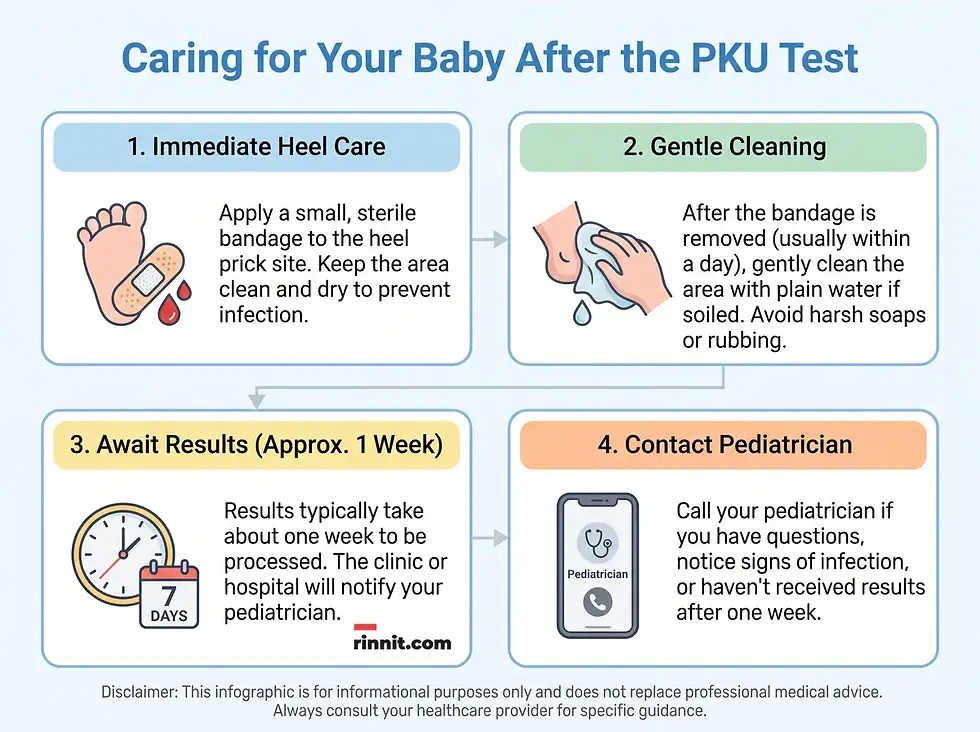
The risks associated with a PKU test are negligible. The most common side effects are a small bruise or a tiny scab at the site of the heel prick. Parents should keep the area clean and follow the healthcare provider's instructions regarding the removal of any bandages. If a scab forms, it should be allowed to fall off naturally to prevent minor bleeding. [1]
Waiting for results can be a period of anxiety for new parents, but it is helpful to remember that the screening is a proactive measure. Most babies receive normal results, and even for those who test positive, early management ensures a high quality of life. The test is a critical safety net that protects a child's neurological development from the very beginning. [1]
Conclusion
The PKU test is one of the most important screenings a newborn will receive. Its ability to detect a rare but serious condition before symptoms appear makes it a cornerstone of modern neonatal care. By participating in this standard screening, parents are taking a vital step in safeguarding their child's cognitive and physical development, ensuring that any necessary treatments can begin at the most effective time.
Frequently Asked Questions
Is the PKU test mandatory?
Yes, in the United States and many other countries, PKU screening is a mandatory part of the standard newborn testing panel performed at the hospital.
Can I feed my baby before the test?
Yes, it is actually required that the baby has consumed breastmilk or formula for at least 24 hours before the test to ensure accurate phenylalanine readings.
How will I receive the results?
Results are typically sent to your baby's pediatrician within one week. If the results are abnormal, the doctor's office will contact you immediately for follow-up.
What if the test is positive?
A positive screening result means your baby needs a second, confirmatory blood test. It does not necessarily mean they have the condition.
Is the heel prick painful for the baby?
The baby may feel a quick pinch and may cry briefly, but the procedure is very fast and the discomfort is temporary.
Can PKU be cured?
There is currently no cure for the genetic condition itself, but it is highly manageable through a lifelong low-phenylalanine diet.
What happens if PKU is not detected?
If undetected and untreated, the accumulation of phenylalanine can lead to permanent brain damage, intellectual disabilities, and developmental delays.
Is PKU a common condition?
No, PKU is considered a rare genetic disorder, but the screening is performed on all babies because early detection is so critical for those affected.
Does a positive test mean my baby needs a special diet immediately?
A special diet is only started after a second, confirmatory test proves the diagnosis. A specialist will guide you through this process.
Are there any long-term risks from the heel prick?
No, there are no long-term risks. The small puncture site heals quickly, usually within a few days, leaving no lasting mark.
Related Reading
Learn more in our guide to Apgar Score: How It's Scored and What Your Baby's Score Means.
References
Cleveland Clinic. PKU Test. Cleveland Clinic Health Library. Last updated November 24, 2025. https://my.clevelandclinic.org/health/diagnostics/pku-test-screening
van Spronsen FJ, Blau N, Harding C, et al. Phenylketonuria. Nat Rev Dis Primers. 2021;7(1):36. PMID: 34017006. DOI: https://doi.org/10.1038/s41572-021-00267-0
Fabie NAV, Pappas KB, Feldman GL. The current state of newborn screening in the United States. Pediatr Clin North Am. 2019;66(2):369-386. PMID: 30819343. DOI: https://doi.org/10.1016/j.pcl.2018.12.007
Vardy ERLC, MacDonald A, Ford S, et al. Phenylketonuria, co-morbidity, and ageing: a review. J Inherit Metab Dis. 2020;43(2):167-178. PMID: 31675115. DOI: https://doi.org/10.1002/jimd.12186
Medical disclaimer
This article is for informational purposes only and is not a substitute for professional medical advice, diagnosis, or treatment. Always seek the advice of your physician or other qualified health provider with any questions you may have about a medical condition.



Comments