Apgar Score: How It's Scored and What Your Baby's Score Means

Updated: 2 days ago
Written and medically reviewed by Dr. Baraa Alnahhal, MD · Last reviewed: November 2026 · How we review
Quick Answer: What is an Apgar score?
The Apgar score is a quick check of how a newborn is doing in the first minutes after birth. A provider rates five signs from 0 to 2 each, for a total of 0 to 10, at 1 and 5 minutes. A score of 7 to 10 is reassuring; a lower score means the baby may need extra support. [1]
What the research says
A low 5-minute score is strongly linked to newborn death risk. In a study of 1,029,207 live births in Scotland, babies with a 5-minute score of 0 to 3 had a far higher risk of early newborn death than babies scoring 7 to 10 (adjusted relative risk 359.4 at term). There was no link between the score and sudden infant death syndrome. (Iliodromiti et al., Lancet, 2014) [2]
Most healthy full-term babies score 7 or higher. Among 11.7 million low-risk, full-term births in the United States, 98.9% had a normal 5-minute score, 0.9% a moderate score (4 to 6) and 0.2% a low score (0 to 3). Babies with lower scores had a much higher risk of serious newborn problems, such as needing breathing support for more than 6 hours, seizures or death. (Chen et al., The Journal of Maternal-Fetal & Neonatal Medicine, 2022) [3]
Heart rate, breathing and color carry the most weight. In 148,765 babies born in Sweden, low points for heart rate, breathing effort and color were each linked to a higher risk of newborn death. The score predicted risk better in very preterm babies (31 weeks or less) than in babies born later. (Cnattingius et al., Paediatric and Perinatal Epidemiology, 2017) [4]
Key takeaways
The Apgar score is a fast check right after birth that helps providers see which babies may need extra care. [1]
Five signs are scored 0 to 2 each: appearance, pulse, grimace, activity and respiration, for a total of 0 to 10. [1]
It is checked at 1 and 5 minutes, and every 5 minutes up to 20 minutes if the 5-minute score is under 7. [1]
A score of 7 to 10 is reassuring; a perfect 10 is uncommon. [1] [3]
A low score means your baby needs a little extra support. It does not predict intelligence, development or future health, and it is not your fault. [1]
What is an Apgar score?
The Apgar score is a tool healthcare providers use to see how a newborn is doing right after birth. It helps them quickly tell whether a baby may need extra care while adjusting to life outside the uterus. [1]
The score is a snapshot of those first minutes. It cannot predict what will happen to a specific baby, and it does not forecast intelligence, development or overall health. Providers look at other factors, too, when deciding what care your baby needs. [1]
What does the Apgar score check?
The score looks at five signs. Their first letters spell the name Apgar, which makes the system easier to remember. Each sign gets 0, 1 or 2 points. [1]
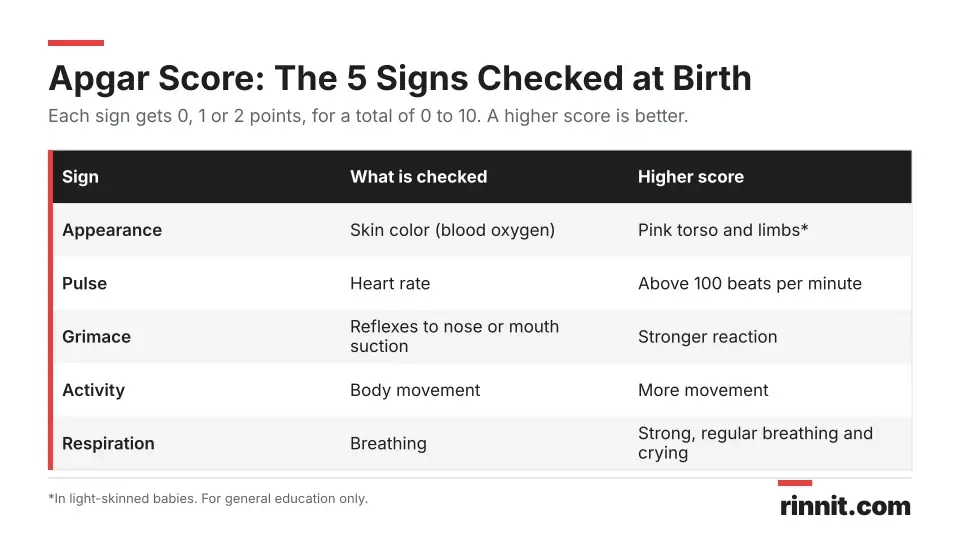
Letter | Sign | What is checked | What earns a higher score |
A | Appearance | Skin color, as a sign of blood oxygen levels | Pink skin on the torso and limbs (in light-skinned babies) |
P | Pulse | Heart rate | A heart rate above 100 beats per minute |
G | Grimace | Reflexes, tested with suction on the nose or mouth | A stronger reaction |
A | Activity | Body movement | More movement |
R | Respiration | Breathing | Strong, regular breathing and crying |
Sources: [1]
How is the Apgar score done?
The Apgar score is one of your baby's first checks. Your baby's provider observes and scores the five signs at set times after birth. [1]
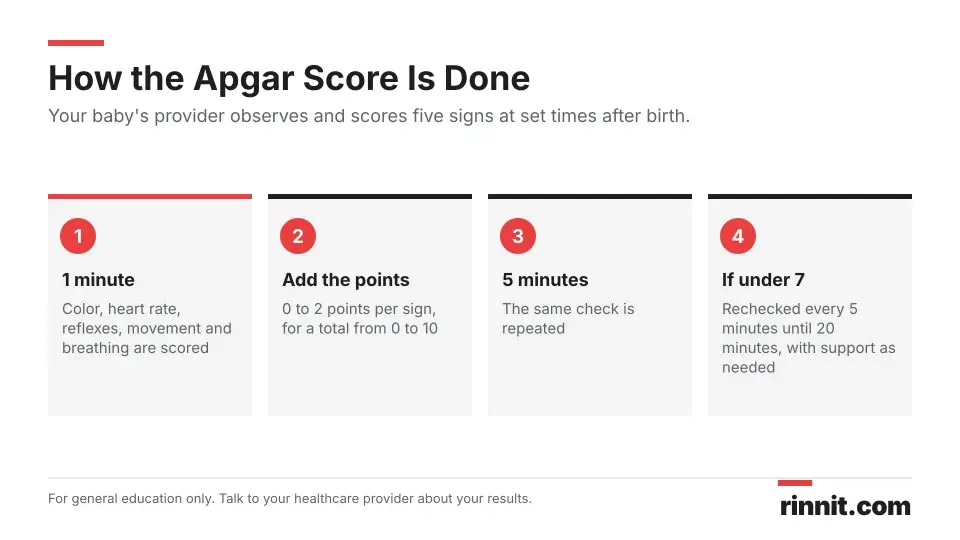
At 1 minute after birth, the provider checks your baby's skin color, heart rate, reflexes, movement and breathing.
Each sign is given 0, 1 or 2 points.
The points are added together for a total score from 0 to 10.
The same check is repeated at 5 minutes after birth.
If the 5-minute score is under 7, the score is checked again every 5 minutes until 20 minutes after birth.
If a score is under 7, your baby may receive supportive care to help with the transition after birth.
Sources: [1]
Apgar score at a glance
Item | Detail |
When it is done | 1 and 5 minutes after birth |
Repeat checks | Every 5 minutes until 20 minutes if the 5-minute score is under 7 |
Signs scored | 5 (appearance, pulse, grimace, activity, respiration) |
Points per sign | 0 to 2 |
Total score | 0 to 10 (higher is better) |
What it shows | How your baby is adjusting right after birth |
Sources: [1]
Experts now also use an expanded version of the score, which lets providers record any advanced care a baby received in the first minutes. [1]
What do Apgar scores mean?
A higher total score is better. Providers group scores into three ranges: [1]
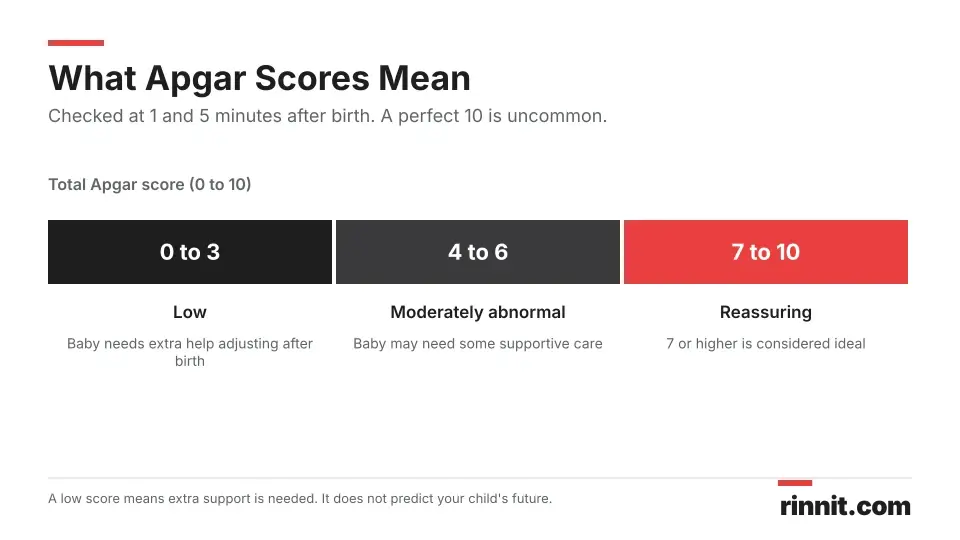
Total score | What it means |
7 to 10 | Reassuring; 7 or higher is considered ideal |
4 to 6 | Moderately abnormal |
0 to 3 | Low |
Sources: [1]
Don't worry if your baby doesn't score a perfect 10. That is uncommon, because a newborn's circulation can take several minutes to fully adjust after birth. [1]
What happens if a baby's Apgar score is low?
A score under 7 means your baby may need supportive care to help with the move to life outside the uterus. Most of the time, a low score simply means your baby needs a little extra help while adjusting. [1]
Area of support | Examples |
Oxygen | Supplemental oxygen |
Breathing | Mechanical ventilation with positive-pressure ventilation (PPV) or neonatal continuous positive airway pressure (NCPAP) |
Airway | Intubation (a breathing tube) |
Heart and circulation | Chest compressions |
Medicines | Medicines such as epinephrine |
Sources: [1]
What can cause a low Apgar score?
Low scores are most often linked to: [1]
Cesarean section (C-section) birth
A difficult labor or delivery
Fluid in the baby's airway
A high-risk pregnancy
Premature birth
Many factors affect how a baby adjusts after birth, and you cannot fully control how pregnancy, labor and delivery go. If your baby has a low Apgar score, know that it is not your fault. [1]
Is the Apgar score accurate for babies with darker skin?
One limitation is the color check. The score gives the highest rating to pink skin and does not properly account for babies with darker skin. Some experts suggest that the color of the lips, tongue and gums may be a better sign, but more research is needed to set clear criteria for those areas. [1]
Who invented the Apgar score?
Dr. Virginia Apgar, an anesthesiologist, first described the score in 1952 and published a research paper about it in 1953. In 1962, two pediatricians from Colorado turned her name into an acronym for the five signs to make the system easier to remember. [1]
Questions to ask your provider
What were my baby's Apgar scores at 1 and 5 minutes?
Did my baby need any extra support after birth?
Does my baby's score change the care plan in the coming days?
What other checks will my baby have before we go home?
Is there anything I should watch for once we are home?
Conclusion
The Apgar score gives your baby's care team a quick, structured look at five vital signs in the first minutes after birth. Scores of 7 to 10 are reassuring, and a perfect 10 is uncommon even in healthy babies. [1]
A low score is a signal for extra support, not a forecast of your child's future. Large studies show that low 5-minute scores are linked to higher risk in the newborn period, which is why care teams act quickly when a score is low. [1] [2] [3]
Keep learning: Read our guides to premature birth, neonatal respiratory distress syndrome and low birth weight. For more on newborn checks, see the MedlinePlus guide to the Apgar score.
FAQ
What is the Apgar score?
The Apgar score is a quick check providers use right after birth to see how a newborn is doing and whether the baby may need extra care.
What does Apgar stand for?
The letters stand for appearance (skin color), pulse (heart rate), grimace (reflexes), activity (movement) and respiration (breathing).
When is the Apgar score done?
It is checked at 1 minute and 5 minutes after birth. If the 5-minute score is under 7, it is repeated every 5 minutes until 20 minutes after birth.
How is the Apgar score calculated?
Each of the five signs gets 0, 1 or 2 points. The points are added for a total from 0 to 10, and a higher score is better.
What is a normal Apgar score?
A score of 7 to 10 is reassuring, and 7 or higher is considered ideal. Scores of 4 to 6 are moderately abnormal and 0 to 3 are low.
Is a perfect Apgar score of 10 common?
No. A perfect 10 is uncommon because a newborn's circulation can take several minutes to fully adjust after birth.
What happens if my baby's Apgar score is low?
A score under 7 means your baby may need supportive care, such as extra oxygen, breathing support, chest compressions or medicines like epinephrine.
What causes a low Apgar score?
Low scores are often linked to C-section birth, a difficult labor or delivery, fluid in the airway, a high-risk pregnancy or premature birth.
Does a low Apgar score mean my baby will have health problems later?
Not on its own. The score cannot predict a specific baby's future intelligence, development or health, and providers do not rely on it alone.
Is the Apgar score accurate for babies with darker skin?
The color check favors pink skin and does not fully account for darker skin. Some experts suggest checking the lips, tongue and gums instead.
Related Reading
Learn more in our guide to Premature Birth: Complete Guide to Signs, Causes, and Care.
Learn more in our guide to Neonatal Respiratory Distress Syndrome: Symptoms, Causes, and Care.
Learn more in our guide to Low Birth Weight: Understanding Causes, Risks, and Neonatal Care.
Learn more in our guide to Persistent Pulmonary Hypertension of the Newborn (PPHN): A Clinical Guide.
Learn more in our guide to Apnea of Prematurity: Why Preterm Babies Pause Breathing and How NICU Care Helps Them Grow.
Learn more in our guide to PKU Test: Essential Newborn Screening for Phenylketonuria.
References
Cleveland Clinic. What Is the Apgar Score? Apgar Testing Explained. Cleveland Clinic. Last updated April 30, 2025. https://my.clevelandclinic.org/health/diagnostics/23094-apgar-score
Iliodromiti S, Mackay DF, Smith GC, et al. Apgar score and the risk of cause-specific infant mortality: a population-based cohort study. Lancet. 2014;384(9956):1749-55. PMID 25236409. https://doi.org/10.1016/S0140-6736(14)61135-1
Chen HY, Blackwell SC, Chauhan SP. Association between apgar score at 5 minutes and adverse outcomes among Low-Risk pregnancies. J Matern Fetal Neonatal Med. 2022;35(7):1344-1351. PMID 32299290. https://doi.org/10.1080/14767058.2020.1754789
Cnattingius S, Norman M, Granath F, et al. Apgar Score Components at 5 Minutes: Risks and Prediction of Neonatal Mortality. Paediatr Perinat Epidemiol. 2017;31(4):328-337. PMID 28493508. https://doi.org/10.1111/ppe.12360
Medical disclaimer
This article is for general education only and does not replace advice from a qualified healthcare professional. Talk to your doctor about your own diagnosis and treatment, and seek emergency care right away for severe or sudden symptoms.



Comments