Premature Birth: Complete Guide to Signs, Causes, and Care

Updated: 2 days ago
Medically reviewed by Dr. Baraa Alnahhal, MD · Last reviewed: September 2026
A premature birth means a baby arrives before the 37th week of pregnancy, in a pregnancy that normally lasts about 40 weeks. Babies born this early are grouped into four types, from late preterm (34–36 weeks) to extremely preterm (before 28 weeks). The earlier the birth, the higher the risk of health challenges such as breathing problems, low body temperature, and feeding trouble. Most premature babies receive care in a special nursery or neonatal intensive care unit (NICU), where incubators, breathing support, and feeding tubes help them stabilize. Many premature babies go home once they can breathe, feed, keep warm, and gain weight on their own.
What Is a Premature Birth?
A premature birth means a baby is born too early. The birth takes place before the 37th week of pregnancy. A typical pregnancy lasts about 40 weeks.
Premature babies often have serious health problems, especially when they are born very early. These problems often vary. But the earlier a baby is born, the higher the risk of health challenges.

The Four Types of Premature Birth
Doctors classify premature birth into four categories based on how many weeks the baby completes in the womb.
| Type | When the baby is born | Key point | | --- | --- | --- | | Late preterm | 34 to 36 completed weeks | Most premature births happen at this stage | | Moderately preterm | 32 to 34 weeks | Often needs special nursery care | | Very preterm | 28 to 32 weeks | Higher risk of health challenges | | Extremely preterm | Before 28 weeks | Highest risk of serious health problems |
Most premature births happen in the late preterm stage. Understanding the category matters because each one carries a different level of risk.
Signs of a Premature Birth in the Baby
Your baby may have very mild symptoms of premature birth or more-serious health problems. Some signs of being born too early include a small size with a head that is large compared with the body.
The baby's features may be sharper and less rounded than a full-term baby's features due to a lack of cells that store fat. Fine hair may cover much of the body.
Other signs appear right after delivery. These include a low body temperature, mainly in the delivery room, trouble breathing, and feeding problems.
Size at Each Stage of Prematurity
The tables below show the median birth weight, length, and head circumference of premature babies at different gestational ages, for each sex.
Boys
| Gestational age | Weight | Length | Head circumference | | --- | --- | --- | --- | | 40 weeks | 7 lbs., 15 oz. (3.6 kg) | 20 in. (51 cm) | 13.8 in. (35 cm) | | 35 weeks | 5 lbs., 8 oz. (2.5 kg) | 18.1 in. (46 cm) | 12.6 in. (32 cm) | | 32 weeks | 3 lbs., 15.5 oz. (1.8 kg) | 16.5 in. (42 cm) | 11.6 in. (29.5 cm) | | 28 weeks | 2 lbs., 6.8 oz. (1.1 kg) | 14.4 in. (36.5 cm) | 10.2 in. (26 cm) | | 24 weeks | 1 lb., 6.9 oz. (0.65 kg) | 12.2 in. (31 cm) | 8.7 in. (22 cm) |
Girls
| Gestational age | Weight | Length | Head circumference | | --- | --- | --- | --- | | 40 weeks | 7 lbs., 7.9 oz. (3.4 kg) | 20 in. (51 cm) | 13.8 in. (35 cm) | | 35 weeks | 5 lbs., 4.7 oz. (2.4 kg) | 17.7 in. (45 cm) | 12.4 in. (31.5 cm) | | 32 weeks | 3 lbs., 12 oz. (1.7 kg) | 16.5 in. (42 cm) | 11.4 in. (29 cm) | | 28 weeks | 2 lbs., 3.3 oz. (1.0 kg) | 14.1 in. (36 cm) | 9.8 in. (25 cm) | | 24 weeks | 1 lb., 5.2 oz. (0.60 kg) | 12.6 in. (32 cm) | 8.3 in. (21 cm) |
Special Care After Birth
If you give birth to a preterm baby, your baby will likely need to stay in a special nursery unit at the hospital. Some infants need to spend time in a unit that cares for them and closely tracks their health day and night. This is called a neonatal intensive care unit (NICU).
A step down from the NICU is an intermediate care nursery, which provides less intensive care. Special nursery units are staffed with health care providers and a team that is trained to help preterm babies.
Your baby may need extra help feeding and adapting right after delivery. Your health care team can help you understand what is needed and what your baby's care plan will be. Feel free to ask them questions.
What Causes a Premature Birth?
Often, the exact cause of premature birth is not clear. But certain things can raise the risk. In fact, many preterm births have no known risk factors at all.
Risk Factors Linked to Pregnancy
Some risk factors are connected to past and present pregnancies.
| Risk factor | Why it matters | | --- | --- | | Pregnancy with twins, triplets, or other multiples | Multiple pregnancies put extra demand on the uterus | | Less than six months between pregnancies | The ideal spacing is 18 to 24 months between pregnancies | | Assisted reproduction, including in vitro fertilization | Treatments to help you get pregnant can raise risk | | More than one miscarriage or abortion | Repeated pregnancy losses are linked to higher risk | | A previous premature birth | Prior preterm birth is one of the strongest risk factors |
Health Problems That Raise Risk
Some health problems can raise the risk of premature birth. These include problems with the uterus, cervix, or placenta. Infections matter too, mainly those of the amniotic fluid and lower genital tract.
Ongoing health problems such as high blood pressure and diabetes also raise the risk, along with injuries or trauma to the body.
Lifestyle Factors
Lifestyle choices can raise the risk of a preterm pregnancy. These include smoking cigarettes, taking illicit drugs, or drinking alcohol often or heavily while pregnant.
Being underweight or overweight before pregnancy plays a role too. Becoming pregnant before age 17 or after 35 raises the risk, as do stressful life events such as the death of a loved one or domestic violence.
For unknown reasons, Black and Native people in the United States are more likely to have premature births than women of other races. But premature birth can happen to anyone.
Complications of Premature Birth
Not all premature babies have health complications. But being born too early can cause short-term and long-term medical problems. In general, the earlier a baby is born, the higher the risk of complications. Birth weight plays a key role too.
Some problems may be clear at birth. Others may not show up until later.
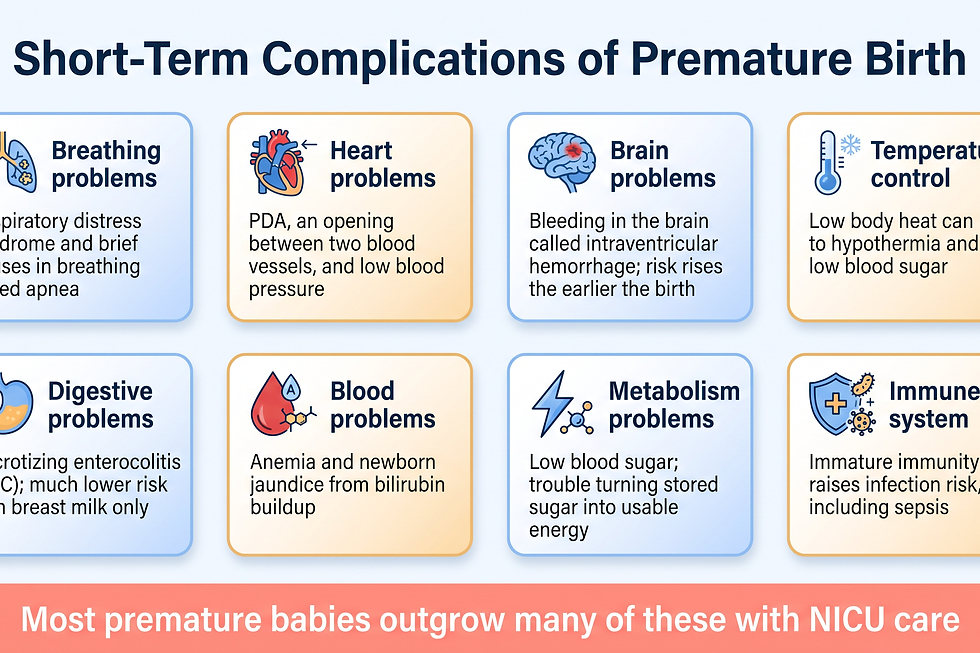
Short-Term Complications
In the first weeks, the complications of premature birth may include the following.
Breathing problems. A premature baby may have trouble breathing due to being born with lungs that are not fully developed. If the baby's lungs lack a substance that allows the lungs to expand, the baby may have trouble getting enough air. This is a treatable problem called respiratory distress syndrome.
It is common for preterm babies to have pauses in their breathing called apnea. Most infants outgrow apnea by the time they go home from the hospital. Some premature babies get a less common lung disorder called bronchopulmonary dysplasia. They need oxygen for a few weeks or months, but they often outgrow this problem.
Heart problems. Some common heart problems that premature babies have are patent ductus arteriosus (PDA) and low blood pressure. PDA is an opening between two important blood vessels, the aorta and the pulmonary artery. This heart defect often closes on its own. But without treatment it can lead to problems such as heart failure, when the heart cannot pump blood as well as it should. Low blood pressure may need treatment with fluids given through a vein, medicines, and sometimes blood transfusions.
Brain problems. The earlier a baby is born, the greater the risk of bleeding in the brain. This is called an intraventricular hemorrhage. Most hemorrhages are mild and resolve with little short-term impact. But some babies may have larger brain bleeding that causes permanent brain injury.
Temperature control problems. Premature babies can lose body heat quickly. They do not have the stored body fat of a full-term infant, and they cannot make enough heat to counter what is lost through the surface of their bodies. If body temperature drops too low, it can lead to a dangerous problem called hypothermia.
Hypothermia in a premature baby can lead to breathing problems and low blood sugar levels. A preterm infant also may use up all of the energy gained from feedings just to stay warm. That is why smaller premature babies need extra heat from a warmer or an incubator at first.
Digestive problems. Premature infants are more likely to have digestive systems that are not fully developed. This can lead to problems such as necrotizing enterocolitis (NEC), in which the cells lining the bowel wall are injured. This problem can happen in premature babies after they start feeding. Premature babies who receive only breast milk have a much lower risk of getting NEC.
Blood problems. Premature babies are at risk of blood problems such as anemia and newborn jaundice. With anemia, the body does not have enough red blood cells. All newborns have a slow drop in red blood cell count during the first months of life, but that drop may be greater in premature babies. With newborn jaundice, the skin and eyes look yellow because the baby's blood contains too much of a yellow-colored substance from the liver or red blood cells, called bilirubin. Jaundice has many causes, but it is more common in preterm babies.
Metabolism problems. Premature babies often have problems with metabolism, the process by which the body changes food and drink into energy. Some premature babies may have a very low level of blood sugar. This can happen because premature infants often have smaller amounts of stored blood sugar than full-term babies. Premature babies also have more trouble turning their stored sugar into more-usable, active forms of blood sugar.
Immune system problems. It is common for premature babies to have immune systems that are not fully developed. This can lead to a higher risk of illnesses. An infection in a premature baby can quickly spread to the bloodstream and cause a life-threatening problem called sepsis.
Long-Term Complications
Over the long term, premature birth may lead to health problems such as cerebral palsy, a group of disorders that can cause problems with movement, muscle tone, or posture. It can be due to an infection or poor blood flow, or it can stem from an injury to a newborn's brain, either early during pregnancy or while the baby is still young.
| Long-term complication | What it involves | | --- | --- | | Trouble learning | Premature babies may lag behind full-term babies on milestones and face more learning disabilities at school age | | Vision problems | Retinopathy of prematurity causes overgrown retinal blood vessels that can scar the retina, pull it out of place, and harm vision | | Hearing problems | Preterm babies have a higher risk of losing some hearing; all babies should be screened before leaving the hospital | | Dental problems | Preterm babies are more likely to have enamel defects and slower tooth development when born very or extremely early | | Behavior and mental health problems | Children born early may face more mental health troubles and developmental delays | | Ongoing health issues | Illnesses, asthma, and feeding problems are more likely to linger; higher risk of sudden infant death syndrome (SIDS) |
Vision deserves special attention. Retinopathy of prematurity happens when blood vessels swell and grow too much in the light-sensing tissue at the back of the eye, called the retina. Sometimes these overgrown vessels slowly scar the retina and pull it out of place. When the retina is pulled away from the back of the eye, it is called retinal detachment. Without treatment, this can harm vision and cause blindness.
How Is Premature Birth Managed?
Tests and Monitoring in the NICU
A premature baby in the NICU may need to have many tests. Some tests are ongoing. Other exams may be done only if the NICU staff thinks the baby might have a certain health problem.
| Test | What it checks | | --- | --- | | Breathing and heart rate monitoring | Breathing and heart rate tracked constantly, plus frequent blood pressure readings | | Fluid input and output measurement | Fluid intake from feedings and veins versus fluid lost through wet or soiled diapers | | Blood tests | Calcium, blood sugar, anemia, and signs of illness; a vein in the umbilical cord stump can be used for frequent samples | | Echocardiography | Ultrasound of the heart to check how well it works | | Ultrasound | Checks the brain for bleeding or fluid buildup, or the stomach-area organs for digestive, liver, or kidney problems | | Eye exam | An ophthalmologist checks the eyes and vision for problems with the retina |
More tests may be needed if your baby has other health problems.
Supportive Care
The NICU or special care nursery closely tracks your premature baby's health. Supportive care may include being placed in an incubator, an enclosed plastic bassinet kept warm to help the baby stay at a regular body temperature. Later on, NICU staff may show you how to hold your baby with direct skin-to-skin contact, known as kangaroo care.
Sensors may be taped to your baby's body to track blood pressure, heart rate, breathing, and temperature. A ventilator or a device called CPAP may be used to help your baby breathe.
At first your baby may receive fluids and nutrients through a tube in a vein. Breast milk may be given later through a tube passed through your baby's nose and into the baby's stomach. When your baby is strong enough to suck, breastfeeding or bottle-feeding often can begin.
Your baby also may spend time under bilirubin lights to treat infant jaundice. These lights help your baby's system break down extra bilirubin, a yellow-colored substance that builds up if the liver cannot process it all. Your baby will wear a protective eye mask while under the lights. Some preterm babies need blood transfusions due to certain health problems, or because many blood samples have been taken for tests.

Medications and Surgery
Medicines may be given to your baby for different reasons. Some medicines help the lungs and heart work better.
| Medication type | What it does | | --- | --- | | Surfactant | Treats respiratory distress syndrome | | Fine-mist or IV medicines | Strengthen breathing and heart rate | | Antibiotics | Treat or prevent illness caused by bacteria | | Diuretics | Help the baby urinate more to manage excess fluid | | Injection into the eye | Stops the growth of new blood vessels that could cause retinopathy | | Medicine for PDA | Helps close the heart defect called patent ductus arteriosus |
Sometimes surgery is needed to treat a premature baby's health problems. Talk with your baby's health care team to understand which complications may lead to surgery and the types of surgery that might be needed.
Can Premature Birth Be Prevented?
The exact cause of preterm birth is often unknown. But some things can be done to help lower the risk of preterm birth.
Taking progesterone supplements. Progesterone is a hormone that plays a role in pregnancy. A lab-made version of it may be able to lower the risk of preterm birth if you have had a premature baby before. It also may lower the risk of preterm birth if you have a short cervix. The cervix is the lower end of the uterus, which opens during labor so a baby can be born.
Cervical cerclage. This is a surgery that is done during pregnancy. Your provider may suggest it if you have a short cervix and you have had a preterm birth before. During this procedure, the cervix is stitched closed with a strong suture. This may give the uterus extra support. The suture is removed when it is time to have the baby. Ask your provider if you need to stay away from vigorous activity during the rest of your pregnancy.
One thing that does not help prevent preterm birth is staying in bed. Bed rest can raise the risk of blood clots, weaker bones, and less muscle strength. It might even make preterm birth more likely.
Bringing Your Baby Home
The following signs mean your baby is ready to go home: the baby can breathe without support, has a stable body temperature, can breastfeed or bottle-feed, is gaining weight over time, and is free of major health problems.
The hospital may let a baby go home before meeting one of these requirements. But the baby's medical team and family first need to set up and agree on a plan for home care and follow-up health care.
Caring for Your Baby at Home
The thought of bringing your baby home from the hospital might make you feel relieved, excited, and nervous. You can do some things ahead of time to prepare for life at home.
Understand how to care for your baby. Before you leave the hospital, take a course in infant CPR. This can save the lives of babies who stop breathing. Ask your baby's medical team any questions you might have, and take notes.
Make sure you are comfortable caring for your baby. This is very important if you will need to use health monitors or give your infant medicines, oxygen, or other treatments. Ask what symptoms to call your baby's health care provider about, such as breathing or feeding problems.
Discuss feedings. Ask the medical team about your baby's need for extra nutrition. The team might suggest products such as breast milk fortifier supplements or preterm infant formula. Keep in mind that premature babies often eat less and may need to be fed more often than full-term babies. Find out how much and how often your baby should eat.
Limit contact with other people. Premature babies are more likely to get serious illnesses than other newborns. Try to keep your baby away from crowded places as much as you can. Make sure everyone who comes into contact with your baby washes their hands first. Ask people who are ill to put off their visit until they are well.
Protect your baby from RSV. Premature babies have a higher risk of getting a serious illness called RSV infection, a disease caused by a virus that affects the lungs and other organs involved in breathing.
There are a few options to protect premature babies from severe RSV infection. One is an RSV vaccine for pregnant people that helps protect babies from birth through 6 months of age. The other is an antibody product given to the infant called nirsevimab (Beyfortus). Rarely, when nirsevimab is not available or a child is not eligible for it, another antibody product called palivizumab may be given.
Follow a suggested schedule for checkups. Discuss your baby's need for future health checkups with your baby's care provider and any specialists. At first, your baby may need to see a primary care provider every week or two so growth and health needs can be watched closely.
Get your baby vaccinated. Vaccines help protect people from dangerous diseases. It is suggested that vaccines be given to premature babies who are in stable health based on their age. Delays in this schedule are common. Work with your baby's care provider to make sure your baby gets every vaccine on the schedule.
Also make sure that other family members in your home are up to date on their vaccines, including shots for the flu and COVID-19. Family members and adult caregivers should also check with their health care providers to find out if they are up to date on their pertussis vaccine for whooping cough. If you are pregnant, make sure you are up to date on this vaccine too.
Note any delays in development. Over the coming months, your baby's care provider may watch for any signs that the baby is taking longer than usual to reach key milestones. Babies who are at risk of such delays or disabilities may need more tests. You may be referred to services and support systems that can help, called early intervention services. The rules that determine who gets to use these services vary based on where you live.
Coping and Support
Caring for a premature baby can be very tiring. You may be anxious about your baby's health. You also might feel angry, guilty, or overwhelmed.
Some tips can help during this hard time. Learn everything you can about your baby's health by talking to your baby's health care providers and asking for pamphlets, books, and trusted websites. Take care of yourself by getting as much rest as you can and eating healthy foods, so you feel stronger and better able to care for your baby.
Build up your milk supply by using a breast pump until your baby is able to breastfeed, and ask the hospital staff for help with the pump and storage supplies. Accept help from others; friends and family could care for your other children, prepare food, clean the home, or run errands, which saves your energy for your baby.
Keep a journal with details of your baby's progress, along with your own thoughts and feelings, and perhaps pictures of your baby. That way you can see how much your child changes from week to week. Find good listeners for support by talking to your partner, friends, family, or your baby's caregivers. The NICU social worker often can be helpful, and your baby's caregivers may be able to suggest a support group in your area or online. Many parents find it very helpful to talk to other parents who care for a preterm infant.
Caring for a premature baby is a great challenge. Take it one day at a time. Despite the worries and setbacks, celebrate your preemie's strength and ability to adapt. Cherish the time you can spend getting to know your child.
Conclusion: Act Early, Stay Informed
Premature birth happens before the 37th week of pregnancy, and the earlier a baby is born, the greater the health risks. If you have had a previous premature birth or have a short cervix, talk to your provider about prevention options such as progesterone supplements or cervical cerclage. Remember that bed rest does not prevent premature birth and may even raise other risks.
If your baby arrives early, know that the NICU team is trained to support the tiniest patients. Track your baby's milestones after discharge, keep up with the vaccine schedule, and protect your baby from RSV and infections.
Talk to your obstetric care team at your next prenatal visit if you have risk factors for premature birth — especially a previous preterm delivery or a short cervix. If your baby was born early, ask the NICU team for a clear discharge plan and a follow-up schedule before you go home.
This article is for general educational purposes and is not a substitute for professional medical advice. Always consult a qualified health care provider for diagnosis and treatment decisions.
FAQ: Premature Birth
What counts as a premature birth?
A premature birth means a baby is born before the 37th week of pregnancy, while a typical pregnancy lasts about 40 weeks.
What are the four types of premature birth?
Premature babies are grouped as late preterm (34–36 completed weeks), moderately preterm (32–34 weeks), very preterm (28–32 weeks), or extremely preterm (before 28 weeks). Most premature births happen in the late preterm stage.
Why do some babies come early?
Often the exact cause is not clear, and many preterm births have no known risk factors. Known risk factors include a previous premature birth, multiples such as twins, pregnancies spaced less than six months apart, assisted reproduction, uterine, cervical, or placental problems, infections, high blood pressure, diabetes, smoking or alcohol during pregnancy, and pregnancy before 17 or after 35.
What health problems can premature babies face?
Short-term problems can include respiratory distress syndrome, apnea, patent ductus arteriosus (PDA), brain bleeding called intraventricular hemorrhage, hypothermia, necrotizing enterocolitis (NEC), anemia, jaundice, low blood sugar, and sepsis. Long-term risks include cerebral palsy, learning delays, retinopathy of prematurity, hearing loss, dental enamel defects, behavioral issues, and a higher risk of SIDS.
What is care like in the NICU?
Care typically includes an incubator for warmth, sensors that track vital signs, breathing help from a ventilator or CPAP, feeding tubes until the baby can suck, fluid and electrolyte monitoring, bilirubin lights for jaundice, and sometimes blood transfusions. Medicines such as surfactant, antibiotics, and diuretics may be used.
When can a premature baby go home?
A baby is ready to go home when they can breathe without support, keep a stable body temperature, breastfeed or bottle-feed, gain weight over time, and be free of major health problems. A hospital may discharge a baby early if the medical team and family agree on a home care plan.
How can premature birth be prevented?
A lab-made progesterone supplement may lower the risk if you have had a premature baby before or have a short cervix. A surgery called cervical cerclage may also help when you have a short cervix and a prior preterm birth. Bed rest does not help and can raise the risk of blood clots and other problems.
What should parents do at home after a premature birth?
Parents should take an infant CPR course, follow feeding guidance such as breast milk fortifiers, limit visitors and require handwashing, protect the baby from RSV with vaccination or antibody products, follow a close checkup schedule, keep vaccines on track, and watch for developmental delays that may need early intervention services.
References
National Institute of Child Health and Human Development — Preterm Labor and Birth
American College of Obstetricians and Gynecologists — Preterm Labor and Birth FAQs
American College of Obstetricians and Gynecologists — Extremely Preterm Birth FAQs
U.S. Food and Drug Administration — RSV Vaccine for Pregnant Individuals
Centers for Disease Control and Prevention — RSV Immunization Information Statement
Comments