Bacterial Vaginosis (BV) Test: How It's Done, Types and What Results Mean

Updated: 2 days ago
Written and medically reviewed by Dr. Baraa Alnahhal, MD · Last reviewed: November 2026 · How we review
Quick Answer: What is a bacterial vaginosis test?
A bacterial vaginosis (BV) test checks a sample of vaginal fluid for BV, a common infection caused by too many harmful bacteria and too few helpful ones. A provider collects the sample with a swab. A healthy vaginal pH is 3.8 to 4.5. Results take one to three days, and BV is usually treated with antibiotics. [1]
What the research says
BV is linked to a higher risk of preterm birth. A meta-analysis of 28 studies with 50,466 patients found that BV during pregnancy was linked to a 60% higher odds of preterm birth (odds ratio 1.60), a weaker link than earlier research suggested. (Hadhoum et al., Journal of Gynecology Obstetrics and Human Reproduction, 2025) [2]
Treating BV may help pregnant women at high risk. In pregnant women at high risk of preterm birth, mostly those with a past preterm birth, screening for and treating BV lowered the rate of preterm delivery (relative risk 0.65), with the clearest effect for clindamycin. (Yefet et al., Gynecologic and Obstetric Investigation, 2025) [3]
Key takeaways
A BV test uses a sample of vaginal discharge, not urine; a urine test cannot diagnose BV. [1]
The main tests are a wet mount, a whiff test, a vaginal pH test and, less often, a DNA (PCR) test. [1]
Avoid douching, sex, tampons and vaginal medicines for 24 hours before the test. [1]
A healthy vaginal pH is 3.8 to 4.5; above 4.5 is high. [1]
Treatment is especially important if you are pregnant or trying to conceive. [1]
What is a bacterial vaginosis test?
A bacterial vaginosis test diagnoses BV, a common bacterial infection of the vagina. It is also called a wet mount test or a vaginal pH test. BV happens when the vagina has too many harmful bacteria and too few beneficial ones. [1]
A primary care provider or gynecologist orders the test and collects the sample in the office. The sample is then looked at under a microscope, tested directly or sent to a lab. [1]
Why is a BV test done?
Your provider may test you for BV if you have symptoms such as: [1]
Foul-smelling discharge, often described as fishy
Gray or white discharge
Pain, irritation or itching
Burning when you urinate
What tests are used to diagnose BV?
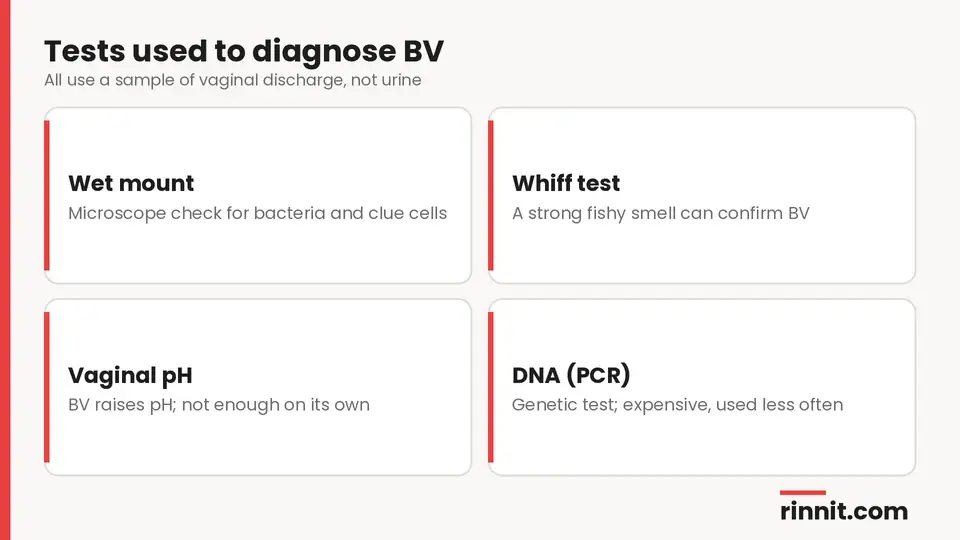
Test | How it works | What it shows |
Wet mount (wet prep) | The sample is mixed with a solution on a glass slide and viewed under a microscope | Bacteria, white blood cells and clue cells (cells with fuzzy borders that point to infection) |
Whiff test | A special solution is added to the sample | A strong fishy smell can confirm BV |
Vaginal pH test | Measures how acidic or alkaline the sample is | BV raises pH, but this test cannot diagnose BV on its own |
DNA (PCR) test | Checks the sample's genetic material | Expensive and used less often |
Sources: [1]
A urine test cannot diagnose BV. Urine tests are used to look for urinary tract infections. [1]
How do you prepare for a BV test?
For 24 hours before the test, avoid: [1]
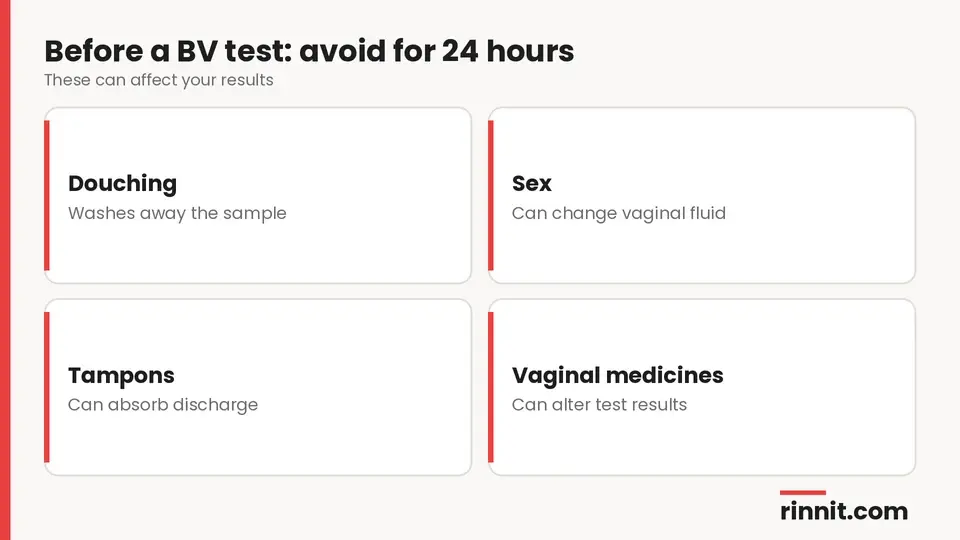
Douching
Sex
Tampons
Vaginal medicines
These can affect your results. [1]
What happens during a BV test?
The test is similar to a pelvic exam. Your provider gently inserts a lubricated speculum into your vagina, which may cause pressure or discomfort. They use a long cotton swab or wooden stick to collect a small amount of vaginal fluid and place it in a sterile container. You can go home right away. [1]
You may have mild soreness or very light bleeding afterward, but there are no activity limits. [1]
What do BV test results mean?

Test | Normal result | Abnormal result |
Wet mount and whiff test | No sign of bacterial infection | Infection present |
Vaginal pH | 3.8 to 4.5 (slightly acidic) | Above 4.5, which makes infection more likely |
Sources: [1]
Results take one to three days. [1]
If your result is positive
BV is usually treated with antibiotics, either pills you swallow or creams or gels you put in your vagina. Creams may also ease pain or itching. Treatment is especially important if you are pregnant or trying to conceive, because BV can cause complications such as premature birth. [1]
If your result is negative
Your provider may order other tests to find the cause of your symptoms. [1]
Can you test for BV at home?
Yes. Home kits are sold online and in pharmacies. With BV kits, you swab your vagina, seal the sample and mail it to a lab, and results take a few days to a week. With pH kits, a swab or paper strip changes color and you compare it with a chart; a high pH could mean BV or another infection. Confirm any home result with your provider. [1]
Conclusion
A BV test is a quick, simple check of a vaginal fluid sample that can confirm bacterial vaginosis. The wet mount, whiff and pH tests together give your provider a clear answer within a few days.
If you have unusual discharge, odor or itching, see your provider rather than relying on a home test alone, especially if you are pregnant or planning a pregnancy.
Keep learning: Read our guides to the pelvic exam and STD testing. For more background, see the MedlinePlus page on the bacterial vaginosis test.
FAQ
What is a bacterial vaginosis test?
A test of vaginal discharge that checks for BV, a common bacterial vaginal infection. [1]
How is a BV test done?
Your provider collects vaginal fluid with a swab during an exam similar to a pelvic exam. [1]
What is a normal vaginal pH?
A healthy vaginal pH is 3.8 to 4.5; above 4.5 is high. [1]
What are clue cells?
Vaginal cells with fuzzy borders seen under a microscope that point to a bacterial infection. [1]
Can a urine test detect BV?
No; urine tests look for urinary tract infections, not BV. [1]
How should I prepare for a BV test?
Avoid douching, sex, tampons and vaginal medicines for 24 hours beforehand. [1]
Does a BV test hurt?
The speculum may cause pressure or discomfort, and you may have mild soreness or light spotting afterward. [1]
How long do BV test results take?
One to three days. [1]
How is BV treated?
Usually with antibiotic pills or vaginal creams or gels. [1]
Are home BV tests reliable?
They can give a useful first answer, but you should confirm the result with your provider. [1]
Related Reading
What Is Bacterial Vaginosis? Symptoms, Causes, and Treatment explains the infection this test diagnoses.
Trichomoniasis: Symptoms, Causes, Diagnosis and Treatment — What You Need to Know covers another infection that can cause similar discharge.
What Is Candidiasis? The Yeast Infection Guide Explained explains yeast infections, a common cause of a negative BV test with symptoms.
Premature Birth: Complete Guide to Signs, Causes, and Care covers the pregnancy complication linked to untreated BV.
Preterm Labor: Recognizing Early Signs and Seeking Care explains the warning signs to watch for during pregnancy.
References
Cleveland Clinic. Bacterial Vaginosis (BV) Test: How It's Done & Results. Cleveland Clinic. Last updated June 21, 2024. https://my.clevelandclinic.org/health/diagnostics/22123-bacterial-vaginosis-test
Hadhoum S, Subtil D, Labreuche J, et al. Reassessing the association between bacterial vaginosis and preterm birth: A systematic review and meta-analysis. J Gynecol Obstet Hum Reprod. 2025;54(1):102871. PMID 39442804. https://doi.org/10.1016/j.jogoh.2024.102871
Yefet E, Mirin D, Massalha M, et al. Screening for and Treatment of Bacterial Vaginosis Reduced Preterm Delivery in High-Risk Pregnant Women: A Systematic Review and Meta-Analysis. Gynecol Obstet Invest. 2025;90(4):353-362. PMID 39842410. https://doi.org/10.1159/000543502
Medical disclaimer
This article is for general education only and does not replace advice from a qualified healthcare professional. Talk to your doctor about your own diagnosis and treatment, and seek emergency care right away for severe or sudden symptoms.



Comments